
When Were Newspapers Invented? Four Centuries of Print


From Roman notice boards to the 1605 Relation, from steam cylinders and rotary webs to offset plates and digital files, this is how the news got printed and how those same machines became the commercial printing you order today.
Newspapers were invented in 1605, when Johann Carolus printed Relation in Strasbourg, the first publication that was mechanically printed, publicly sold and issued on a regular schedule. Public news itself is far older, running back to the Roman Acta Diurna and Chinese court gazettes. Gutenberg movable type made it repeatable from about 1450, steam and rotary presses made it mass media after 1814, and offset lithography from around 1904 still underpins commercial printing today.

Start here
Four centuries of newspaper printing in one paragraph
Public news is ancient, printed news is not. Rome posted the Acta Diurna and Tang China circulated court gazettes, but news only became a product once Gutenberg made type reusable around 1450. Johann Carolus put those two things together in Strasbourg in 1605 and produced the first true newspaper. Steam presses from 1814, curved stereotype plates, web fed rotary machines from 1863 and the Linotype from 1886 turned that product into mass media. Offset lithography arrived around 1904 and quietly won, and it is still the process behind most of what a commercial printer produces for you today.
When the first newspapers appeared

People wanted regular public news long before anyone could print it. In ancient Rome the Acta Diurna were carved or written notices posted in public places carrying court judgments, military results and civic announcements. In Tang dynasty China, court gazettes circulated among officials as handwritten reports. Both were news on a schedule, produced entirely by hand.
Europe in the 1500s ran on a similar system of handwritten avvisi, subscription newsletters copied by scribes and sent along trade routes by merchants and bankers who needed to know about wars, harvests and shipping. Printed single sheets called broadsides covered dramatic one-off events, but nothing came out on a promise of next week.
That promise arrived in 1605, when Johann Carolus began printing Relation in Strasbourg. He had been selling handwritten newsletters and realized a press could serve far more subscribers for the same effort. Historians treat Relation as the first newspaper because it combined three things at once: mechanical printing, public sale and regular weekly publication. England followed with corantos in the 1620s, the Daily Courant became the first English daily in 1702, and the Boston News-Letter carried the format into the American colonies in 1704.
The printing press and early publishing

None of it works without Gutenberg. Around 1450 in Mainz he assembled several existing ideas into one workable system: a hand mould that cast individual metal characters in quantity, an oil based ink that stuck to metal rather than beading off it, and a screw press adapted from winemaking that pressed paper evenly against the inked forme.
The important part was the reuse. A page could be set, printed hundreds of times, then broken apart so the type returned to the case for the next job. Copying a book had been an expense measured in months of a scribe's life. Printing one became a setup cost followed by cheap repetition, which is the same economic shape every print quote still has today. Our deeper look at the printing press and modern printing follows that line from Mainz to the pressroom floor.
Early publishers learned the rest of the craft fast. They standardized page sizes so sheets could be folded and trimmed predictably, invented the title page so a book could identify itself, and built the first distribution networks through booksellers and fairs. By the time newspapers arrived, the infrastructure of publishing already existed. The news simply plugged into it.
Industrial-era newspaper printing

For roughly 350 years a printer worked a hand press and produced a few hundred impressions in an hour. Steam broke that ceiling. In 1814 The Times of London installed a steam driven cylinder press built by Friedrich Koenig and Andreas Bauer, and output jumped by an order of magnitude overnight. The paper printed the news of its own conversion in the edition that came off the new machine.
Three more inventions turned a fast press into mass media. Stereotyping let printers cast a whole page as a single curved metal plate, which meant type could finally be wrapped around a rotating cylinder. Richard Hoe built rotary presses on that principle in the 1840s. Then William Bullock's web fed rotary press of 1863 took paper from a continuous roll instead of feeding sheets one at a time, so the machine never had to pause. Add papermaking from wood pulp and the price of a copy fell within reach of nearly everyone.
Composition was the last bottleneck, and it fell in 1886 when Ottmar Mergenthaler's Linotype went into service at the New York Tribune. One operator at a keyboard could now cast a full line of type as a single slug of hot metal, replacing several hand compositors. The combination of Linotype, rotary printing and cheap newsprint is what produced the enormous circulation dailies of the late nineteenth and early twentieth centuries, along with the advertising economy that funded them.
The shift to offset and digital

Letterpress had a hard limit. Metal type slamming into paper wears down, fine detail breaks up, and photographs never reproduce cleanly. Lithography offered an alternative based on chemistry rather than relief, and around 1904 Ira Washington Rubel found by accident that an image transferred first onto a rubber blanket and then onto paper printed better than one hit directly from the plate. Caspar Hermann was working along the same lines, and offset lithography was born.
The rubber blanket does the quiet work. It conforms to the surface of the sheet, so the plate never touches paper, plates last far longer and the press can run faster on a wider range of stocks. Through the twentieth century offset took over commercial printing, then newspapers themselves, as web offset presses replaced letterpress rotaries through the 1960s and 1970s.
Composition went digital in parallel. Phototypesetting exposed characters onto film from the 1950s, desktop publishing moved page assembly onto screens in the 1980s, and computer-to-plate systems in the 1990s removed film from the workflow entirely by imaging the plate straight from the file. Digital toner and inkjet presses then made short runs and personalization affordable for the first time. That is why color decisions now travel as data, which is exactly the problem the Pantone color system was created to solve, and why the Arial and Helvetica story is really a story about digital type licensing.
How modern print shops descend from this history
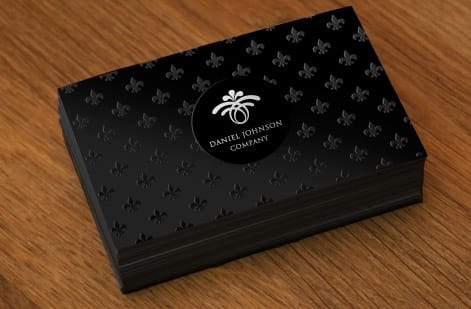
Open a modern quote and you are looking at four centuries of inherited logic. Price drops steeply with quantity because setup, whether that is a plate or a press calibration, is the expensive part and each additional impression is nearly free. Newspapers pushed that curve harder than anyone, and every commercial shop inherited the result.
Standard sizes come from the same place. Broadsheet and tabloid formats exist because a press roll and a folder impose them, and the same sheet economics decide why a poster, a custom calendar or a folded piece lands on the sizes it does. Bleed, trim and safe margins are compensations for paper moving through a fast machine, a tolerance that has existed since sheets first left a cylinder at speed. Registration marks solved the problem of laying four colors on top of one another accurately, and they still do.
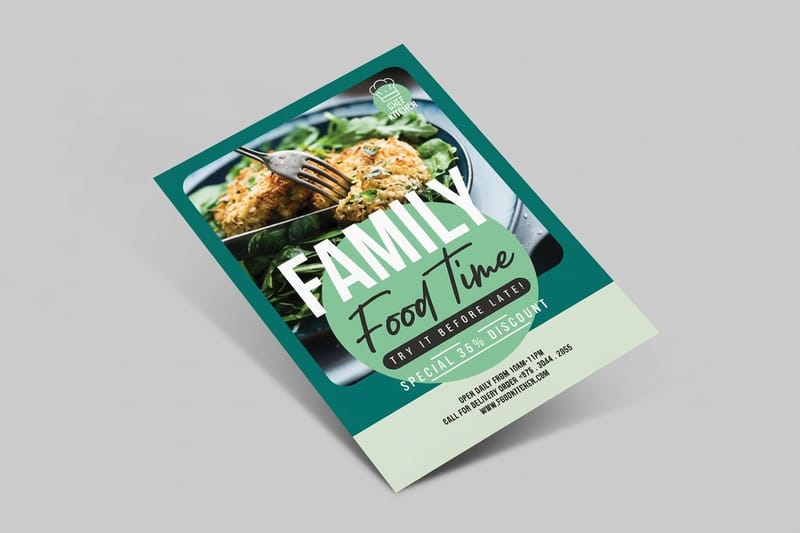
Even the paper conversation is historical. Newsprint was optimized for speed and cost and pays for it in longevity, which is why archived papers yellow and crumble. Coated commercial stocks went the other direction, sealing the surface so ink sits on top and detail holds, which is what a sheet like 80 lb gloss book paper is doing for you. The broadside handed out on a street corner also survives, now as the business flyer, and printed design has carried public argument and celebration throughout, something the graphic design of Black History Month shows clearly. Brands learned the same lesson about consistency across every press run, which is much of what the Pepsi logo history teaches.
Print today at 4OVER4
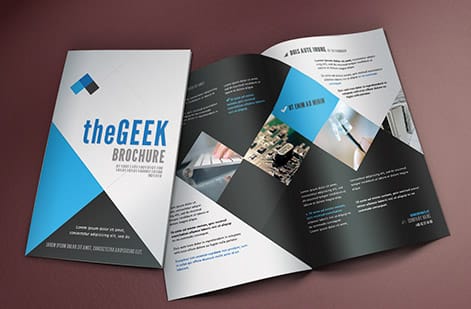
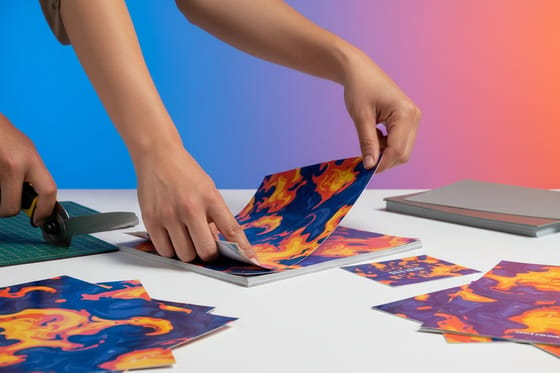
We run the descendants of those machines. Offset presses handle the long runs where plate setup pays for itself, digital presses cover short runs and fast turnarounds, and large format equipment prints the things a newspaper press never could. The workflow that took centuries to build now happens between a file upload and a delivery date.
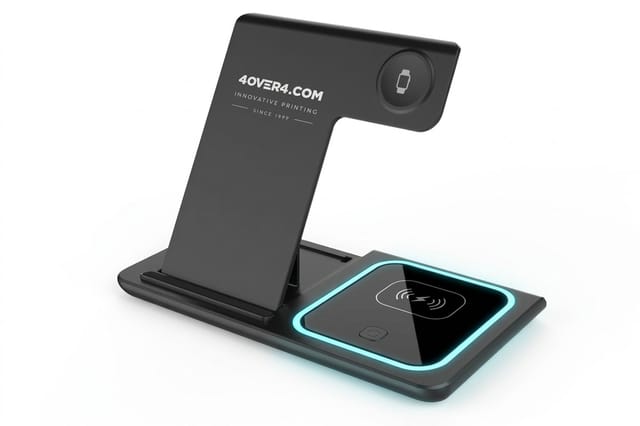
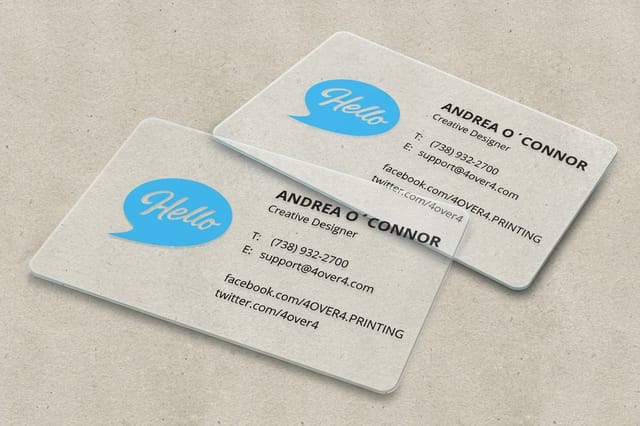
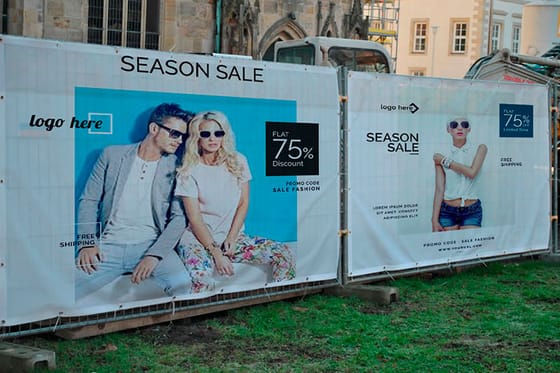
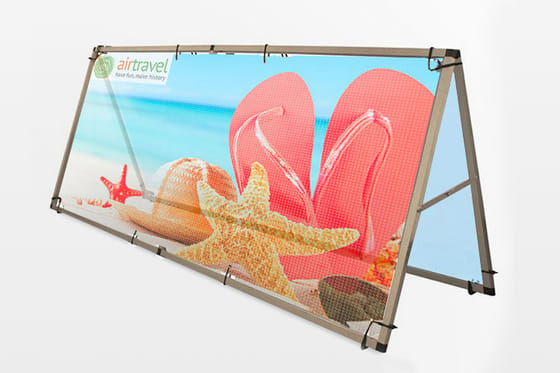
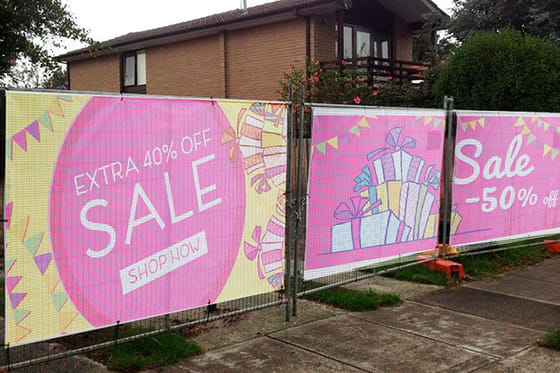
What changed most is access. A publisher in 1605 needed a press, a license and a distribution network. Today the setup, the plates and the press time sit behind a product page, and the same industrial economics that once served only the biggest dailies apply to a run of a hundred pieces. A 2 sided blockout banner starts at $108.75 and prints an opaque core between two faces so neither side shows through, which is the modern answer to the old problem of ink striking through thin stock. 30mil clear plastic cards start at $529.26 and put the same graphic craft on a substrate no press of the letterpress era could have handled, and a 3 in 1 foldable wireless charger starts at $15.00 for the branded merchandise side of the same job.
The history is worth knowing because it explains the rules you are working inside. Set up once, print many, respect the tolerances of a machine that moves paper fast, and choose the stock that matches how long the piece needs to live. Printers have been solving that equation since Mainz.
Wally explains the press
Every print quote you read was written by a machine from 1814
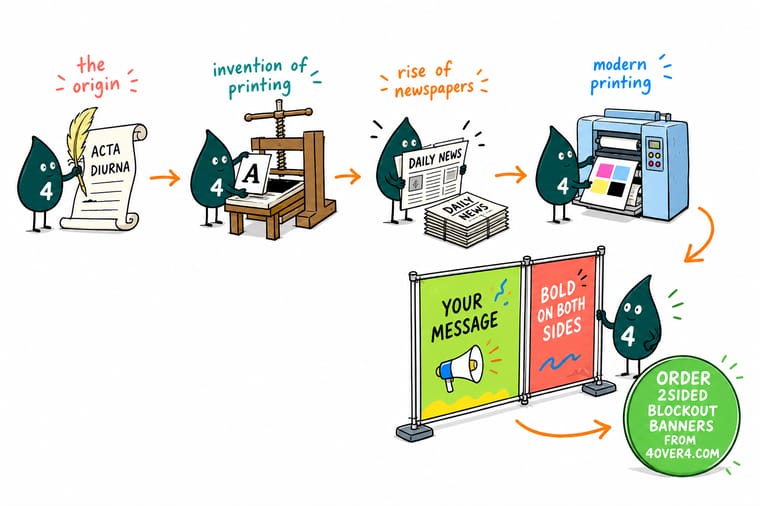
Wally likes to point out that the shape of a printing price has not changed in four hundred years. Setting up costs real money, whether that meant locking metal type into a forme or burning a plate today, and every copy after the first is cheap. Newspapers proved it at enormous scale. That is why ordering more pieces almost always lowers your price per piece.
See live printing prices →Infographic
The newspaper printing timeline at a glance
Seven turning points that took news from a hand copied sheet to a machine printing tens of thousands of pages an hour, and then to the plate on a modern press.
No single invention made the newspaper. Type, power, rotation, composition and chemistry each removed one bottleneck, and the press we run today is what was left standing after all of them.
Specs and pricing
Blockout banner specs and live pricing
Opacity was the oldest problem in newspaper printing, because thin newsprint let ink show through from the reverse side. A blockout banner solves the modern version of it with an opaque core between two printed faces.

| Quantity | Price Per Unit | Total |
|---|---|---|
| 1 | $108.75 | $108.75 |
| 2 | $108.74 | $217.47 |
| 3 | $108.74 | $326.22 |
| 4 | $97.76 | $391.02 |
| 5 | $97.76 | $488.78 |
| 6 | $97.76 | $586.53 |
| 7 | $89.28 | $624.98 |
| 8 | $86.77 | $694.18 |
Print it
Modern presses, ready for your job

See it in use
Real printed work, produced in house





Explore more
Where to go next



By the numbers
Printing you can count on at 4OVER4.COM
Common Questions
Common questions about newspaper printing history
When were newspapers invented?
The first publication that historians widely accept as a newspaper is Relation aller Fuernemmen und gedenckwuerdigen Historien, printed by Johann Carolus in Strasbourg in 1605. It qualifies because it was mechanically printed, publicly sold, dated and issued on a regular schedule rather than whenever news happened to arrive. Earlier news sheets, corantos and handwritten avvisi circulated for decades before that, but they lacked the fixed periodicity that defines a newspaper.
What was the first newspaper in America?
Publick Occurrences Both Forreign and Domestick appeared in Boston in 1690 and was shut down by colonial authorities after a single issue, so it is usually called the first attempt rather than the first newspaper. The Boston News-Letter, launched in 1704 by postmaster John Campbell, was the first continuously published newspaper in the American colonies and ran for decades under royal license.
How did the printing press change publishing?
It replaced copying with reproduction. Once a page was set in reusable metal type, the marginal cost of the next copy collapsed, so a printer could serve a town instead of a patron. That economic shift created publishers, distribution networks, advertising and eventually the daily press. Every commercial print shop today, including ours, still runs on the same idea of setting up once and producing many.
What is the difference between letterpress, offset and digital printing?
Letterpress presses inked raised type directly against paper, which is how newspapers were printed for centuries. Offset lithography transfers ink from a flat plate to a rubber blanket and then to the sheet, giving cleaner detail and far higher speed. Digital printing skips plates entirely and images the sheet from a file, which makes short runs and variable data affordable.
Why did newspapers use such thin, rough paper?
Newsprint was engineered for speed and cost, not longevity. Groundwood pulp is cheap, light enough to ship in bulk and porous enough to absorb ink instantly on a fast web press. The tradeoff is that residual lignin yellows and grows brittle with light and air, which is why old papers crumble while a coated commercial stock from the same decade still looks fresh.
What replaced hot metal typesetting?
Phototypesetting arrived through the middle of the twentieth century and exposed characters onto film instead of casting them in lead, which is why the industry called it cold type. Desktop publishing then moved composition onto screens in the 1980s, and computer-to-plate systems in the 1990s removed film as well, sending a finished digital page straight to the printing plate.
How does newspaper printing history affect what I order today?
Directly. The plate, ink and press logic that newspapers pushed to its limits is what lets a modern shop quote a run of banners, cards or booklets in minutes. Setup is the expensive part and each additional piece is cheap, which is why unit prices drop sharply as quantity rises. Understanding that curve is the fastest way to order print efficiently.
Get Started
Ready to put four centuries of press engineering to work?
Upload your file, pick a stock and let the same setup-once economics that built the daily newspaper bring your cost per piece down.
Legal Disclaimer
Gold Standard guarantees apply to all standard orders placed through 4over4.com. Price match requires verifiable proof of a competitor's published price for an equivalent product with matching specifications and turnaround time. Satisfaction guarantee covers manufacturing defects and print quality issues. Contact support with order number and documentation. On-time delivery rate based on tracked orders 1999 to 2026. Individual results may vary based on shipping carrier performance.
