
What Slippery When Wet Signs Mean And Where They Are Required


"A slippery-when-wet sign warns of a hazard that only appears in certain conditions, and in many settings it is required by code. This page covers what the sign means, where the rules demand it, the standard sizes, and how to order one built to last."
A slippery-when-wet sign warns that a road or floor becomes slick under wet conditions, and it is a caution, not a prohibition. On roads it appears as a yellow diamond warning sign; indoors it appears as a wet-floor caution sign. Workplaces, businesses, and public spaces are often required to post them to meet safety codes, and durable options come in standard sizes for roadside, wall, and floor use.

What a slippery-when-wet sign means
A slippery-when-wet sign communicates a specific, conditional hazard: the surface is safe in dry conditions but becomes slick when it rains, after washing, or when a spill occurs. It is a warning, which means it advises caution rather than prohibiting anything. The point is to give people enough notice to slow down, watch their footing, or choose a different path before they lose traction.
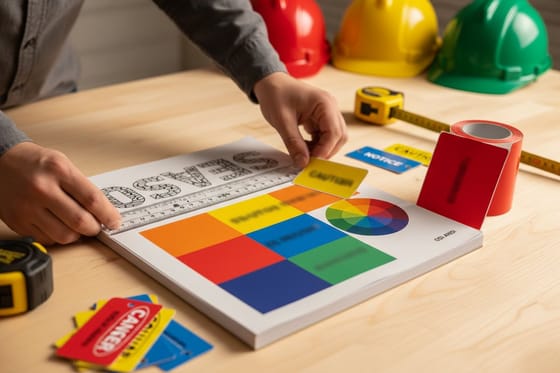
The visual language matters. On roads, the warning takes the form of a yellow diamond, the universal shape and color for cautioning drivers about conditions ahead, often paired with a car-and-skid-marks pictogram. Indoors, the same message appears as a bright yellow wet-floor sign, usually a folding A-frame or a wall-mounted panel. Both rely on high-visibility color so the warning registers instantly. To print these correctly, understanding OSHA safety colors and ANSI codes is essential.
Whether roadside or indoor, the sign does one job well: it turns an invisible hazard into a visible one, so a slip becomes something people can avoid rather than an accident waiting to happen. Durable aluminum signs carry that warning reliably in any weather.
Where slippery-when-wet signs are required

In many settings, posting a slip hazard warning is not optional. Employers have a general duty to keep workplaces safe and to warn of known hazards, so wet-floor signs are standard after mopping, around entrances in wet weather, and near any recurring spill risk. Businesses open to the public, from restaurants and retail to lobbies and restrooms, post them both to comply with safety expectations and to reduce liability if someone falls.
Roadside slippery-when-wet warnings are placed by road authorities where a stretch of pavement is known to lose traction in rain, on curves, bridges, or worn surfaces. For property owners and facility managers, the practical rule is simple: if a surface predictably becomes slippery and people will be on it, warn them, and keep the sign in place while the hazard exists. Pair the warning with other safety signage for a complete program, and see our online design tool if you need to add facility-specific wording.
Because these signs often serve a compliance role, they need to be legible, correctly colored, and durable enough to stay readable for as long as the hazard lasts. That is a printing and material decision as much as a design one.
Standard sizes for road, wall, and floor signs

Sizing depends on where the sign lives and how far away it must be read. Roadside warning diamonds are large, commonly 30 by 30 inches or 36 by 36 inches, so drivers can see them at speed. Indoor wet-floor A-frame signs are much smaller, typically around 12 by 25 inches folded upright, sized to be noticed by someone walking. Wall-mounted caution panels come in common formats like 7 by 10 or 10 by 14 inches for doorways and corridors.
Match the size to the viewing distance and the setting. A parking lot or driveway hazard may call for a larger panel than a restroom entrance. If you are producing signage for a facility, standardizing on a couple of sizes keeps the program consistent and easy to reorder. Our aluminum signs and coroplast signs both come in a range of sizes, and you can order free samples to check legibility before a bulk run.
Whatever the size, keep the design clean: a bold pictogram, high-contrast color, and short text read faster than a crowded sign, and speed of recognition is the whole point of a warning.
Choosing a durable material that lasts

A warning sign only works while it is still readable, so material is a safety decision, not just a cost one. For outdoor and long-term use, rust-proof aluminum is the standard: it withstands weather, holds color, and lasts for years mounted to a post or wall. For temporary or budget-conscious placements, or for lightweight A-frames, corrugated plastic, known as coroplast, is durable, water-resistant, and easy to move.
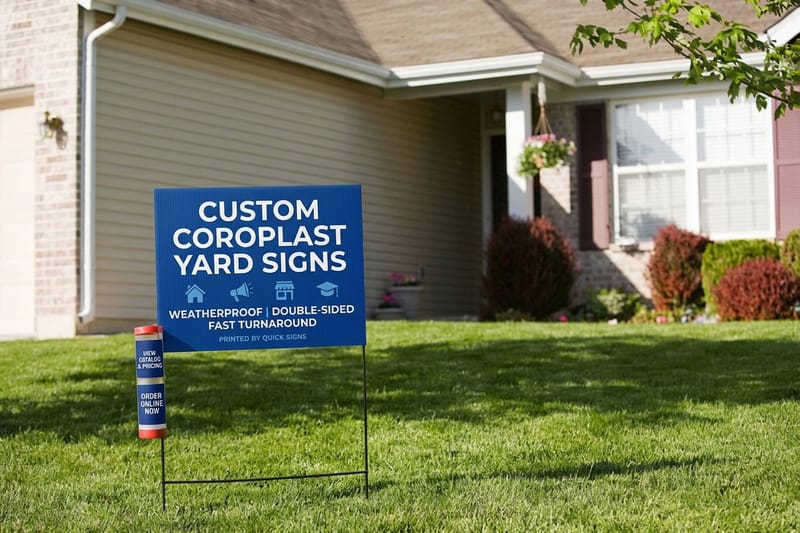
Add reflective material where signs must be seen at night or in low light, such as roadside and parking-area placements, so headlights bring the warning to life after dark. Consider a UV-resistant finish for signs in constant sun to keep the color from fading. Our aluminum signs suit permanent outdoor warnings, coroplast yard signs handle temporary or ground-level placements, and yard signs cover driveway and lot hazards.
Use the live specs and pricing panel below to configure the exact material, size, and finish for your setting, and print a warning that stays clear for as long as the hazard is there.
Wally makes a hidden hazard impossible to miss
Yellow, bold, and built to last outdoors
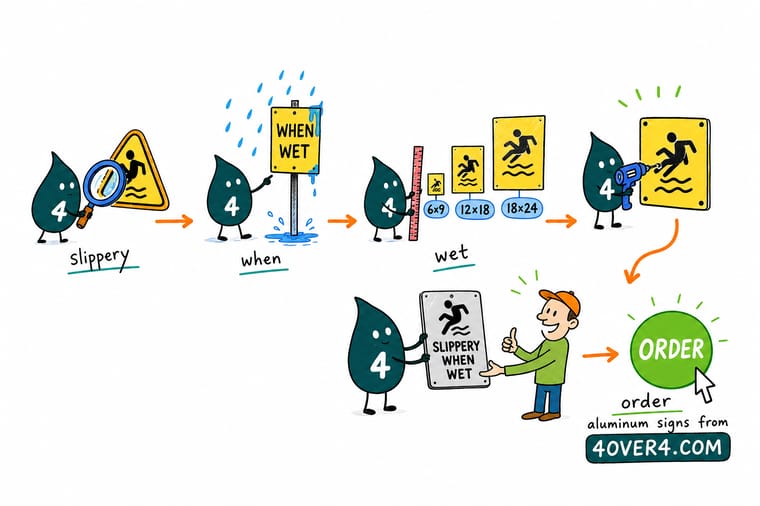
Wally spots the slick patch, then plants a bright yellow warning where nobody can miss it: a diamond for the road, an A-frame for the floor. It is a caution, not a rule, just enough notice to slow down and stay upright. Printed on rust-proof aluminum or tough coroplast, it keeps warning through rain and sun for years. Pick your size and material, and 4OVER4 prints it durable.
Order durable safety signs →Quick reference
The key details, at a glance
| Detail | What to know | Why it matters |
|---|---|---|
| Sign type | Warning (caution) | Advises care about a conditional hazard, not a prohibition. |
| Roadside form | Yellow diamond | Standard shape and color for a caution about conditions ahead. |
| Indoor form | Wet-floor A-frame or panel | Folding or wall sign posted after mopping or a spill. |
| Road sizes | 30x30 or 36x36 in | Large enough for drivers to read at speed. |
| Indoor sizes | ~12x25 in A-frame; 7x10, 10x14 wall | Sized for someone walking to notice. |
| Material | Aluminum or coroplast | Aluminum for permanent outdoor; coroplast for temporary. |
| Add-ons | Reflective, UV finish | Reflective for night visibility; UV to resist fading. |
Step by step
How to do it in 7 steps
- Confirm the hazard and settingDecide whether the warning is roadside, an entrance, or a floor, since that sets the sign form, size, and material.
- Choose the right sign formUse a yellow diamond for roads, a folding A-frame for floors, or a wall panel for doorways and corridors.
- Size it to the viewing distancePick a large 30 or 36 inch panel for roads and lots, or a smaller A-frame or wall size for indoor foot traffic.
- Design for instant recognitionUse a bold pictogram, high-contrast yellow, and short text in the correct safety colors so it reads at a glance.
- Select a durable materialChoose rust-proof aluminum for permanent outdoor signs or coroplast for temporary and lightweight placements.
- Add reflective or UV optionsInclude reflective material for night visibility and a UV-resistant finish where the sign sits in constant sun.
- Configure size and quantitySet your material, size, and quantity in the configurator, review the live price, and order.
Specs and pricing
Live specs and pricing
Coroplast yard signs print on 4mm white coroplast in 5 business days, aluminum signs in 4. Set size and quantity below.

| Quantity | Price Per Unit | Total |
|---|---|---|
| 1 | $36.00 | $36.00 |
Order it
Bring your project to 4OVER4

Explore more
Where to go next




By the numbers
Signs that stay legible outdoors
Common Questions
Common questions
What does a slippery-when-wet sign mean?
It warns that a surface, a road or a floor, is safe when dry but becomes slick when wet, whether from rain, mopping, or a spill. It is a caution sign, so it advises care rather than prohibiting anything. On roads it appears as a yellow diamond, often with a car-and-skid pictogram, while indoors it appears as a bright yellow wet-floor A-frame or wall panel. The goal is to make an invisible hazard visible so people can avoid a fall.
Where are slippery-when-wet signs required?
Workplaces and businesses open to the public frequently must post slip warnings to meet safety obligations and reduce liability, for example after mopping, around wet entrances, and near recurring spill areas. Road authorities place roadside versions where pavement is known to lose traction in rain. The practical rule for any property owner is that if a surface predictably becomes slippery and people will be on it, you should post a warning and keep it up while the hazard exists.
What does a safety sign cost and how is the price set?
Price depends on the material, size, finish, and quantity. Aluminum costs more than coroplast but lasts far longer outdoors, larger panels cost more than small ones, and add-ons like reflective material or a UV finish add to the total. Ordering multiple signs lowers the unit price. You set every option in the 4OVER4 configurator and the price updates live, so you can compare an aluminum panel against a coroplast one before you decide.
What sizes are available for slippery-when-wet signs?
Roadside warning diamonds are large, commonly 30 by 30 or 36 by 36 inches, so drivers can read them at speed. Indoor wet-floor A-frames are around 12 by 25 inches folded upright, and wall-mounted caution panels come in formats like 7 by 10 or 10 by 14 inches for doorways and corridors. Match the size to the viewing distance, and order free samples first to confirm legibility before a bulk run.
How long does it take to print and ship safety signs?
Turnaround depends on the material, size, finish, and quantity, and the product page shows the current production time for your configuration. Coroplast signs and standard aluminum sizes produce quickly, while reflective or specialty finishes may add a little time. You can add expedited shipping if you need signage in place fast, and preparing a clean, high-contrast file the first time avoids reprint delays.
Get Started
Aluminum signs run 4 business days, coroplast yard signs 5
Configure your safety sign on the material, size, and finish your setting needs, from rust-proof aluminum to reflective coroplast, with the price updating live as you go.
Legal Disclaimer
Gold Standard guarantees apply to all standard orders placed through 4over4.com. Price match requires verifiable proof of a competitor's published price for an equivalent product with matching specifications and turnaround time. Satisfaction guarantee covers manufacturing defects and print quality issues. Contact support with order number and documentation. On-time delivery rate based on tracked orders 1999 to 2026. Individual results may vary based on shipping carrier performance.
