
Self-Coaching Mastery, From The First Question To The Weekly Review


The sequence a coach uses, run on yourself, in twenty minutes a week. What to ask, what to write, how often to review it, and the point where the method stops being the right tool.
Self-coaching is running a coach's sequence on yourself and writing it down: the situation in facts, one question, at least three options, one commitment with a verb and a date, and a blank line for the evidence. The writing is what separates it from thinking about your problems, which you already do and which rarely changes anything. Ten minutes of review every Friday moves more than a long session once a quarter, because the correction lands while the week is still fixable.

Quick answer
A sequence, a written commitment, and a line you check next week
Self-coaching is structure applied to your own thinking. Describe the situation in facts, choose one question, force out three options, commit to a single action with a date and a size, then leave a blank line and fill it in later with what actually happened. That last line is the part that turns a good session into a changed habit, and it is the part nearly everyone drops. Run it weekly rather than heroically.
The Five Questions, In The Order That Makes Them Work

A coach does not give advice. A coach asks a sequence, and the sequence is the part you can copy. Run it in this order and it holds up; run it out of order and you end up defending a decision you had already made before you sat down.
One, the situation, in facts only. Write what is observably true. Not "the launch is a mess" but "three of the six pages are unwritten and the date is in eleven days". The rewrite from judgment to fact takes two minutes and changes what the rest of the session is even about.
Two, one question. Not a list. A session with four questions answers none of them. Good questions are narrow enough to answer in twenty minutes: what do I cut to hit the eleventh, rather than how do I stop overcommitting.
Three, at least three options. The first is the plan you walked in with. The second is usually its opposite, which makes it a false choice. The third is the one you have to work for, and it is where the session earns its time. Write all three even when two are obviously bad, because seeing them written next to each other is what makes the good one feel like a choice rather than a default.
Four, one commitment with a verb, a date and a size. "Be more consistent" is not a commitment. "Draft the two remaining pages before Thursday, one hour each" is. If you cannot picture yourself doing it on a specific afternoon, it is still a wish.
Five, leave a blank line for the evidence. Next week you fill it in with what actually happened. That blank line is the entire accountability system, and it is the step almost everyone skips.
Set Up The Session So It Actually Happens

Motivation decides whether you start once. Friction decides whether you start forty times. Every part of the setup below is a friction question, not a discipline question.
Fix the time before you fix the method. Attach the session to something that already happens without negotiation: the first coffee on Friday, the train home on Tuesday. A floating intention to "do a session this week" reliably lands on Sunday night or never.
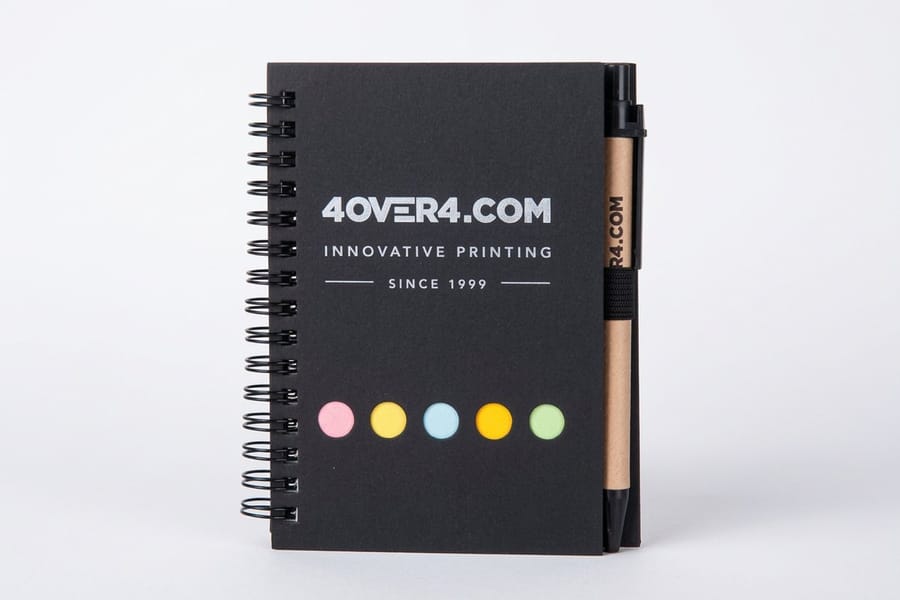
Pick a surface that cannot interrupt you. This is the one place where paper genuinely beats an app, and the reason is boring: a notebook has no notifications and no other tabs. Handwriting is also slower than typing, which sounds like a drawback and works as a filter, because you compress instead of transcribing. A bound book such as a leather journal lives on the desk and opens at the last page you used, which removes the two seconds where you decide not to bother. Ours start at $10.00. If you would rather have something you can flatten and tear out of, a Deluxe Spiral Notebook starts at $5.00 and lies flat on both halves.
The honest trade-off: paper does not sync, does not search, and cannot be read from a hotel room. Most people who run both end up writing the session by hand and photographing the commitment page into their phone, which takes five seconds and solves the retrieval problem without giving up the quiet.
Put the current commitment where you will see it without opening anything. A closed notebook is out of mind by Tuesday. One line on the wall is not. A dry erase poster from $29 holds the week's single commitment and gets wiped every Friday, and a dry erase magnet from $33.99 does the same job on a fridge or a filing cabinet for people who work from a kitchen table. If you want a version that is not about self-coaching at all, the same visible-surface trick is why planner layouts that stay open outperform beautiful ones that stay shut.
Weak Questions, And The Sharper Version Of Each

Most sessions fail at step two. The question sounds serious, produces a paragraph of feeling, and commits you to nothing. Here are the swaps that do the most work.
| Weak question | Sharper version | Why the swap works |
|---|---|---|
| Why do I keep procrastinating? | What is the first physical step, and what is in the way of it? | Moves from a trait you cannot change to an obstacle you can name and remove. |
| How do I get more motivated? | What would make the next attempt easier than the last one? | Treats effort as a design problem, not a character flaw. |
| Should I do A or B? | What would have to be true for B to be obviously right? | Surfaces the assumption the whole decision rests on, which is usually testable. |
| Why did that go badly? | What did I know at the time, and what would I need to know next time? | Separates a bad outcome from a bad decision. They are not the same thing. |
| What are my goals this year? | What is the one thing that, if it happened, makes the others easier? | Kills goal inflation, which is the most common way a session produces nothing. |
One more question belongs in every session and almost never appears: what would someone who thinks I am wrong about this say? You cannot see your own blind spot, so the only workaround is to argue the other side deliberately. Write their case in their voice, in two sentences. It is uncomfortable, which is the signal that it is working.
The Review Cadence, And Where Self-Coaching Stops Working
Sessions generate commitments. Reviews are what convert them into a pattern you can see. The cadence below is deliberately light, because a review system that takes an hour gets abandoned in about six weeks.
| Cadence | Time | The only question | What it leaves behind |
|---|---|---|---|
| Daily | 2 minutes | Did the committed thing happen today, yes or no? | A tick or a blank in the margin. No commentary. |
| Weekly | 10 minutes | What did I commit to, what happened, and what is next week's one commitment? | Last week closed out, next week's line on the wall. |
| Monthly | 25 minutes | Which commitments kept slipping, and what do the slips have in common? | A named pattern, which is usually about time of day or energy, not willpower. |
| Quarterly | 90 minutes | Is the thing I am working toward still the right thing? | One page you would be willing to show a person you respect. |
Now the limits, because a page that only sells the method is not much use. Self-coaching works on decisions and habits inside your control. It does not treat anxiety, depression or trauma, and using a worksheet on those is a way of postponing a therapist. It also cannot fix another person's behavior; if the real problem is a manager or a partner, the session will keep producing clever workarounds for a conversation you have not had.
The failure mode to watch for is rumination wearing the method's clothes. If you have written the same situation four weeks running with a new question each time, you are not coaching yourself, you are circling. Break it by committing to the smallest possible physical action, even a trivial one, and by asking someone else the question out loud. For the wider system around the practice, our work notebook organization guide covers indexing so past sessions stay findable, the dotted journal guide covers the page structure, and the first-time entrepreneur launchpad covers what to point all of it at when the goal is a business rather than a habit.
Wally coaches himself
One question, three options, one line with a date
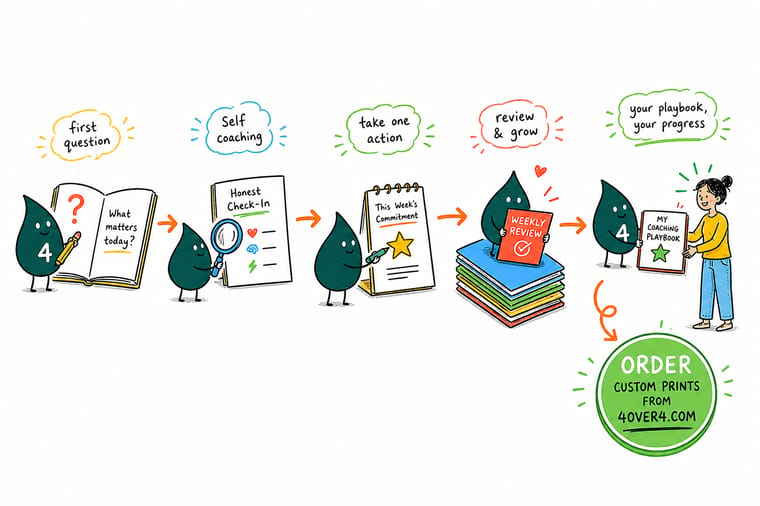
Wally writes the situation as facts, picks a single question, and refuses to stop at two options because the third is where the thinking happens. Then he writes one commitment with a verb, a date and a size, and leaves a blank line under it. Friday he fills that line in. That is the whole method, and the blank line is the part that makes it work.
Print a journal for your sessions →Specs and pricing
Notebooks and boards for the practice, with starting prices
The three surfaces most self-coaching routines end up using: a bound book for the sessions, a spiral pad that lies flat, and a wipe-clean board for the commitment you need to see all week.



Print it
Print the notebook you will actually open



Explore more
Where to go next




By the numbers
Printed by 4OVER4 since 1999
Common Questions
Your self-coaching questions, answered
What is self-coaching?
Self-coaching is running the structure of a coaching conversation on yourself: describe the situation in facts, pick one question, generate several options, commit to one action with a date on it, then check later whether it happened. The structure is what makes it different from thinking about your problems. Thinking loops. A written sequence ends somewhere, and it leaves a record you can argue with next week.
How is self-coaching different from journaling?
Journaling records what happened and how you felt about it. Self-coaching pushes toward a decision. A journal entry can end with nothing resolved and still be worth writing; a self-coaching session that ends without one committed action has failed at its own job. Many people run both in the same notebook, with the free writing on the left page and the commitment boxed on the right so it is easy to find during the review.
How long should a self-coaching session take?
Twenty to thirty minutes for a real question, and ten minutes for the weekly review. Longer sessions tend to drift into rehearsing the problem rather than answering it. If you are still writing at forty minutes, the question was probably too big, and the fix is to split it: one session on what you would need to know to decide, a second on the decision itself.
Does self-coaching work without writing it down?
Rarely, and not for long. Spoken or purely mental sessions feel productive because the insight arrives, and insight feels like progress. A week later the specific wording is gone and only the mood remains, so the same realization shows up again and feels new. Writing is what turns the insight into something the next session can test.
When is self-coaching the wrong tool?
When the problem is clinical, when it involves someone else's behavior you cannot influence, or when you genuinely lack the information rather than the resolve. Anxiety, depression and trauma need a therapist, not a framework. A bad manager needs a conversation or an exit, not a better morning routine. Self-coaching works on decisions and habits that are actually inside your control, which is a smaller set than it first appears.
What should I write in a self-coaching notebook?
Four things per session, and nothing else required: the date, the one question, the options you considered, and the single commitment with its deadline. Leave a blank line under the commitment for the result. That blank line is the whole review system. A ruled notebook is enough, though a bound one you keep on the desk gets used more than an app, mostly because it never shows you a notification while you write.
Get Started
Give the practice a book worth opening
Pick a bound journal, a spiral pad that lies flat, or a wipe-clean board for the week's one commitment. Printed in Queens, shipped nationwide.
Legal Disclaimer
Gold Standard guarantees apply to all standard orders placed through 4over4.com. Price match requires verifiable proof of a competitor's published price for an equivalent product with matching specifications and turnaround time. Satisfaction guarantee covers manufacturing defects and print quality issues. Contact support with order number and documentation. On-time delivery rate based on tracked orders 1999 to 2026. Individual results may vary based on shipping carrier performance.
