
How to Start Journaling for Your Business and Make the Habit Stick


Journaling only helps a business when it sticks. The loop runs purpose, tool, routine, prompts, reflection, and it ends with the notebooks and notepads that keep it going.
Define a purpose, pick the right notebook or notepad, anchor it to a daily trigger, use a few standing prompts, and reflect weekly. Start small, keep the tool visible on your desk, and read your entries back each week to turn notes into decisions. A branded journal makes the habit stick and doubles as a client gift.
Start here
The loop that makes journaling stick
Business journaling is a short, regular written record of how you run the business: the decisions you make, the problems in front of you, the ideas you would otherwise lose, and what each one turned into. Five parts make it work: purpose, tool, routine, prompts, reflection. Decide what the journal is for, pick a notebook or notepad that removes friction, anchor writing to a daily trigger, keep a few standing prompts to beat the blank page, and read your entries back each week. Start small, one page a day, and keep the tool visible on the desk rather than in a drawer. The diagram below shows the loop that keeps the habit alive.
Define your journaling purpose

Business journaling is the habit of writing a short, dated entry about your own business: what you decided, what got in the way, what a customer said, and what you plan to do next. It is not a diary and it is not bookkeeping. It is a working record you can read back and act on.
A business journal only sticks when it has a job. Before you write a word, decide what the journal is for. Common purposes are daily planning, end-of-day reflection, capturing ideas before they escape, and tracking wins for perspective on hard weeks. You can combine a couple, but name them, because a journal with a defined purpose gives every entry a reason to exist.
Purpose also settles how often you write. For most owners the answer is daily and short, one page or five minutes tied to a fixed trigger, plus one longer review each week where you read the last seven days back, and a quarterly sit-down where you compare the last three months. Daily and short beats weekly and long, because the record only becomes useful once there is enough of it to compare.
What goes in an entry follows from the purpose: the day's single priority, decisions made and the reasoning behind them, problems you are stuck on, what a customer or supplier actually said, the one number you are watching, ideas you do not want to lose, and a line on what went well. Keep names, dates and numbers in it, because vague entries are the ones you never reread.
This first choice quietly shapes everything else, including which tool fits. A planning journal wants space to lay out a day. An idea journal wants to be within arm's reach the second inspiration strikes, which is exactly where a desk notepad earns its place. Clarity on purpose is what separates a journal you keep from a notebook that goes blank after a week.
Write your purpose on the first page as a one-line reminder. It anchors the habit and gives you something to return to when the routine wobbles, which it will in the first few weeks before it sets.
Select the right tool: notebook vs notepad

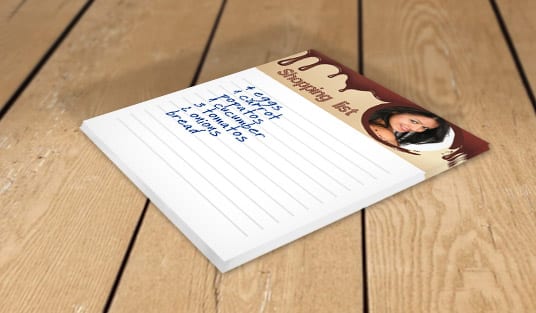
The tool is not a detail. The right one removes friction, and friction is what kills a new habit. Two formats cover most needs. A bound notebook suits long-form reflection and planning, anything you want to keep and page back through, because it holds a running record in one place. A notepad suits quick capture: meeting notes, to-do lists, and fast ideas you act on and tear off.
Many owners run both, a notebook for a deeper weekly reflection and a notepad on the desk for daily quick capture. Choose based on how and where you actually write. If you think best in the morning at a desk, a notepad within reach wins. If you reflect in longer sessions, a notebook you can flip through wins. Our guide on making custom notebooks covers the cover stocks, binding, and interiors worth choosing.
Whatever you pick, a tool that feels good to use gets used. A quality spiral notebook that lies flat, or a notepad with a cover you like, lowers the bar to writing every single day. If the daily entry is short and the weekly review is where the thinking happens, a tear-off notepad for the week and a notebook for the review is the pairing most owners settle on.
Establish a routine and start small
Habits run on triggers, not motivation. The reliable move is to anchor journaling to something you already do every day. Journal with your first coffee, or in the last five minutes before you close the laptop. The existing habit becomes the cue, and the cue carries the new behavior far better than a reminder ever will.
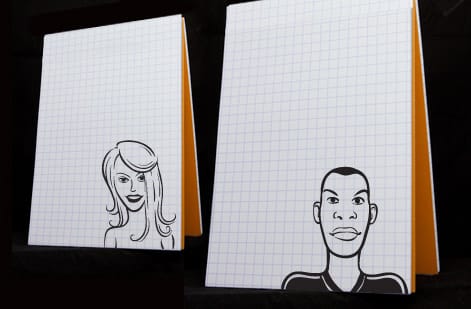
Start small on purpose. Three lines a day beats a page you dread, and a light goal like five entries a week makes early wins easy to hit. Momentum from small, consistent entries is what turns journaling from a resolution into a routine. Keeping the tool physically visible helps too: a notepad left open on the desk is a standing invitation to write.
This is where a branded tool quietly pays off. A notebook or notepad you are glad to have out stays out, and a tool that stays out gets used. The visibility of the physical object is doing habit-formation work that an app buried in a menu cannot.
Use strategic prompts to beat the blank page
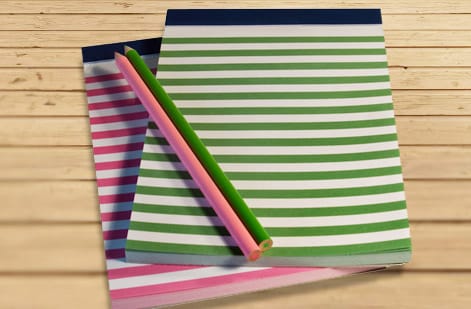
The blank page is the enemy of consistency. The fix is a small set of standing prompts you answer each time, so you start writing in seconds instead of staring. Three to five questions is plenty. For a business journal, strong prompts include: what is the one thing that matters most today, what went well yesterday, what am I stuck on, and what decision am I avoiding.
Prompts do two jobs. They remove the starting friction, and they keep entries useful by pointing your writing at what actually moves your business. You can rotate them, morning planning prompts and evening reflection prompts, but keep the set short so answering stays fast. Pre-printing your prompts at the top of a custom notepad makes them automatic, so every sheet already asks the right questions.
Over time these answers become a searchable record of your thinking: what you worried about, what you decided, what worked. That record is the raw material for the reflection step, where journaling turns into insight.
25 business journaling prompts
Use this list as a menu, not a checklist. Pick three to five prompts, answer the same ones every day for a month, and only then swap any of them out. Prompts 1 to 10 are daily, 11 to 18 are for the weekly review, and 19 to 25 are quarterly, for the sit-down where you decide what the next three months look like. Pick your five daily prompts, then have them pre-printed across the header of a custom notepad so every sheet asks them for you.
Daily prompts, 1 to 10
- What is the one thing that matters most today, and what happens if it slips?
- What went well yesterday, and what made it work?
- Where am I stuck right now, and who could unstick me in ten minutes?
- What decision am I avoiding, and what am I waiting on before I make it?
- What did a customer say today, in their own words?
- What did I say yes to that I should have said no to?
- Which number moved today: quotes sent, orders placed, calls answered, cash in?
- What took far longer than it should have, and where did the time go?
- What is one task I can hand to someone else this week?
- Rate my energy today from 1 to 5, then name what set it there.
Weekly review prompts, 11 to 18
- Which three entries from this week actually matter, and what do they have in common?
- What did I plan on Monday that never happened, and why?
- Which job or client was most profitable this week, and what made it so?
- Which question or complaint came up more than once?
- What did I learn that changes how I work next week?
- What did I spend money on this week, and would I spend it again?
- Which task did I repeat often enough that it deserves a checklist or a template?
- What are next week's three actions, written down before Friday ends?
Quarterly prompts, 19 to 25
- What is the business measurably better at than it was three months ago?
- Which goal did I hit, which did I miss, and which did I quietly drop?
- Where is my time going that no longer earns its place?
- Which customers do I want more of, and where did they come from?
- What did I stop doing, and did anything break when I stopped?
- What does the next quarter look like if only one thing goes right?
- What did I say this journal was for on page one, and is that still true?
Answering all 25 in one sitting is not the goal. A five minute daily entry against the same few questions beats a long entry you write once and abandon, because the value comes from comparing today's answer to last Tuesday's.
Reflect on your progress and add visuals

Writing entries is only half the practice. The value shows up when you read them back. Once a week, spend a few minutes reviewing your entries and pull out three things: patterns you did not notice in the moment, decisions worth making, and next actions. Reflection is the step that converts scattered notes into real business insight, and it is the one most people skip.
Adding visuals sharpens the practice further. Simple sketches, quick charts, or a mood or energy marker per day give you signal you can scan at a glance during review. You do not need to be an artist; a rough diagram often captures a system faster than a paragraph. A notepad with room to sketch, or a dotted or gridded notebook, makes this natural.
Build the weekly review into your routine the same way you built the daily entry, anchored to a set time. That closes the loop shown in the diagram above: define, tool, routine, prompts, reflect, then repeat, with each week compounding on the last.
Branded journals for your team and clients

Once journaling works for you, it becomes a tool you can extend to your team and clients. Custom notebooks and notepads carrying your logo do three things at once: they encourage the same reflective habit across your team, they keep your brand in view on every desk, and they make a genuinely useful gift that clients actually keep and use.
Unlike most swag, a good notebook earns its place. A client who journals in a leather or embossed notebook with your logo sees your brand every time they think through a problem, day after day. That is far more valuable than a pen that vanishes. Pull the notebook together with cards and other pieces into one branded stationery set for a coordinated look.
For a team rollout, the split is simple. Give each person a deluxe spiral notebook that lies flat for the weekly review, and keep custom notepads on the desks for the daily entry, with your logo and your five standing prompts printed across the header so nobody has to remember them.
Because notebooks and notepads price down at quantity, a branded batch for a team or a client-gift run is affordable. Order custom notebooks and notepads together, and the journaling habit that helps you becomes a marketing asset that works for your business too.
Wally keeps the journaling loop turning
Purpose, tool, routine, prompts, reflect, repeat
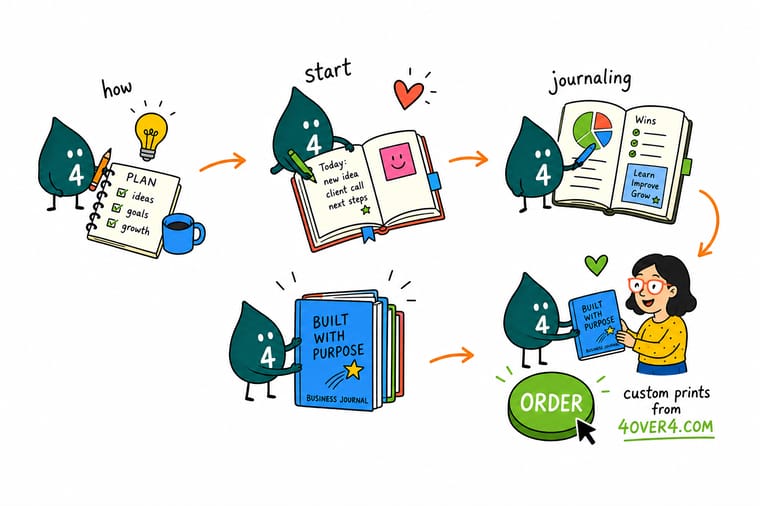
Wally does not rely on willpower. He names the journal purpose, keeps the right notepad in reach, ties writing to his morning coffee, answers a few standing prompts, and reads the week back every Friday. A branded notepad on the desk is the nudge that keeps the loop turning. Print one for yourself and a batch for the team, and the habit spreads.
Order custom notepads →Quick reference
The business journaling routine, at a glance
Six moves take journaling from a resolution to a habit that actually informs your decisions.
| Move | Aim for | Why it matters |
|---|---|---|
| Define purpose | One clear focus | Planning, reflection, or ideas: knowing the job keeps entries useful, not aimless. |
| Pick the tool | Notebook or notepad | Long-form thinking wants a bound notebook, quick capture wants a desk notepad. |
| Set a trigger | Anchor to a habit | Tie it to coffee or day-end so the routine runs on a cue, not willpower. |
| Use prompts | 3 to 5 standing questions | A short prompt set gets you writing in seconds and keeps entries on point. |
| Reflect weekly | Read back your notes | Review turns scattered entries into patterns and better decisions. |
| Brand the tool | Custom cover and logo | A branded journal on the desk makes the habit visible and doubles as a client gift. |
Step by step
Build your journaling habit in 7 steps
- Define your journaling purpose Choose one primary focus, daily planning, reflection, idea capture, or gratitude, so every entry has a job and the habit has a clear reason to continue.
- Select the right tool Pick a bound notebook for long-form thinking or a desk notepad for quick capture. Match the format to how and where you will actually write.
- Establish a routine Anchor journaling to an existing habit, your first coffee or the last five minutes of the workday, so a trigger carries the habit instead of motivation.
- Start small and set goals Begin with three lines a day rather than a page, and set a light goal like five entries a week so early wins keep you going.
- Use strategic prompts Keep three to five standing questions at the top of the page so you never face a blank sheet and every entry stays useful.
- Reflect on your progress Once a week, read back your entries and pull out patterns, decisions, and next actions. Reflection is where journaling pays off.
- Bring in tools and branding Add visuals or sketches, and put branded notebooks and notepads on your team and client desks so the habit spreads and markets your business.
Specs and pricing
Custom notepad specs and live pricing
A notepad on the desk is the easiest journaling tool to keep visible. Pick your size, page count, and finish and watch the price update live, straight from the configurator.

| Quantity | Price Per Unit | Total |
|---|---|---|
| 25 | $3.73 | $93.37 |
| 50 | $2.53 | $126.32 |
| 100 | $1.92 | $192.22 |
| 150 | $1.72 | $258.12 |
| 200 | $1.65 | $329.52 |
| 250 | $1.58 | $395.42 |
| 300 | $1.54 | $461.32 |
| 400 | $1.48 | $593.13 |
Print it
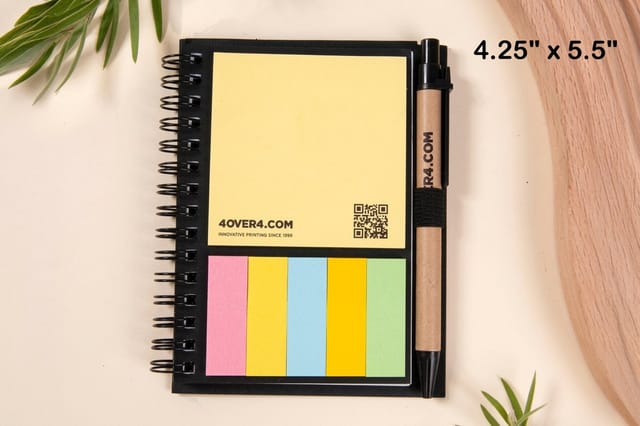
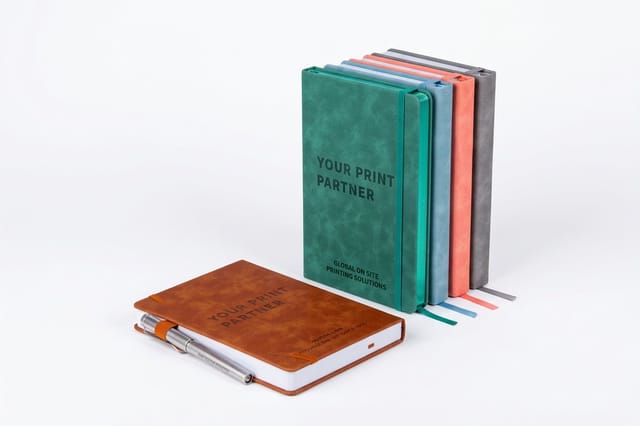
Journals and notepads, from 4OVER4

See it in use
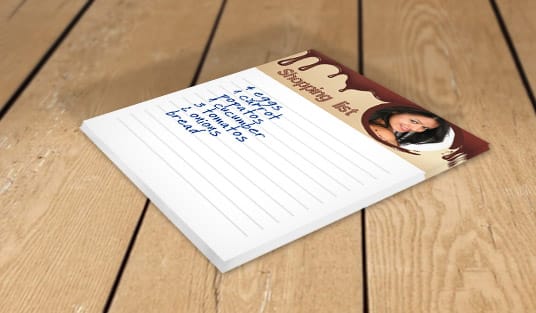
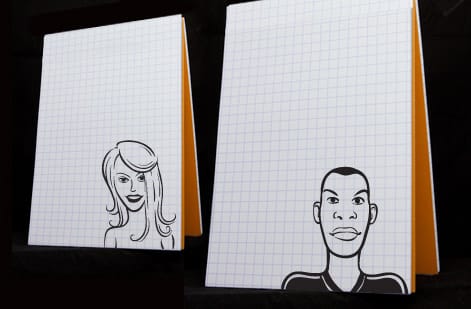
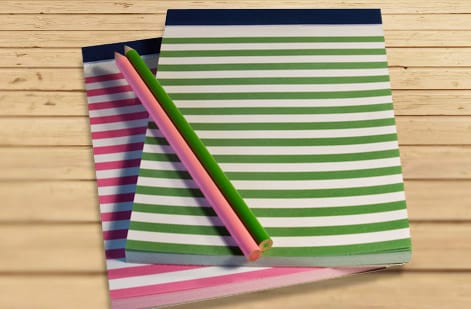
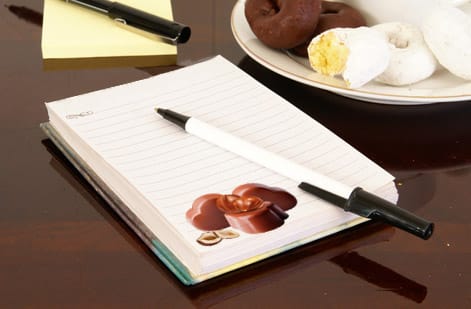
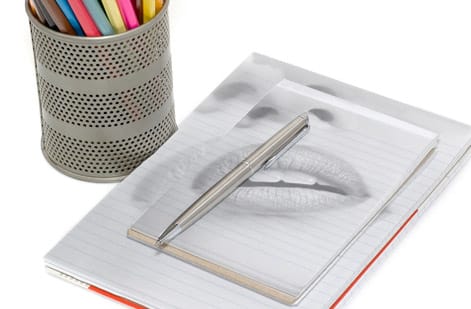
Notepads customers ordered for daily use



Explore more
Where to go next







By the numbers
Five steps, and the catalog to print them on
Common Questions
Common questions about business journaling
How do I start journaling for my business?
Start by defining the journal purpose, whether it is daily planning, reflection, idea capture, or gratitude, so every entry has a clear job. Pick the right tool for how you work: a bound notebook for long-form thinking or a desk notepad for quick capture. Anchor the habit to something you already do, like morning coffee, so a trigger carries it instead of willpower. Keep a short set of standing prompts so you never face a blank page, start small with just a few lines a day, and read back your entries once a week. That weekly reflection is where scattered notes turn into real business insight.
Should I journal in a notebook or on a notepad?
Match the tool to the kind of thinking you do. A bound notebook suits long-form reflection, planning sessions, and anything you want to keep and page back through, since it holds a running record in one place. A notepad suits quick capture at the desk, meeting notes, to-do lists, and fast ideas you act on and tear off. Many owners use both: a notebook for deeper weekly reflection and a notepad for daily quick capture. The best tool is the one that removes friction for your habit, because friction is what kills a new routine. Branded versions of both keep the habit visible on the desk.
What does a custom notebook or notepad cost and how are prices set?
Custom notebooks and notepads are affordable, and the per-unit price drops as quantity rises, which makes them practical for both personal use and team or client gifting. Price scales with the format, size, page count, cover stock and finish, binding, and quantity. A simple branded notepad costs very little per pad in a modest run, while a premium leather or embossed journal costs more per piece but reads as a high-value gift. You set each option in the configurator and the price updates live, so you can compare a basic notepad against a deluxe journal before you order.
What sizes, stocks, and finishes are available for journals and notepads?
Notepads come in standard desk sizes with tear-off sheets and a range of page counts, while notebooks run from compact pocket sizes to full letter formats. Cover options range from soft printed covers to spiral-bound, embossed, and leather finishes, and interiors can be blank, lined, dotted, or gridded. Finishes like embossing or foil on the cover turn a plain notebook into a premium branded piece. The specs panel below shows the exact sizes, stocks, binding, and finish options with live pricing so you can build the journal that fits your habit.
How long does it take to print and ship custom notebooks and notepads?
Custom notepads and notebooks print on a quick turnaround, with production time depending on the format, page count, binding, finish, and quantity you choose. Simpler notepads move fastest, while embossed or leather-bound journals with special finishing take a little longer. The configurator shows the live turnaround for your exact specs, and shipping is added on top based on your delivery method. Ordering a batch for your team or as client gifts on one job keeps everything arriving together and ready to hand out.
Get Started
Order 25 notepads on 70# uncoated text from $93.37
Print a custom notebook or notepad that you are glad to keep on the desk, then order a branded batch for your team and clients. A 25 sheet run of notepads on 70# uncoated text starts at $93.37 and ships in 7 business days.
Legal Disclaimer
Gold Standard guarantees apply to all standard orders placed through 4over4.com. Price match requires verifiable proof of a competitor's published price for an equivalent product with matching specifications and turnaround time. Satisfaction guarantee covers manufacturing defects and print quality issues. Contact support with order number and documentation. On-time delivery rate based on tracked orders 1999 to 2026. Individual results may vary based on shipping carrier performance.
