
Postcard Advertising That Earns a Response


The sizes that decide your postage tier, when EDDM beats a bought list, the offer that gets answered, and how to measure what came back.
Postcard advertising puts one offer on an unenveloped card and mails it to a chosen set of addresses, either a named list or every address on a carrier route through EDDM. Size decides the cost before design does: up to 4.25 by 6 inches you pay the USPS postcard price, past that letter prices, and past 6.125 inches tall the piece is a flat, which is the only size EDDM Retail accepts. The offer, the frequency and a tracking code drive the result far more than the artwork.
Quick answer
Pick the postage tier first, then write the offer
Postcard advertising is one offer, printed on a card with no envelope, delivered to addresses you choose. Two dimensions govern the budget: 4.25 by 6 inches is the top of the USPS postcard price, and 6.125 inches tall is the top of the letter price, above which the piece becomes a flat and qualifies for EDDM Retail. Choose the tier, size the design to it, put one dated offer and one action on the front, and mark the card with a code so the response can be counted. Everything else is decoration.
Does Postcard Advertising Still Pull Responses
It works where the buyer is local, the offer is simple, and the same audience gets mailed more than once. It fails where a business mails a few hundred cards one time, to a list it never chose carefully, with a website address instead of an offer.
The mechanism is worth understanding because it explains both outcomes. A postcard carries no envelope, so there is no decision to open it. The message is read at the mailbox or over the recycling bin, in the two or three seconds it takes to sort the pile. That is a short window, but it is a window that email does not get once a message lands in a promotions tab. The card also sits somewhere physical afterward, on a counter or a fridge, and that second life is why magnet postcards exist at all.
Now the limit nobody advertises. Postcard advertising is a volume and repetition channel, not a precision one. Most of the people who receive your card are not in the market this week, which is normal and not a failure. You are paying to be present when a small share of them becomes a buyer, so the economics only work if the cost per piece is low enough and the drop is large enough for that small share to be a real number. A campaign of 300 cards cannot tell you anything. A campaign of 3,000 to the right route, repeated, can.
The other honest caveat is time. Mail does not spike the way a paid search click does. Responses arrive over two to three weeks after delivery and often continue past the point most people declare the campaign dead, which is exactly why the tracking method in the last section matters more than the artwork.
The Ad Sizes That Change Your Postage Bill
Size is a postage decision before it is a design decision. The USPS prices mail in tiers, and a postcard crosses from one tier into the next at fixed dimensions, so a quarter inch of extra height can raise the cost of every piece in the drop.
| Size | Postage tier | What it is good for | The catch |
|---|---|---|---|
| 4 x 6 in | USPS postcard price, the lowest tier | Reminders, coupons, appointment nudges, repeat drops to the same route | One headline and one image. Not enough room for a real explanation |
| 5 x 7 in | Letter price | A photograph plus a headline plus a short offer block | You pay letter postage for a card most people still read like a postcard |
| 6 x 9 in | Letter price | Listings, menus, service lists, anything that needs a second column | Costs the same postage as 5 x 7, so use the space or drop back down |
| 6.5 x 9 in and larger | Flat price | Standing out in the stack, and the only tier EDDM Retail accepts | Highest cost per piece. Justify it with the offer, not with the size |
Read the middle two rows together. Once you leave the postcard price you are already paying letter postage, so going from 5 by 7 up to 6 by 9 costs you almost nothing more in mail and gives you meaningfully more selling space. The upgrade that genuinely costs money is the jump to a flat, and the only reasons to take it are EDDM eligibility or a deliberate decision to be the largest thing in the mailbox that day.
Stock matters less than size but it is not nothing. A 14pt card mails fine and feels like advertising. A 16pt card feels like something you keep, which is worth the difference on a card carrying a coupon that has to survive a month on a fridge. Standard postcards start at $16.48 and oversized postcards start at $51.62, so you can test the two formats side by side without a serious budget. For the full dimension breakdown, the postcard sizes and dimensions guide lists every size we print, and our postcard printing pages carry live pricing for each one.
EDDM Explained, and When It Beats a Mailing List
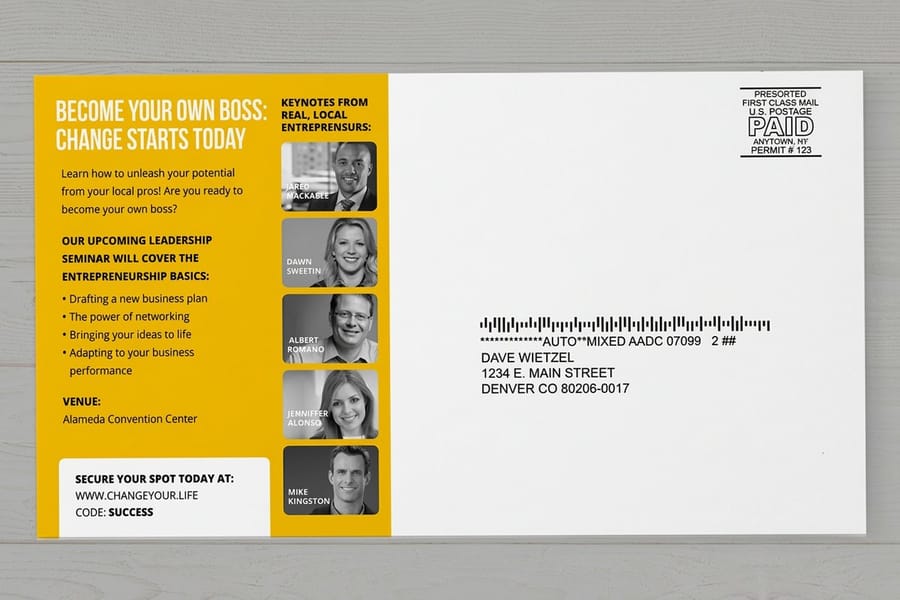
Every Door Direct Mail lets you pick carrier routes on a USPS map and deliver a card to every address on them, with no list to buy and no individual addresses to print. The card carries a simplified address block rather than a name, which is what makes it possible.
Three rules shape the whole thing. The piece has to be flat sized, meaning it exceeds one of the letter limits, which in practice means taller than 6.125 inches. EDDM Retail caps you at 5,000 pieces per day per ZIP code. And the routes are all or nothing, so you take every address on the route including the ones that will never buy from you.
That last rule is the real decision. Saturation is excellent when your customer is defined by geography: a restaurant, a dental practice, a gym, a lawn service, a new store opening two miles away. It is wasteful when your customer is defined by anything else. If you sell to property managers, or to households that bought a home in the last ninety days, or to one profession, then paying for a list and mailing direct mail postcards to named recipients costs more per piece and less per customer.
Run the comparison on cost per response rather than cost per piece, because the two point in opposite directions. Our guide to building or renting a mailing list covers what list data actually costs, and what Every Door Direct Mail is walks the route selection and submission end to end. If you would rather hand the whole thing over, our direct mail services print, address and drop the mailing for you.
Writing an Offer the Mailbox Cannot Ignore
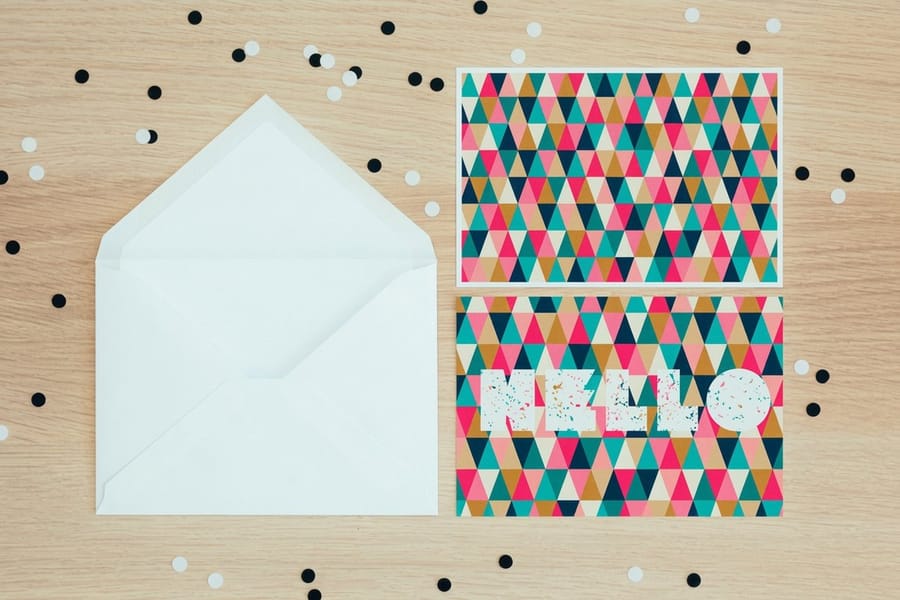
You have one headline, one image and roughly three seconds. Everything on the front should serve a single action, and anything that does not serve it is taking space from something that would.
A working front carries four things: who it is for, what they get, why now, and what to do next. "New patients, first cleaning $59, book before March 31, call to reserve" does all four in one line. A card that says "Quality dental care since 1998" with a logo and a website does none of them. The second card is not badly designed, it is simply not an advertisement.
Some habits that consistently pay off:
- Date the offer. An expiry converts hesitation into a decision. Without one the card goes on the pile of things to think about later.
- Name the audience out loud. "For homeowners on Ditmars Boulevard" outperforms a generic headline because the reader recognises themselves before they read the offer.
- Make the price specific. A dollar figure or a real percentage is read. "Great savings" is not.
- One action only. Call, or scan, or visit. Three ways to respond is three chances to defer.
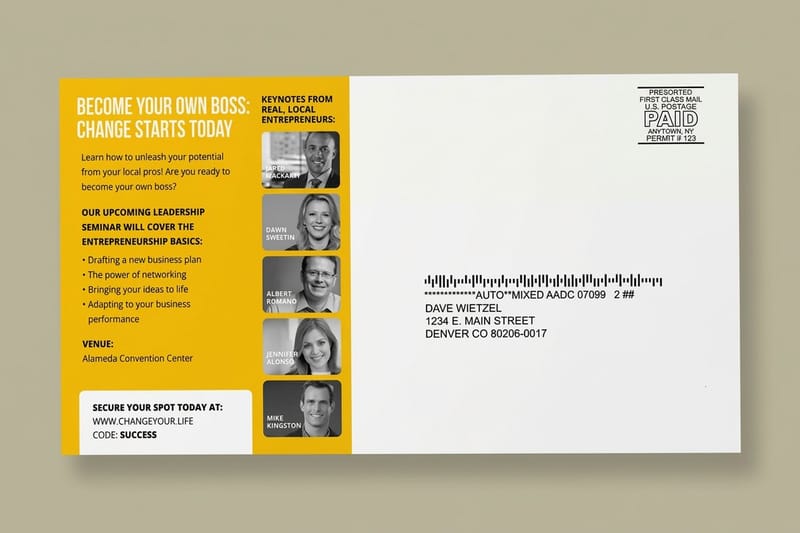
- Leave the address side alone. The right portion belongs to the delivery address and the barcode clear zone, so put your terms and hours on the left half.
On the print side, keep the headline outside the trim margin, mind the safe zone, and remember that a gloss coating fights a ballpoint pen if you want anyone to write on the card. Start from a correctly sized layout in the blank template library, or build the card in our free online Designer, and check the mailing panel against the rules in how to address a postcard for mailing. For a deeper pass on the front, the ten elements of an effective direct mail postcard goes element by element.
Measuring Response Without Fooling Yourself
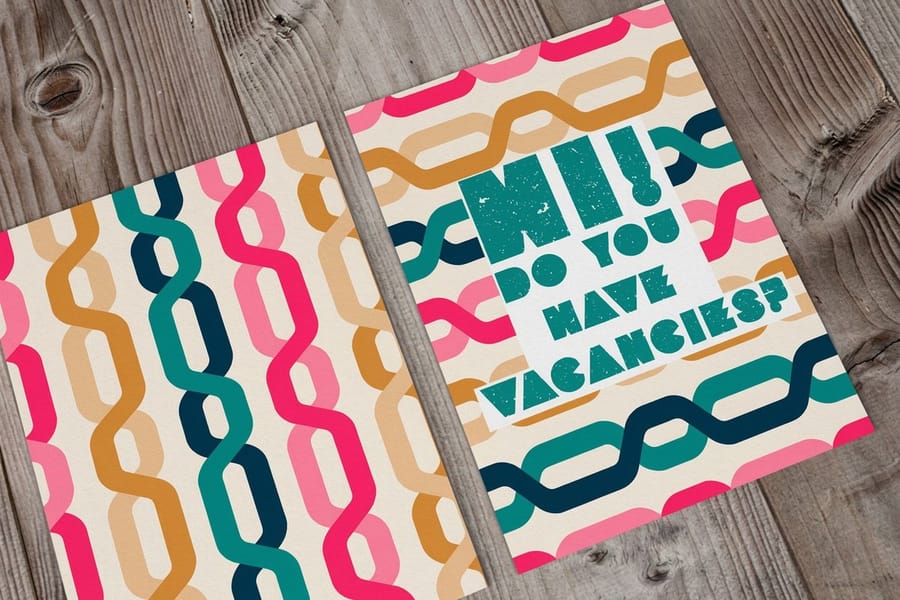
A drop with no tracking mechanism produces an opinion, not a result. Decide before you mail how a response will identify itself, and the campaign becomes a number you can act on.
Pick one of four markers and use it nowhere else: a coupon code the staff has to enter, a vanity URL that redirects to a landing page, a QR code carrying its own tracking parameter, or a phone number used only on that card. Then write down the two figures that make the arithmetic work, which are the number of pieces mailed and the total campaign cost including print, postage, list and design.
The calculation itself is simple. Total cost divided by responses gives cost per response. Cost per response divided by your close rate gives cost per customer. Compare that against what a customer is worth over their lifetime, not against what they spend the first time, because a $40 cost per customer looks terrible next to a $60 first order and excellent next to a customer who returns four times a year.
Two traps distort the number. The first is counting too early: mail responses arrive over two to three weeks and trail on for longer, so a verdict at day five is a verdict on the postal service. The second is comparing your result to a published industry average without matching the list quality, the offer and the frequency behind it. Averages are context, never a target. If you want that context, direct mail response rates by industry sets out the ranges, and direct mail cost per piece breaks down the cost side you will be dividing.
Then repeat before you rewrite. The most common mistake in postcard advertising is treating a single mailing as a test of the channel. Mail the same route or segment two more times with the same offer, tracked the same way, and the second and third drops will tell you far more than a redesign would.
Wally explains postcard advertising
Measure first, then write the offer
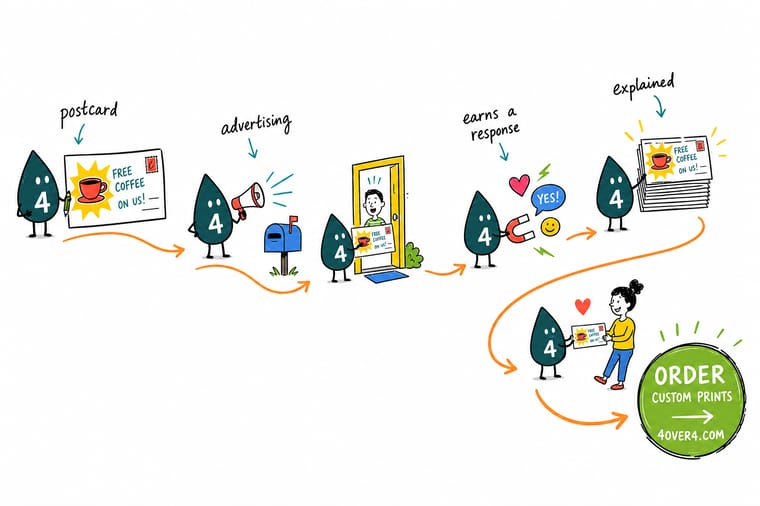
Wally lays a rule across the card before he touches the design. Under 4.25 by 6 inches it mails at the postcard price. Over that it is a letter. Over 6.125 inches tall it is a flat, which costs more but is the only shape EDDM Retail will take down the route. Then he writes one offer, gives it a date, prints a code nobody else uses, and mails the same street three times instead of a new street once.
Order direct mail postcards →Specs and pricing
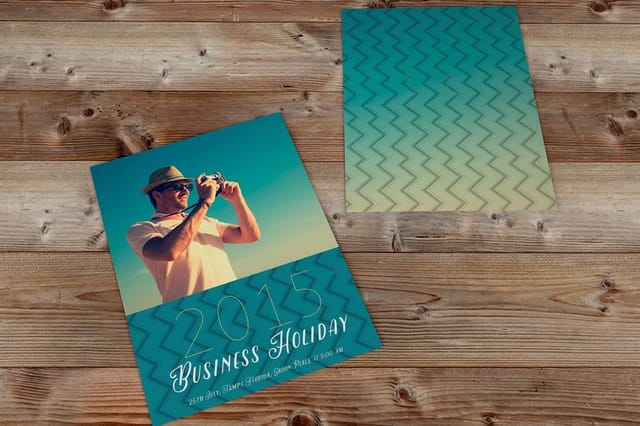
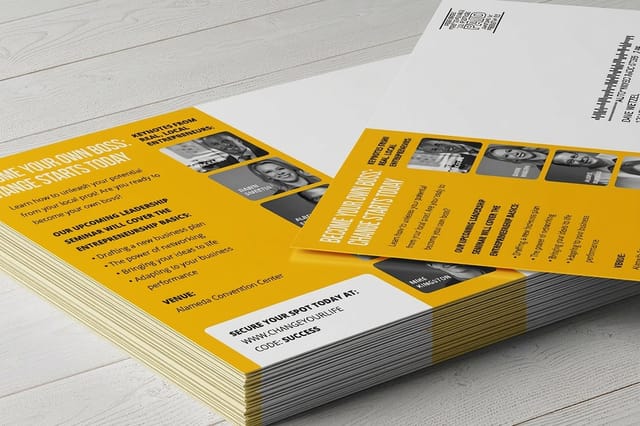
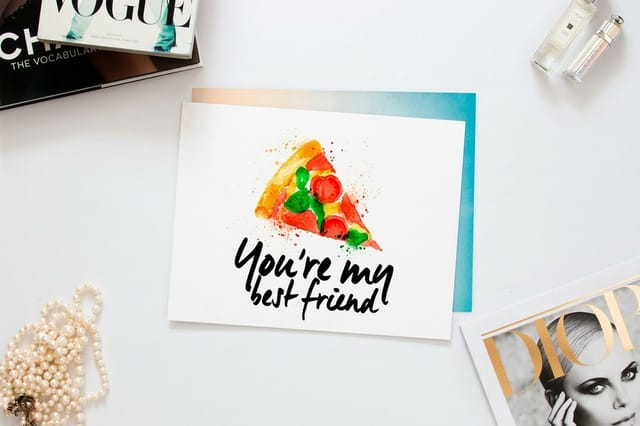
Postcard sizes, stocks and starting prices
Compare the three formats most advertising campaigns use, with live configuration choices and starting prices straight from the 4OVER4.COM configurator.


Print it
Order the card your campaign needs
Explore more
Where to go next
By the numbers
Campaign printing you can plan around at 4OVER4
Common Questions
Your postcard advertising questions, answered
What is postcard advertising?
Postcard advertising is paid promotion printed on an unenveloped card and delivered by mail to a chosen set of addresses. The message is visible the moment the card is picked up, so the whole format is built around one offer and one action rather than a brochure worth of information. Businesses use it two ways: mailed to a purchased or house list of named recipients, or dropped to every address on a carrier route through Every Door Direct Mail. The print side is ordinary, standard postcards start at $16.48 at 4OVER4.COM, and the campaign side is where the money and the thinking go.
What size postcard should I use for advertising?
Start from the postage tier, not the design. A 4 by 6 inch card stays inside the USPS postcard price and is the cheapest way to reach a lot of addresses, which suits reminders, coupons and repeat drops. A 5 by 7 or 6 by 9 card mails at letter prices and buys room for a photograph and a real headline, which suits a first introduction or a listing. Anything over 6.125 inches tall becomes a flat, costs more per piece again, and is the only size EDDM Retail accepts. Oversized postcards at 4OVER4.COM start at $51.62.
Is EDDM cheaper than a mailing list?
Per piece it usually is, because you skip the list cost and the addressing, but the comparison only holds if most of the route is a plausible customer. EDDM delivers to every address on the route you pick, so a restaurant or a dentist with a two mile catchment gets real value while a business that sells to one narrow trade wastes most of the drop. EDDM Retail also caps you at 5,000 pieces per day per ZIP code and requires the flat sized piece described above. When your buyer is defined by profession, purchase history or property type, a targeted list beats saturation even at a higher cost per piece.
How do I track responses from a postcard campaign?
Put something on the card that exists nowhere else. A short vanity URL that redirects to a landing page, a coupon code the staff has to type in, a QR code with its own tracking parameter, or a phone number used only on that drop. Then record two numbers before you mail: how many pieces went out and what a customer is worth to you. Divide total campaign cost by responses and you have a cost per response you can compare against your other channels. Adding a QR code is the easiest of these, and our guide on QR codes for flyers, brochures and postcards covers the placement and size that scan reliably.
How many postcards do I need to mail to see anything?
Enough that a normal response looks different from luck. On a small drop of a few hundred pieces, two or three replies could be chance, so you cannot tell whether the offer worked. Most local campaigns start somewhere around a few thousand pieces to one well chosen route or list segment, then repeat the same audience rather than chasing a new one. Repetition is the part people skip. The same household seeing a card three times over a quarter responds at a different level from a household seeing it once, and a single drop that underperforms is often a frequency problem rather than a creative problem.
What should go on the back of an advertising postcard?
The address side is half yours and half the post office. The right portion carries the delivery address and the barcode clear zone and must stay empty of design, while the left portion is free for your offer details, terms, hours, or a small map. Keep the important message on the front where it is seen first. If you are laying out the mailing side for the first time, work from a real template so the address block and clear zone land in the legal position rather than guessing at margins.
Get Started
Ready to put your offer in the mailbox?
Pick the size that fits your postage tier, upload the card or build it in our Designer, and we print and mail the drop from Queens.
Legal Disclaimer
Gold Standard guarantees apply to all standard orders placed through 4over4.com. Price match requires verifiable proof of a competitor's published price for an equivalent product with matching specifications and turnaround time. Satisfaction guarantee covers manufacturing defects and print quality issues. Contact support with order number and documentation. On-time delivery rate based on tracked orders 1999 to 2026. Individual results may vary based on shipping carrier performance.
