
Postcard Mailing Rates Explained by Size, Class and Volume


The postcard rate is a box with four walls. Here is exactly where those walls sit, which sizes fall out of the box, and when volume moves you to Marketing Mail or EDDM.
A rectangular card between 5 by 3.5 inches and 6 by 4.25 inches, and between 0.007 and 0.016 inches thick, pays the First-Class Mail postcard price, the cheapest single piece rate USPS sells. Cross any one of those four limits and the same card pays the letter price instead. Past 11.5 by 6.125 inches it pays the flat price. At 200 pieces and up you can switch to USPS Marketing Mail for lower postage, at the cost of a permit, a presorted list, extra transit days, and no forwarding when an address goes bad.
Quick answer
Four measurements decide what every piece costs
Length, height, thickness and shape set the tier before anyone reads your offer. Stay rectangular, between 5 by 3.5 and 6 by 4.25 inches, and between 0.007 and 0.016 inches thick, and you hold the postcard price. Go longer or taller and you pay the letter price, which is what a 5 by 7, a 6 by 9 and a 6 by 11 card all do. Go past 11.5 by 6.125 inches and you pay the flat price. Volume then chooses the class: single piece First-Class for speed and forwarding, presorted First-Class from 500 pieces, USPS Marketing Mail from 200 pieces for the lowest postage, or EDDM when you want a whole carrier route and have no list.
The Size Window That Decides Your Rate
USPS does not price a postcard by what it looks like. It prices by four measurements, and a card that misses one of them pays letter postage no matter how postcard it feels in the hand.
To hold the First-Class Mail postcard price a piece must be rectangular, at least 5 inches long by 3.5 inches high, no more than 6 inches long by 4.25 inches high, and between 0.007 and 0.016 inches thick. Caliper trips people up more often than size does. A card printed on light 100lb text stock can fall under the 0.007 minimum and get rejected as too flimsy, while a heavy 18pt or 24pt card can pass 0.016 and lose the rate for being too stiff. Standard 14pt and 16pt cardstock sits comfortably in the middle, which is why it is the default for mailing work. Our postcard paper and cardstock guide covers what each weight feels like once it lands.
There is a fifth rule that only bites unusual shapes. For automated handling the length divided by the height has to land between 1.3 and 2.5. A 4 by 6 card is 1.5 and sails through. A square 5 by 5 card is 1.0, so it leaves the postcard tier and collects a nonmachinable surcharge as well.
| Card size | Rate tier | Why it lands there | What it is good for |
|---|---|---|---|
| 4 x 6 in | Postcard | Inside every limit, ratio 1.5. | The cheapest way to mail. Reminders, offers, appointment cards. |
| 4.25 x 6 in | Postcard | Exactly on the ceiling, still inside it. | Slightly more artwork area at the same postage. |
| 5 x 7 in | Letter | Longer than 6 in, so it drops a tier. | Invitations and announcements where the card is kept. |
| 6 x 9 in | Letter | Fits the 11.5 x 6.125 in letter box. | Real estate and retail pieces that need a headline you cannot miss. |
| 6 x 11 in | Letter | Right at the top of the letter box. | Maximum impact while still avoiding flat postage. |
| 8.5 x 11 in | Flat | Taller than 6.125 in. | EDDM saturation drops and menu style mailers. |
Read the second column before you fall in love with a layout. The gap between a 4 by 6 and a 6 by 9 is small on the design table and permanent on the postage line, because you pay it on every piece in every drop. If you want the full dimension list side by side, the standard postcard sizes guide lays out each one with bleed and safe area.
First-Class, Marketing Mail and EDDM Compared
Size sets the tier. Volume sets the class, and the class is where the real money moves. There are three routes a postcard campaign can take, and they trade speed against price in ways that are easy to get backwards.
| Route | Minimum | What it needs | The trade-off |
|---|---|---|---|
| First-Class single piece | None | A stamp, or a permit imprint. | Fastest and most forgiving. Forwarded to movers and returned if undeliverable, at no extra charge. |
| First-Class presorted | 500 pieces | Permit, presort, address standardization. | Keeps First-Class speed and handling with a discount, but the list work is mandatory. |
| USPS Marketing Mail | 200 pieces or 50 lb | Permit, annual fee, presort, cleaned list. | The lowest per-piece postage. Slower, and pieces are discarded rather than forwarded or returned. |
| EDDM Retail | A full carrier route | No list at all, and a piece bigger than a letter. | No targeting whatsoever, and a 4 x 6 card does not qualify. |
The forwarding rule in the fourth column is the one that costs people money without showing up on an invoice. Marketing Mail is discarded when the address is bad, so if your list is two years old you are paying the cheap rate to mail nothing. First-Class comes back and tells you which records are dead, which is worth the difference on a list you plan to use again. Clean the file first and the choice gets easier either way. Our guide on building or renting a mailing list covers how to get that file in shape.
EDDM sits apart because it removes the list entirely. You pick carrier routes on a map, USPS delivers to every address on them, and the piece has to exceed letter dimensions to qualify, which pushes you to 6.5 by 9 inches or larger. Retail EDDM caps at 5,000 pieces per ZIP code per day. If you want the mechanics of dropping one, EDDM Retail versus BMEU walks through both submission paths, and direct mail cost per piece shows how printing, postage and list costs stack into one number.
Design Details That Quietly Push You Up a Tier
Most rate surprises are not size mistakes. They are artwork mistakes that surface at the mail acceptance counter, long after the job is printed.
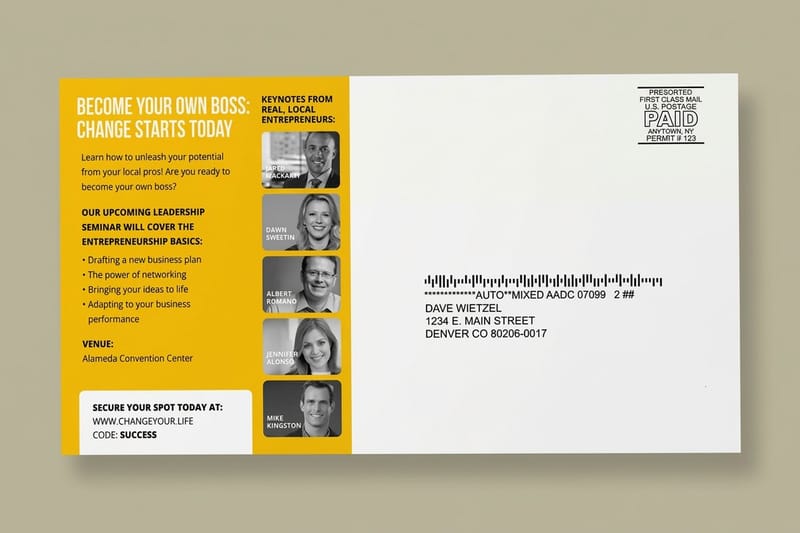
The address side is where it happens. USPS reserves the right half of that side for the delivery address, the postage indicia and the barcode. The barcode clear zone is a strip roughly 4 inches wide and 0.625 inches tall in the bottom right corner, and it has to stay empty of artwork, rules, background color and anything else the scanner might read as data. A logo bleeding into that strip is enough to make an automated piece nonmachinable. The address side layout rules map the zones exactly, and every layout in our blank template library already has them marked.
Coating is the second trap. A high gloss UV finish on the address side can defeat the inkjet head that sprays the address, causing smearing or a failed read. Print the front in whatever finish you want and either leave the back uncoated or ask for a spot coating that keeps the address block bare. Any mail house will thank you for it, and it is the single most common fix we apply to customer files.
Third, watch the corners and the shape. Rounded corners are fine and stay inside the postcard tier. Die cuts, cutouts and non rectangular outlines are not. If you want an unusual shape, order it, mail it as a letter, and price the campaign that way from the start rather than discovering it at the counter. For the full address side walkthrough including return addresses and endorsements, see how to mail a postcard.
What To Print, and Who Puts It in the Mail
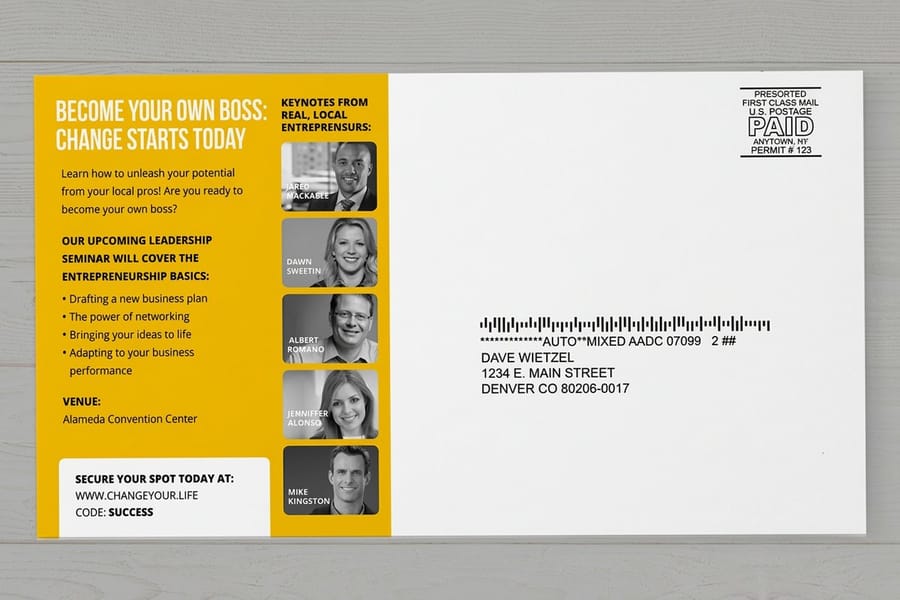
Once the class is settled, the print order is straightforward. Standard postcards start at $16.48 and cover the 4 by 6 workhorse that holds the postcard rate. Oversized postcards start at $51.62 and cover the 6 by 9 and 6 by 11 sizes that pay letter postage and get read across a kitchen counter. Folded postcards start at $84.36 when you need four panels of room for a menu, a schedule or a coupon block.
If you would rather not touch the postage at all, direct mail postcards start at $89.68 and bundle printing, addressing, the permit imprint, the presort and the drop into one order. You upload artwork and a list, we handle the mail stream. That is the right choice when the list is yours and the campaign has a date attached. The postcard mailing services guide explains what happens on our side after you hit submit.
Industry specific decks are already sized and set up for mailing. Real estate postcards start at $16.48 for just listed and just sold drops. Browse the whole range on postcards printing, or see the mailing side of the business on the direct mail services collection. Order a sample before a big run. Caliper is the one spec you cannot judge from a screen, and it is the spec most likely to cost you the postcard rate.
Wally measures before he mails
Six inches long, 4.25 high, and a caliper that fits
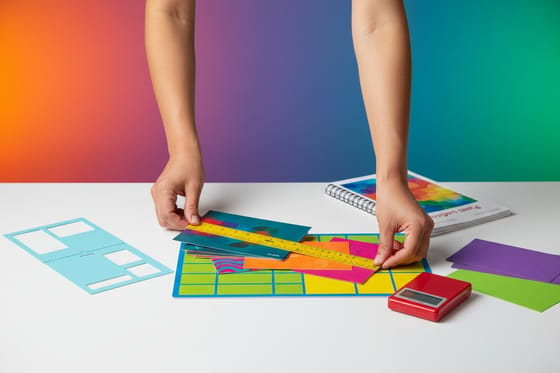
Wally keeps a ruler on the bench for one reason. A card up to 6 by 4.25 inches goes in the cheap pile. One inch longer and USPS calls it a letter, and that extra cost repeats on every piece for the whole campaign. He checks thickness too, because 14pt and 16pt sit inside the 0.007 to 0.016 inch window while very heavy stock does not. Then he checks the bottom right corner of the address side is empty, so the barcode has somewhere to land.
Order direct mail postcards →Specs and pricing
Postcard sizes, stocks and starting prices
Compare the mailing sizes side by side, with live configuration choices and starting prices straight from the 4OVER4.COM configurator.


Print it
Print the card, or print it and mail it
Explore more
Where to go next

By the numbers
Direct mail you can count on at 4OVER4
Common Questions
Your postcard postage questions, answered
What postcard size gets the cheapest USPS rate?
Anything from 5 by 3.5 inches up to 6 by 4.25 inches, as long as the card is rectangular and between 0.007 and 0.016 inches thick. In practice that means the classic 4 by 6 card, which is why it is the default size for most mailing campaigns. Order a 4 by 6 on 14pt or 16pt stock and you are safely inside the window on both dimension and caliper. USPS publishes the current cent figure for that tier on usps.com, and it moves most years, so quote from their page rather than from a number you saw last season.
Does a 5 by 7 postcard cost more to mail than a 4 by 6?
Yes. A 5 by 7 card is longer than 6 inches, so it leaves the postcard tier and pays the First-Class Mail letter price. The same is true of 6 by 9 and 6 by 11 cards, which still fit inside the letter limits of 11.5 by 6.125 inches. The jump is worth it when the extra space earns you a response, and it is a waste when the card is a reminder that would work at 4 by 6. Run the math on total cost, not on postage alone, since a larger card also costs more to print.
What is the cheapest way to mail 1,000 postcards?
Presorted USPS Marketing Mail, if the offer is not time sensitive. At 1,000 pieces you clear the 200 piece minimum comfortably, and the per-piece postage sits well below single-piece First-Class. The costs people forget are the mailing permit, the annual fee, the address standardization pass, and the extra days in transit. A mail house folds all of that into one line, which is what our direct mail postcards service does at $89.68 to start. If the card announces a date, pay First-Class and keep the delivery window tight.
Do postcards still need stamps if a printer mails them for me?
No. Commercial mailings go out under a permit imprint, which is the small block of text printed where a stamp would sit. It carries the mailer permit number and the class of mail, and USPS deducts the postage from a prepaid account when the job is inducted. You never buy or stick a stamp. That also means the postage indicia has to be in the artwork before we print, which is one reason mailing services want the list and the class settled before the press runs.
Can I mail a square or die-cut postcard?
You can mail it, but not at the postcard price. USPS requires a rectangular piece with a length to height ratio between 1.3 and 2.5 for automated handling. A square card sits at 1.0 and a die-cut shape has no clean ratio at all, so both drop to the letter price and pick up a nonmachinable surcharge on top. If the shape is the whole idea, budget for it deliberately. If the shape is decoration, round the corners on a standard rectangle instead and keep the cheaper rate.
Is EDDM cheaper than mailing to a purchased list?
Per piece, usually yes, because there is no list to buy and no names to clean. The catch is that you cannot choose who gets it. EDDM covers every address on a carrier route, so a roofing company reaching a whole neighborhood does well and a B2B supplier reaching the same neighborhood pays to deliver to houses that will never order. It also forces a larger piece, since an EDDM mailer has to exceed letter dimensions. Compare it against a targeted list before assuming the lower unit price wins.
Get Started
Ready to get the cards in mailboxes?
Pick a size that holds the rate you want, upload your list, and we print, address, presort and drop the whole run for you.
Legal Disclaimer
Gold Standard guarantees apply to all standard orders placed through 4over4.com. Price match requires verifiable proof of a competitor's published price for an equivalent product with matching specifications and turnaround time. Satisfaction guarantee covers manufacturing defects and print quality issues. Contact support with order number and documentation. On-time delivery rate based on tracked orders 1999 to 2026. Individual results may vary based on shipping carrier performance.
