
Order Custom Sized Cardboard Boxes Built to Your Exact Dimensions


Custom sizing is three numbers and one convention. Here is the order they go in, why they are measured inside the box, and how a tighter size cuts both freight and damage.
You order a custom sized cardboard box by choosing the style, then typing three inside measurements into the configurator in the order length, width, height. Length and width are the two edges of the opening with the longer one first, and height is the wall between them. Measure the product packed as it ships, add your padding twice per axis, and pick the board grade before you finalize the numbers, because a thicker flute takes space out of the interior you just specified.
Quick answer
Length, width, height, measured on the inside
A custom size is entered, not selected. You give three inside dimensions in a fixed order: the two edges of the opening with the longer one first, then the wall height. The dieline is cut to those numbers, so the accuracy of the measurement is the accuracy of the box. Everything else follows from it, including how much board the job uses, how the artwork lays out across the panels, and what the carrier bills you every time you ship one.
Ordering a Box at an Exact Size, Step by Step
The whole order is five decisions, and only one of them is the size. Take them in this order and the configurator stops feeling like a form.
One, pick the style before the size. A mailer box, a roll end tuck top and a regular slotted shipping box are cut from different dielines, and each one turns your three numbers into a different flat sheet. Our box style guide walks through which one suits what you sell.
Two, measure the product as it will actually ship. Packed. In its bag, with its insert, with the tissue. Measure the widest point of each axis, not the nominal size on the spec sheet, because a moulded lid or a rolled label adds real millimeters.
Three, add clearance. Decide how much padding sits on each face, then add that depth twice per axis. A quarter inch of foam on both sides of a product adds half an inch to that dimension, not a quarter.
Four, enter the inside dimensions as length, width, height. Length and width describe the opening, longer edge first. Height is the wall. If the configurator rejects the size, it names the dimension that fell outside the range for that style, so you can adjust one number instead of guessing.
Five, choose board and quantity together. They move the price far more than the size does. Then order the custom mailer boxes or shipping boxes and wait for the proof.
Inside Dimensions, Outside Dimensions, and the Gap Between Them
This is the mistake that costs the most reprints. Two suppliers quote what looks like the same box, and one of them is measuring the outside.
Corrugated board is not a line on a drawing. It has thickness, and that thickness sits between the inside face and the outside face on every wall. Order 8 by 6 by 4 as an outside measurement in B-flute and the usable interior lands nearer 7.75 by 5.75 by 3.9, because roughly an eighth of an inch of board is subtracted at each end of each axis. On a product with any kind of snug fit, that quarter inch is the difference between sliding in and being forced in.
The trade convention is inside dimensions, and our configurator follows it. State it anyway when you brief anyone else, in writing, in the same sentence as the numbers. The habit costs nothing and it has saved more jobs than any other single line in a packaging spec. If you also need cubic volume for freight or storage, the cubic inch guide shows the calculation and where carriers apply it.
Board Grades and What Each One Costs You in Space
Board grade is chosen for the load, but it is worth understanding as a space decision too, because a thicker wall eats the interior you just specified.
| Board | Approximate wall | Holds up to | Best fit |
|---|---|---|---|
| Printed cardstock | Thin, flat, no flute | Light retail items | Folding cartons and retail boxes where the print surface matters most. |
| E-flute | About 1/16 inch | Small courier parcels | Mailer boxes that need a crisp printed face and still survive a delivery van. |
| B-flute | About 1/8 inch | General shipping loads | The everyday shipping box, stiffer than E without much bulk. |
| C-flute | About 5/32 inch | Heavier or taller boxes | Larger cartons and anything that gets stacked in a warehouse. |
Read the second column as a tax on your interior. Moving a 10 by 8 by 6 box from E-flute to C-flute takes roughly a further eighth of an inch out of each axis in total, which is invisible on most products and fatal on a snug one. Change the board, then re-check the fit before you approve anything.
The other trade-off is print. A flat cardstock carton takes fine detail and heavy solids beautifully. Corrugated has a flute running under the liner, and on coarser grades that ripple can show through in large flat areas of ink. E-flute is the usual compromise when the artwork is doing real work. Cardstock versus corrugated compares the two materials in full, and kraft mailer boxes show what an uncoated corrugated surface looks like in print.
Right-Sizing, and Where the Money Actually Goes
Custom sizing is not a vanity feature. The reason to order a box built to your product is that every stock box you settle for is carrying air, and you pay to ship air on every parcel.
Carriers bill the greater of the actual weight and the dimensional weight, and dimensional weight is length times width times height in inches divided by a published divisor. On standard UPS and FedEx retail rates that divisor is 139. Work it through and the effect is easy to see: a box measuring 12 by 10 by 8 comes to 960 cubic inches, which divides to about 7 pounds of billable weight even when the contents weigh two. Trim it to 11 by 9 by 6 for the same product and you are at 594 cubic inches, or roughly 4.3 pounds. Same item, same protection, three pounds less on the invoice, on every order for the life of the product.
Damage is the other half. A product rattling inside an oversized box has room to build momentum before it hits a wall, and loose contents fail drop tests that snug ones pass. Filling the void with more paper works, but you are then buying void fill to correct a box you chose badly. It is cheaper to cut the box.
The limit worth naming: right-sizing only pays if the size is stable. If your product line changes size every season, a slightly generous box that covers three products beats three custom dies that go obsolete. Custom sizing rewards a settled product, not a moving one. For a settled one, roll end tuck top boxes and custom box printing let you cut the die once and stop overpaying.
Artwork, the Dieline, and What to Check on the Proof
A custom size means a custom dieline, and artwork that was drawn for a different box will not simply scale onto it. The panels move relative to each other when the proportions change.
Build the file on the dieline for your dimensions, not on a rectangle. Keep logos and text clear of every fold and every glue tab, because ink sitting on a crease cracks when the box is folded and a tab is glued face down where nobody will see it. Carry your bleed past the trim on every panel, set images at full size rather than scaling them up in the layout, and outline your fonts before you send. Our packaging file preparation guide covers the handoff in detail, and the blank template library has correctly built starting layouts.
When the proof arrives, resist the urge to look only at the color. Check that the panel you think is the front is the one facing you, that nothing important crosses a fold, and that the dimensions printed on the dieline are the numbers you entered. Those three checks catch nearly every problem that would otherwise appear as a pallet of boxes. Proofs are free, which means there is no reason to skip a careful read of one.
Wally sizes a box
Inside first, longest edge first, then the wall
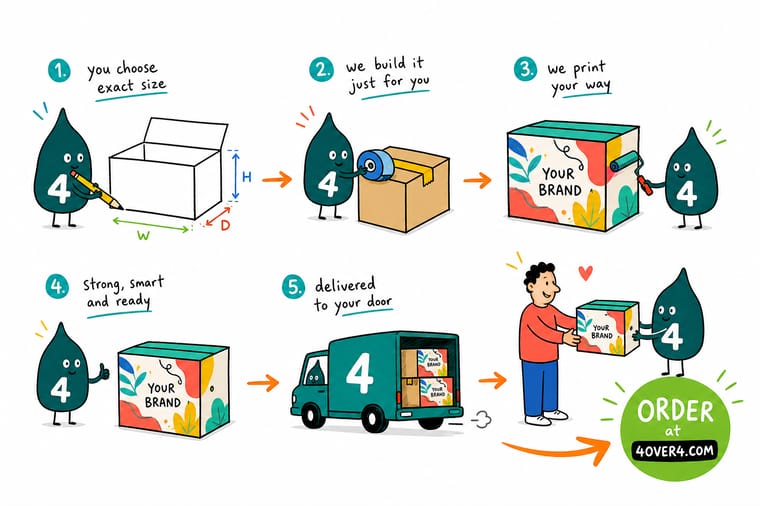
Wally puts the tape inside the box, not around it. He measures the long edge of the opening for length, the short edge for width, and the wall for height, in that order every time. Then he checks the product actually fits with its padding on, because the foam counts twice on each axis. Give him a settled product and he cuts the die once and you stop paying freight on empty air. Give him a product that changes size every season and he will tell you to buy a slightly bigger box instead.
Order custom mailer boxes in your size →Specs and pricing
Box styles, options, and starting prices
The three styles that take custom dimensions most often, with live configuration choices and starting prices straight from the 4OVER4.COM configurator.

Print it
Order a box cut to your dimensions
Explore more
Where to go next
By the numbers
Custom packaging you can count on at 4OVER4
Common Questions
Your custom box sizing questions, answered
How do I order a cardboard box in a custom size?
Pick the box style first, then enter the three inside dimensions in the configurator instead of choosing from a size list. The order is always length, then width, then height: length and width are the two edges of the opening with the longer one first, and height is the wall. The dieline is built to those numbers, the price updates as you type, and a proof follows before anything is cut.
Should I give inside or outside dimensions?
Inside, unless someone explicitly asks for outside. The inside is the space your product occupies, and it is the only measurement that answers the question you actually care about. Outside dimensions are larger by the caliper of the board on each face, so a box specified at 8 by 6 by 4 outside in B-flute gives you closer to 7.75 by 5.75 by 3.9 of usable room. If a supplier quotes outside without saying so, the box will feel a size too small when it arrives.
How much clearance should I add around the product?
It depends on what happens to the box after it leaves you. A retail box that sits on a shelf wants a small allowance, enough that the product slides in without a fight and the lid still closes over a sticker or a band. A shipping box wants room for whatever padding you use on all six faces, measured in place rather than guessed. Measure the product packed the way it will actually ship, including any bag, insert or tissue, then add the padding depth twice per axis.
What board should I choose for a custom size?
Match the board to the load and the trip. Printed cardstock folding cartons suit light retail items under a pound where the graphics matter more than the crush strength. E-flute corrugated adds a thin corrugated layer that keeps a crisp printed surface while surviving a courier. B-flute is the common shipping middle ground, and C-flute is thicker and stiffer for heavier or taller boxes. Every step up in flute adds wall thickness, so change the board and the inside dimensions before you re-check the fit.
Is there a minimum quantity on custom sized boxes?
Yes, and it varies by style rather than by size. Each box product shows its own quantity ladder in the configurator, and the price per box drops steeply across the first few steps because the die and the setup are spread over more pieces. That is the single biggest lever on cost. Ordering a size that is 10 percent smaller barely changes the sheet count, while doubling the quantity usually moves the unit price a long way.
Do I see a proof before the custom size is cut?
Yes. Free proofs come with the order, and on a custom size the proof matters more than usual because it shows your artwork laid onto the dieline that was built for your dimensions. Check three things on it: that the panel labeled as the front is the one you intended, that no text or logo crosses a fold or a glue tab, and that the dimensions printed on the dieline match the numbers you entered. Approve only after those three read correctly.
Does a custom size cost more than a standard box size?
A little, and less than most people expect. The cutting die is the part that changes, and it is a one-off tooling step rather than a per-box charge, so the difference shrinks as the quantity climbs. The bigger cost swing is the material area: a box that is an inch larger on every dimension uses noticeably more board per piece and pushes the shipping cost up on every parcel afterwards. Custom mailer boxes start at $711.78 and cube boxes at $213.09 at 4OVER4.COM, and the configurator reprices live as you change the dimensions.
Get Started
Ready to order a box that fits?
Enter your own inside length, width and height, choose the board, and we cut the dieline to match. Free proofs come with every order.
Legal Disclaimer
Gold Standard guarantees apply to all standard orders placed through 4over4.com. Price match requires verifiable proof of a competitor's published price for an equivalent product with matching specifications and turnaround time. Satisfaction guarantee covers manufacturing defects and print quality issues. Contact support with order number and documentation. On-time delivery rate based on tracked orders 1999 to 2026. Individual results may vary based on shipping carrier performance.
