
How to Market a Clothing Brand in 7 Steps


Marcus is our print marketing voice, built from the knowledge of our production team, with over 20 years in printing.
A crowded, fast-moving market rewards clarity, not budget. Here is a seven-step playbook for building a clothing brand people recognize, buy, and come back to, with the print and packaging that make an online label feel real in a customer's hands.
To market a clothing brand, understand your audience, build a brand people recognize on sight, make the product the hero with strong photography, choose two or three channels you can win, set clear KPIs, carry the brand into print with hang tags and packaging, and turn first buyers into a returning community. Do the steps in order. Each one makes the next cheaper and more effective, and the physical touches are often what convert a browser into a buyer.

Start here
The whole playbook in one paragraph
Marketing a clothing brand comes down to being recognized, easy to buy, and worth remembering. Name the exact customer you dress, build one look you repeat everywhere, let strong photography sell the product, win two or three channels instead of chasing all of them, track a few honest numbers, and bring the brand into the physical world through hang tags, packaging, and pop-ups. Then turn first buyers into a returning community. The seven steps below expand each of those into a decision you can act on today. In print, that means four orders: hang tags on the garments, thank you cards for the box, sticker sheets for the parcel and a blockout banner for the pop-up.
Watch it printed
See hang tags for clothing on the press, in 130 seconds
Hang tags, seven sizes from 2 x 2 inches
Your hardest-working printed piece, with live pricing
A hang tag is one of the only marketing pieces a customer holds while deciding to buy. Custom hang tags for clothing at 4OVER4.COM come in seven sizes from 2 x 2 to 4 x 6 inches, on 20 stocks from 14pt gloss cover to 26pt metallic pearl ice, drilled with a 1/8 or 3/16 inch hole where you choose. The live specs and price per unit sit below, with the free services that brand the rest of your range.

| Quantity | Price Per Unit | Total |
|---|---|---|
| 50 | 50.5¢ | $25.27 |
| 100 | 28.6¢ | $28.56 |
| 200 | 15.9¢ | $31.86 |
| 300 | 12.4¢ | $37.35 |
| 400 | 10.2¢ | $40.64 |
| 500 | 8.79¢ | $43.94 |
| 600 | 8.24¢ | $49.43 |
| 700 | 7.53¢ | $52.73 |
Why marketing decides whether a clothing brand survives
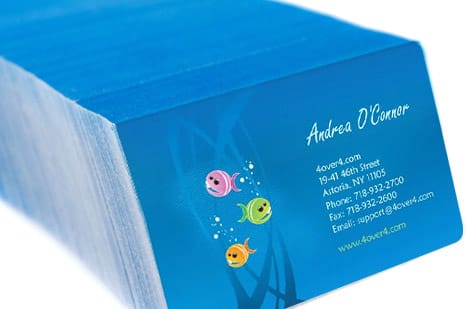
Anyone can print a run of shirts. The hard part comes after, when those shirts have to find the people who will pay full price, tell their friends, and come back next season. The print side of that work is small and specific: a 2 x 3.5 inch hang tag on each garment, a thank you card in the box and a sticker on the parcel. That gap between a good product and a real business is exactly what marketing fills, and for clothing it is unusually unforgiving. The category is crowded, tastes move fast, and you are carrying inventory that loses value the longer it sits.
The labels that sell through their first drop decided early who they dress, built a look people spot on sight, and showed up in the two places their customers already scroll. This guide works toward that: a clothing brand that is easy to recognize, easy to buy, and easy to remember.
We will walk through the seven steps in order, because each one makes the next cheaper and more effective. Along the way you will see where the physical pieces come in, from the hang tags on your garments to the insert in the box, because that is where an online label becomes something a customer can hold. If you want the identity groundwork first, our guide on building a strong brand identity pairs closely with this one.
Things to consider before you spend a dollar on marketing

Marketing clothes is different from marketing most products, and it pays to name why before you commit a budget. You are selling identity as much as fabric, so emotion and taste drive the purchase. You carry real inventory, so a campaign that sells the wrong sizes still leaves you with stock. And you live on seasons and drops, so timing matters as much as message: a standard hang tag run takes 5 production days, so the tags have to be ordered before the garments land, not after.
Three questions settle most of it. First, who is this for, precisely enough that you could describe one real customer. Second, what makes your clothing worth choosing over the dozen alternatives a scroll away. Third, what a healthy price and margin look like once returns, shipping, and marketing are counted, because a beautiful campaign on a product that loses money is not marketing, it is a leak.
Get honest answers to those three and the rest of this guide becomes a set of decisions rather than guesses. If you are still shaping the look and feel, spend time with the logo design best practices and, if your instinct is toward a clean, premium feel, the guide to creating a minimal brand identity.
Step 1: Understand who you are actually dressing
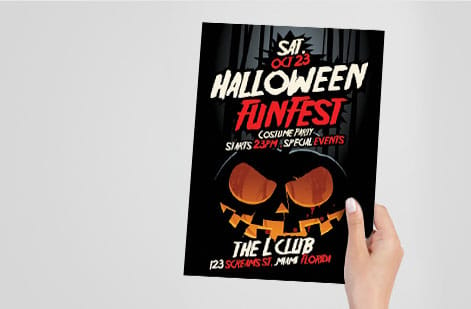
Every strong clothing brand can name its customer in a sentence: one person, what they do, what they already wear, what they are trying to say about themselves when they get dressed. Picture that person and the smaller calls get easy, from fabric to platform to the tag itself. A workwear label for that buyer might hang an 18pt kraft uncoated tag made from 100% post consumer stock; a premium evening line might hang a 24pt ultra thick gloss tag instead.
Build that picture from real signal, not assumptions. Read the comments on brands adjacent to yours, note which of your own pieces sell out and which linger, and talk to the people who already buy. Pay attention to the language they use, because the words a customer chooses for a garment are the words that will make your ads and product pages land. If your audience skews older than the usual fashion pitch, the tactics in marketing to baby boomers are a useful corrective to one-size-fits-all advice.
Write it down and keep it visible. A one-page profile of your core customer becomes the filter every later decision runs through, and it is the difference between a brand that speaks clearly to a few and one that mumbles at everyone.
Step 2: Build a brand people recognize in a single glance
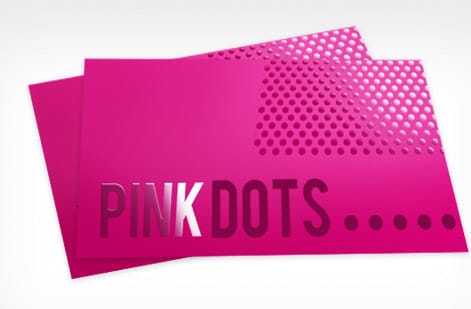
In clothing, recognition is worth more than reach. A customer scrolling past hundreds of images has a fraction of a second to register yours, and the brands that get remembered are the ones that look the same everywhere. That means one logo used consistently, a tight color palette, a typeface or two you never stray from, and a voice that sounds like a single person across every caption and card.
Repetition is the engine here. When your business cards, your labels, your packaging, and your social grid all repeat the same handful of visual cues, each piece reinforces the others and the whole thing starts to feel established long before it actually is. The hang tag is where this becomes physical: it is one of the very few marketing pieces a customer holds while deciding to buy, which is why hang tags still matter so much for apparel.
Do not overthink the launch version. Lock a logo, two colors, and one type pairing, then apply them relentlessly. You can refine later, but consistency from day one is what turns a scattered set of products into a brand. Our design templates make it easy to keep that system consistent across every printed piece.
Step 3: Make the product the hero with real photography

People cannot touch your clothes online, so your images have to do the touching for them. Photography is not a nice-to-have for a clothing brand, it is the product page, the ad, the social post, and the lookbook all at once. Flat, poorly lit shots quietly cap your price, while clean, consistent, well-styled images let you charge what the garment is worth.
Shoot for a system, not a single hero image. You want the same garment on a model, on a flat lay, and in close-up detail so a shopper can judge fit, drape, and fabric. Keep lighting and backgrounds consistent across a collection so your grid reads as one brand rather than a stock-photo jumble, which is the same repetition principle from step two applied to your camera.
Carry the look through to print. The lookbook you hand a wholesale buyer, the postcard in a customer's parcel, and the poster at a pop-up should all use the same photography, so the brand feels consistent from screen to paper. When you move those images onto stock, our notes on bleeds, cut line, and safety keep the print clean and edge to edge.
Step 4: Choose the two or three channels you can genuinely win
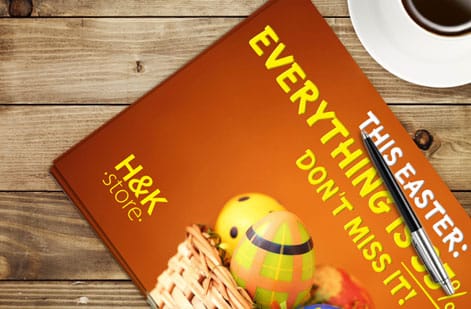
The fastest way to burn a small marketing budget is to try to be everywhere. New brands spread themselves across every platform, post inconsistently on all of them, and end up memorable on none. The better move is to pick the two or three channels where your specific customer already spends time, and commit to them for a full season before you judge the results.
For most visual, trend-led clothing, image and short-video platforms tend to earn their place first, because the product sells itself when it is shown well. Email is the quiet workhorse that most young brands neglect, and it is the one channel you actually own, so build a list from day one. And do not discount the physical world: local markets, pop-ups, and events put your clothing on real bodies in real rooms, backed by pop-up banners and cards that send people to your shop.
Whatever mix you choose, feed each channel toward one place you control, usually your store and your email list, so a viral moment turns into customers you can reach again. A pre-built launch print set shows how the physical pieces can work together to support a rollout across several of these channels at once.
Step 5: Set clear goals and the KPIs that prove them
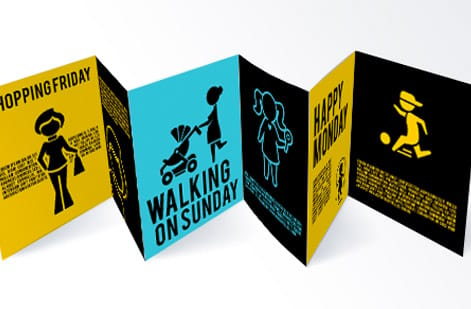
Marketing without goals is just activity, and activity is easy to mistake for progress. Before a campaign runs, decide what success looks like in numbers a season from now, then choose the few metrics that actually tie back to those goals. Follower counts feel good and tell you little about whether the business is growing. Print gives you one clean number: put a code on the thank you card, or a QR code on a 2 x 3.5 inch hang tag, that appears nowhere else, and every redemption is an order the print brought in.
For a clothing brand, the honest numbers are things like conversion rate on your product pages, the cost to acquire a customer against what that customer is worth over time, email list growth, repeat purchase rate, and sell-through on each drop. Track a handful, not dozens. A goal like moving repeat purchase rate up over two seasons is worth ten dashboards nobody reads.
Set the targets, then let them steer spending. When the data shows that your hang-tag QR codes drive shop visits or that one channel returns far more than another, that is your cue to put more behind the winner and quietly cut the rest. If you want context for the targets you set, our brand loyalty statistics and promotional product ROI data are useful benchmarks.
Step 6: Carry the brand into the physical world
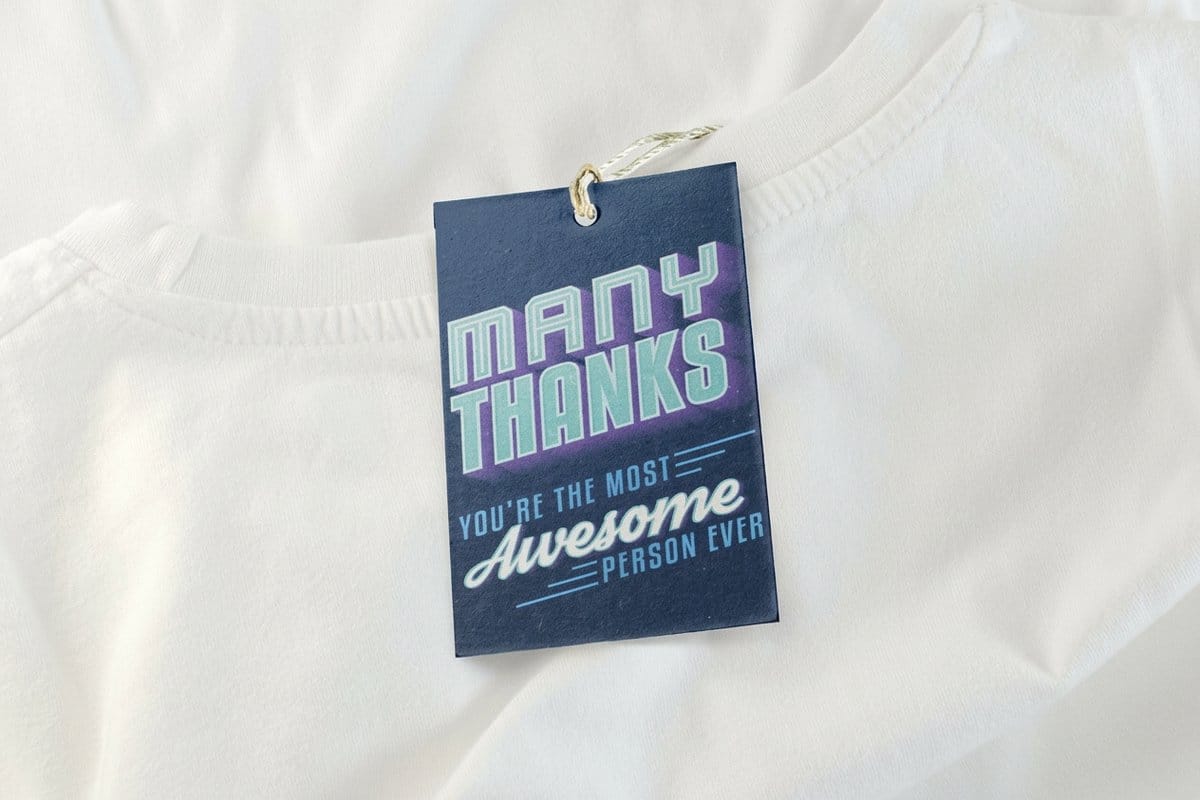
This is the step online-first brands skip, and it is often the one that closes the sale. A customer can scroll past a thousand images, but the hang tag they turn over in a store, the tissue and thank-you card in the box, and the sticker on the parcel are physical, undeniable, and yours. These touches are where a young clothing label stops feeling like a web page and starts feeling like a brand.
Start with the pieces every customer touches. Branded hang tags for clothing carry your logo, care details, story, and a QR code to your shop, and they keep working long after the sale. Add a packaging insert or thank-you card that asks for a review or offers a return-visit code, and label the parcel so the delivery itself feels considered. If you are shipping direct, blind shipping means the box arrives with your brand on it and nothing else, and our guide to custom shipping boxes covers the outer packaging.
Settle five choices before you upload the tag file. The size sets how much the tag can carry, the stock sets how it feels in the hand, and the hole sets how it hangs.
| Choice | Options on our hang tags | How to pick |
|---|---|---|
| Size | Seven sizes, 2 x 2, 2 x 3.5, 2 x 6, 2.5 x 2.5, 3 x 3, 3 x 4 and 4 x 6 inches | 2 x 3.5 holds a logo, a price and a QR code; go to 3 x 4 when the tag tells the brand story |
| Stock | 14 stocks, from 14pt gloss cover to 24pt ultra thick gloss, 18pt kraft uncoated and 18pt premium white linen | Uncoated and kraft take a pen and read handmade; gloss makes photos pop |
| Full color front only, black on the back, or full color both sides | Print the back when it carries care details or a code | |
| Hole | A 1/8 or 3/16 inch hole, top center, top left, top right or on the left side | Match the hole to the string or safety pin you will use |
| Proof | Straight to production, a free online proof or a next day hardcopy proof | Take the free online proof on a first run |
When you sell in person, this same brand system scales up to pop-up banners, postcards, and stickers that turn a market stall into a recognizable booth. Stickers cost little per piece and travel far, as the logo sticker ideas piece and our vinyl versus paper sticker guide both show. Selling in a major market like New York, our New York printing services can turn a fast reorder around with local pickup.
Step 7: Turn first-time buyers into a community that returns
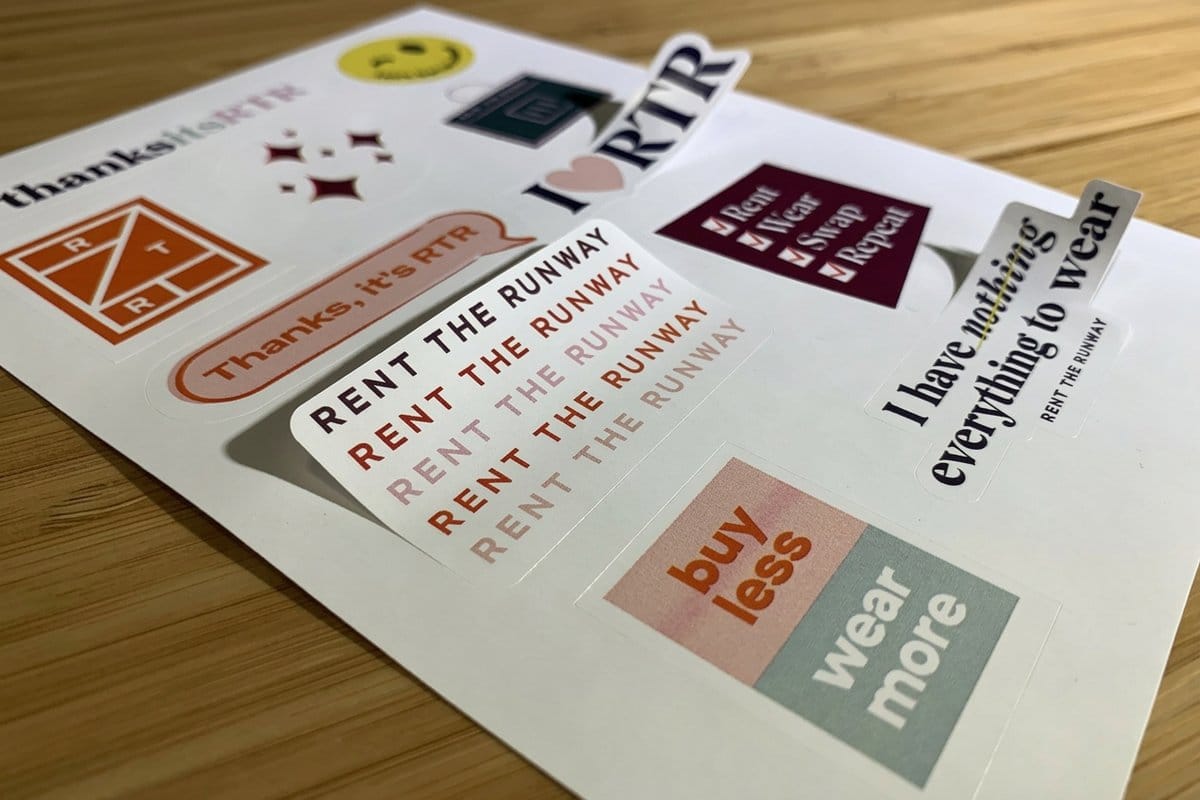
The cheapest growth a clothing brand ever gets comes from the customers it already has. A first sale is expensive to win, so the brands that thrive are the ones that turn that first buyer into a second, a third, and eventually an advocate who brings friends. Retention is not a separate program bolted on at the end, it is the point of everything in the first six steps.
Give people a reason to come back and a reason to talk. That can be a loyalty code printed on the thank-you card, early access to the next drop for email subscribers, or a small, genuinely useful branded extra in the box such as a sticker sheet or a seasonal card at the right time of year. Consistency matters here too: the same look, voice, and quality on the second order that won them on the first is what builds trust.
Ask for the word-of-mouth you want. A tasteful insert that invites a review, a repost, or a referral turns satisfied buyers into your most credible marketing channel, at close to zero cost. A few hundred customers who reorder each season pay for the ads that find the next few hundred.
The first ninety days, and what to print at each stage
The seven steps are the order of the work, not a calendar. Laid over a drop they fall into three stages, and each stage has one printed piece that earns its place before the others do.
| Stage | What you are doing | What to print | Starting price |
|---|---|---|---|
| Before the drop | Steps 1 to 3. Name the customer, lock the logo and palette, shoot the line. | Nothing yet. Order free paper samples so the stock is chosen before the artwork is. | Free |
| The launch | Steps 4 and 6. Two channels, and the pieces every buyer touches. | Hang tags on the garments, a thank you card in the box. | Hang tags from 65 dollars, cards from the low 50s |
| After the first orders | Steps 5 and 7. Read the numbers, sell in person, ask for the repeat. | A pop up banner and stickers for the parcel. | Banners from 109 dollars |
The order matters more than the budget. Printing hang tags before the logo is settled means printing them twice, and a banner bought before you know which channel works is a banner for an event you did not need to attend.
What it costs to print your clothing-brand marketing
The good news for a bootstrapped clothing brand is that print pricing is easy to reason about. Cost scales with a few simple levers: quantity, size, stock, and finish. More pieces lower the unit price, larger formats and premium stocks cost more, and every option updates the price live as you choose it, so there are no surprises at checkout.
In practice you can start small to test a design, then reorder the winners at a lower per-unit cost once you know what your customers respond to. Custom hang tags for clothing start around $65 for a run, pop-up banners for an event start near $109, and thank-you and seasonal cards start in the low $50s. Use the specs and pricing panel above to build your exact combination.
Before you commit to a full run, order free paper samples so you can feel the stock and finish in your hands, and lean on the free online designer to lay everything out without design software. Browse the full range of packaging and labels and business stationery to see everything a clothing brand can put its name on.
Wally explains clothing-brand marketing
A brand is what people recognize before they read a word
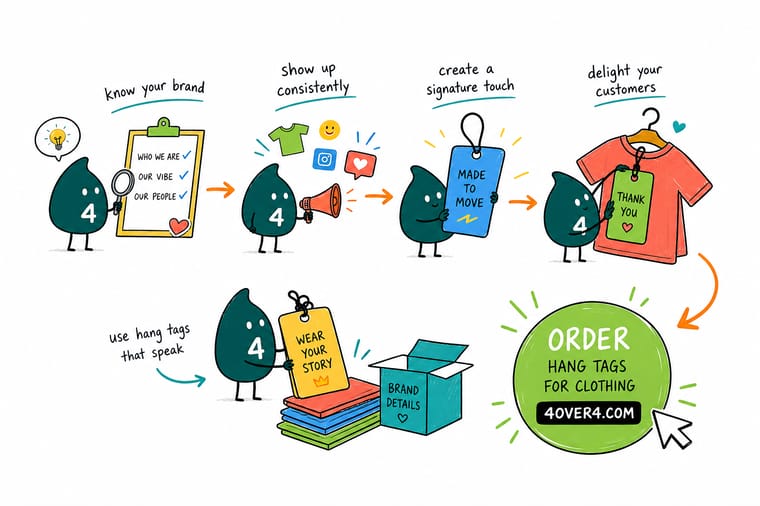
Wally puts it simply: pick the exact person you dress, give them one look they can spot in a crowded feed, and then make it physical. The hang tag on the garment, the card in the box, and the banner at the pop-up are where an online label becomes a brand a customer can hold. Nail those touches and every ad you run works harder. Sketch your tags and packaging, then let 4OVER4 print them sharp on the stock you choose.
Design and print hang tags →
At a glance
The seven steps on one screen
Keep this as a checklist the next time you plan a drop, a campaign, or a full brand launch. The order matters: each step makes the next one cheaper and more effective.
Put your name on it
Printed pieces that carry a clothing brand
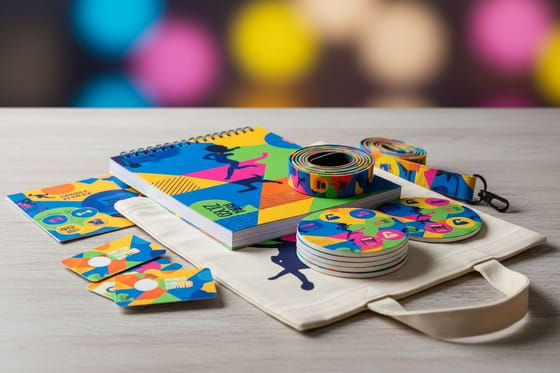
The physical touches that turn an online label into something customers can hold, from pop-up banners to branded merch and seasonal cards.



Explore more
Where to go next



By the numbers
A print partner built for growing brands
Common Questions
Common questions about marketing a clothing brand
What does it mean to market a new line of clothing?
It means building demand for one release rather than for the label as a whole. A line is a set of pieces launched together, so the marketing has a date, a story and an end. You tease it, you launch it, you sell it through. That is different from the always on work of keeping a brand visible, and it is why a drop gets its own photography, its own emails and its own printed pieces.
What is the 3-3-3 rule for clothing?
It is a styling challenge rather than a marketing rule: three tops, three bottoms and three pairs of shoes, worn every way they combine. Brands borrow it for content because it proves a small set of pieces stretches a long way, which is exactly the argument a capsule collection has to make. If your line is small, one post built around it does more work than nine separate product shots.
What is the 3-7-27 rule in branding?
It is a rule of thumb about repetition. Roughly three impressions before someone registers a brand, seven before they recognize it, and twenty seven before they think of it first in its category. The numbers are not measured law and nobody should budget from them. What they get right is the shape of the problem, which is why one consistent look repeated across a hang tag, a parcel and a feed beats three clever campaigns that look like three different companies.
What should you consider before marketing a clothing brand?
Before spending on ads, settle three things: who your customer is, what makes your clothing different, and what a healthy price and margin look like. Clothing is a crowded, fashion-driven market with real inventory and seasonality, so your marketing has to point at a specific person and a specific reason to buy. Once those are clear, every channel and every printed piece becomes easier to plan, because you are no longer guessing who you are talking to.
How do you market a clothing brand in seven steps?
Understand your audience, build a brand people recognize on sight, make the product the hero through strong photography, choose the two or three channels you can genuinely win, set clear goals and KPIs, carry the brand into the physical world with hang tags and packaging, and turn first-time buyers into a repeat community. Do them in order. Each step makes the next one cheaper and more effective, and the physical touches in step six are often what convert a browser into a buyer.
How do you market a new line of clothing?
A new line is a launch moment, so build anticipation before it drops and give the release a reason to exist, such as a season, a collaboration, or a story. Photograph the line properly, tell existing customers first through email and social, and make the unboxing feel like an event with branded hang tags, tissue, and a thank-you insert. A small, well-supported line that sells through beats a large line that sits unsold, so market to the audience you already have before chasing new reach.
How do I choose the right marketing channel for a clothing brand?
Start where your buyers already spend time rather than where you feel you should be. If your look is visual and trend-led, image and short-video platforms usually earn their keep first, while a local or events-driven brand may get more from pop-ups, markets, and printed collateral. Pick two or three channels, commit for a full season, and measure honestly. It is better to dominate a couple of places than to post everywhere and be memorable nowhere.
How do I market a clothing brand on a small budget?
Spend on the pieces a customer holds. Under $500 covers a run of custom hang tags for clothing from around $65, sticker sheets light enough to add to a parcel for free, postcards carrying a code that is only ever printed so you can measure what the print returned, a promotional banner from near $109 for one local pop-up, and greeting or thank-you cards from the low $50s for the follow-up. Those buys are made once and used all season, unlike a paid post that stops the day you stop funding it. Keep the first run small, order free samples so you choose stock and finish in your hand, then reorder the design that sold at a lower unit cost.
How much does it cost to market a clothing brand with print?
Print marketing scales with quantity, size, stock, and finish, and the per-unit price drops as your run grows. Custom hang tags for clothing start around $65 for a run, promotional banners for a pop-up start near $109, and greeting or thank-you cards start in the low $50s, with live pricing updating as you choose options. You can start small to test a design and reorder the winners at a lower unit cost once you know what your customers respond to.
Do hang tags actually help sell clothing?
Yes. A hang tag is one of the few pieces of marketing a customer literally holds while deciding to buy, and it carries your logo, your story, care details, and often a QR code to your shop. A well-made tag signals quality before anyone tries the garment on, and it keeps working after the sale as a reminder of where the piece came from. For most apparel brands it is the hardest-working printed item they own.
What print materials should a clothing brand invest in first?
Start with the pieces every customer touches: branded hang tags on the garments, a packaging insert or thank-you card in the box, and stickers or labels for the parcel. From there, add pop-up and market collateral such as banners and postcards when you sell in person, and business cards for wholesale and press conversations. Order free samples first so you can judge stock and finish, then scale the pieces that earn their place.
Get Started
Ready to make your clothing brand physical?
Bring your logo to 4OVER4.COM and print the hang tags, packaging, and pop-up pieces that turn browsers into buyers. Adjust every option and watch your price update live.
Legal Disclaimer
Gold Standard guarantees apply to all standard orders placed through 4over4.com. Price match requires verifiable proof of a competitor's published price for an equivalent product with matching specifications and turnaround time. Satisfaction guarantee covers manufacturing defects and print quality issues. Contact support with order number and documentation.
