
How to Design a Store Window Decal That Reads From the Sidewalk


Jordan is our labels, packaging and sustainability voice, built from the knowledge of our production team, with over 20 years in printing.
Storefront decals are read standing up, in motion, from a distance you can measure. Size the letters first, pick the film and the mounting face second, and the layout mostly designs itself.
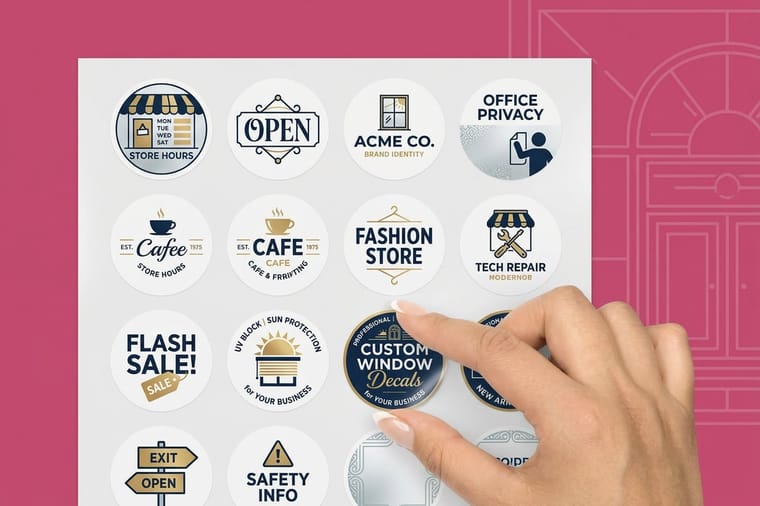
Start with viewing distance: allow about one inch of capital letter height for every ten feet the customer stands away, and place that message between 48 and 72 inches off the floor where a walking adult looks. Then choose the film and the face of the glass together, because a decal mounted inside has to be built reverse reading. Supply vector artwork at final size in CMYK, with 0.125 inch bleed, fonts outlined, and any contour cut path drawn as a named spot color.
Quick answer
Distance sets the letter height, the glass sets everything else
A store window decal is designed backwards from the viewer. Measure how far away someone stands when they need to read it, allow roughly one inch of cap height per ten feet, and put that line in the 48 to 72 inch band at eye level. Choose the film and the mounting face together, since an interior decal is printed reverse reading on its adhesive side and clear film needs a white underprint against a dark room. Then build the file at final size in vector, CMYK, with bleed and a named cut path.
Size the Type Before You Draw Anything Else
Every storefront decal that fails, fails at the same point. Someone designed it on a monitor at 30 percent zoom, it looked balanced, and on the glass the phone number is unreadable from four feet back.
Work the other way round. Decide how far away the person is standing when they need to read it, then apply the sign trade rule: about one inch of capital letter height for every ten feet of viewing distance. A customer already on your sidewalk is roughly ten to fifteen feet from the glass, so two inch caps. Someone on the far pavement of a two lane street is nearer forty feet, so four inch caps. A driver at fifty feet needs five inch caps and one line of text, because they have about two seconds.
That arithmetic caps how much you can say. At two inch caps across a 48 inch pane you fit roughly five or six words per line. So pick the one thing the window has to do. A name and a category beats a name and a mission statement. If you need hours, a license number and a delivery partner logo as well, put them low on the glass in one inch type, below 40 inches, where a person stops and reads deliberately instead of walking past.
Thin geometric faces and low contrast color pairs both need extra height to hold up, which is the part nobody accounts for. A hairline sans at two inches reads like a one and a half inch bold. The color choices that keep signage legible matter as much as the point size here.
Pick the Material and the Mounting Side Together
Material and mounting side are one decision, not two, because each film only behaves properly on one face of the glass. Choose them before layout, since second surface work has to be built mirrored and a perforated print needs a different color approach to a solid one.
| Option | Mounts | From inside you see | Where it belongs |
|---|---|---|---|
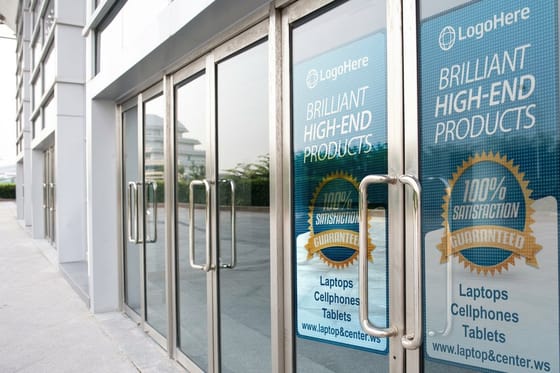
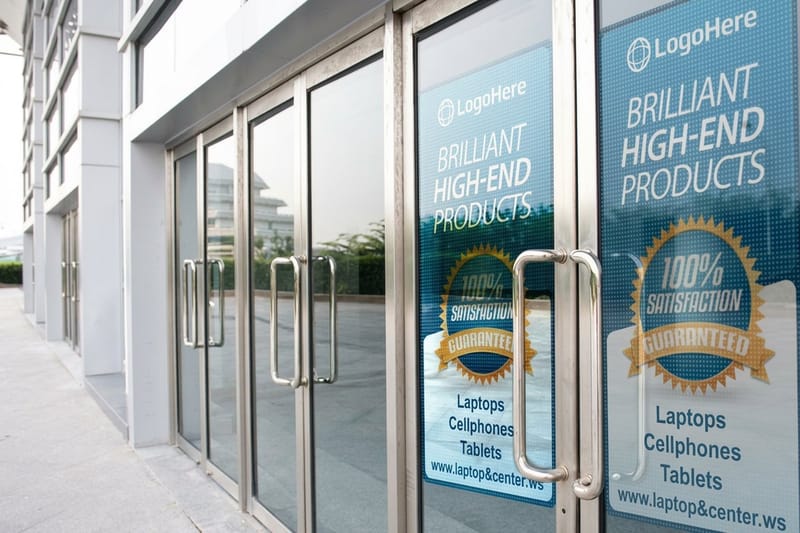
| Window decals | Either face, opaque white vinyl | The back of the vinyl, a solid block | Logos, door graphics and anything that must hold full color density. From $93.37. |
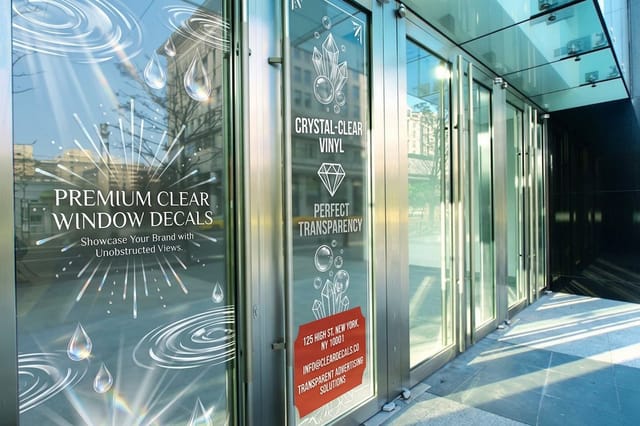
| Clear window decals | Either face, transparent film | The artwork faintly, glass elsewhere | Light interiors and floating logos where you want no visible panel. From $30. |
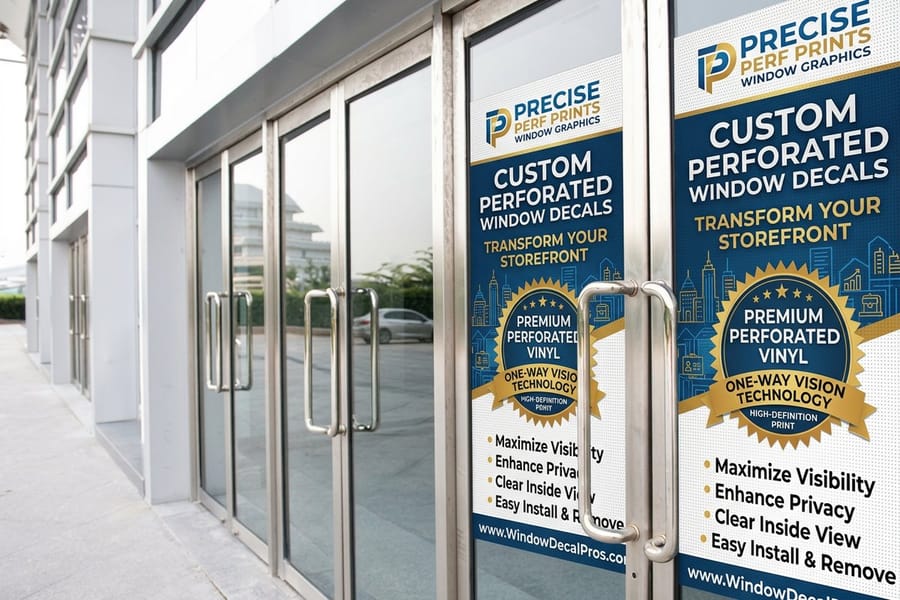
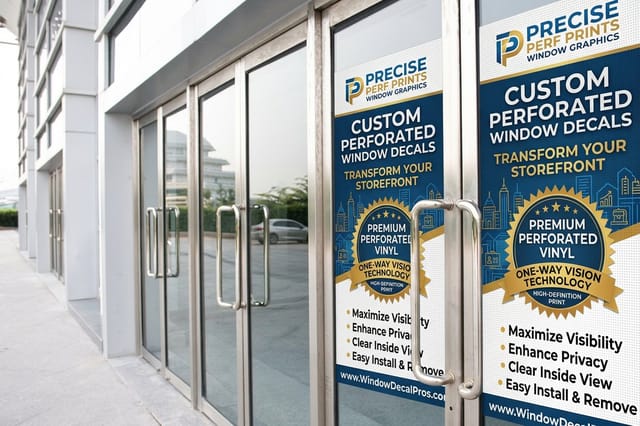
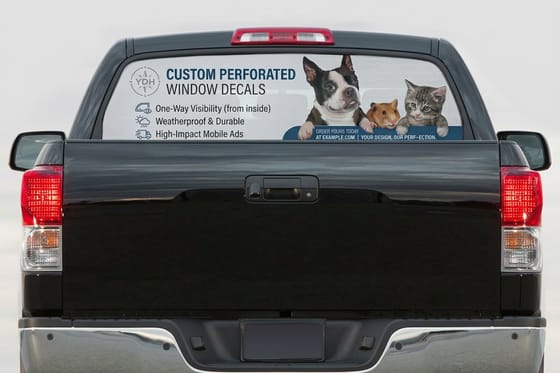
| Perforated window decals | Outside face, black backed film | The street, dimmed and slightly grainy | Large coverage that still lets staff and customers see out. From $30. |
| Frosted etched vinyl | Either face, translucent | Diffused daylight, no detail | Privacy bands, door manifestation and low key branding. From $25. |
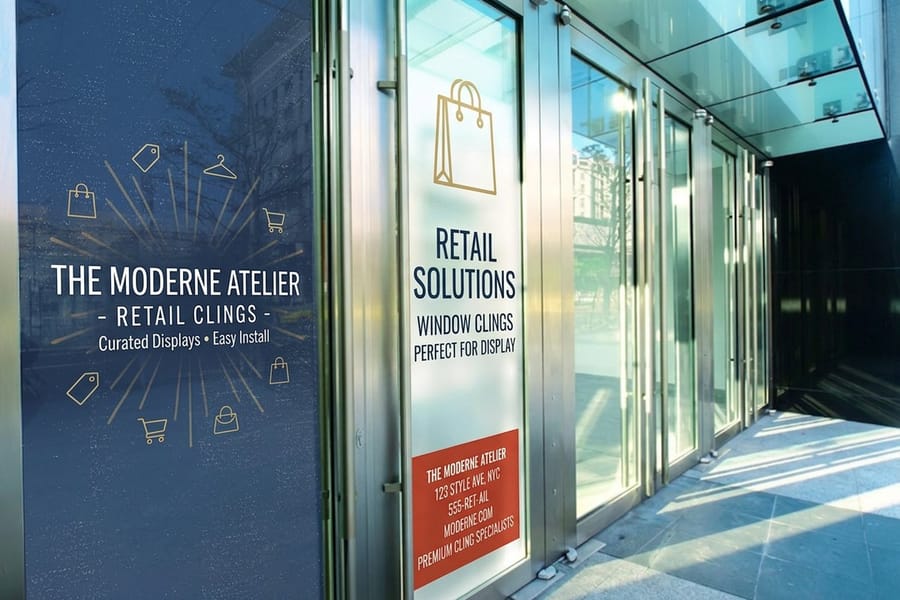
| Retail window clings | Inside face only, static grip | The back of the cling | Sale messages and seasonal promos you take down and reuse. From $30. |
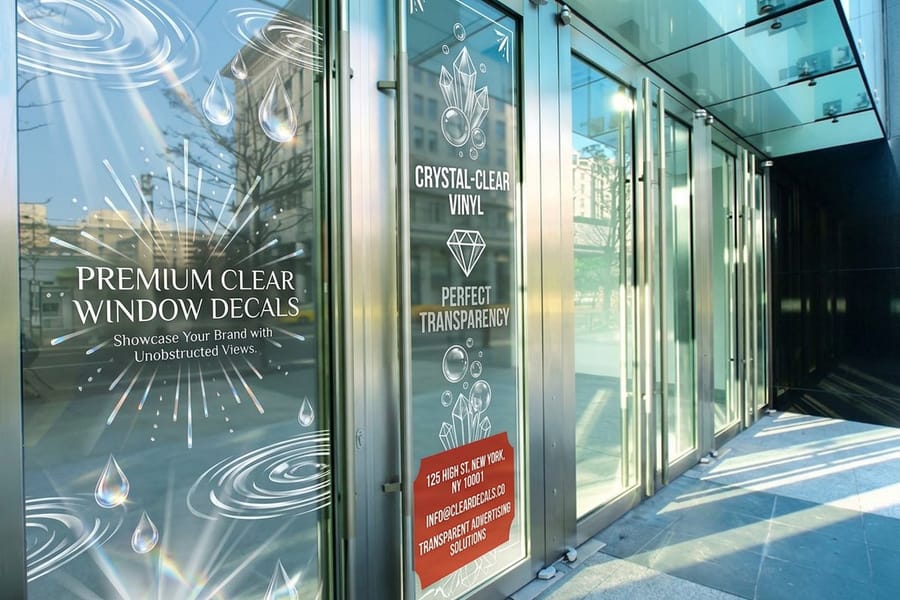
The two traps sit in the third column. Clear film against a dark interior is the common one: the ink has nothing behind it, so a sharp logo turns into a ghost by mid afternoon. Fix it with a white ink layer printed under the color, or move to opaque vinyl. Perforated film is the other. A 60/40 pattern means 60 percent print and 40 percent open hole, so you lose roughly that share of your color brightness, and at arm's length the image is visibly dotted. It earns its place anyway on any window that staff need to see through, and it is the standard answer where a local code caps solid coverage.
Second surface application, meaning the decal goes on the interior face and reads out through the glass, is worth the extra file discipline on any street level pane. Weather, cleaning brushes and casual vandalism never touch the print. Just remember that the artwork is mirrored and the ink sits on the adhesive side. The full comparison lives in our window clings versus window decals guide.
Build the File So the Press and the Plotter Both Agree

A window decal file has two jobs. It has to print, and if the shape is anything other than a rectangle it has to be cut. Those are two different machines reading two different parts of your document, and most delays come from the second one being missing.
- Build at final size in vector. Draw the artwork at the real dimensions rather than scaling a small file up. Convert every font to outlines before export, since a substituted typeface at five inch caps is obvious from the street.
- Photographs at 100 to 150 dpi at final size. Large format does not need 300 dpi and the file would be unmanageable if it did. A window is read from feet away, not inches.
- CMYK, and check your brand color. A saturated brand blue or orange that lives in RGB will shift on a wide format printer. Ask for a proof if the color is the point.
- 0.125 inch bleed, 0.25 inch safety. Extend background color past the trim by an eighth of an inch, and keep live type a quarter inch inside it.
- Cut path as a named spot color. For a die cut or contour cut shape, draw the outline as a stroke in a spot swatch, set to overprint, on its own layer. Name it clearly. A cut line built as a normal black stroke gets printed rather than cut.
- Say which face it mounts to. Put first surface or second surface in the filename and in the order notes. Mirroring is the printer's job, but only if we know.
Measure the glass before any of this. Measure the visible opening, not the outside of the frame, because the reveal hides half an inch or more on every side and it is rarely equal on all four. Then hold your artwork half an inch inside that measurement. Mullions matter too: if a bar crosses the pane, split the design around it rather than letting a word land on the metal.
Our print ready PDF export guide covers the export dialog itself, and you can start from a correctly proportioned layout in the clear window decal blank template rather than building the artboard from scratch.
The Constraints Nobody Mentions Until the Decal Is Up
Three things regularly undo a decal that was designed correctly. None of them show up on screen.
Coverage limits. Many municipalities cap how much of a storefront window may carry signage, and the figure is set in local zoning code rather than in any national standard, so it changes from town to town. Fire and police visibility rules can add separate limits on doors and on glass facing the street. One phone call to the planning desk settles it, and our state by state sign permit guide is a reasonable starting point. If solid coverage is restricted, perforated window decals usually satisfy the rule while still reading as a full graphic from outside.
What is behind the glass. Your design competes with whatever is two feet inside the window. A clear decal over a dark stockroom wall reads beautifully. The same decal over a bright display case or a doorway to a sunlit space disappears. Stand outside at the hour you most want customers, look at the actual background, and choose opaque or clear on that evidence rather than on the mock up.
Sun and orientation. A south or west facing pane cooks the film. Adhesive vinyl there is a two to four year piece, not a decade, and it will get brittle before the ink visibly fades. Plan on replacement, or use an interior window cling for anything short lived so you are not scraping brittle vinyl off hot glass in August.
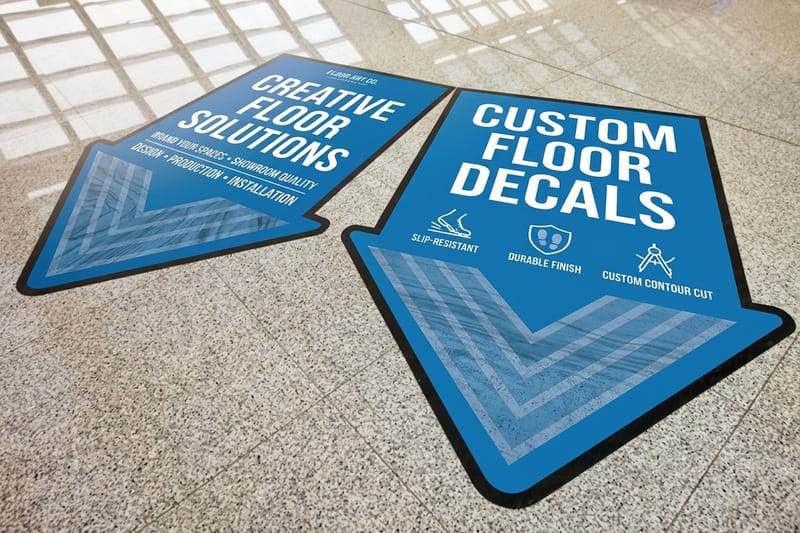
Finally, decide what the window is part of. A decal on the glass and nothing else is a missed handoff. Carrying the same message onto the pavement with an entry floor decal, or repeating it on an A frame, gives a passing customer a second and third chance to notice. The window graphics range and the decals category hold every film mentioned here, priced by size.
Wally sizes a window decal
He walks away from the glass before he draws anything
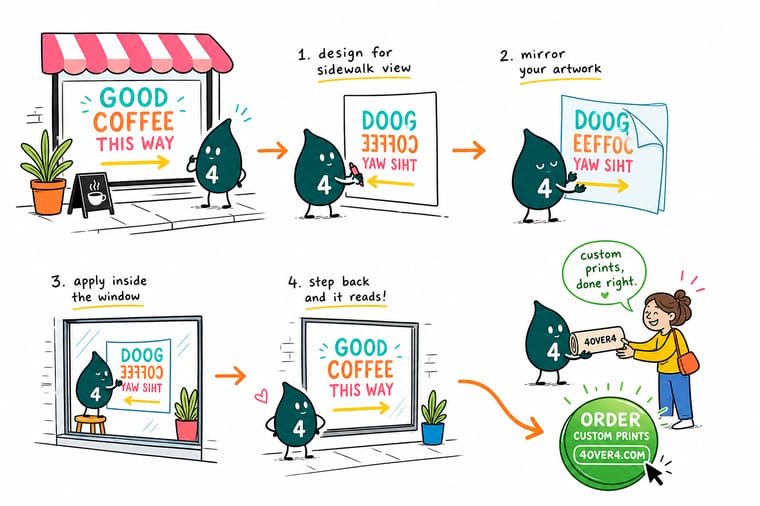
Wally measures the distance from the kerb to the window, divides by ten, and that number in inches is his capital letter height. He puts the message at eye level, between 48 and 72 inches up, and pushes the hours and the licence sticker down low where people stop and read. Then he checks what sits behind the glass. Dark stockroom, clear film is fine. Bright display, he switches to opaque white or perforated so the artwork still has something to stand against.
Order custom window decals →
Specs and pricing
Window films, sizes, and starting prices
Custom window decals cut 16 sizes from 2 by 2 to 11 by 11 inches on white or clear vinyl, from 25 for $93.37. Perforated window decals run 14 sizes from 11 by 17 to 40 by 60 inches or any size, from $30.00 with 2 business days of production, and retail window clings run 19 sizes on clear cling from $30.00. Compare the storefront options side by side, with live size and material choices and starting prices straight from the 4OVER4.COM configurator.



Print it
Order the film your storefront actually needs
Small logos and hours go on custom window decals, a full pane you still need to see through goes on perforated vinyl, and clear window decals up to 40 by 60 inches carry a large graphic from $30.00 in 3 business days.


Explore more
Where to go next
Eight next reads: clings against decals, how perforated vinyl trades brightness for a view, applying a decal without bubbles, restaurant glass and door signage, sign permits by state, the window graphics range, floor decals and our printing FAQs.



By the numbers
What 25 years of press floor brings to a storefront graphic
Common Questions
Your window decal questions, answered
How big should a store window decal be?
Size the type first and let the graphic follow. The working rule in the sign trade is one inch of capital letter height for every ten feet of viewing distance, so a decal read from the sidewalk directly outside needs about two inch caps, and one read from a road fifty feet away needs about five inch caps. Once the type is sized, the panel is whatever surrounds it comfortably. Most storefront decals land somewhere between 18 by 24 inches for a door graphic and full glass width for a window band. We print window decals to your exact dimensions rather than a fixed size list.
Should a window decal go on the inside or the outside of the glass?
Put it inside where you can. Second surface application, which means the decal sits on the interior face of the glass and reads outward through it, protects the print from rain, road grit, sun and anyone with a fingernail. The catch is that the file has to be built reverse reading, and the print is on the adhesive side, so tell your printer before the job goes to press. Outside application is the right call on textured or coated glass, on doors that get washed constantly from inside, and any time the interior side is blocked by shelving.
Do I need to mirror my artwork?
Only for second surface, inside the glass application. If the decal goes on the outside face, supply the file normal reading like any other print. If it goes on the inside face, the artwork is mirrored and printed on the adhesive side so it reads correctly from the street. The safest habit is to label the file, literally: name it second-surface-reverse or first-surface-normal. That one word in the filename has saved more reprints than any preflight check.
What file format do you need for a window decal?
Vector artwork as a print ready PDF, with all fonts converted to outlines and colors built in CMYK. If part of the design is a photograph, supply it at 100 to 150 dpi at final printed size, which is plenty for large format because nobody reads a window from six inches away. Add 0.125 inch of bleed on every edge, keep live text at least 0.25 inch inside the trim, and if the shape is anything other than a rectangle include the cut path as a separate spot color swatch so the plotter knows where to go. Our guide to exporting a print ready PDF walks through the export dialog settings.
Can I cover the whole window with a decal?
Physically yes, legally maybe not. A lot of municipalities cap how much of a storefront window may be covered by signage, and the limit lives in the local zoning code rather than in any national standard, so the number varies from one town to the next. Fire codes and police visibility ordinances can add their own restrictions on doors and on glass facing the street. Call the planning desk before you order a full glass graphic. If coverage is capped, perforated window vinyl is the usual answer because it reads as a graphic from outside while remaining see through from inside.
Will a window decal leave residue or damage the glass?
A cast or calendered vinyl decal with a removable adhesive comes off glass cleanly for a few years, and the failure mode is age plus heat rather than the adhesive itself. Left up through several summers on a south facing pane, the vinyl gets brittle and tears into pieces as you pull it. Warm the film with a heat gun or hot water, peel at a shallow angle, and clean the last of it with isopropyl alcohol. For anything seasonal that goes up and comes down repeatedly, use a static cling instead, since it has no adhesive at all.
What is the difference between a window cling and a window decal?
Grip. A decal is printed vinyl with an adhesive back that bonds to the glass and is meant to stay for a season or several years. A cling is a heavier static film that holds by surface tension with no adhesive, so it peels off, stores flat and goes back up next month. Clings are for interior glass and for anything you rotate, such as a sale message or a holiday promotion. Decals are for the permanent stuff, such as your logo, your hours and your door graphics. Clings also lose their grip on dusty or textured glass in a way decals do not.
Get Started
Order 25 window decals from $93.37
Send the dimensions of the visible opening, tell us which face of the glass it mounts to, and we print window decals cut to your shape and ready to squeegee.
Legal Disclaimer
Gold Standard guarantees apply to all standard orders placed through 4over4.com. Price match requires verifiable proof of a competitor's published price for an equivalent product with matching specifications and turnaround time. Satisfaction guarantee covers manufacturing defects and print quality issues. Contact support with order number and documentation.
