
How Google Performance Max Campaigns Work and How to Scale Them


One campaign, one budget, six Google surfaces, and far less control than the old campaign types gave you. You still steer more than it looks, the reports hide the rest, and spend only grows when the bidding is left alone.
Performance Max is one Google Ads campaign that buys Search, Shopping, YouTube, Display, Discover, Gmail and Maps inventory from a single budget and a single Smart Bidding strategy, with the channel split decided by Google rather than by you. What you still control is the asset groups, the audience signals, the product feed, the exclusions, and above all the conversion values it optimizes toward. Get those values wrong and the campaign scales the wrong outcome faster than any manual setup could.

Quick answer
One budget in, six surfaces out, and conversion values as the only real dial
Performance Max trades control for reach. It serves across Search, Shopping, YouTube, Display, Discover, Gmail and Maps from one budget, and it decides the split itself. You supply asset groups, an audience signal, a product feed if you sell retail, and a definition of what a conversion is worth. Everything useful you can do to the campaign happens through those inputs, through exclusions, and through structure. An eligible exact match keyword in a standard Search campaign still wins that query, which is the one piece of priority you keep.
What Performance Max Actually Buys on Your Behalf

Strip away the branding and Performance Max is a bidding model with six shop fronts. You hand it creative and a definition of value. It goes shopping across Search, Shopping, YouTube, Display, Discover and the Gmail and Maps inventory, and it settles every auction on its own prediction of where the next conversion comes cheapest.
The unit of work is the asset group: headlines, long headlines, descriptions, images, logos, and video. Give it no video and Google assembles one from your images and text, which almost always looks like a template because it is one. Upload real video even if it is a plain product demo shot on a phone. Each asset group also takes an audience signal, and the word signal is doing heavy lifting there. It points the model at a starting population. It never fences the campaign in the way a Display audience does.
Retail accounts add a Merchant Center feed and split it into listing groups, which is the closest thing to real structural control the campaign type offers. Without a feed the campaign leans harder on Display and video, because those are the surfaces it can still fill.
Bidding is Smart Bidding only: Maximize conversions or Maximize conversion value, with an optional Target CPA or Target ROAS. There is no manual bid, no keyword bid adjustment, and no channel level cap. If that trade sounds unacceptable, the honest answer is that a standard Search campaign is still the right tool, and our breakdown of marketing funnels explains which stage each campaign type genuinely serves.
Get the Inputs Right Before You Turn It On
A Performance Max campaign is only as sensible as the numbers it optimizes toward. It has no judgment and no context. It scales whatever you told it to value, faster than any manual campaign would.
Fix conversion values first. Counting a quote request, a phone call, a PDF download and a purchase all as one conversion tells the model those outcomes are interchangeable. They are not. Assign real values, even estimated ones based on close rate, and switch the bid strategy to Maximize conversion value. For anything with a sales cycle, set up offline conversion import so the qualified lead and the closed deal flow back rather than the form fill.
Then decide what counts as a primary conversion. Secondary actions still report but do not steer bidding. Moving micro-conversions to secondary is often the single change that turns a noisy campaign into a usable one.
Build more than one asset group. One asset group covering every product line forces one creative story onto every audience. Split by product family, by margin band, or by customer intent, and give each group its own audience signal and its own landing page. Watch the asset performance ratings of Low, Good and Best, and replace the Low ones rather than adding more.
Add search themes deliberately. They tell the campaign which queries you believe matter without pretending to be keywords. Pair them with account level and campaign level negative keywords so you are not paying to discover that your brand name plus the word jobs converts badly. The measurement habits in our content marketing analytics and ROI guide apply here almost line for line.
Where Print and Offline Demand Fit the Performance Max Loop

Performance Max harvests demand better than it creates it. That is a compliment and a warning at once. Every branded search, every direct visit, every person who already knows your name arrives cheap and lands in the campaign report, which is exactly why the offline half of a plan changes what these numbers mean.
Two practical uses come out of that. The first is creating the demand the campaign will later collect. A mailed offer, a card handed over at a counter, or a leaflet dropped in a delivery box puts a brand in front of someone who was not searching yet. Standard postcards start at $16.48 and are the cheapest physical way to reach a named list, while standard business cards at $17.57 still convert conversations into searches better than any impression does. Point each piece at its own landing URL or its own scannable code so the resulting visit is attributable rather than mysterious. Our walkthrough on building a QR code for Google reviews covers the same tracking mechanics.
The second use is keeping the report honest. If a mail drop or an event pushes branded search up, and Performance Max is allowed to buy branded queries, the campaign will take credit for the print spend. Switch on brand exclusions, keep a separate brand Search campaign, and compare the account total across the weeks a print campaign runs rather than the campaign row. The uplift is real. It just did not come from where the dashboard says.
Where print pulls its weight hardest is the moment after a digital conversion: a printed insert or a folded brochure from $57.11 in the box turns a first order into a second one, and it does it without paying a second click. Flyers from $39.54 do the same job for local footfall. Browse the marketing materials collection or start with postcard printing, and the postcard marketing ideas roundup has offers worth testing.
Where the Reporting Will Mislead You

Performance Max reports at asset group level and gives you asset performance ratings, a search terms view grouped into categories, and conversion columns. What it will not hand over is a clean per channel breakdown, and that gap is where most bad decisions get made.
Three specific traps, in the order they usually bite:
- Brand cannibalization. The campaign buys queries containing your own name and books cheap conversions from people who were already yours. Brand exclusions exist precisely for this.
- View-through conversions. A Display or YouTube impression that was never clicked can still claim the sale. Segment them out before you use the ROAS figure to justify a budget increase.
- Final URL expansion. On by default. The campaign sends traffic to whichever page on your site it thinks fits, including your strongest organic landing pages. Turn it off while you are learning the campaign, or restrict it with URL rules.
Comparing campaign types honestly makes the choice easier than any best practice list:
| Campaign type | What you control | What it is best at | Where it breaks |
|---|---|---|---|
| Performance Max | Assets, signals, feed, exclusions, budget. | Reaching every Google surface from one budget without managing six campaigns. | Thin reporting, brand absorption, and no way to cap a weak channel. |
| Standard Search | Keywords, match types, negatives, ad copy, bids. | High intent queries and anything you need to defend or diagnose. | Reach stops at what people actually type. |
| Standard Shopping | Feed structure, priority, bids, negatives. | A predictable, auditable retail baseline with real query data. | No video or Discover reach, and it loses shared auctions to Performance Max. |
| Demand Gen | Audiences, creative, placements across video and feed surfaces. | Building interest before anyone searches, with visible placement control. | Weaker last click numbers, so it needs patient measurement. |
Read the last column first. Choose the campaign whose failure mode you can live with, not the one with the most flattering case study.
Scaling Without Resetting the Learning

Most Performance Max accounts do not fail at launch. They fail two months later, when someone doubles the budget on a Monday and the cost per acquisition falls apart by Thursday.
Google already spends flexibly: a campaign can use up to twice its average daily budget on a strong day and balance out across the month. So the model is not being held back by small daily variance. It is held back by conversion volume and by creative. Raise the budget in modest steps, wait for the campaign to settle before judging the change, and never move budget and target in the same week. When you do want to tighten a Target ROAS, move it in small increments rather than one jump, because a target the model cannot hit makes it withdraw from auctions instead of trying harder.
Two changes move the needle more than budget ever does. The first is new creative: replace the assets rated Low, add a second video, and give the campaign a genuinely different angle rather than a reworded headline. The second is structure: split a bloated asset group so high margin lines stop subsidizing low margin ones, or run a separate campaign for a product family with its own economics.
Before you scale anything, use the built-in experiment tool to test Performance Max against your existing Shopping or Search setup rather than trusting the campaign to grade its own work. And check the bottleneck downstream: at triple the spend, the constraint is usually the landing page, stock, or the people answering the phone. The same discipline runs through our guide to scaling with YouTube ads, and there is more of it in the marketing strategy guides library.
Wally explains Performance Max
One budget goes in, Google picks the doors
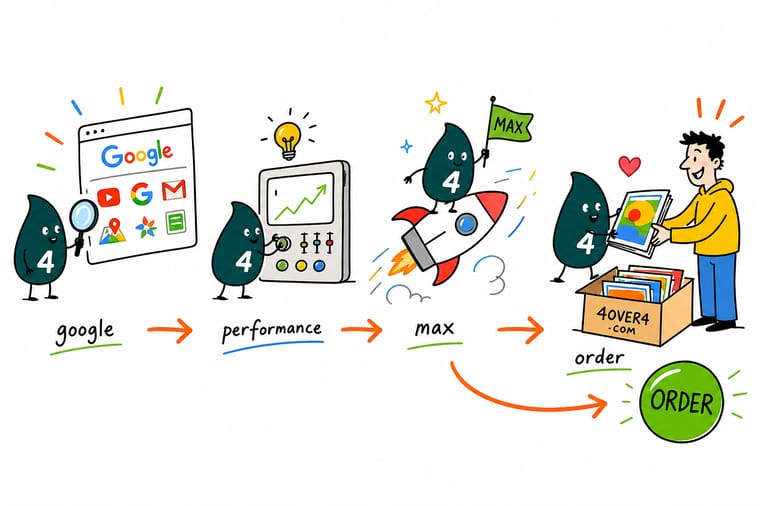
Wally drops one budget into the machine and it spreads across six Google surfaces at once. He does not get to say how much goes to each door. What he does get to set is the creative, the audience hint, the feed, and what a conversion is worth. So he prices a sale properly, marks the newsletter signup as secondary, blocks his own brand name so the machine cannot claim credit for people already walking in, and posts the postcards that send them searching in the first place.
Print postcards that create the demand →Specs and pricing
Print assets for the offline half of the plan
The pieces that create branded demand and follow a digital order into the box, with live configuration options and starting prices from the 4OVER4.COM configurator.



Print it
Give the campaign something to harvest


Explore more
Where to go next




By the numbers
The print side of your marketing, handled at 4OVER4
Common Questions
Your Performance Max questions, answered
What is a Google Performance Max campaign?
Performance Max is a single Google Ads campaign type that serves across Search, Shopping, YouTube, Display, Discover, Gmail and Maps from one budget and one Smart Bidding strategy. Instead of keywords and placements, you supply asset groups made of headlines, descriptions, images, logos and video, plus an optional audience signal and, for retail, a Merchant Center product feed. The bidding model decides which surface to buy on for each auction based on where it predicts the next conversion.
Does Performance Max replace Search and Shopping campaigns?
No, and running it as a replacement is the most expensive mistake with this campaign type. An eligible exact match keyword in a standard Search campaign still takes priority over Performance Max on that query, which is why serious accounts keep a brand Search campaign and their highest intent non-brand terms in Search. Performance Max is best used to cover the demand those campaigns do not reach: broad discovery, the long tail, and the video and feed surfaces.
Why does Performance Max report conversions that seem too cheap?
Three reasons, usually stacked. It absorbs branded searches from people who were already coming to you. It counts view-through conversions from people who saw a Display or YouTube impression and never clicked. And final URL expansion, which is on by default, lets it send traffic to any page on your site it judges relevant, including pages that already convert well on their own. Turn on brand exclusions, look at the campaign with view-through stripped out, and check the whole account rather than the campaign row.
How long does Performance Max take before the numbers settle?
Plan on the first two weeks being data collection rather than performance, and do not judge it in the first few days. Google guidance for Target ROAS is to have a meaningful conversion history in place first, around thirty conversions in the previous thirty days, because a target set on thin data locks the model into a bad answer. Every edit to the target, the budget size, or the conversion setup restarts that settling period.
Can you control where Performance Max ads appear?
Partially, and less than most advertisers expect. You get account level and campaign level negative keywords, brand exclusions, account level placement exclusions, the option to switch off final URL expansion or restrict it with URL rules, and content suitability settings. What you do not get is a channel dial. If keeping spend off Display matters more than reach, that campaign belongs in Search or Demand Gen instead.
Is Performance Max worth running for lead generation rather than ecommerce?
It can be, but only after the lead quality problem is solved. Optimized toward raw form fills it will find the cheapest form fills available, which are rarely the ones sales wants. The fix is offline conversion import: send the qualified lead, the opportunity, or the closed value back into Google Ads and let the model bid on that instead. Without that feedback, a lead generation Performance Max campaign scales volume and dilutes quality at the same time.
How much budget do you need to start?
Enough that the campaign can gather conversions in a reasonable window, which in practice means a budget where you expect conversions weekly rather than monthly. A campaign starved of conversion data never leaves the exploratory phase, so it keeps testing surfaces at your expense. If the budget only supports one campaign, put it where intent is highest first and add Performance Max when there is data to feed it.
Get Started
Order 50 standard postcards from $16.48 for the offline half
Postcards that put your offer in a mailbox, cards that turn conversations into branded searches, and inserts that make a second order cheaper than a second click.
Legal Disclaimer
Gold Standard guarantees apply to all standard orders placed through 4over4.com. Price match requires verifiable proof of a competitor's published price for an equivalent product with matching specifications and turnaround time. Satisfaction guarantee covers manufacturing defects and print quality issues. Contact support with order number and documentation. On-time delivery rate based on tracked orders 1999 to 2026. Individual results may vary based on shipping carrier performance.
