
Event Ticket Formats, Sizes, Numbering and Stubs Explained


The formats, the size we actually print, how sequential numbering works, where to put the perforation, and what the stub is for once the door has torn it.
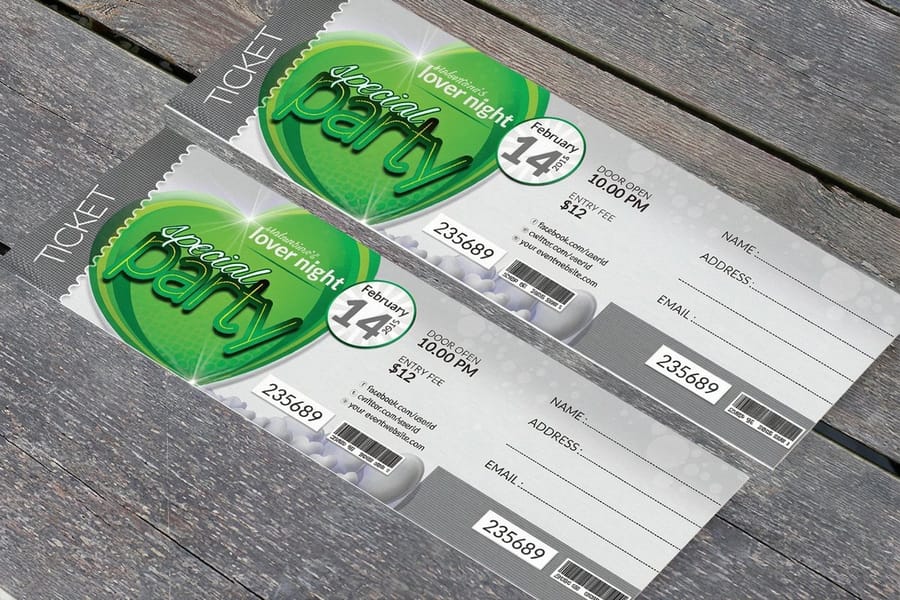
Printed event tickets come in three formats: a plain admission ticket, a ticket with a tear-off stub at a perforation, and a sequentially numbered ticket, and most real events order the last two together. At 4OVER4.COM both Event Tickets and Square Event Tickets print at a fixed 2 by 5.5 inches, on 15 stocks, with numbering in black ink and perforation offered as options. Square refers to the corners, not the shape.
Quick answer
Plain, perforated, numbered, and why most events need two of the three
The format is a decision about what happens at the door, not about how the ticket looks. A plain ticket admits someone and tells you nothing afterwards. A perforation gives the gate a stub to keep. A sequential number is what makes that stub mean something, because it ties one torn half to one ticket in one person's hand. Our tickets print at a fixed 2 by 5.5 inches, so the real choices are stock, ink sides, numbering, perforation, and how many spares you order.
The Three Event Ticket Formats, and What Each One Is For
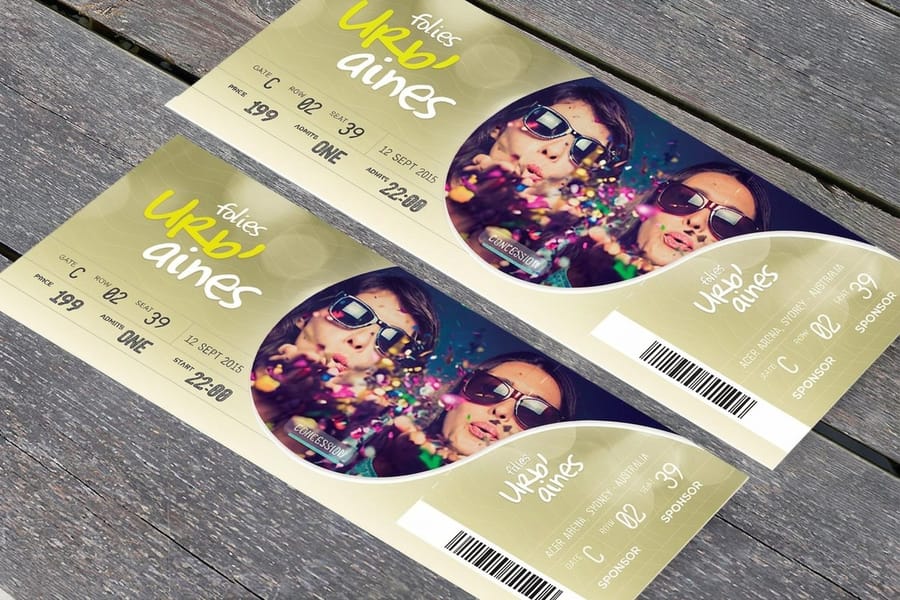
Strip away the artwork and every printed event ticket is one of three things. The format decision is not cosmetic: it decides whether you can count the room, whether the door has anything to keep, and whether a ticket can be handed back after it is checked.
| Format | What it is | What it gives you | What it costs you |
|---|---|---|---|
| Plain admission | One solid ticket, no tear line, no number. | The cheapest and simplest piece to design. Nothing to line up, nothing to reconcile. | No headcount, no way to spot a duplicate, nothing for the gate to keep. |
| Perforated stub | A tear line splits a stub from the keeper. | The door tears and keeps the stub, the guest keeps the ticket. Physical proof both sides of the gate. | Artwork has to be laid out around the tear, and a stub without a number is just a scrap of paper. |
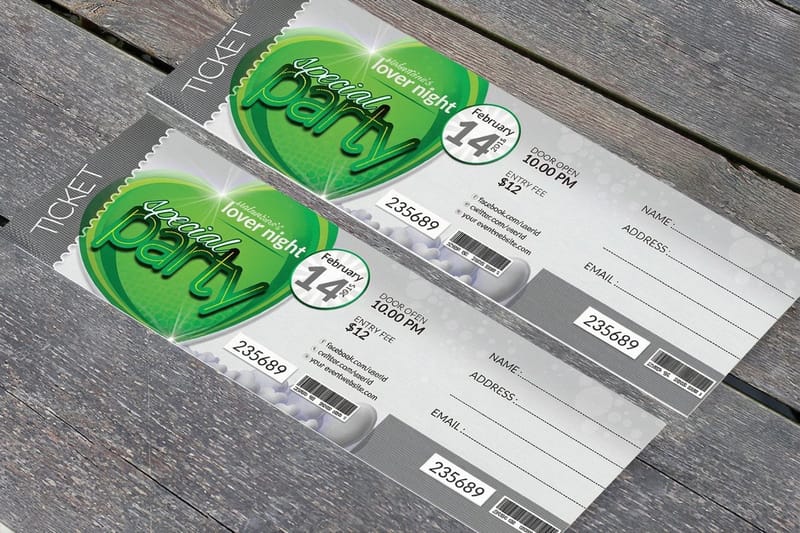
| Sequentially numbered | A running number printed in black on each ticket. | A countable event. Reconcile sold against attended, tie a number to a seat, draw a raffle. | You have to leave clean space for the number and tell us where the sequence starts. |
| Numbered and perforated | Both, with the number printed on each side of the tear. | What most real events order. A stub the door can match back to a ticket in someone's hand. | The most layout discipline, and the format that punishes a badly placed number. |
Read the last column before the second. The reason organisers end up on the bottom row is that the first three each fail in a way you only discover on the night. Our event tickets print at a fixed 2 by 5.5 inches with numbering and perforation both offered as options, so the format is a choice you make in the configurator rather than a different product.
Two naming traps are worth clearing up here. Square event tickets are not square. They are the same 2 by 5.5 inches with square-cut corners instead of the softer look, which is a finishing detail rather than a format. And a roll ticket, the double numbered cloakroom roll you buy off a shelf, is a different animal entirely: it is preprinted, so it cannot carry your event name. If you want your own artwork, you are ordering a printed sheet ticket. For the dimensions themselves, the ticket sizes guide lays the common footprints side by side.
Sequential Numbering, and the Two Ways It Goes Wrong
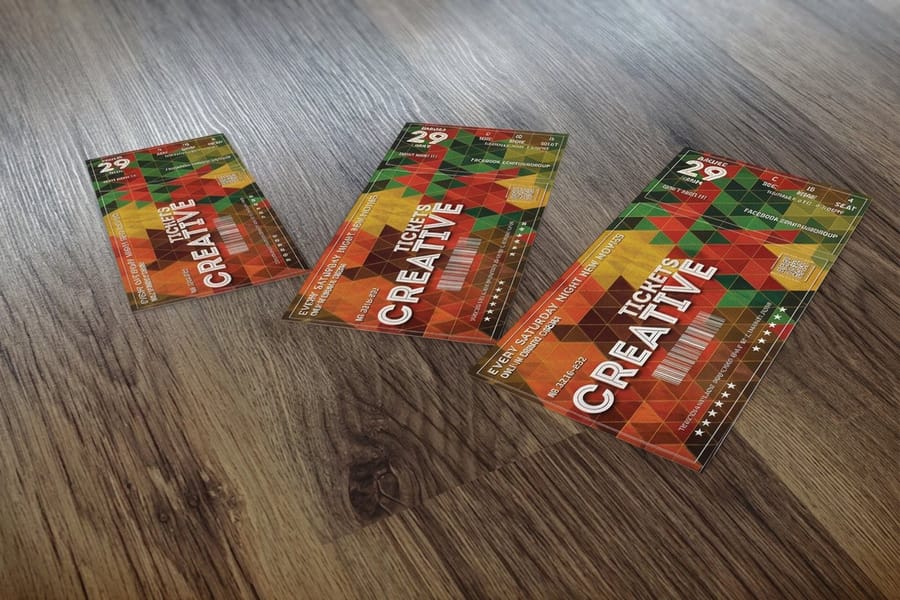
Numbering is what turns a stack of printed paper into a box office. The press prints a running number on each ticket, in black ink, so ticket one carries 0001 and the last ticket in the run carries the total. That single feature is what lets you count the room, match a stub to a ticket, and run a draw that nobody can argue with.
Two things go wrong, and both are set in the artwork rather than on press. The first is contrast. The number prints in black, and only black, so it disappears into a dark photograph, a deep navy panel or a heavy pattern. Leave a light, quiet patch for it, roughly the width of the number plus a comfortable margin, and check the placement on the proof rather than assuming the press will find a gap.
The second is the sequence itself. Numbering runs straight through the order, which means it behaves exactly as you expect on one run and surprises you across two. Split a 1,000 ticket event into two orders of 500 and you get two tickets numbered 0001 unless you say where the second batch should start. Tell us the start number, keep a note of the range you assigned to each price tier or each gate, and the reconciliation at the end of the night is arithmetic rather than guesswork.
One habit saves the most trouble: print the number on both sides of the perforation. The whole point of tearing a stub is that two halves of the same number exist in two different places. If the number only appears on the keeper, the pile of stubs in the cash box tells you how many people came in and nothing else. Our walkthrough on printing custom tickets covers the ordering steps, and making raffle tickets goes deeper on numbering a draw.
Perforation, Stubs, and the Stock That Refuses to Tear
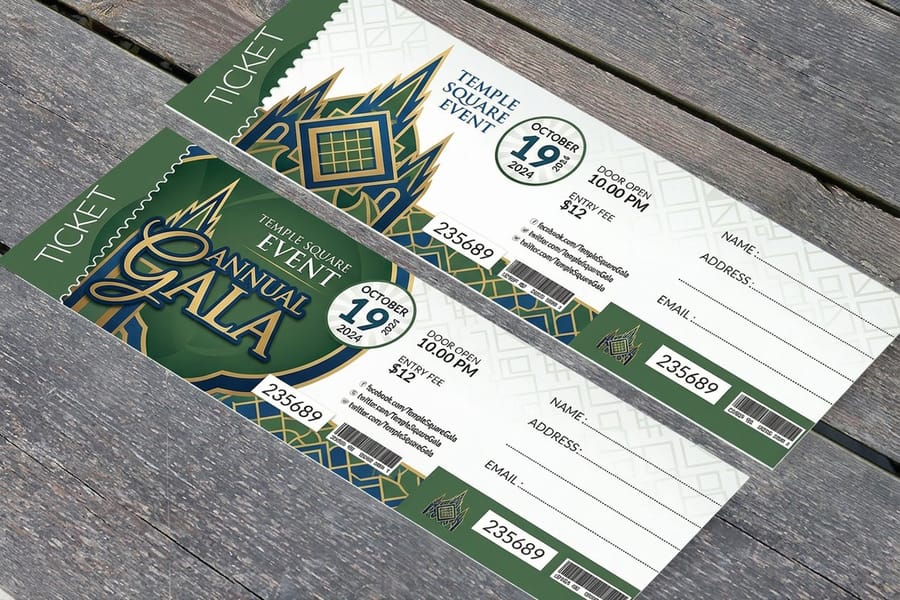
A perforation is a line of tiny cuts through the sheet with small bridges of paper left between them. Pull, and the bridges break in sequence. It is a mechanical detail with real design consequences, because a tear never follows the cuts perfectly.
Place the tear about an inch and a half from one end of a 5.5 inch ticket. That leaves the gate a stub with room for a number, a seat, and a scribbled note, and it leaves the guest a keeper that still reads as a ticket rather than a fragment. Then keep everything that matters at least an eighth of an inch clear of the line. Type that runs across a perforation loses a letter to the tear, and a logo straddling the line ends up split between the cash box and someone's coat pocket.
Stock changes the behaviour more than most people expect. On the paper stocks, a heavier sheet resists the first pull and then tears in a straighter line, which is why a stub on 16pt or 18pt board comes away cleanly while a thin sheet crumples first. The waterproof synthetic plastic stock is the outlier and the one to plan around: it is built not to tear, so a perforation in plastic drags and stretches rather than snapping. For a multi-day outdoor pass on plastic, plan on scanning or clipping at the gate instead of tearing, and put the number where a phone camera can find it. The ticket stock guide walks through all 15 materials and what each one does under a thumbnail.
If the stub is going to be written on, and at a fundraiser it always is, pick an uncoated stock. Pen ink sits on a gloss coating and smears when someone stacks the stubs. That is the trade-off nobody mentions until the raffle draw turns into forensics.
Choosing Stock, Ink Sides, and How Many to Print
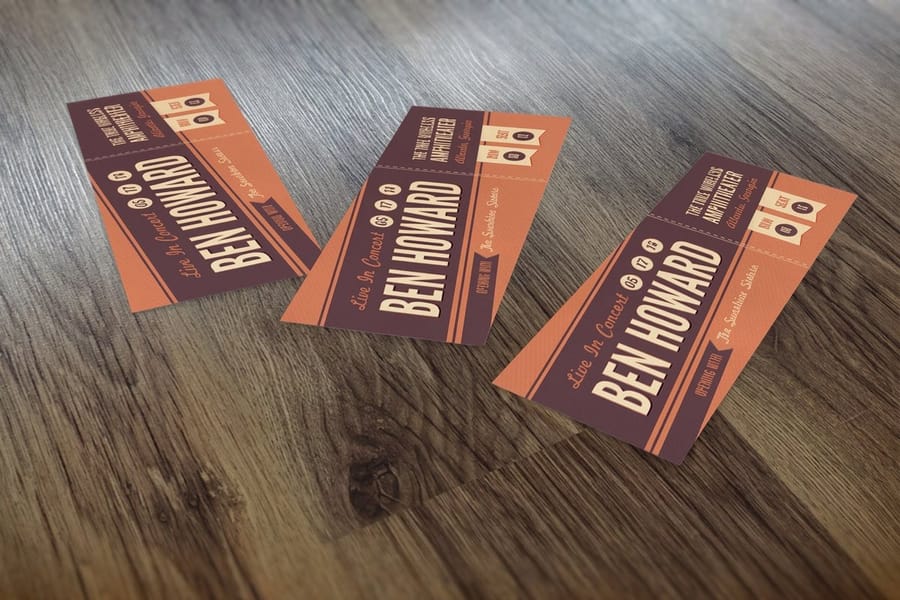
The format decisions above cover what the ticket does. Three ordering choices decide how it feels and what it costs. Start with the stock: there are 15, running from 14pt and 16pt gloss through 13pt to 18pt uncoated, cream and recycled post-consumer sheets, white linen, four metallic pearl finishes, and the waterproof synthetic plastic. A gala invitation reads differently on pearl. A school fundraiser does not need it.
Next, the ink sides. A 4/0 ticket is full color on the front with a blank back, which is the right pick when staff write on the stub. A 4/1 adds black on the back, the cheapest home for terms, a schedule, a no-refunds line or a sponsor list. A 4/4 runs full color both sides and earns its cost when the back carries a map, a lineup, or an ad someone is paying you to place.
Then the quantity, which is where most orders are too conservative. Fifty tickets start at $25.27, about $0.51 each, and the per-ticket price keeps sliding as the count climbs toward 5,000. Tickets get torn wrong, handed out twice and lost, so order above your headcount rather than to it. Standard turnaround is 5 business days, with 4-day, 3-day, 2-day and Next-Day rush available when a date has already been announced.
Tickets rarely travel alone. Event badges handle staff, press and vendor access once people are inside, and flyers do the work of filling the room in the first place. Set your artwork up on a correctly sized layout from the blank template library, follow the design walkthrough in designing custom event tickets, and if the event is a multi-day outdoor one, the festival printing checklist covers what else needs to be on the truck. Everything ticket related sits together on event ticket printing.
Wally explains ticket formats
Tear the stub, keep the number, count the room
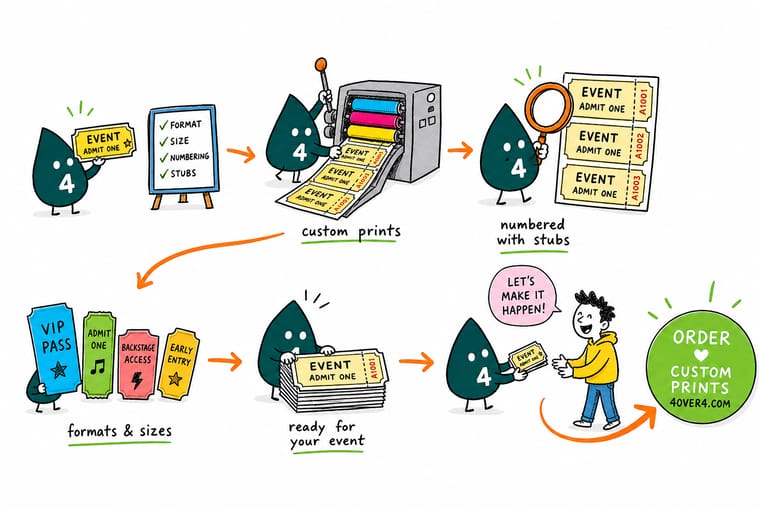
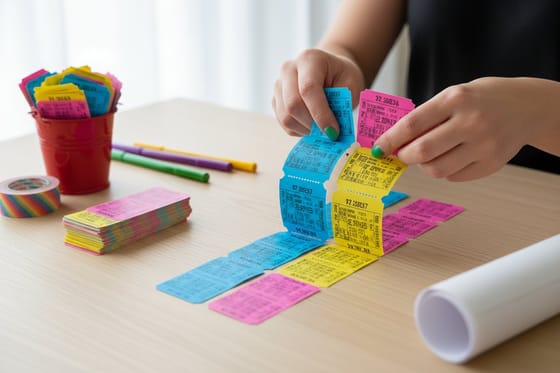
Wally prints a 2 by 5.5 inch ticket, runs a perforation about an inch and a half from one end, and drops the same sequential number on both halves. At the door he tears, keeps the stub, and hands back the keeper. At the end of the night the pile of stubs matches the tickets in the room, number for number. Skip the numbering and the stubs only tell him how many, never which. Print on the waterproof plastic stock and there is nothing to tear at all, so he scans instead.
Order numbered event tickets →Specs and pricing
Ticket and badge options, sizes, and starting prices
Compare the ticket formats and the credentials that go with them, with live configuration choices and starting prices straight from the 4OVER4.COM configurator.

Print it
Order tickets your door can actually count
Explore more
Where to go next

By the numbers
Event printing you can count on at 4OVER4
Common Questions
Your event ticket questions, answered
What size are event tickets?
At 4OVER4.COM the ticket size is fixed at 2 by 5.5 inches, on both Event Tickets and Square Event Tickets. That shape exists for a reason: it is long enough to carry an event name, a date, a seat and a number while still splitting into a usable stub, and it fits a shirt pocket and a standard cash box without folding. If you need a different footprint for a raffle strip or a drink token, compare the options in our guide to the most used ticket sizes before you commit to artwork.
Are square event tickets actually square?
No, and the name catches people out constantly. Square Event Tickets print at the same 2 by 5.5 inches as our standard Event Tickets. The word square describes the corners, which are cut at a clean right angle rather than rounded. Both products carry the same 15 materials, the same optional sequential numbering and the same optional perforation, so the choice between them is a corner detail rather than a format decision.
Do event tickets have to be numbered?
No, but skipping the number costs you the one thing a printed ticket does that a wristband cannot, which is counting. A sequential number lets you reconcile the box office against the door, spot duplicates, tie a ticket to a seat, and run a raffle draw with something to draw against. Numbering is an option in the configurator and prints in black ink. If your event is free entry with no capacity limit, plain tickets are fine.
Where should the perforation go on a ticket?
On a 5.5 inch ticket, put the tear about 1.5 inches from one end. That gives the gate a stub big enough to hold, write on and file, and leaves the guest a keeper wide enough to still read as a ticket. Keep type and logos at least an eighth of an inch clear of the perforation line, because a tear never follows the cuts perfectly and a headline that runs across the perf will lose a letter.
Can I print on the back of an event ticket?
Yes, in two ways. A 4/1 layout gives you full color on the front and black on the back, which is the cheapest place to put terms, a no-refunds line, a schedule or a sponsor list. A 4/4 layout runs full color on both sides, which is worth it when the back carries a map, a lineup or an ad someone paid for. A 4/0 ticket leaves the back blank, and that is the one to pick if staff need to write on it at the door.
How many extra tickets should I order?
Order above your headcount, not to it. Tickets get torn in the wrong place, handed to the wrong person, ruined in a rain queue and lost between the printer and the box office. The price also rewards the bigger run: 50 tickets start at $25.27, roughly $0.51 each, and the per-ticket cost keeps dropping as the quantity climbs toward 5,000, so the spare hundred usually costs less than the panic reprint.
Can printed tickets carry a barcode or QR code?
Yes, as long as you supply it in the artwork. We print what is in your file, so a barcode or QR code has to be generated on your side and placed in the layout, ideally on a light background with a quiet margin around it and at a size your scanner has actually been tested against. What we add on press is the sequential number, in black ink. Many organisers use both: the code for fast scanning, the printed number as the fallback when a phone or a scanner gives up.
Get Started
Ready to print tickets that hold up at the door?
Pick your stock, switch on sequential numbering and a tear-off perforation, and we print tickets that split into a stub the gate can match back to a seat.
Legal Disclaimer
Gold Standard guarantees apply to all standard orders placed through 4over4.com. Price match requires verifiable proof of a competitor's published price for an equivalent product with matching specifications and turnaround time. Satisfaction guarantee covers manufacturing defects and print quality issues. Contact support with order number and documentation. On-time delivery rate based on tracked orders 1999 to 2026. Individual results may vary based on shipping carrier performance.
