
Church Flyers vs Church Banners vs Church Brochures for Reaching Your Community


Three pieces, three distances, three jobs. One suits an event, one gets reused for years, and each falls down somewhere.
Print a banner to be seen from the road, flyers to be handed to people, and a brochure to answer the questions a visitor will not ask out loud. A banner is read at 40 feet or more and works without a volunteer standing there, so it earns its cost over seasons if you leave the year off the artwork. Flyers are cheap enough to reprint every time a date changes, but only work when someone distributes them. A brochure has the panels a single-page flyer does not, which is why it is the piece for service times, parking, kids programs and next steps.
Quick answer
Distance decides which one you print
Choose by how far away the reader is standing. A banner is a road sign and holds about one line of seven words, because sign practice allows roughly one inch of capital height per ten feet of viewing distance. A flyer is read at arm’s length and carries one event, one date, one action. A brochure is read seated and carries the panels a first-time visitor needs. Most churches end up printing two of the three: a banner that stays up and flyers that change with the calendar.
What Each Format Is Actually For
These three pieces are not three sizes of the same thing. They sit at three different distances from a person’s eyes, and that distance decides everything about them.
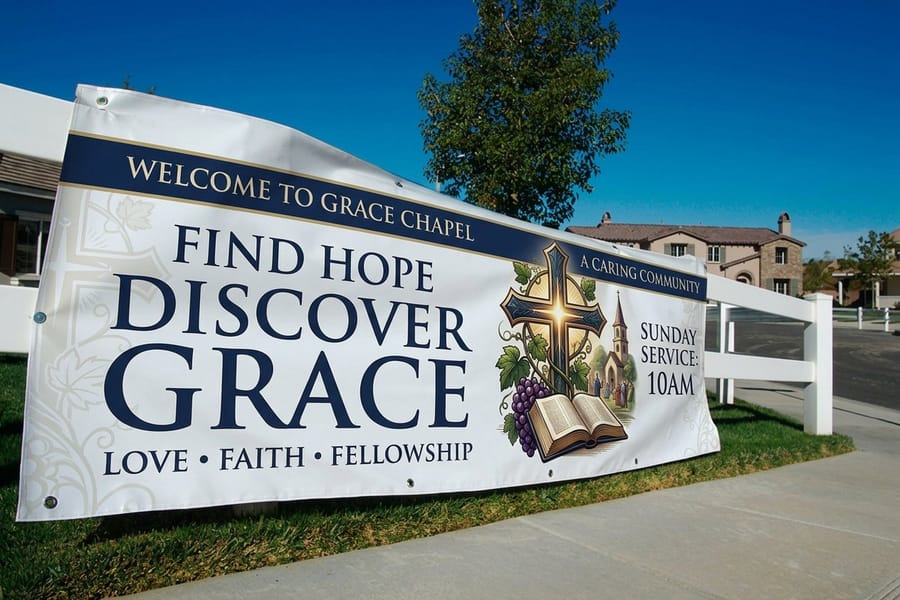
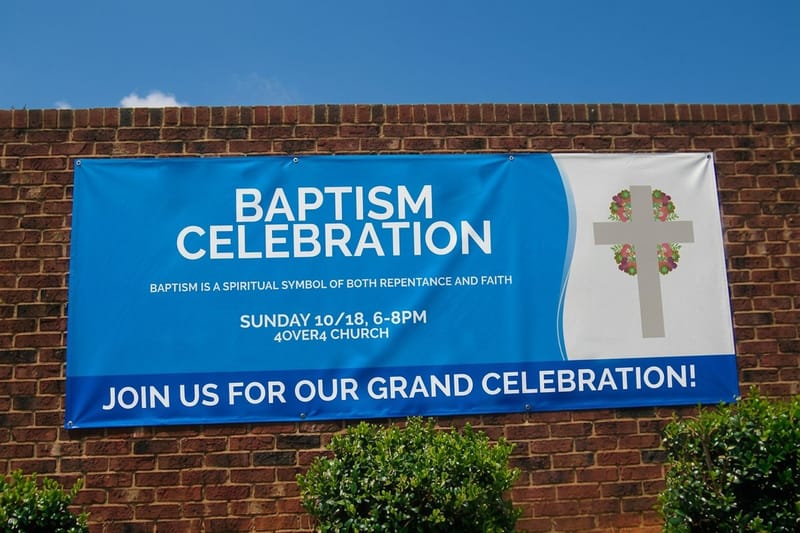
A banner is a sign. It is read from 40 feet or more, often from a car doing 30 miles an hour. The old sign trade rule still holds: allow about one inch of capital letter height for every ten feet of viewing distance. On a 3 by 8 foot banner facing a road, that leaves room for one line of roughly seven words. Anything past that is decoration nobody reads. Church banners start at $79, and the reason they are worth it is that they work every hour of every day without a volunteer standing there.
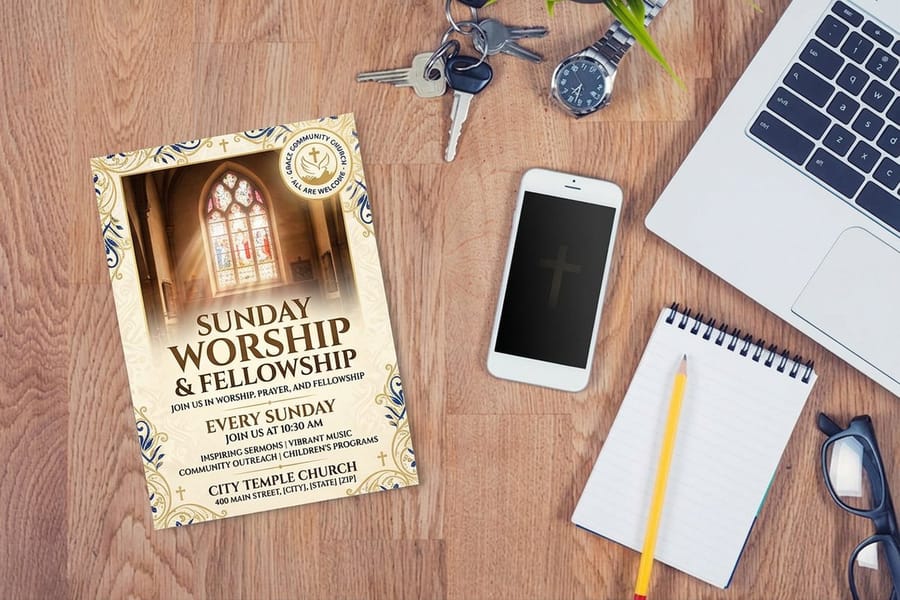
A flyer is a handover. It is read at arm’s length for a few seconds, usually while the person is walking, and then it is either kept for the date or dropped in a bag. That is not a criticism. It is the job. Church flyers start at $39.54, and their cheapness is the feature: the date changes, you reprint, nothing is lost.
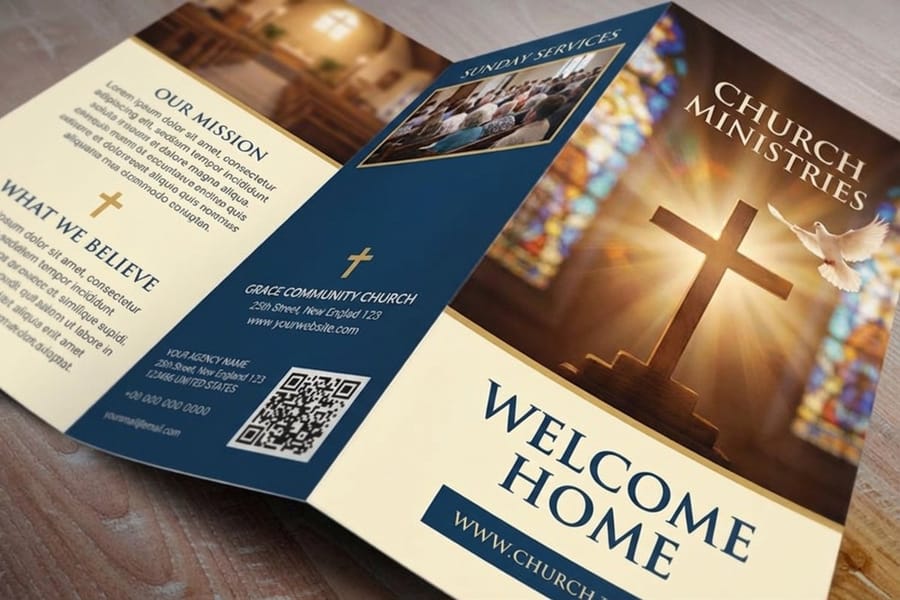
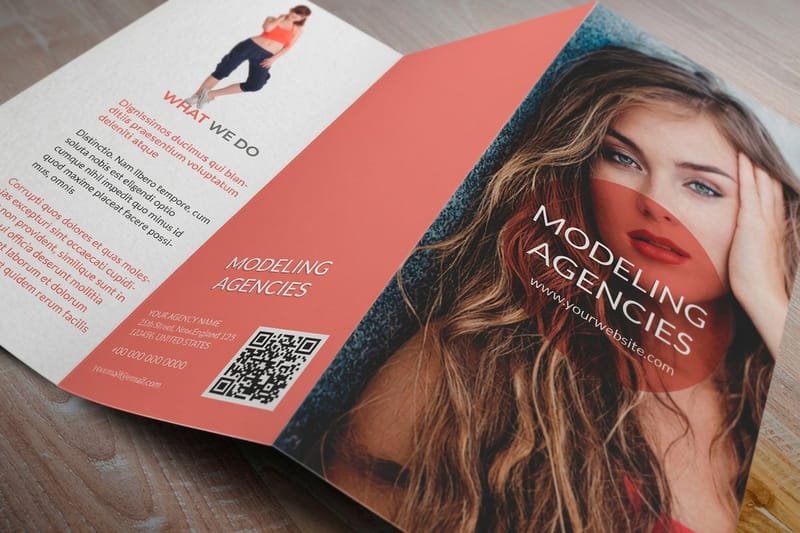
A brochure is a conversation. Somebody sits down with it. Panels give you room for service times, what the kids do during the sermon, where to park, and who to email. Church brochures start at $57.11, which is more than a flyer, and that money buys panels rather than a bigger sheet.
If a piece is failing, the usual cause is that it was asked to do a different distance’s job. A banner with a paragraph on it. A flyer with 9 point body copy on a folding table. A brochure taped to a fence.
Church Flyers, Banners and Brochures Side by Side
Four things separate them in practice: how far away they are read, how long they stay useful, what they cost to start, and who has to do work for them to function.
| Format | Read from | Useful life | Starts at | Needs a volunteer? |
|---|---|---|---|---|
| Church flyers | About 18 inches, held in one hand | Until the event, then gone | $39.54 | Yes, someone must hand them out |
| Church banners | 40 to 100 feet, often from a car | Seasons, and years if undated | $79 | No, once it is hung |
| Church brochures | About 14 inches, seated | Weeks on a counter or in a bag | $57.11 | Only at the point of handover |
| Church postcards | Arm’s length, at the mailbox | One reading, then kept or binned | $16.48 | No, the mail carries them |
Read the last column before the price column. A flyer run that nobody distributes costs the same as one that reaches a thousand hands. That is why churches with small volunteer teams get more out of a banner and a mailed postcard than out of a large flyer order, and why churches with an active youth group get the opposite result.
The useful life column is the other one people skip. Undated banner artwork is the single cheapest decision in church print, because it turns one purchase into a piece you hang every Easter, every Vacation Bible School, every carol service.
Choosing by the Event, Not by the Budget
Pick the piece by what has to happen next, and the budget question mostly answers itself.
- A dated event, like Easter or a Christmas service. Banner at the road with the event name and no year, flyers with the date and the times. The banner does the awareness, the flyer does the detail. Reuse the banner, reprint the flyer.
- A new service or a new location. Banner first, and keep it up for months. People need to pass it repeatedly before it registers. One flyer run will not do that on its own.
- Growing a visitor into a member. Brochure. This is the only one of the three with room for what somebody actually needs to know before they come back a second time.
- Vacation Bible School or a youth week. Flyers, in volume, through the school run and the neighbourhood, plus a banner on the fence so parents driving past see it every day of the sign-up window.
- A capital campaign or a building appeal. Brochure, on a heavier stock, with the numbers laid out. A flyer cannot hold a giving plan and a banner certainly cannot.
When the money only stretches to one piece, the honest answer depends on foot traffic past the building. Road frontage means banner. No road frontage means flyers and a distribution plan, and our flyer distribution guide covers where those actually land. Either way, the church printing collection keeps the whole set in one place so the artwork stays consistent across them.
The Setup Details That Trip Up Church Volunteers
Each format has one thing that goes wrong more than everything else combined. Knowing them beforehand saves a reprint.
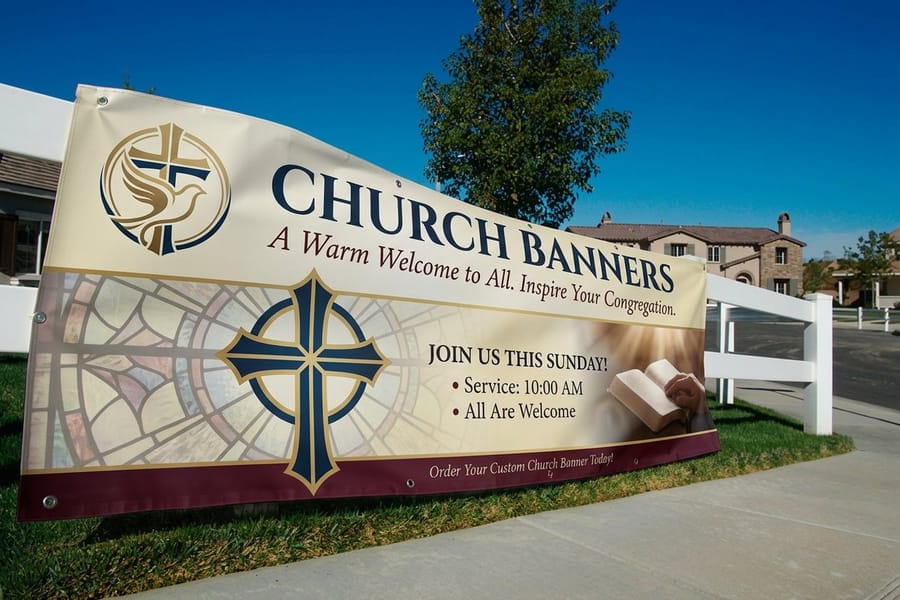
Banners fail at the edges and in the wind. Order hem and grommets rather than a raw cut edge, and hang from every grommet rather than only the corners, or the middle bows and the corners tear. On a solid fence or a flat wall, air has nowhere to go and a solid vinyl banner acts as a sail, so mesh is the safer material there. Our 13 oz, 18 oz, and mesh comparison lays out where each one belongs. Keep important type well inside the hem, since the hem folds over roughly an inch of the printed edge.
Flyers fail on stock weight and text size. A flyer on light text stock feels like a leaflet and gets dropped. A heavier text stock or a light cover stock survives a bag and a pocket, and the flyer paper weight guide shows what each weight feels like in a hand. Keep body copy at 10 point or above, because a flyer is read standing up, in bad light, by people over 50 as often as under.
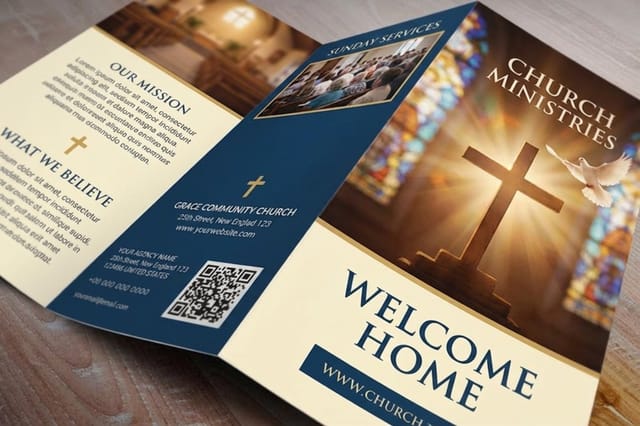
Brochures fail at the fold. The panels of a tri-fold are not equal. The panel that tucks inside is trimmed slightly narrower so the fold closes flat instead of buckling, and building the file with three identical panels is the most common church brochure mistake. Start from a correctly proportioned layout in our blank template library, and read the brochure fold guide before you write a word of copy, because the fold decides how the content is chunked.
One more that applies to all three: whatever is printed, the church name and the service time should be legible on it. A visitor who picks up a piece at a community event and cannot find when the service starts is a visitor who does not come.
Wally sorts the three by distance
Road, hand, chair
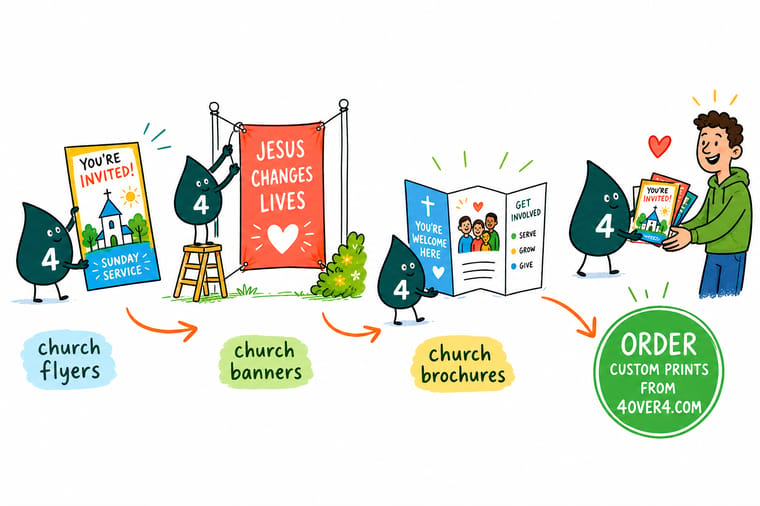
Wally hangs the banner at the road, because that reader is 40 feet away in a car and gets one line of about seven words. He hands the flyer over at arm’s length, because that reader gets a few seconds and needs the date. He gives the brochure to somebody sitting down, because that reader has real questions about parking, kids, and what happens next. He also leaves the year off the banner, so the same banner comes back out next Easter.
Shop the church printing collection →Specs and pricing
Sizes, stocks and starting prices for all three
Configure each format side by side, with live size, stock and quantity options and starting prices straight from the 4OVER4.COM configurator.



Print it
Order the piece the job actually needs


Explore more
Where to go next


By the numbers
Banners, flyers, and folded brochures
Common Questions
Church print questions, answered
Should a church buy flyers or a banner first?
Buy the banner first if the building sits on a road with traffic, and flyers first if it does not. A banner works while nobody is doing anything, which matters for a volunteer team. Flyers only work when somebody is out handing them over, so they need people and a plan for where those people will stand. If the church has a corner lot and a sign ordinance that allows it, the banner earns more attention per dollar over a year than any single flyer run.
Can we reuse a church banner next year?
Yes, and it is the main reason to spend more on the banner than on anything else. Leave the year, the date, and the service time off the artwork. Print the event name, the church name, and one short line, then let the flyers and the postcards carry the details that change. A vinyl banner stored rolled rather than folded, out of direct sun, comes back out looking the same. Folded storage puts creases across the print that never fully relax.
What size should a church flyer be?
For handing out and for bulletin inserts, 5.5 by 8.5 inches is the practical size, because it drops inside a folded 8.5 by 11 bulletin without sticking out. For a community board or a coffee shop window, go to 8.5 by 11 so the headline still reads from a few feet back. Half-page flyers also cut waste, since two land on the same parent sheet the full page needs.
Do we need a mesh banner instead of vinyl?
Only if it is going on a fence or a wall where wind cannot escape. Mesh has small perforations that let air pass, which stops the banner acting as a sail and pulling out its grommets. The trade-off is real: mesh looks slightly washed out up close because part of the print area is holes. For a banner hanging on a rail, over a doorway, or on a frame where air moves behind it, standard 13 oz vinyl gives a cleaner image.
Which fold should a church brochure use?
A tri-fold, also called a letter fold, for a welcome brochure, because the front panel does the greeting, the inside three panels take service times, ministries, and directions, and the back panel takes the map and contact block. Use a half fold instead when you have long text and photographs, such as a capital campaign piece. One setup detail catches volunteers out: the panel that tucks inside a tri-fold is trimmed slightly narrower than the others, so the panels are not equal widths in the file.
Is a brochure worth it if we already hand out flyers?
It is worth it once people are showing up. A flyer moves somebody from not knowing to attending one event. A brochure moves somebody from attending once to knowing where they fit, and it survives on a kitchen counter for weeks in a way a single-event flyer does not. If the church runs a newcomers class or a welcome desk, the brochure is the piece that desk hands over.
How many flyers should we print for an outreach push?
Count the hands, not the houses. Work out how many volunteers will distribute, how many hours they will actually give, and how many pieces one person can hand over in an hour, then add a reserve for the welcome desk and the bulletin. Printing far more than the team can distribute is the most common way church print money gets wasted, and boxes of last year’s flyers in a storage closet are the evidence.
Get Started
50 church flyers cost $39.54, 50 brochures $57.11
Hang an undated banner at the road, hand out flyers with the date on them, and keep a brochure at the welcome desk for the people who come back.
Legal Disclaimer
Gold Standard guarantees apply to all standard orders placed through 4over4.com. Price match requires verifiable proof of a competitor's published price for an equivalent product with matching specifications and turnaround time. Satisfaction guarantee covers manufacturing defects and print quality issues. Contact support with order number and documentation. On-time delivery rate based on tracked orders 1999 to 2026. Individual results may vary based on shipping carrier performance.
