
Why Stickers Work and How Sticker Psychology Sells Your Brand


Jordan is our labels, packaging and sustainability voice, built from the knowledge of our production team, with over 20 years in printing.
Stickers are printed face stock on an adhesive backing, and they work because they are the one ad format the audience chooses to keep, and then gives a surface to. Reciprocity gets it accepted, identity gets it placed, and the print spec, from a $23.88 paper run to laminated vinyl for a water bottle, decides whether it is still there next year.
Sticker facts to know before you order
Four facts about stickers decide how one performs: its size, its face stock, its shape and its finish. Each one has a price attached, so you can plan a first run before you draw anything.
- Size. Standard stickers come in 53 preset sizes, starting at .375 by 1 inch, and 25 cost $23.88. A laptop lid takes two to four inches.
- Stock. Paper is fine on a folder or a mailer seal indoors. Vinyl, from $25.00, survives a water bottle, a laptop lid or a bumper, and premium stickers from $29.16 use a heavier face that holds color longer under sun.
- Shape. A die cut follows the outline of the artwork and starts at $93.37, because the cutting die is real tooling.
- Finish. Clear stickers from $25.00 let the glass show through, and holographic runs of 100 cost $322.98, which is why most brands print one as the chase piece in a standard set.
Where stickers end up and how long they last
| Surface | How long it lasts there | Who sees it | What it has to be printed on | Product at 4OVER4 |
|---|---|---|---|---|
| Laptop lid | Two to four years, until the machine is replaced | Every colleague in every meeting and every cafe | Vinyl, matte or gloss, die cut | Die-Cut Stickers |
| Water bottle | Months, if the stock is right | Gym, office, classroom, trail | Vinyl with a laminate, never paper | Vinyl Stickers |
| Car bumper or rear glass | Years outdoors | Every driver behind that car | Outdoor vinyl, UV rated adhesive | Bumper Stickers |
| Shop window or fridge door | Until the promotion ends | Everyone who walks past or opens it | Clear face so the glass shows through | Clear Stickers |
| Product box or mailer seal | One unboxing, then the laptop | The buyer, and whoever they show | Paper or vinyl, small run, low cost | Standard Stickers |
Pick the surface before you pick the size: a laptop lid wants two to four inches of die-cut vinyl and keeps it for two to four years, a water bottle needs vinyl with a laminate, and a mailer seal can be a $23.88 paper run. You can order standard stickers in any of these shapes straight from the configurator.
Stickers as a human obsession

Nobody keeps a banner ad. People keep stickers, and then they give them a surface. That single difference is the whole argument: a sticker is advertising that the audience opts into, carries around and defends, and it is the only print format where the recipient does the distribution for you.
Three ordinary behaviors drive it. The first is reciprocity, because something handed over free creates a small pull to reciprocate, even if the payment is only attention. The second is identity signalling: a sticker on a laptop tells a room what its owner is into before anyone speaks. The third is nostalgia, because most adults spent childhood earning stickers for good work, and the object still carries a faint reward feeling decades later.
None of that survives a bad print. A sticker that curls at the corner after a fortnight gets peeled off, and the loop stops before it starts. Our guide to sticker materials covers what each face stock actually does under sun, water and abrasion.
The loop that makes them cheap
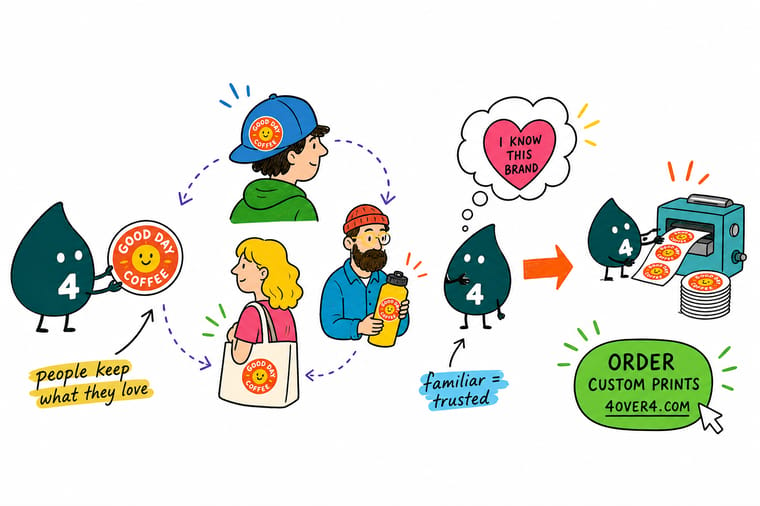
Look at the diagram above and count where the money goes. You pay once, at the moment the sticker leaves your hand. Every stage after that is free: the placement, the daily viewing by everyone near the owner, the conversation, and the next person asking where to get one.
That is why a sticker budget behaves so differently from a paid media budget. A run of standard stickers at $23.88 does not stop working when the campaign ends. It keeps running on other people’s laptops until the adhesive gives up.
The collecting and identity instinct
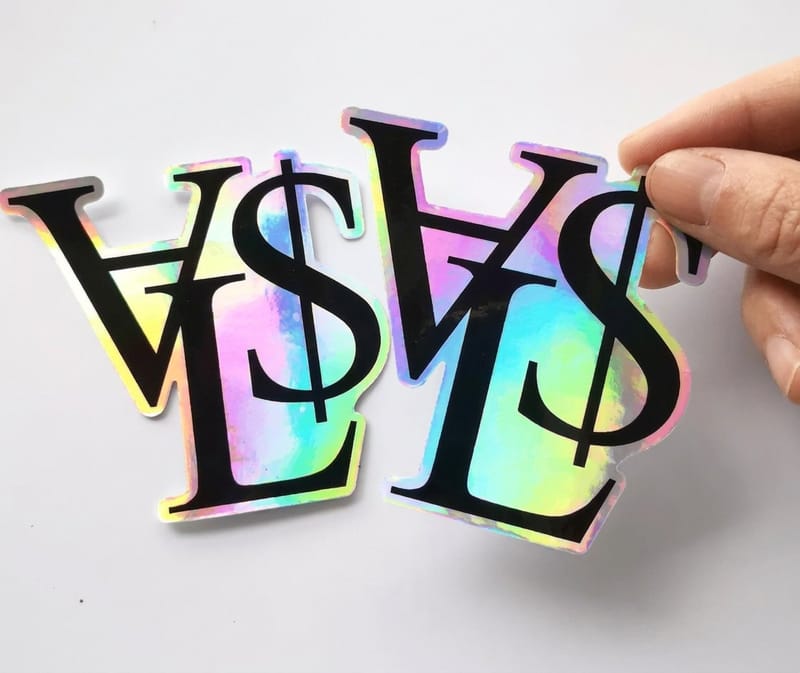
Collecting is the behavior brands underestimate most. People do not keep one sticker, they keep a drawer of them, and a drawer implies a set. The moment your stickers look like part of a series, they get sorted, saved and traded rather than used up.
The practical version is simple. Print a family with one shared element and one variable, then release it in parts. A shape that stays constant, a color that changes, a number in the corner. Skate shops, breweries and software companies have all run this for years, and it is why their stickers end up on the same laptop lid together.
Finish carries a lot of the collecting weight. A flat printed sticker is a nice object; a holographic sticker is a thing people show other people. That effect costs real money, since holographic runs start at $322.98 against $23.88 for standard, so most brands use one holographic piece as the chase item in an otherwise standard set.
Identity beats information
The stickers that get placed say something about the owner. The stickers that stay in the envelope say something about the company. A logo alone is company speech, and it competes with everything else on that laptop lid for space it has not earned.
Print the in-joke, the local landmark, the tool your customers actually love, the phrase your community already uses. Your mark can sit small in the corner and still be read every day. Ten ways to use logo stickers works through the versions of this that survive contact with a real audience.
Do the honest test before you order. Would someone with no connection to your company put this on their own laptop? If the answer is no, a bigger quantity will not fix it, and you have just bought a box that lives in a cupboard.
Why tiny stickers punch above their weight
A three inch sticker on a laptop is seen more often than a billboard most people drive past once a week. It sits at eye level in meetings, in cafes, on video calls and in photographs, for as long as the machine lasts. The reach is small and the frequency is enormous, which is the opposite of almost every other format you can buy.
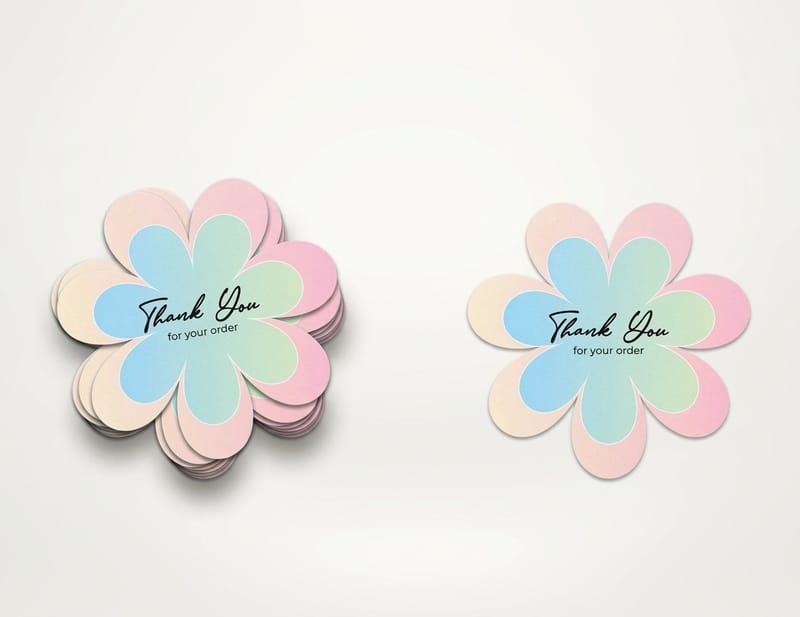
The size and shape decide whether it earns that spot. A die-cut sticker follows the outline of the artwork instead of a rectangle, so the shape itself becomes recognisable at a glance, and it sits neatly beside other stickers rather than fighting them for a square. That cut costs more, because a die is tooling: die-cut stickers start at $93.37 against $23.88 for a standard rectangle. If your logo is already a strong silhouette, the cut is worth it. If it is a wordmark in a box, it is not.
The other quiet decision is the surface it is aimed at. Stickers do not float, they live somewhere, and the place they live sets both the lifetime and the audience.
Where a sticker lives decides what it is worth
Design for a target surface and the sticker becomes a much better buy. A laptop lid wants a shape roughly two to four inches wide. A water bottle wants a curve friendly shape and a stock that survives the dishwasher. A hard hat, a toolbox or a bike frame wants outdoor vinyl and a laminate, not a coated paper.
Paper stock is not a mistake in every case. On a mailer seal or a folder, paper is cheaper, prints beautifully and lasts long enough for the job. Put the same sticker on a bottle and you will be scraping off half of it in a week. Vinyl against paper stickers lays out the exact trade.
How stickers create memorable campaigns
Campaigns that use stickers well share a structure: something worth keeping, a reason to place it now, and a way for the placement to be seen. Drop any one of the three and you have printed a coaster.
The reason to place it now is the piece most brands skip. A sticker handed over with no context goes into a bag and stays there. A sticker handed over with a line attached, such as a member badge for a launch, an entry mark for an event, a spot on the laptop that says you were in the first hundred, goes on within the hour.
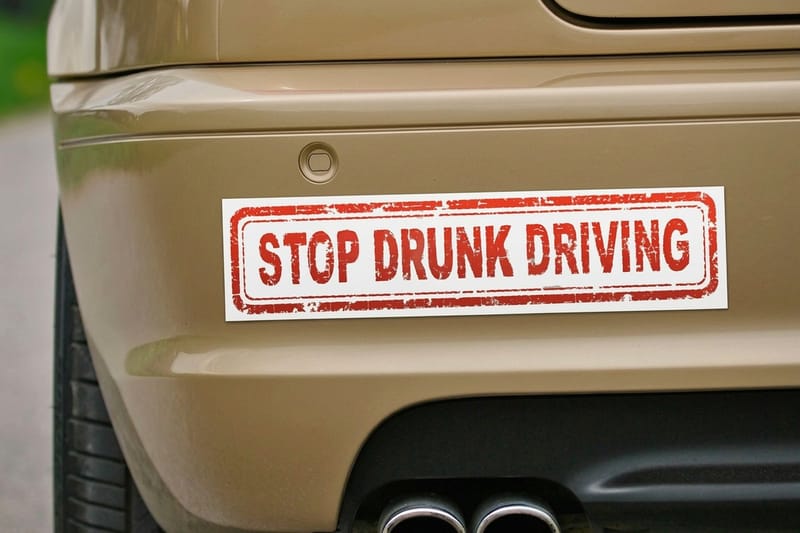
Bumper stickers are the extreme version of the format, and they behave differently from every other sticker we print. They are read by a captive audience at a traffic light, they need copy legible from three car lengths back, and they live outdoors for years. They also hold the highest rating of any sticker in our catalog, 4.9 out of 5 across 71 reviews. Bumper stickers start at $38.44 and want short copy, high contrast and no small print.
The mistakes that cost campaigns
Printing before the artwork is finished is the first. Stickers reproduce fine detail badly at small sizes, so hairlines vanish, thin type fills in, and a gradient that looked subtle on screen goes muddy. Simplify the artwork until it survives at the real size, then print one and hold it at arm’s length.
Ordering one giant run of a single design is the second. Sticker pricing steps down with quantity, which tempts brands into ten thousand of an untested design. Print a few hundred, watch which one people actually take, and reorder that one.
The third is the QR code that lands on a homepage. If you put a code on the sticker, point it at the thing the sticker promised. A code that dumps someone on a generic page teaches them not to scan your codes again.
For a full campaign structure rather than a single run, our sticker marketing campaign guide takes it from goal to reorder.
Real brand sticker stories
The clearest proof is the laptop lid at any developer conference. Nobody was paid to put those logos there. The companies printed a good sticker, gave it away at a booth, and the audience turned their own hardware into a display case. It is the same mechanism a band uses at a merch table and a brewery uses when it drops a sticker into a case of cans. Our video on Brewery Stickers shows that case of cans version.
Skate and surf shops have run this the longest, and their version is worth copying: the shop logo is a shape people can draw from memory, the sticker is die cut to that shape, and there is always a slightly rarer one behind the counter. Scarcity and silhouette, nothing more complicated than that.
Local trades run a quieter version. A plumber or an electrician who leaves a small vinyl sticker inside the boiler cupboard with a phone number is buying years of visibility for pennies, because the next person who opens that cupboard is a customer with a problem. Numbers on the wider label and sticker market sit on our stickers and labels market statistics page rather than being guessed at here.
What each one got right
Every example above put the sticker where the audience already was, rather than asking the audience to come and collect it. The booth, the case of cans, the cupboard, the merch table. Distribution is not an afterthought to a sticker run; it is most of the work.
They also all printed something with a life beyond the campaign. None of those stickers carry a date, a hashtag that expires or a promotion that ends, which is why they were still working a year later. Sticker marketing, why and how it works goes deeper into the distribution side, and the psychology of stickers covers the collecting instinct on its own.
8 ways to supercharge your brand with custom stickers
These are the eight moves that separate a sticker run that spreads from a box that sits in a cupboard. None of them need a big budget, and most of them are decisions rather than costs.
- Put one in every order. The cheapest distribution you own. It costs cents, it arrives at a moment of goodwill, and the recipient is already holding your brand. Standard stickers at $23.88 make this a rounding error on shipping.
- Print a set, not a single. One shared element, one variable. A series gets collected, a single gets used. Release the parts over time and the second drop does the work of the first.
- Make one hard to get. A holographic or foil version behind the counter, at $322.98 for the run, turns an ordinary giveaway into something people ask for by name.
- Design for a surface. Pick the laptop lid, the bottle, the toolbox or the bumper before you draw, and set the size, the shape and the stock to that surface.
- Cut to your silhouette. If your mark is a shape rather than a wordmark, a die-cut outline at $93.37 reads instantly and sits neatly next to other stickers.
- Say something the owner would say. The phrase your community already uses beats a logo on its own, and it earns the space on someone else’s laptop.
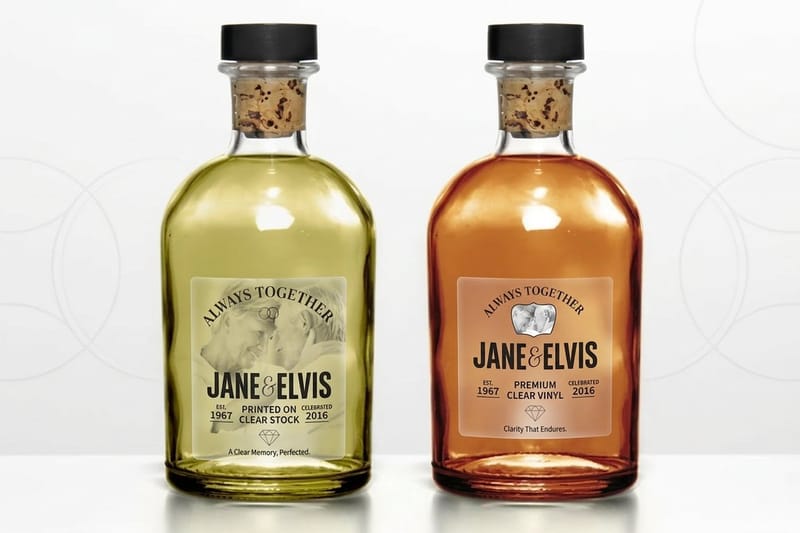
- Use clear stock on glass. Clear stickers at $25.00 on a shop window or a fridge door look printed onto the surface itself, which is why they outperform a white rectangle in retail.
- Reorder the winner, not the set. Print a small first run, watch which design disappears from the pile fastest, then put the volume behind that one.
Print it
Standard stickers, ready to hand out
The low cost first run, sized and cut to your artwork, so you can test two designs before you commit to volume.
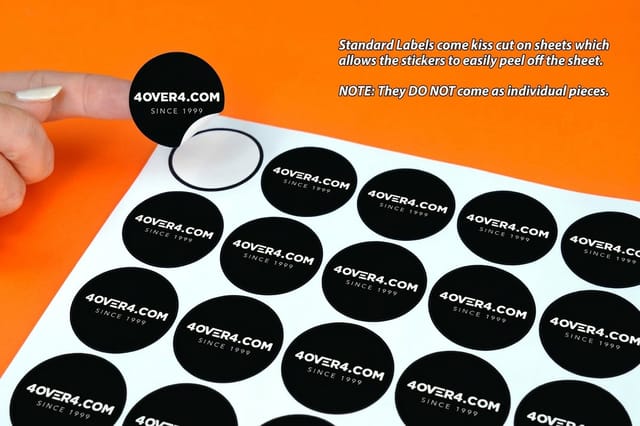
Distribution is the part that decides the result. Put stickers where your audience already stands rather than asking them to come and collect: in the box with every order, on the counter, at the booth, in the case of cans. If you are running this as a proper campaign rather than a one off, building a sticker pack is the step that turns single designs into something people keep as a set.
Designing your own custom stickers with 4OVER4.COM
Sticker pricing moves with size, stock, finish and quantity, and the per unit cost drops as the run grows. The numbers below come from the live configurator, so you can size the budget before you order rather than after.
Quantity and price
Sticker pricing and specs
Real configurator numbers on our standard sticker stock, where the more you order the lower the per unit cost drops.
| Quantity | Price Per Unit | Total |
|---|---|---|
| 25 | 95.5¢ | $23.88 |
| 50 | 72.9¢ | $36.44 |
| 100 | 42.7¢ | $42.72 |
| 150 | 32.7¢ | $49.01 |
| 200 | 27.6¢ | $55.29 |
| 250 | 24.6¢ | $61.57 |
Upgrading the stock is the decision that matters most. Premium stickers at $29.16 use a heavier face and hold their color longer under sun, and vinyl stickers at $25.00 are the right call for anything that meets water or hands. You also earn coins on every order and can redeem them against future printing.
Who gets the most out of stickers
The format bends to the business. Here is where each type of brand tends to get the best return, and what to print for it.
- Ecommerce and DTC brands. One sticker per order, printed on paper for cost and slipped in with the packing slip. The unboxing moment is the highest goodwill point you will ever get with that customer.
- Cafes, bars and breweries. Vinyl for bottles and laptops, and a rotating design each season so regulars collect the set. Put the good one behind the counter.
- Software and SaaS companies. Die-cut logo silhouettes for conference booths, sized two to four inches for a laptop lid. Print the in-joke as well as the logo.
- Bands, artists and makers. A merch table sticker at a low price point that people buy alongside the record. Small runs, frequent new designs, no dates on the artwork.
- Trades and local services. Small vinyl stickers with a phone number, applied to the equipment you install. Outdoor stock and a laminate, because the next reader might be three years away.
- Campaigns and causes. Bumper stickers for the car, at $38.44 a run, with copy legible from three car lengths back and no small print at all.
Where a sticker file should start
Start the file from a blank at the size and stock you picked: 25 standard stickers at $23.88 in one of 53 sizes, 25 vinyl at $25.00, 25 premium at $29.16, or 100 holographic chase pieces at $322.98. Each blank arrives with the cut line and bleed marked, so the artwork lands inside the cut the first time. Pull one from the blank template library before you start drawing.
Start fast
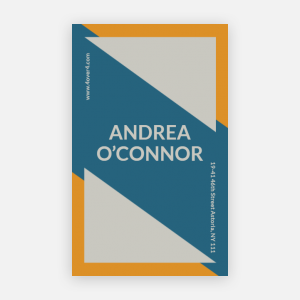
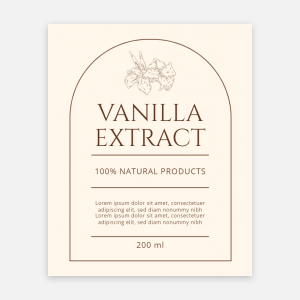
Sticker templates and exact-size blanks
Design templates and print-ready blanks with bleed and trim marked, so nothing important sits on the cut line.


Wally on why a sticker keeps working after you paid for it
You buy stage one, the audience does the rest
Pick the surface first, because a laptop lid wants two to four inches and a bottle wants vinyl with a laminate. Keep type clear of the cut line, print a few hundred across two designs, and reorder whichever one disappears from the pile first. Standard stickers start at $23.88 at 4OVER4.COM and ship fast.
Order custom stickers →What decides whether a sticker gets stuck
Design rules that decide whether a sticker gets kept
- Simplify until it survives the size. Hairlines vanish and thin type fills in at three inches. Print one at the real size and read it at arm’s length before you order the run.
- Contrast beats detail. A sticker is read in a fraction of a second on a moving surface. Strong shapes and high contrast carry; delicate shading does not.
- Leave a safe margin. Keep type well clear of the cut line. A die cut has a small tolerance, and copy that sits tight to the edge is the first thing to get clipped.
- Match the stock to the surface. Paper for mailers and folders, vinyl for anything that meets water, sun or a hand. This one choice decides whether the sticker reaches its second month.
- Skip the expiry date. No dates, no ending promotions, no temporary hashtags. The value of a sticker is the years it keeps working after the campaign closes.
Explore more
More ways to print and promote
Holographic stickers run 100 for $322.98 in 6 business days and bumper stickers print in 5.
Product Standard Stickers The low cost test run, from $23.88. Product Die-Cut Stickers Cut to your silhouette instead of a rectangle. Product Custom Holographic Stickers The chase item people ask for by name. Product Bumper Stickers Outdoor vinyl, rated 4.9 across 71 reviews. Product Clear Stickers Printed artwork with the surface showing through.  Product Premium Stickers Heavier stock and finishes, from $29.16.
  Product Vinyl Stickers The stock that survives bottles and bags. Category Sticker Printing Every shape, stock and finish in one place.
  Guide How Stickers Are Printed From press to cut line, step by step.
  Guide Custom Sticker Pricing What moves the price on a sticker run.
  Guide Building Sticker Packs Turning single designs into a collectable set. Article 7 Sticker Advertising Tips Distribution tactics that actually land.
 Ready to print stickers people keep?
Pick the shape, drop in your design or a free template, and 4OVER4.COM prints it sharp on stock that survives the surface you aimed it at.
Common questions about sticker marketing
Do custom stickers actually work as marketing?
They work when the recipient chooses to place them, which is the whole mechanism. A sticker on a laptop lid or a water bottle is seen by everyone near its owner, every day, for as long as the adhesive holds, and none of that exposure costs you anything after the print run. Where they fail is when a brand prints a bare logo and hands it out with no reason to place it, because that sticker goes into a bag and stays there. The honest test before you order is whether someone with no connection to your business would put the design on their own laptop.
Why do people love stickers so much?
Three ordinary behaviors stack up. Something given free creates a small pull to give something back, even if that something is only attention. A sticker placed on a personal object signals identity, telling a room what its owner is into before anyone speaks. And most adults were handed stickers as rewards in childhood, so the object still carries a faint reward feeling. Collecting sits on top of all three, which is why a set of stickers gets kept and sorted while a single one gets used and forgotten.
What material should a promotional sticker be printed on?
Match the stock to the surface you are aiming at. Paper is cheaper and prints beautifully, and it is the right choice for a mailer seal, a folder or anything indoors that stays dry. Vinyl is what survives a water bottle, a laptop lid, a toolbox or a bumper, because it does not soften when it gets wet and a laminate takes the abrasion instead of the ink. Vinyl stickers start at $25.00 at 4OVER4.COM. Putting paper on a bottle is the single most common sticker mistake we see, and it usually shows up within a week.
Are die-cut stickers worth the extra cost?
They are worth it when your mark is a shape and not worth it when it is a wordmark in a box. A die cut follows the outline of the artwork, so the silhouette itself becomes recognisable and the sticker sits neatly beside others on a laptop lid rather than claiming a rectangle. The cut is real tooling rather than a software setting, which is why die-cut stickers start at $93.37 against $23.88 for a standard rectangle. If you are unsure, print the rectangle first, see whether people place it, then invest in the cut.
How many stickers should I order for a first campaign?
Order a few hundred across two or three designs rather than thousands of one. Sticker pricing steps down as the quantity climbs, which pushes new brands into a large run of an untested design, and the feedback you need only arrives once real people have a pile in front of them. Print small, put them where your audience already is, watch which design disappears first, then put the volume behind that one. The cost of testing is low: a standard run starts at $23.88.
What should go on the sticker besides the logo?
Something the owner would be happy to say themselves. The phrase your community already uses, the in-joke, the local landmark, the tool your customers love. Your logo can sit small in a corner and still be read every day, because the sticker earns its place on the strength of what it says rather than who made it. Keep the artwork simple enough to survive at the real size, keep type clear of the cut line, and leave dates and expiring promotions off it entirely so the sticker keeps working after the campaign ends.
