
6 Print Products That Turn a SWOT Analysis Into a Decision
A SWOT session fails in one of two ways: the grid records whatever the most senior person said first, or it becomes a photograph nobody opens again. Six printed pieces fix both, and they are listed here in the order the session uses them, from $16.48 for 50 postcards.
A SWOT workshop needs a printed grid, blank cards and a pad per seat, and then a poster, a folder and a booklet to carry the result out of the room. The dry erase grid holds the fixed frame so you rewrite only the contents, the cards run the silent-write step so quiet people get lines on the wall, and the poster, folder and booklet are what the decision travels in afterwards.

The picks
Six pieces, from $16.48 postcards to a $240.55 booklet set
Buy the first three for the session itself and the last three only once the grid has settled. Each one can be laid out from scratch in our free online designer, or started from a design template with your logo dropped in. Prices come from the configurator and fall as the quantity climbs.

Start here
Why this exercise needs paper at all
SWOT is a sorting exercise, and sorting is a physical act. The value is not in the four words. It is in a group moving lines between boxes until they agree what is inside their control and what is not, then pairing the boxes into four decisions. That happens faster standing at a wall with cards in hand than it does around a shared document where one person types. The pieces below are ordered the way the session uses them: the frame, the raw lines, the private drafting, then the three things that carry the result outside the room.
What to order and when
The six pieces, what they cost, and where each one is used
The first three run the session. The last three exist because a decision that never leaves the meeting room is not a decision. Read the row, tap the piece to jump to its section, and note that the two most expensive items are the two you should order last.
| Piece | What to order | Where it is used |
|---|---|---|
| 1. Dry erase posters | Print the empty grid and the four labels once. From $29 | The wall you run the session against. You rewrite the contents every quarter and the frame never changes. |
| 2. Standard postcards | 4 in x 6 in, blank or lightly ruled on one side. From $16.48 | The silent-write step. One line per card, no discussion, so the loudest person in the room does not set the agenda. |
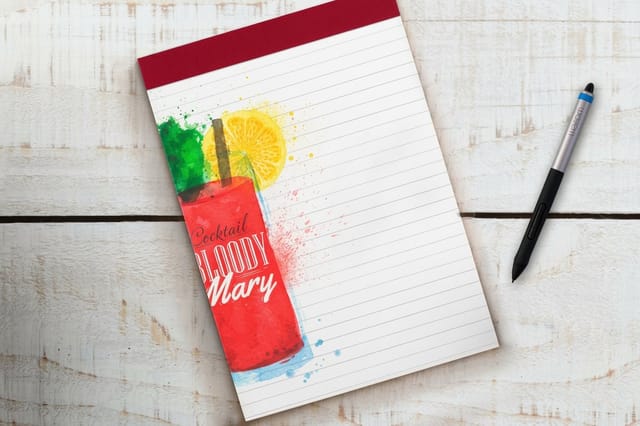
| 3. Standard notepads | Per-seat pad, printed header with the four box names. From $93.37 | Every chair. It is where the half-formed thought lands before anyone is willing to say it out loud. |
| 4. Standard posters | The finished grid, one poster, body text no smaller than 24pt. From $108.75 | The wall for the rest of the quarter, so the decision keeps being looked at after the room empties. |
| 5. Short run presentation folders | Short run, so 25 or 50 rather than a case of 500. From $108.75 | The bank, the board, the investor. It holds the grid, the numbers and the ask as one object. |
| 6. Standard booklets | Saddle stitched, 12 to 24 pages is the usual length. From $240.55 | The plan the SWOT feeds. Print it after the second revision, never the first. |
1. Dry erase posters: print the frame once, rewrite the contents forever
A SWOT grid has two parts, and only one of them changes. The axes, the four labels and the rule about what belongs where are fixed. The lines inside the boxes are different every quarter. A dry erase poster lets you print the fixed part and write the moving part, which is exactly the wrong way round on a whiteboard, where you redraw the same four boxes by hand every single time and they come out crooked every single time.
Print the grid with the labels already set: Strengths and Weaknesses across the top row, Opportunities and Threats across the bottom, and the two axis notes down the side reading internal, you control it and external, you do not. Those two notes are the part teams get wrong. Put them on the poster and you stop the argument about whether a new competitor is a weakness before it starts. There is a longer explanation of that rule in our SWOT analysis guide.
Here is where it does not pay. If you run SWOT once a year for a bank meeting, a writable surface is money spent on a feature you use twice. Buy a plain printed poster instead. The dry erase version earns itself back when the grid is a standing quarterly item, because at that point you are reusing one $29 poster instead of reprinting four.
2. Standard postcards: the cheapest way to stop the loudest voice winning
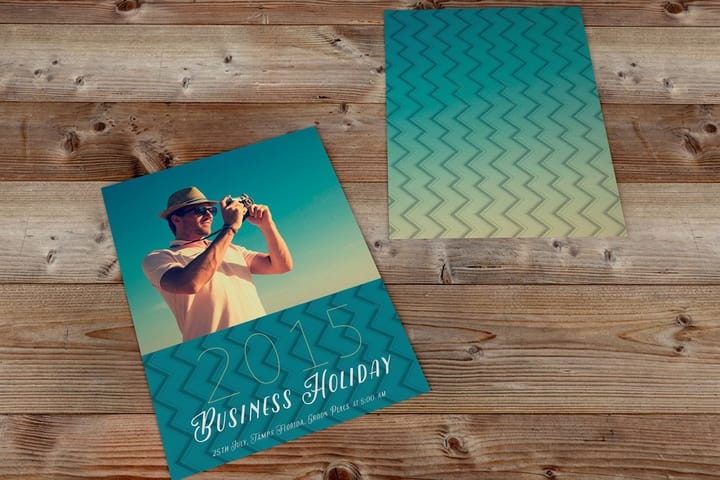
The failure mode of a SWOT session is not a bad grid. It is a grid that records what the most senior person in the room said in the first four minutes. Cards fix that, and they fix it for $16.48. Hand every person a stack of blank 4 in x 6 in postcards, set a timer for four minutes, and let nobody talk. One idea per card. Then everything goes on the wall at once and gets grouped, and the room argues about lines instead of about people.
A card is better than a scrap of paper for a physical reason. It is rigid enough to stay flat under tape, thick enough to survive being moved four times as the clusters change, and big enough that handwriting stays readable from six feet when the group stands back to sort. Print a faint four-box key on the reverse so anyone can check which box a line belongs in without asking.
The honest comparison is with a pad of sticky notes, which costs less and sticks by itself. Notes win on speed and lose on everything else: they fall off overnight, they curl, and you cannot hand a stack of them to the person writing the summary. If your session ends in the same hour it started, use notes. If the grid has to survive until Thursday, use cards. Either way the sorting method is the same one described in the SWOT walkthrough.
3. Standard notepads: where the half-formed thought lands first
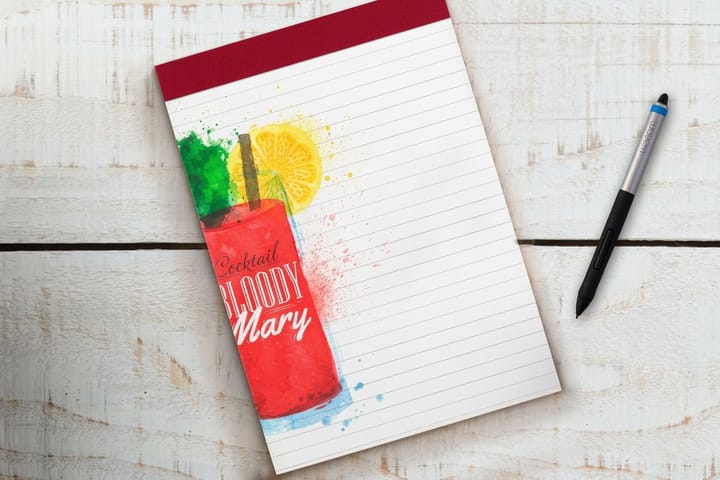
Cards are for the lines you are willing to post. A pad is for the ones you are not, yet. Put a printed notepad at every chair with the four box names running down the header and a single instruction under them, something like five lines maximum per box, and people draft in private before they commit anything to the wall. The drafting step is where the good weaknesses come from, because a weakness is a thing nobody wants to say first.
A pad also carries the session forward. The cards get grouped and eventually thrown away, but the pad goes back to the desk with the owner of the action still written on it. That is the difference between a workshop that produces a photograph and one that produces work. Pair it with the sequencing in our guide on building a small business marketing plan, which is where most SWOT outputs are supposed to land.
The catch is the order size. Notepads start at $93.37 and that buys a real quantity, not four pads, so this is a good buy for a team that meets weekly and a poor one for a single offsite. If the pads are only ever going to be used once, skip them and give people the back of the postcards. If your team runs recurring planning meetings, the per-pad cost at a sensible quantity is small, and the ladder behind that is explained in how print price breaks work.
4. Standard posters: the finished grid, hung where it can be argued with

A SWOT that lives in a slide deck stops being consulted about eleven days after the meeting. A SWOT on the wall gets pointed at in arguments, which is the only test that matters. Once the grid settles, set the final five lines per box, print it as a poster and hang it where the team already stands.
Two things decide whether it gets read. Set body text no smaller than 24pt, because a poster is read from across a room rather than from a laptop, and a line at 14pt is a line nobody will ever squint at twice. And date it. Put the quarter in the corner in type as large as the box labels, so that when the poster is four months stale everyone can see that it is, instead of quietly treating last spring as the current view.
Print the pairings under the grid rather than only the boxes. Four short lines, attack, build, defend, drop, with the decision next to each one. That turns a wall of observations into a wall of commitments, and it is the step almost every printed SWOT skips. If the poster is going to carry your brand alongside the grid, the type and color rules in brand messaging explained will keep it looking like it came from your company. You can start from a layout in our design templates rather than a blank artboard.
5. Short run presentation folders: the grid, the numbers and the ask as one object
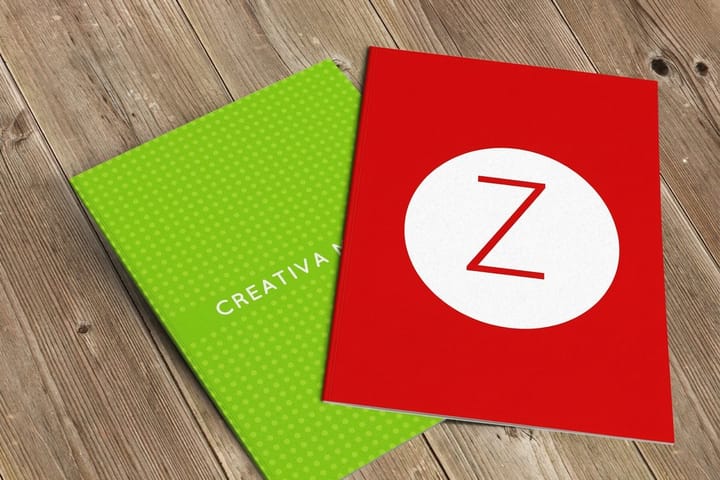
The moment a SWOT leaves your own wall, it needs a container. A lender, a board or an investor is handed the grid, a one page summary, the numbers and the ask, and if those arrive as four loose sheets they will be four loose sheets by the time anyone reads them. A short run presentation folder holds the set together and puts your name on the outside of it.
Short run is the operative half of that name. You need 25 or 50 folders for a funding round, not a case of 500, and ordering short means the folder can carry this year’s positioning instead of a design you are stuck with for three years. Folders start at $108.75, which is the cost of looking like the pitch was prepared rather than assembled in the car park.
Be clear about what a folder does and does not do. It is a container, so it improves the first three seconds and nothing after them. If the summary inside is vague, the folder makes a vague pitch look tidy, which is worse than one that looks rushed. Fix the inserts first. The same reasoning drives the wider set in our small business lead generation strategies, where presentation always sits behind substance.
6. Standard booklets: print the plan once it stops changing
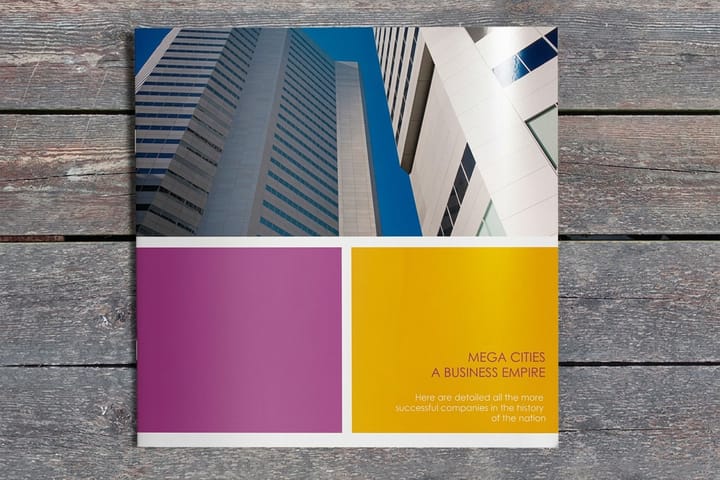
A SWOT is not a plan. It is the input to one, and the plan is where the four pairings turn into owners, dates and budgets. When that document is written, a booklet is what makes people read it, because a stapled stack of paper reads as a draft and a bound one reads as a decision. Twelve to twenty four pages is the usual length: the grid, one page per pairing, the numbers, and the calendar.
The timing is the trade-off, and it is a real one. Booklets start at $240.55 and a plan built on a fresh SWOT typically changes twice inside the first month as the first assumptions meet reality. Printing in week one wastes the run. Print the poster in week one, let the plan take its two revisions, then commit it to a booklet in week six when the pairings have stopped moving.
Order enough for the people who have to act on it, not for a shelf. One per team lead, a handful for the board, and two spares. If you want the same logic applied to a different kind of launch, our ecommerce store product picks follows the same rule of printing the durable pieces last. Everything here sits in the wider marketing materials range if you want to build the set in one order.
Specs and pricing
Compare the two pieces every session uses
The grid and the cards are the two items you will reorder, because one gets rewritten and the other gets used up. Here are the live specs and the price ladders for both.


| Quantity | Price Per Unit | Total |
|---|---|---|
| 50 | 33.0¢ | $16.48 |
| 100 | 24.2¢ | $24.16 |
| 200 | 15.9¢ | $31.86 |
| 300 | 12.8¢ | $38.45 |
| 400 | 11.3¢ | $45.04 |
| 500 | 10.3¢ | $51.62 |
| 600 | 9.89¢ | $59.31 |
| 700 | 9.57¢ | $67.00 |
| Quantity | Price Per Unit | Total |
|---|---|---|
| 1 | $29.00 | $29.00 |
Wally sorts the boxes into decisions
The grid is input, the pairs are output
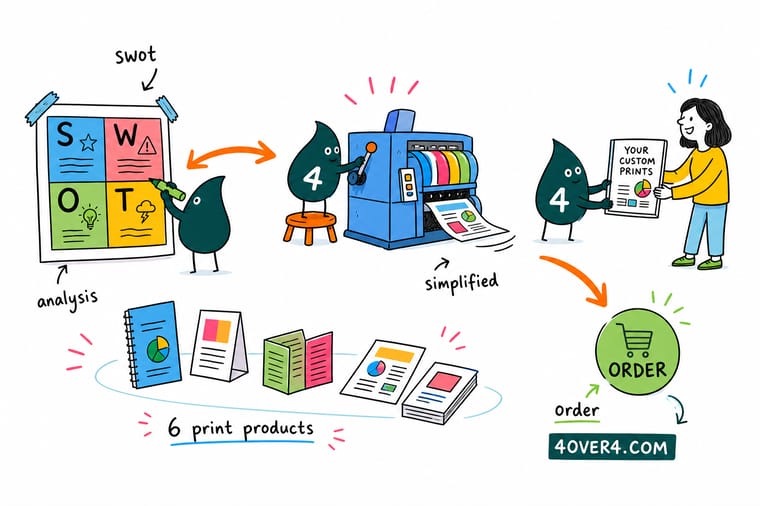
Wally runs the session the way it works: print the frame once on a dry erase poster, hand everybody blank cards and four silent minutes, then group the lines on the wall. When the grid settles, he pairs the boxes. Strength with opportunity is what you attack, weakness with opportunity is what you build, strength with threat is what you defend, and weakness with threat is what you drop. Those four lines go on the printed poster under the grid, because they are the only part anyone can act on.
Shop marketing materials →See it in use
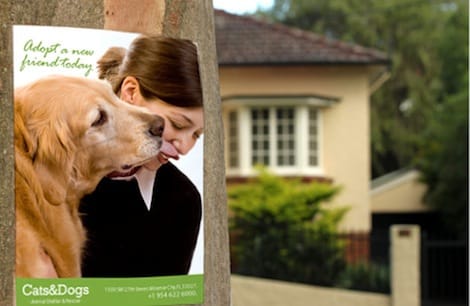
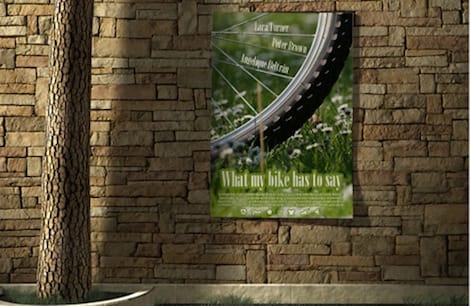
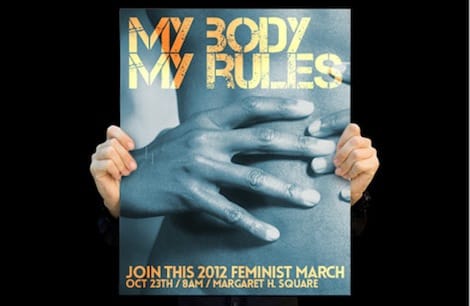
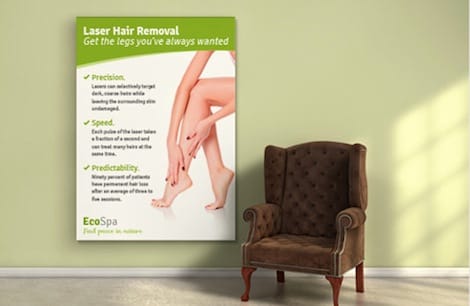
Posters teams have filled in




Explore more
Where to go next


By the numbers
What a strategy session can be printed on
Common Questions
Common questions about printing for a SWOT session
What do I actually need to print for a SWOT workshop?
Three things cover a normal session: a grid on the wall, blank cards for the silent-write step, and a pad per seat. At 4OVER4.COM that is a dry erase poster from $29, standard postcards from $16.48 and notepads from $93.37. The poster, the folder and the booklet come later, once the grid has settled into a decision worth carrying out of the room.
Dry erase poster or plain poster for the grid?
It depends on how often you rerun it. A dry erase poster from $29 is the right buy when SWOT is a standing quarterly item, because you write and wipe the same frame four times a year. If you run it once for a loan application or an annual plan, print the finished grid as a standard poster from $108.75 and skip the writable surface, which you would use twice.
How many cards does each person need?
Ten to twelve per person for a one hour session. People write more than they post, and the discards are part of the exercise. For a six person team that is around seventy cards, which sits comfortably inside a starting postcard order, and the leftovers become the next session’s stack.
What size should the grid be on the wall?
Large enough that four people can stand at it and read the far box. In practice that means setting box labels around 48pt and the lines inside them no smaller than 24pt, then choosing the sheet size that fits that type rather than picking a size first. A grid that people have to walk up to one at a time turns a group exercise into a queue.
Should the printed grid include the pairings?
Yes, and it is the part most printed SWOTs leave out. Under the four boxes, print four lines: strength plus opportunity is what you attack, weakness plus opportunity is what you build, strength plus threat is what you defend, weakness plus threat is what you drop. The boxes are observations. The pairings are the only thing anyone can act on.
What goes in the folder you hand a lender?
The finished grid on one page, a one page summary of the four pairings with owners and dates, the financials, and the ask. Four inserts, no more. A short run presentation folder from $108.75 holds them as one object with your name on the cover, which is what stops the pack becoming four loose sheets on somebody’s desk.
When is it worth printing the plan as a booklet?
Once it has stopped changing, which is usually the second revision rather than the first. Booklets start at $240.55, so a run printed in week one gets thrown away in week three when the first two assumptions turn out to be wrong. Hang the poster immediately, let the plan settle, then print the booklet at around week six.
Can I write directly on a standard poster?
Treat it as a fixed print, not a writing surface. Standard posters are made to be read, so ink sits on the surface and smears rather than wiping clean. If you want to add and remove lines each quarter, that is what the dry erase version is for. Many teams run both: a writable grid in the meeting room and a printed final grid on the wall people walk past.
Get Started
Print the frame, then print the decision
Order the six-piece SWOT session kit at 4OVER4.COM. Start with the dry erase grid and the cards, add the poster once the boxes settle, and every price updates live as you build the order.
Legal Disclaimer
Gold Standard guarantees apply to all standard orders placed through 4over4.com. Price match requires verifiable proof of a competitor's published price for an equivalent product with matching specifications and turnaround time. Satisfaction guarantee covers manufacturing defects and print quality issues. Contact support with order number and documentation. On-time delivery rate based on tracked orders 1999 to 2026. Individual results may vary based on shipping carrier performance.
