
The 12-Piece Financial Advisor Print Set That Wins Local Clients
People hand their savings to advisors who feel established, and they judge that with their hands: a heavy card, real letterhead, a plan delivered in a 9 by 12 in folder worth keeping. These are the 12 print pieces that build a local advisory practice, from the card in a client's wallet to the calendar on their kitchen wall.
The financial advisor local-marketing print set is 12 pieces that grow a practice: business cards, seminar postcards, flyers, and rack cards build local visibility, brochures and gloss presentation folders win and close first meetings, and letterhead, handwritten notecards, printed discovery forms, annual greeting cards, branded notepads, and wall calendars make the ongoing service feel like a firm clients recommend.
The picks
Twelve pieces, from 25 notecards to 250 folders
Start here. The first quantity step runs from 25 flat notecards at $19.77 to 250 gloss presentation folders at $844.54, and the 12 products are numbered in the order a practice needs them. Use one type family from card to letterhead, then read on for what each piece does.



Design and print help
Name, credentials and disclosures, set once
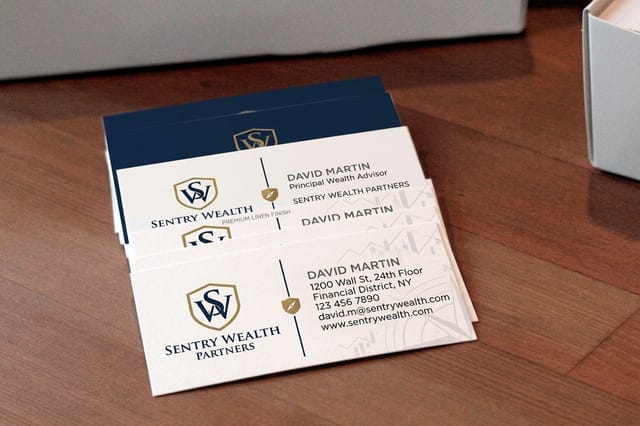
Clients read visual consistency as institutional discipline. Set your name, credentials and required disclosures once in the online designer, reuse that block on the 2 by 3.5 in card, the 8.5 by 11 in letterhead and the 9 by 12 in folder, and check every registration number on the free proof before anything prints.
How they work together
Known locally, the first meeting, then years of service
Four pieces make you known locally, two win the first meeting and six serve the client for years. Print the whole sequence and each stage feeds the referrals the next one depends on.
Cards seed every handshake, CPA lunch, and estate-attorney coffee, seminar postcards put your name and your next event into the households you want as clients, flyers work the seminar chairs and community boards, and rack cards hold your spot in every referral partner lobby.
The brochure states your philosophy in short, concrete terms and goes home to the spouse; the folder turns your proposal into a document worth keeping.
Review letters on real letterhead, handwritten notes at life milestones, and printed discovery forms make onboarding feel like a process refined over years, while the annual greeting card, the branded notepad on a partner desk, and the year-end calendar keep the practice present between reviews.
1. Financial advisor business cards: the wallet-borne referral
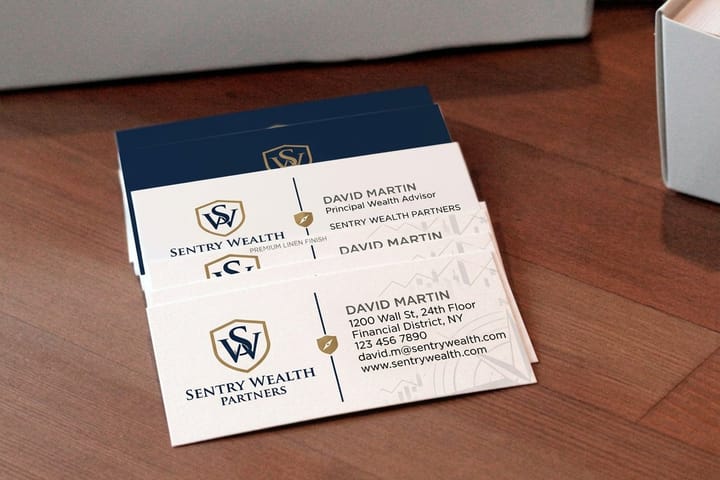
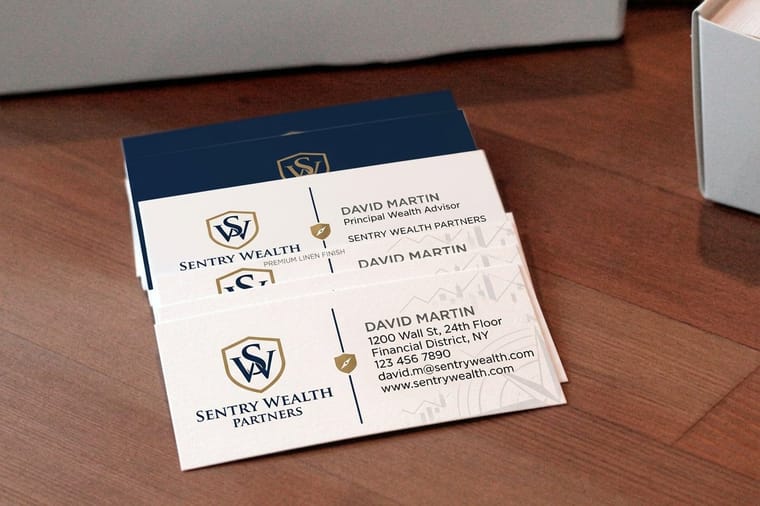
Advisory books grow one introduction at a time: the client who mentions you at a family dinner, the CPA who slides your card across the desk during tax season, the estate attorney who keeps three advisors in a drawer and recommends whichever card is there. The physical card is the mechanism of every one of those referrals, which makes it the most important piece in this set.
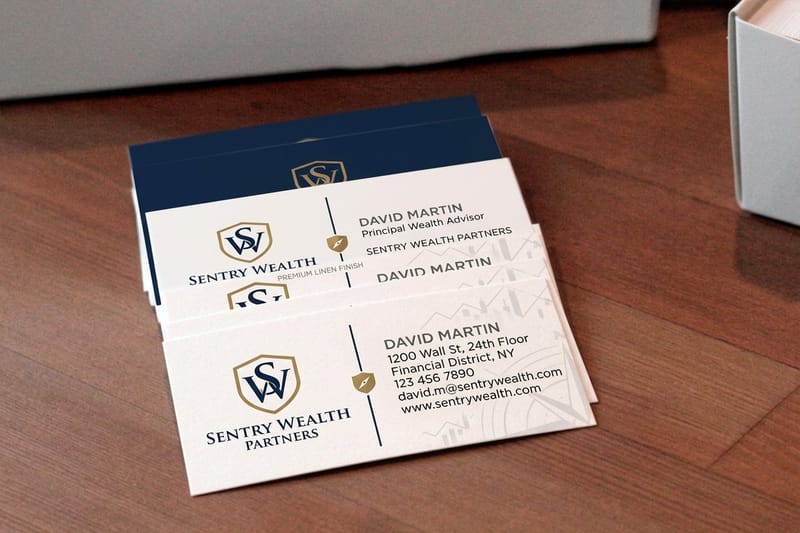
Weight is the message. A thick, matte card with restrained typography says stability the way no glossy gimmick can, and your credentials and registrations in the fine print do quiet reassurance work. Configure financial advisor business cards on the heaviest stock the budget allows, and browse business card printing for finish options when the practice moves upmarket.
Give every client three cards at the annual review, unprompted. You are arming your referral network.
2. Postcards: the seminar invitation that fills the room

The educational seminar, retirement income, Social Security timing, estate basics, remains the steadiest local acquisition engine in financial services, and the mailed postcard is what fills its chairs. The audience you want, people within a decade of retirement with assets to manage, still opens its mailbox daily, and a well-made invitation card lands with a specificity no ad can match.
The formula is stable because it works: one topic in plain words, a date and a respected venue, an RSVP line, mailed to chosen zip codes two to three weeks ahead. The direct mail ROI data lays out the return math, and the financial services marketing case studies show the play in context. Configure standard postcards per event and reorder each season.
Promise education, not products. The card that teaches fills rooms; the card that sells fills recycling bins.
3. Brochures: your philosophy, stated once and left behind
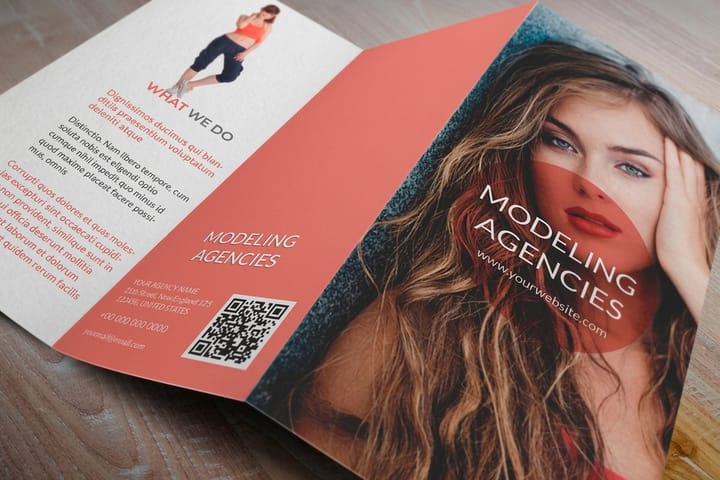
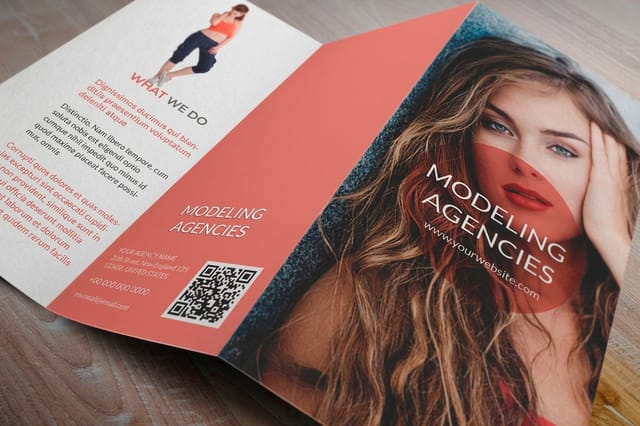
Every first meeting ends the same way: the prospect goes home to think, and to talk to someone who was not in the room. The brochure is your representative in that conversation. It states how you work, what you charge and why, who you serve best, and what a first year together looks like, in the calm plain language that the industry's jargon-heavy materials conspicuously lack.
Structure it around the reader's questions rather than your services list, and keep performance claims out so it never ages. The layouts in company brochure examples are worth studying for hierarchy, and standard brochures fold to fit the presentation folder, the seminar chair, and the referral partner's desk drawer.
Print for the second reader, the spouse, the adult child, the skeptical brother-in-law. That is who the brochure actually convinces.
4. Gloss presentation folders: the plan becomes a keepsake document
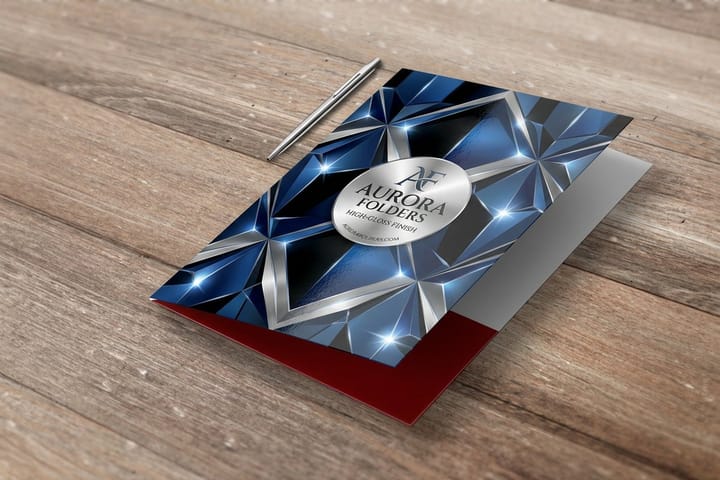
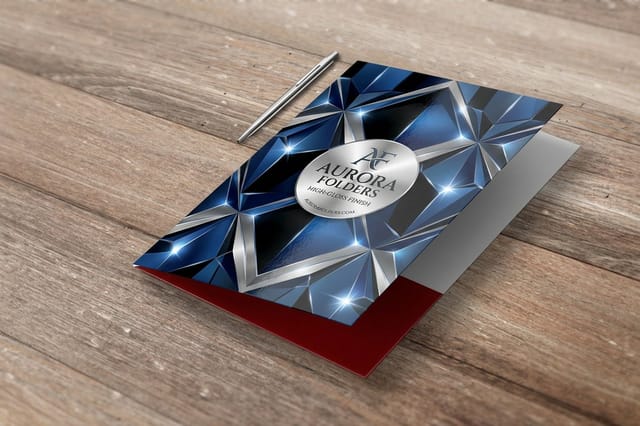
A financial plan is dozens of pages of your best thinking, and how it is handed over decides how it is treated. Loose pages get skimmed and shelved; the same plan in a branded gloss folder gets filed with the family's important documents, brought to reviews, and opened when a spouse asks what the plan actually says. The folder extends your presence into every one of those moments.
Choose interior pockets that organize the engagement, plan on one side, statements and next steps on the other, with a slit for your card. The folder design showcase has real layouts to borrow from, and the wider presentation folders range steps up to linen and foil when your client minimums do.
Hand every prospect their meeting notes in one, even before they sign. The folder that goes home unsigned still argues your case from the kitchen counter.
5. Letterheads: correspondence that reads as a firm
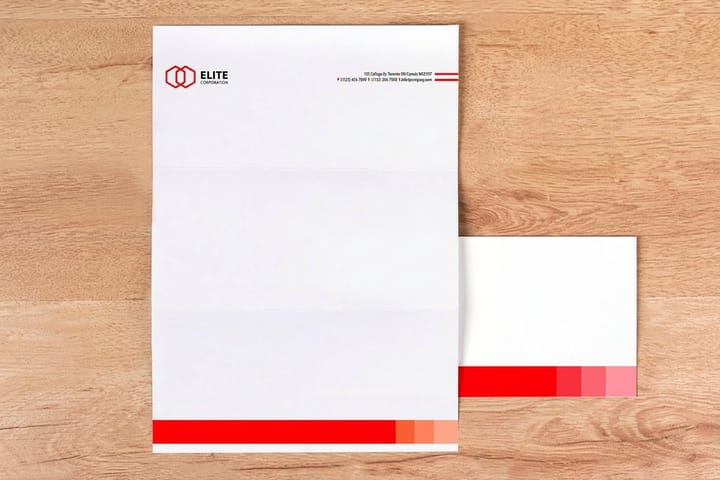
Most advisory correspondence is digital, which is exactly why the letters that arrive on paper carry weight. The annual review summary, the engagement letter, the note accompanying a delivered plan: printed on real letterhead, these read as the output of a firm with standards rather than an individual with a laser printer, and older clients in particular register the difference.
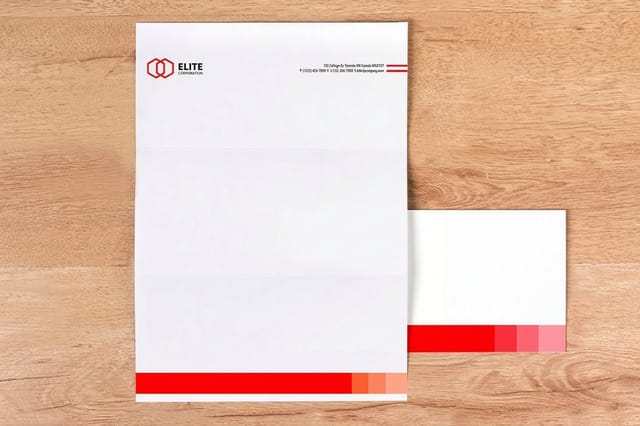
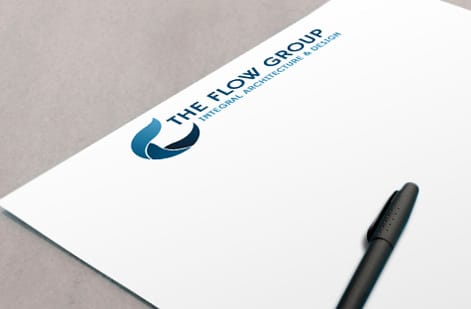
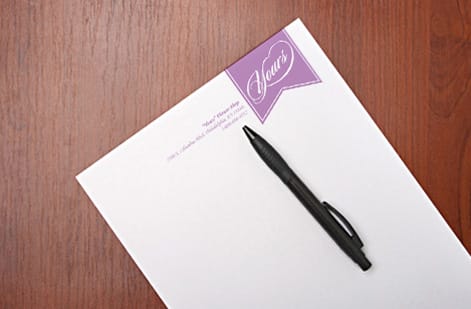
Design it once and quietly: name, credentials, registrations, and contact in a restrained header, your brand color as a single rule line. The primer in what is a letterhead covers the fundamentals, letterhead design tips handles type and format, and standard letterheads print on stocks that match your envelopes.
Reserve letterhead for the letters that matter. Scarcity is what keeps the signal strong.
6. Flat notecards: the handwritten touch no platform can send
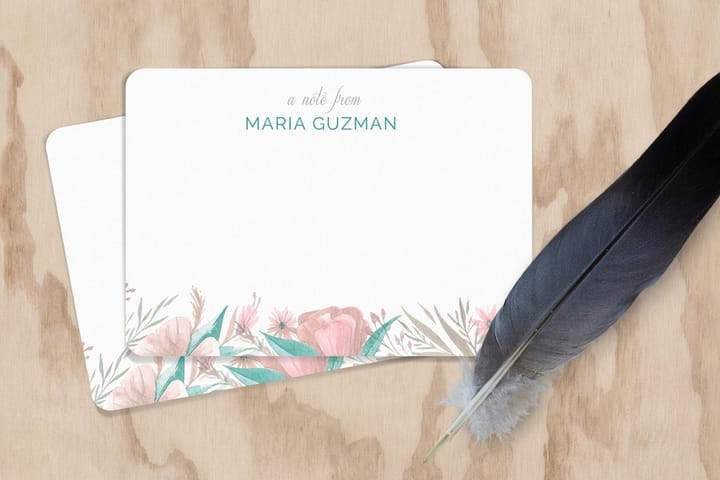
In a business being commoditized by robo-platforms, the moments that differentiate an advisor are stubbornly human: the thank-you after a referral, congratulations on a retirement or a grandchild, condolences after a loss. A handwritten note on a heavy printed card marks those moments in a way no automated email sequence can imitate, and clients keep them, which is the entire point.
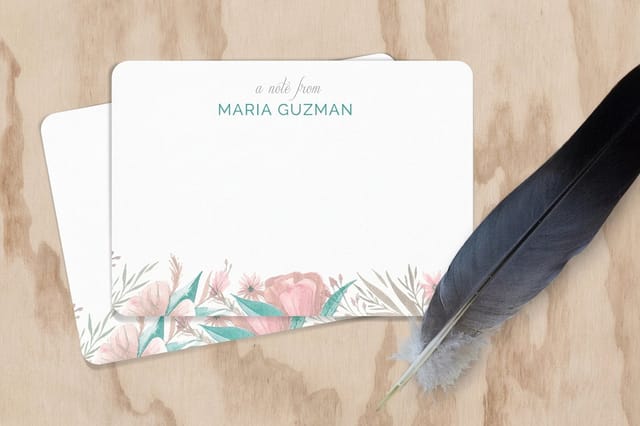
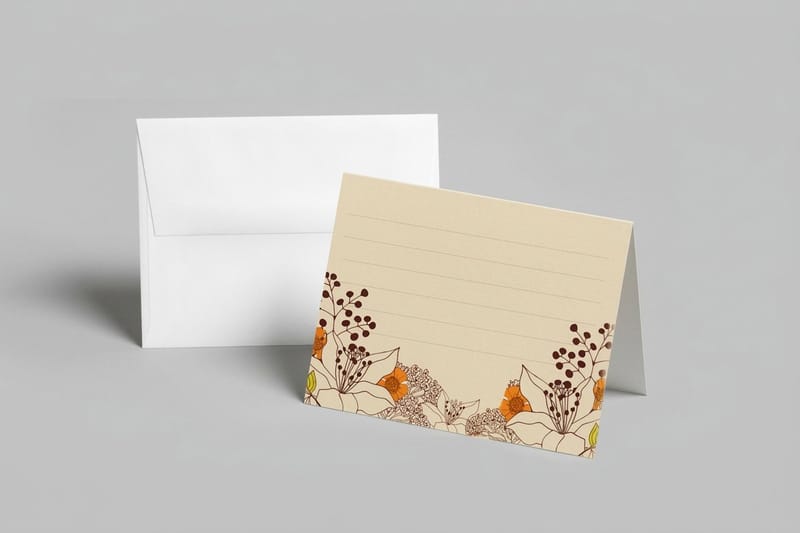
Print flat cards with your name or monogram small at the top and nothing else; the emptiness is where the handwriting goes. Keep a box and stamps in the desk drawer so the note goes out the same day the moment happens. The notecards range covers flat and folded formats, and flat notecards start at a price that makes the habit effortless.
Write three a week. It is the cheapest client-retention program in existence, and the hardest for any competitor to copy.
7. Business forms: onboarding that feels like a refined process
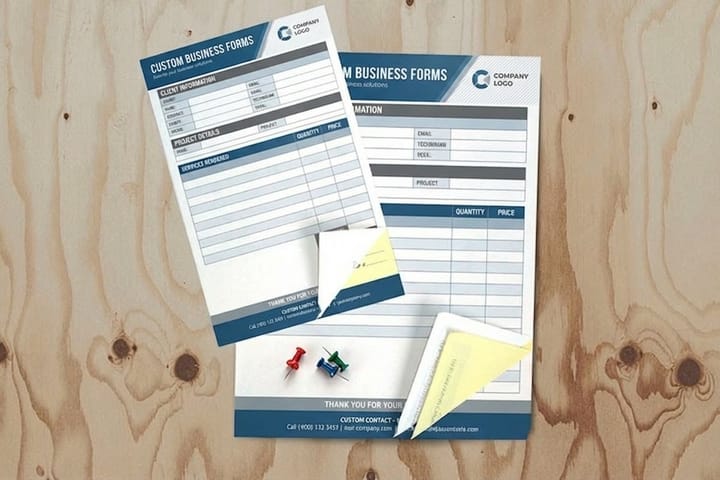
The discovery meeting sets the tone for the whole engagement, and nothing sets it faster than a printed, branded questionnaire sliding across the table. Goals, accounts, risk comfort, family considerations, captured in a form refined over many meetings, tell the prospect they are entering a process, not a pitch. Improvised legal-pad notes tell them the opposite.
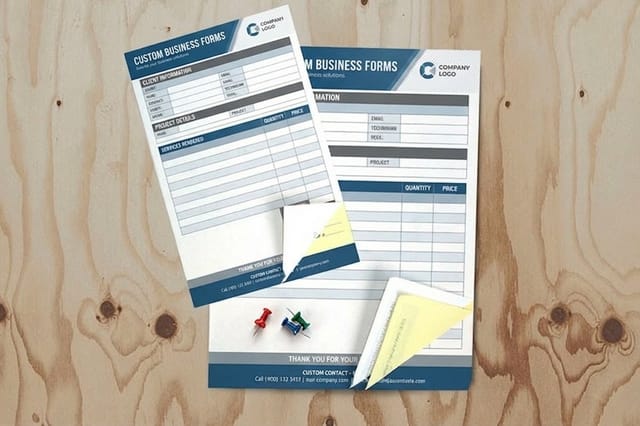
Carbonless duplicates give the client a copy of what they shared, which builds trust and protects you in a regulated business where documentation is everything. Meeting-summary and account-checklist forms extend the same discipline through the engagement. Print custom business forms to your exact layout, numbered and padded to match how your meetings actually run.
The form is the least glamorous piece in this set and the one that most changes how the first meeting feels.
8. Flyers: the seminar handout and the workshop one-pager
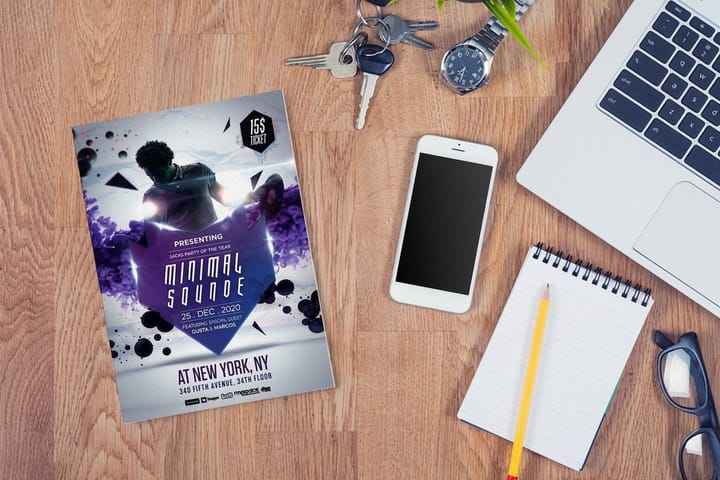
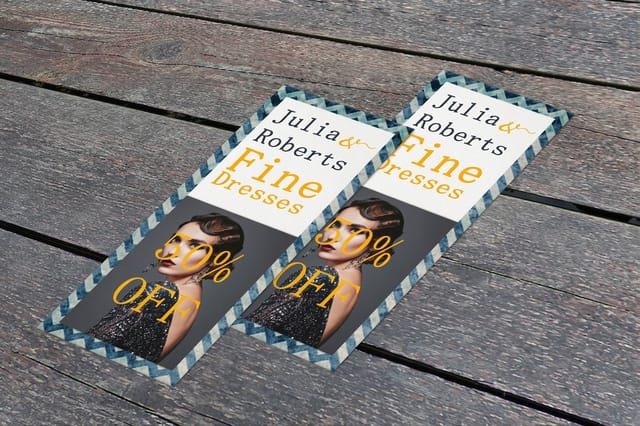
The postcard fills the seminar room; the flyer is what the room takes home. A one-page agenda on every chair, with the three key points of the talk and your contact block at the bottom, turns an hour of education into a document that survives the drive home and surfaces again when the market gets interesting. It is also the piece that books the follow-up meeting, because the offer for a complimentary review sits right under the notes the attendee just took.
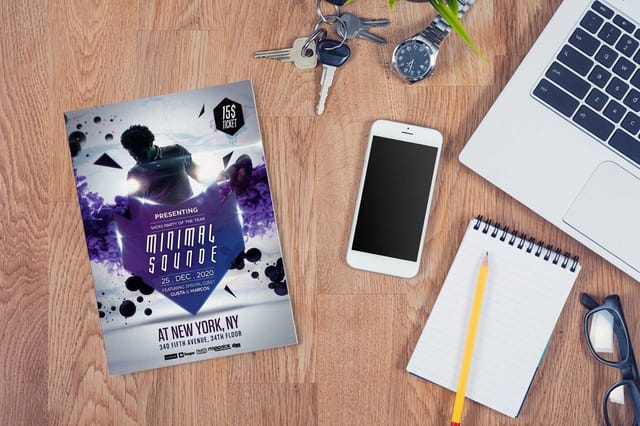
Outside the seminar, the same format works the community: a retirement-readiness checklist on the library board, a college-savings one-pager at the school fundraiser, a plain-language explainer at the chamber table. Our guide to how to design flyers keeps the hierarchy clean, and flyer distribution best practices covers where a professional-services flyer is welcome. Configure standard flyers per event.
Educate on the page the way you educate in the room. A flyer that teaches gets kept; a flyer that pitches gets binned.
9. Rack cards: your panel in the referral partner lobby
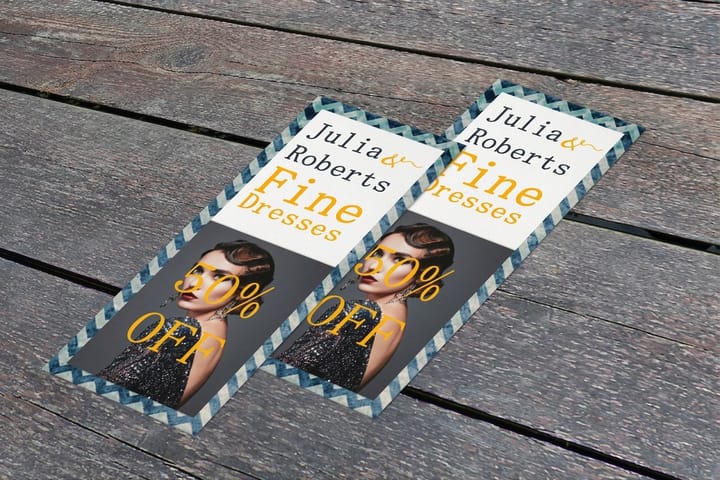
The best advisory leads sit in other professionals' waiting rooms: the CPA's clients during tax season, the estate attorney's clients updating a will, the mortgage broker's clients suddenly thinking about the long term. A rack card in those lobbies is your practice introducing itself at exactly the moment financial questions are already on the visitor's mind, with the referral partner's implicit endorsement standing behind it.
Keep it to one panel of plain answers: who you serve, how you charge, what a first conversation looks like, and how to reach you. Our explainer on what rack cards are covers the format, and how to create a captivating rack card design keeps the narrow canvas working. Configure standard rack cards and refresh the stack each quarter when you visit.
Trade racks with your partners: their card in your office, yours in theirs. The rack card formalizes the referral relationship both sides already want.
10. Greeting cards: the once-a-year touch every client remembers

The notecard marks moments as they happen; the greeting card marks the calendar. A printed holiday card, signed by hand and mailed to every household in the book, is the one touch per year that reaches every client at the same time, including the quiet ones who never call and are therefore the easiest to lose. In a relationship business, being remembered in December is worth more than being clever in July.
Print a card that matches the practice: restrained design, your brand color, a warm message that is signed rather than printed. Skip the market commentary entirely. The greeting cards range covers folded formats and stocks, and greeting cards price by quantity so the whole book mails for less than one client lunch.
Order in October, sign in November, mail the first week of December. The card that arrives early is the one that gets displayed on the mantel all month.
11. Notepads: your name on the desk between referrals

Referral partners forget you between introductions, not because the relationship soured but because nothing on their desk says your name. A branded notepad fixes that for months at a time: the CPA jots a client's number on your pad, the attorney sketches an estate diagram on it, and your name and phone sit in the margin of every page they tear off. It is the cheapest permanent presence you can buy in the offices that feed your practice.
Design it like your letterhead's younger sibling: name, credentials, and phone in a slim header, plenty of white space below. Drop a fresh pad at every partner visit and leave one in your own conference room for meeting notes that go home branded. The notepads range covers sizes and sheet counts, and standard notepads pad in quantities that make the habit sustainable.
Clients take them too. A pad by the kitchen phone keeps your number where the family actually looks for it.
12. Calendars: the year-end gift that works all year
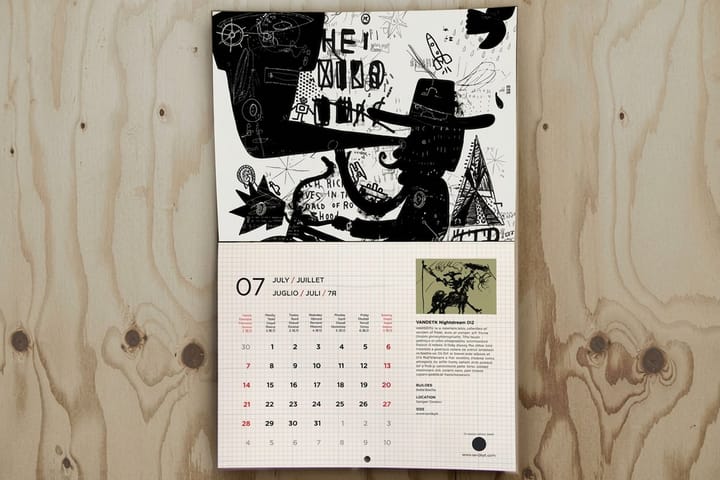
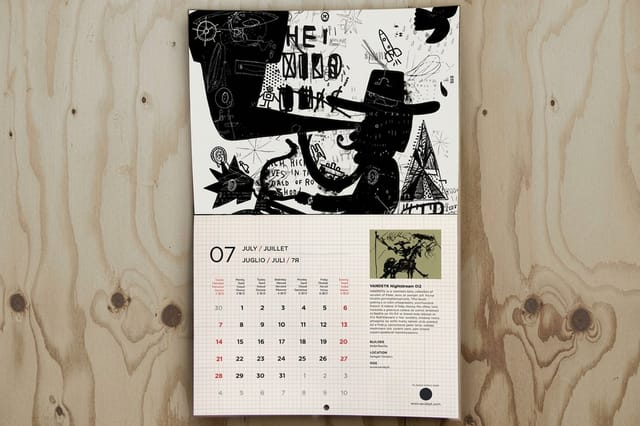
Most client gifts are consumed and forgotten by January. A printed wall calendar hangs in the kitchen for twelve months, and your name is on it every time the household checks a date, which is daily. For an advisor, that is 365 quiet impressions per client per year, in the room where financial conversations between spouses actually happen. No other piece in this set works that long on a single order.
Make it a calendar worth hanging: clean photography or local scenes, generous date grids, and your practice name and phone in a restrained footer rather than a billboard header. Mark the dates that matter to your clients, tax deadlines, RMD season, open enrollment, and the calendar becomes quietly useful in exactly your domain. The calendars range covers wall and desk formats, and standard calendars price by quantity for the whole book.
Hand them out at annual reviews in November and December. The gift doubles as the reminder that the review season has arrived.
%22%2F%3E%3Ccircle%20cx%3D%2236%22%20cy%3D%2220%22%20r%3D%2231%22%20fill%3D%22%23a78bfa%22%20opacity%3D%220.15%22%2F%3E%3Ccircle%20cx%3D%2233%22%20cy%3D%2229%22%20r%3D%2210%22%20fill%3D%22%23a78bfa%22%20opacity%3D%220.1%22%2F%3E%3Crect%20x%3D%2276%22%20y%3D%2210%22%20width%3D%2221%22%20height%3D%2220%22%20rx%3D%224%22%20fill%3D%22%23a78bfa%22%20opacity%3D%220.08%22%20transform%3D%22rotate(16%2080%2030)%22%2F%3E%3C%2Fsvg%3E)
Specs and pricing
Advisor card stocks and the price per card
The business card is the piece an advisor hands out most, so it sets the pace. A 100 pack is $17.57, or $0.18 a card, in 3 business days.
| Quantity | Price Per Unit | Total |
|---|---|---|
| 100 | 17.6¢ | $17.57 |
| 200 | 11.5¢ | $23.07 |
| 300 | 9.15¢ | $27.46 |
| 400 | 7.96¢ | $31.86 |
| 500 | 7.25¢ | $36.26 |
| 600 | 6.77¢ | $40.64 |
| 700 | 6.43¢ | $45.04 |
| 800 | 6.18¢ | $49.43 |
Wally explains the set
Twelve pieces, one practice, printed to be worth recommending
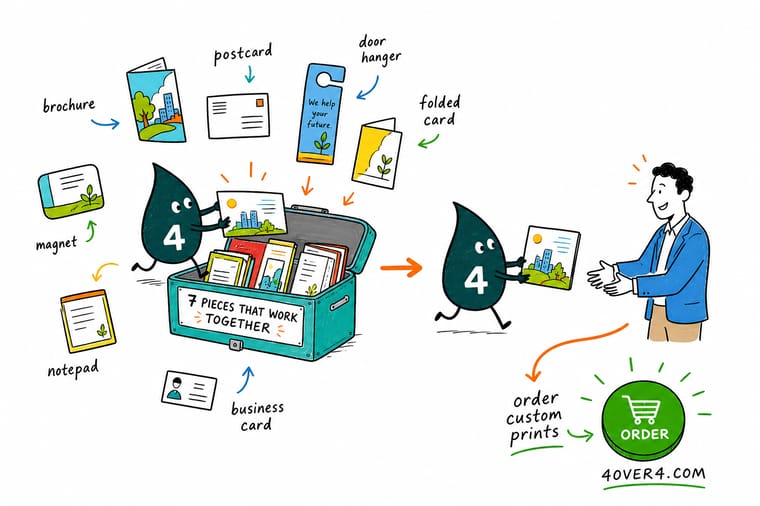
Wally thinks an advisory practice grows like compound interest. The card, the seminar postcard, the flyer, and the rack card are the steady contributions, the brochure and the gloss folder convert meetings into clients, and the letterhead, notecard, discovery form, greeting card, notepad, and calendar are the discipline that keeps clients referring for decades. Keep one typeface and palette on all 12 and the whole practice reads as one trustworthy firm.
Shop financial printing →See it in use
Letterhead work from our press

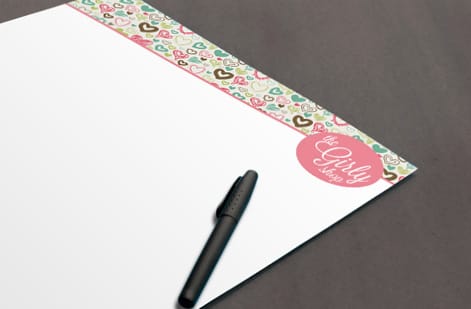
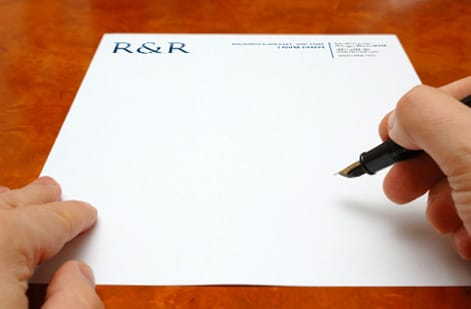


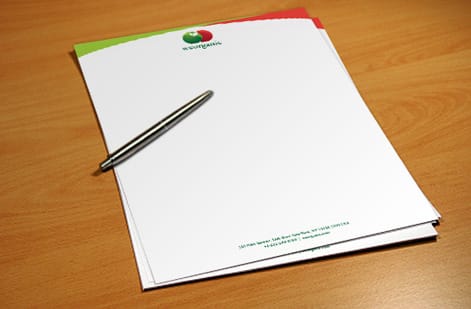

Explore more
Where to go next


By the numbers
One set, printed to compound
Common Questions
Common questions about the advisor print set
What is in the financial advisor local-marketing print set?
Twelve pieces that build and serve a local advisory practice: financial advisor business cards, postcards, brochures, gloss presentation folders, letterheads, flat notecards, business forms, flyers, rack cards, greeting cards, notepads, and calendars. Cards, postcards, flyers, and rack cards create local visibility, brochures and folders win first meetings, and letterhead, notecards, forms, greeting cards, notepads, and calendars make the ongoing service feel like an established practice.
What should a new advisor print first?
Business cards on a noticeably heavy stock, then seminar postcards. The cards work every networking moment from chamber events to CPA referral lunches, and the postcards fill the educational seminars that remain the steadiest local acquisition channel in financial services. Everything else in the set builds on those two.
Do seminar invitation postcards actually fill rooms?
Mailed invitations remain the workhorse for financial seminars because the audience that attends, often pre-retirees with real assets, still reads its mail. A clear topic, a date, a respected venue, and an RSVP line, mailed to selected zip codes two to three weeks out, is the formula practices repeat year after year because it keeps working.
Why does presentation matter so much for a financial plan?
Because the plan is the product, and clients cannot evaluate portfolio math the way they can evaluate how the engagement feels. A plan delivered in a branded gloss folder gets filed, revisited at reviews, and shown to spouses and heirs, extending your presence into decisions you are not in the room for. Loose pages, however brilliant, rarely survive the drive home.
Is printed letterhead still relevant for an advisory practice?
For the letters that matter, yes. Annual review summaries, engagement confirmations, and milestone letters carry more weight on real letterhead than in an email thread, and older clients in particular read paper correspondence as a sign of a firm rather than a freelancer. Match the letterhead stock to your envelopes and the practice reads as one considered brand.
What do the notecards accomplish that email cannot?
A handwritten note is scarce, and scarcity signals care. A thank-you after a referral, congratulations on a retirement or a grandchild, condolences after a loss: these are the moments that decide whether clients mention you to friends. Two minutes of ink on a printed notecard outperforms any automated touchpoint in the relationship business.
Can the set be reordered piece by piece?
Yes. Each product has its own configurator, so reordering postcards for the next seminar season or another run of notecards takes a few clicks without touching the rest. Keep one set of design files and the practice looks identical from your first client to your five hundredth.
Get Started
Order 25 notecards for $19.77
Order the set from 4OVER4.COM one piece at a time, folders and calendars first. Adjust size, quantity, and finish on any product and watch the price update live.
Legal Disclaimer
Gold Standard guarantees apply to all standard orders placed through 4over4.com. Price match requires verifiable proof of a competitor's published price for an equivalent product with matching specifications and turnaround time. Satisfaction guarantee covers manufacturing defects and print quality issues. Contact support with order number and documentation.
