
What Table Tent Cards Are and Where They Sell Best


Sofia is our design and templates voice, built from the knowledge of our production team, with over 20 years in printing.
A table tent is the folded card standing between the salt and the ketchup. Here is what it is made of, where it earns its place in each type of venue, and the stock that keeps it upright through a service.
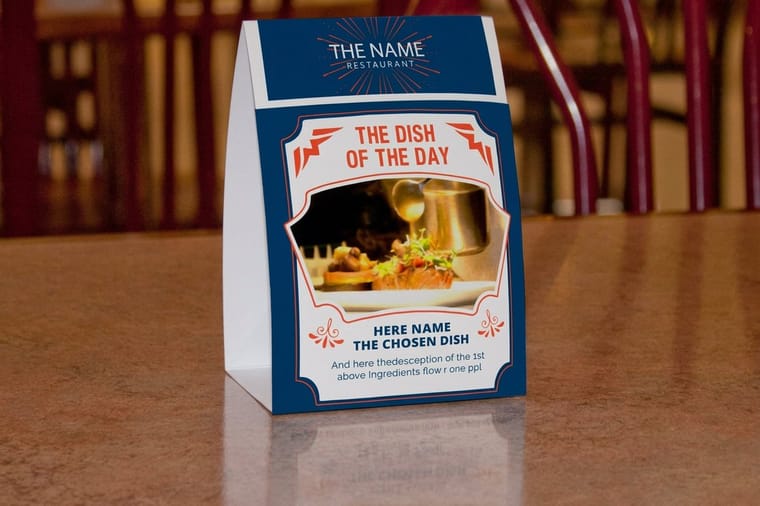
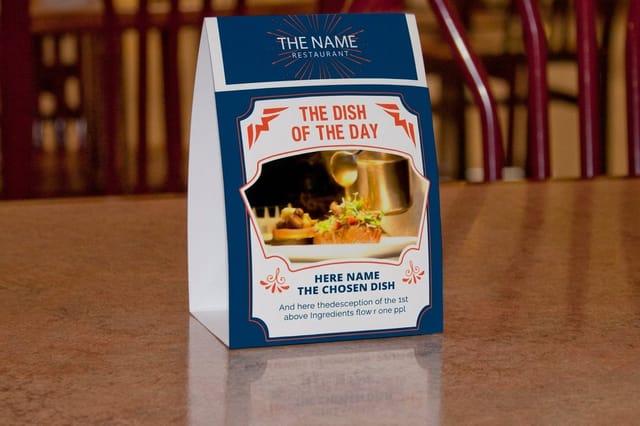
A table tent card is a piece of cardstock scored twice and folded into a self standing triangle, with a flap that tucks under the base to lock it. Businesses use it to put one offer in front of a seated or waiting customer at every table, bar rail, and counter at once. Both large faces are read, because people sit on opposite sides, so each one carries a different message. The finished tent stands about half as tall as the flat sheet, and 16pt cardstock is what stops it leaning after a week.
Quick answer
One scored sheet, two reading faces, no holder
A tent card is cardstock scored twice, folded into a triangle, and locked by a flap that tucks under the base. It stands on a table or a counter without hardware, which is why it goes on every surface in a venue at once. The two large panels face opposite directions, so a single piece serves both sides of a table and each face should carry a different message. Fold height is the catch: the finished tent is roughly half the flat sheet, so build the artwork to the flat size with bleed on all four edges and keep type clear of the score lines.
Tent cards
What a table tent is, and the names buyers use for it
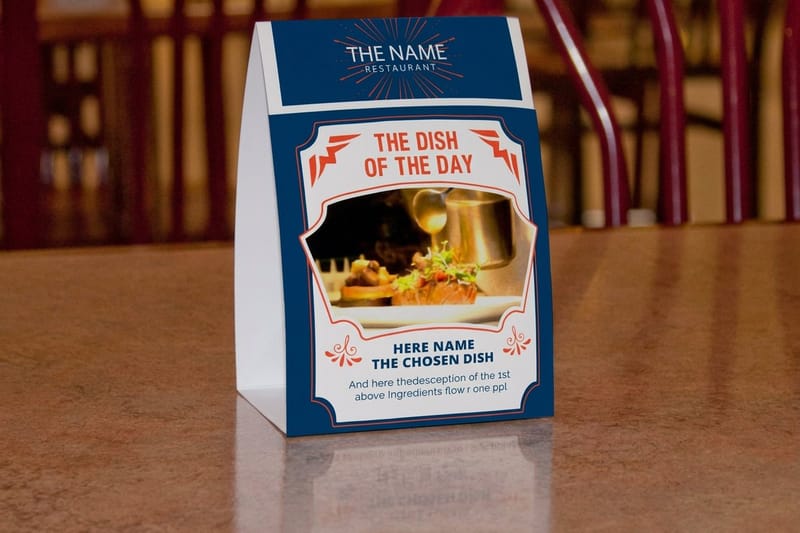
A table tent is a scored card folded to stand on a table with two reading faces, and tent card, table talker and table topper all name the same piece. Our table tents print 4 x 6 inches finished from a 4 x 16.25 inch flat sheet, on 14pt gloss cover with a high gloss UV coating, starting at 250 for $554.39. A tent card works the same way at any size: one sheet, two scores, a flap under the base, and a message on each face for the people on either side of the table.
What a Table Tent Card Is, and What It Is Not

Take a rectangle of cardstock, score it twice across the width, fold it into a triangle, and tuck the bottom flap under the base. That is a table tent. The two large panels lean into each other and hold the shape by geometry, which is why the piece needs no easel, no acrylic holder, and no clip.
What it is not is a sign. A sign is read at distance by someone walking past. A tent is read at arm's length by someone who has already stopped moving, which changes everything about how you write it. You get more words than a poster and fewer than a menu, and you get them from a person who is sitting still with nothing else to look at.
The trade calls the same object several things. Table tent, tent card, table talker, counter card. They describe the same folded piece at slightly different sizes, and a supplier will understand any of them. If the piece has a flat back and needs a stand behind it, it is a counter card and not a tent, and that distinction matters when you compare quotes.
Table tents live in the same family as printed menus and flyers, but they are the only one of the three that stands up by itself. Browse the folded formats in the table tent printing category to see how the score pattern changes with the size.
A tent card and a place card share the fold and split the job. The table tent is the promotional piece for restaurants and retail, 4 x 6 inches finished, standing on a table for a season or a two or three week promotion on 14pt or 16pt cover. At weddings and events, tent card also means a small folded name card at each seat, which carries a guest name instead of an offer. The sizing and stock advice on this page is for the promotional tent.
Why a Folded Card Outperforms a Flyer on the Same Table
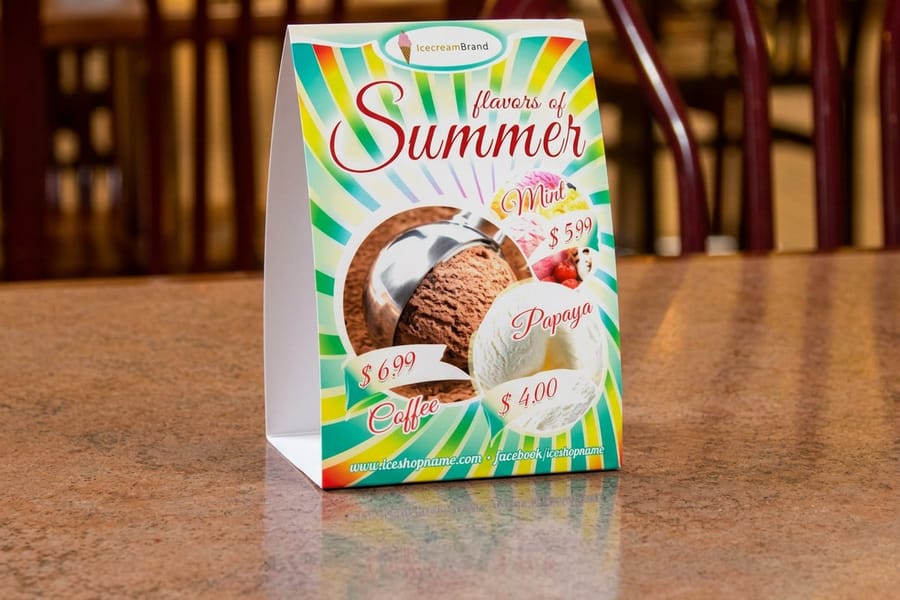
A flyer lying flat on a table competes with the tablecloth. A tent stands in the sightline of somebody who is already seated and waiting, which is the only advertising position in the building where the audience cannot leave.
Two structural advantages do the work. First, the tent is vertical, so it holds its message at roughly eye level for a seated adult instead of lying in the peripheral field below the table edge. Second, it has two reading faces pointed in opposite directions, so a two top gets served by a single piece. A flyer serves one person and then gets moved when the food arrives.
The honest limit is dwell time. A tent only works where people sit or stand still for a few minutes. Put one on a table in a fast counter service line where nobody sits and it does nothing, and the money would have gone further on a wall poster above the register. Match the piece to the pause.
The other limit is clutter. One tent per table reads. Three tents, a condiment caddy, and a card stand on the same surface means none of them are read, and staff quietly stack them at the end of the table. If you already have a folded piece on every table, replace the message instead of adding a second tent.
What Table Tents Actually Do for Restaurants and Retail
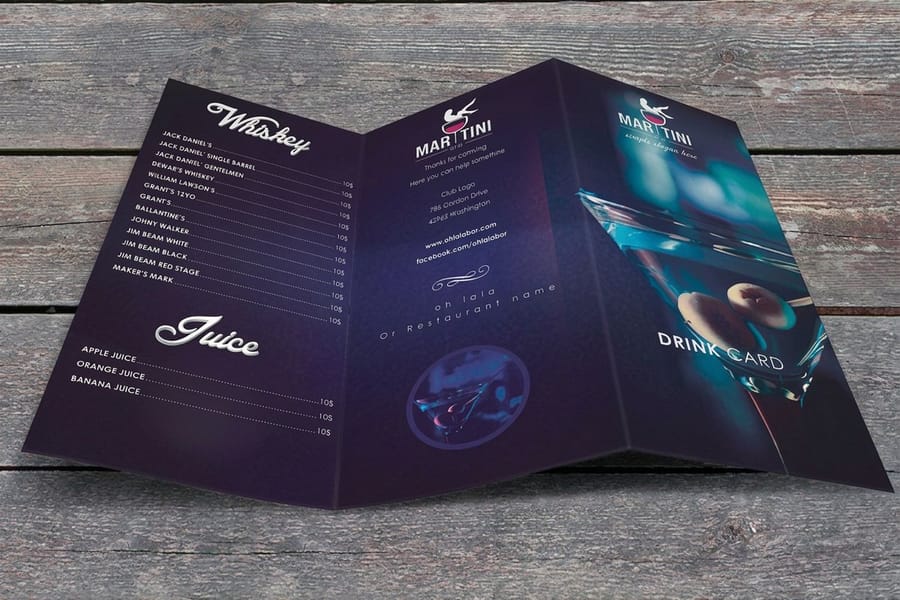
The strongest use is the upsell that a server does not have time to make. A 4 x 6 inch tent on the table for a dessert flight, a cocktail of the week, or a Tuesday prix fixe puts the offer in front of a guest during the exact minutes between ordering and eating, and it does it at every table at once without adding a word to the server's script. Put the dessert on the face toward one seat and the loyalty signup on the face toward the other, and one card carries two offers.
The second use is the ask that is awkward in person. Loyalty program signups, review links, wifi passwords, catering enquiries, and gift card reminders all sit better on a card than in a conversation. The guest reads it in their own time and acts or does not, with nobody standing there waiting.
In retail the same logic applies to any surface where a customer stands still. A checkout counter, a fitting room ledge, a service desk. A tent there carries a return policy, a financing offer, or a product care instruction better than a sticker on the counter, because it is legible from a standing height and can be swapped weekly.
Where it fails: anything that needs to leave with the customer. A tent is a fixture, not a handout. Pair it with something that travels, like postcards for a takeaway offer or printed menus a guest can carry to the door, and let the tent do the standing still.
Where to Put Table Tents, Venue by Venue
Placement is the decision that separates a tent that gets read from one that gets pushed to the edge of the table. The rule underneath the whole table below is simple: the piece works where somebody has stopped and has nothing in their hands.
| Venue | Best surface | What it should say | Why it works there |
|---|---|---|---|
| Full service restaurant | Centre of the table, behind the condiments | Dessert, drink of the week, next visit offer | Guests sit for several minutes before and after ordering with nothing to read. |
| Bar or pub | Bar rail, spaced every third stool | Cocktail list, happy hour window, event nights | People wait standing at the rail, and the tent is the only thing at eye level. |
| Cafe counter | Beside the register, angled to the queue | Loyalty card, pastry pairing, bean of the month | The queue is captive and facing forward for the length of the order. |
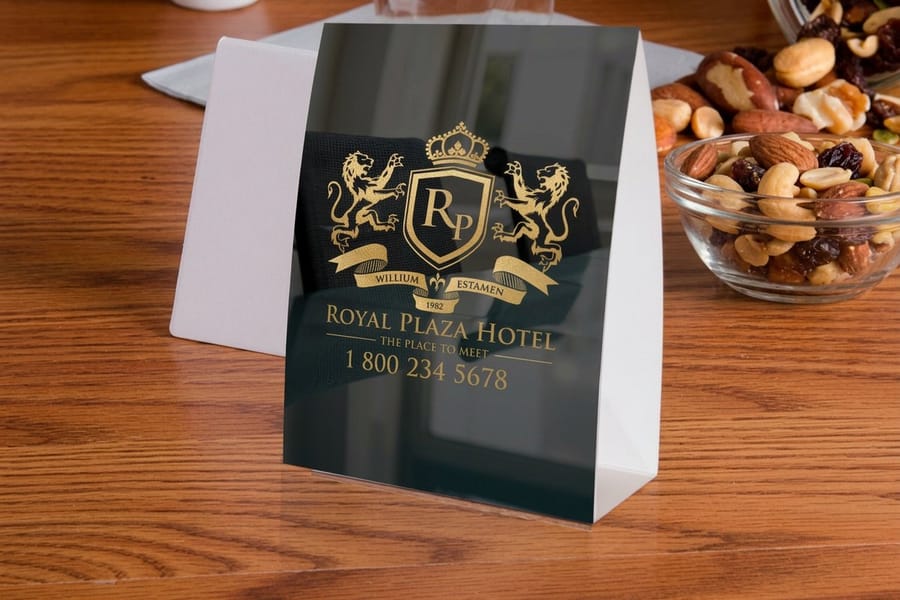
| Hotel lobby and rooms | Reception desk and the in room desk | Restaurant hours, spa booking, late checkout | Guests read the desk surface while unpacking, with no staff present to ask. |
| Retail checkout | Counter, turned toward the customer side | Returns policy, warranty, financing, add on | Standing height reading during the payment pause. |
| Trade show booth | Demo table and the corner of each seat | Spec sheet highlights, booth number, meeting link | Visitors browse a table alone before anyone greets them. |
| Salon or clinic waiting area | Side tables between chairs | Service menu, referral offer, aftercare | Long seated waits, and a tent outlasts a magazine stack. |
Two placement mistakes repeat everywhere. Facing the tent toward the kitchen instead of the guest is the first, and it happens whenever staff reset tables in a hurry, so print both faces and the problem solves itself. The second is putting a tent on a table that gets a full plate service, where it is moved on the first course and never put back. On those tables, a smaller tent at the far corner survives; a tall one does not.
For venues that also need a piece the guest carries away, the restaurant printing collection covers the pieces that pair with a tent on the same table.
Sizes, Stock, and Coating That Keep a Tent Standing
Size first, because folding roughly halves the sheet. If you want a finished tent that stands six inches tall, the flat sheet is a little over twelve inches tall before the flap, and your artwork has to be built to that flat size with bleed on all four edges. Designing to the finished dimension is the single most common file error on this product.
Stock is what decides whether the piece is still standing on Friday. A tent has no support behind it, so the paper is the structure.
| Choice | How it behaves as a tent | Best for |
|---|---|---|
| 14pt cardstock | Holds a fold, but leans on anything above roughly five inches tall and softens in a humid room. | Short promotions of two or three weeks, small counter tents. |
| 16pt cardstock | Noticeably more rigid. Stands square, takes a knock, and can be stood back up without a new crease. | Anything living on a table for a season, and any tent above five inches. |
| Gloss coating | Wipes clean. Condensation rings and thumbprints come off with a cloth instead of staining. | Bars, cafes, anywhere drinks are set down beside the piece. |
| Matte coating | Kills glare under hard pendant and spot lighting, but holds grease marks and shows a scuff sooner. | Dim dining rooms, hotel desks, waiting areas away from food. |
| Uncoated | Takes pen and stamp ink, absorbs spills permanently, scuffs at the fold. | Tents staff write on, such as reserved cards and daily specials. |
One detail that catches people out: a heavy coating cracks slightly along a fold if the crease is pressed with a fingertip rather than run along a straight edge. Scoring before folding is what prevents it, and it is why a scored tent from a printer folds cleanly while the same card cut on a home guillotine cracks white along the crease. The cardstock weights guide covers what the point measurement means, and the gloss versus matte comparison covers the coating decision in more depth.
How to Design and Order Table Tents Without a Reprint
Start from a correctly scored template rather than an empty artboard. The score positions decide where the fold lands, and a layout built without them puts type across a crease more often than not. Our blank template library has the flat layouts with the fold lines marked.
Then apply four rules that survive contact with a real dining room.
- One idea per face. A tent is read in about three seconds by somebody who is also talking. A headline, a price or a detail, and one instruction is the whole budget.
- Keep type off the score. Give the fold line a clear margin on both sides. A word that straddles the crease is unreadable at an angle and cracks first.
- Write Face B as a different ad. The seat opposite is a second person. Give them a second offer, or the loyalty signup, or the wifi.
- Leave the bottom inch quiet. The base of a tent disappears behind a condiment caddy, a napkin holder, or a plate rim more often than you expect.
On price, plan the quantity before you compare products. Table tents start at $554.39 at 4OVER4.COM, against $57.11 for standard menus, $108.75 for standard posters, and $39.54 for standard flyers. The gap is not a markup on the same thing: a tent is a heavier stock, scored, folded, and made in runs sized for a whole room rather than a handful. Check the quantity tiers on the configurator before you set the comparison, because the per piece cost moves sharply with the run.
Order once, order for the room, and order spares. If you are new to sending print files, how online printing works walks through the handoff from file to delivered box, and restaurant menu sizes covers the piece that usually ships alongside the tents.
Wally explains table tents
Two scores, one fold, and a card that stands on its own
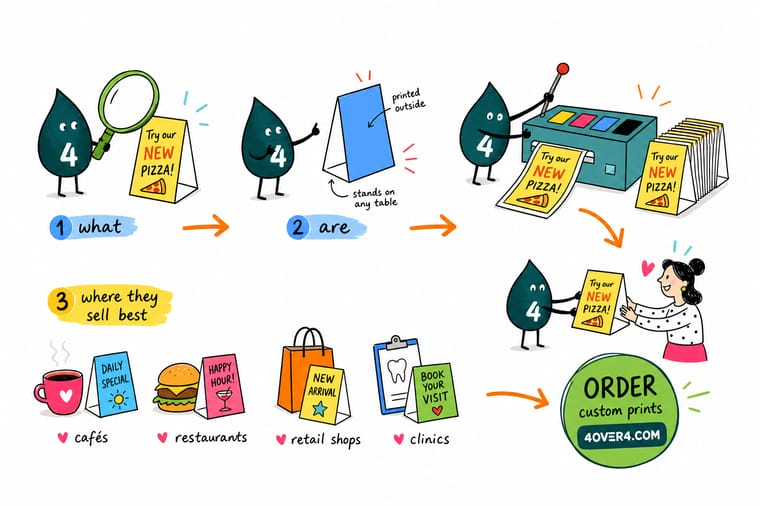
Wally prints the sheet flat, scores it twice, folds it into a triangle and tucks the flap under the base. Now it stands up with nothing holding it. He puts the dessert offer on the face pointing at you and the loyalty signup on the face pointing at whoever sits opposite, because both get read. He uses 16pt so it does not lean by Friday, and he keeps the type off the crease so nothing cracks along the fold.
Order custom table tents →
Specs and pricing
Table tents and the pieces that sit beside them
Table tents run 4 x 6 inches finished on 14pt gloss cover from 250 for $554.39. Menus start at 50 for $57.11 in sizes from 4.25 x 11 to 11 x 25.5 inches, and flyers at 50 for $39.54 from 4.25 x 5.5 inches up. The cards below carry the live configuration choices from the 4OVER4.COM configurator.

Print it
Print the tent, the menu, and the wall piece together
Order the 4 x 6 inch tent, a menu in 8.5 x 11 or 11 x 17 inches, and a poster from 11 x 17 up to 22 x 28 inches for the wall, so the same offer runs at the table, in the hand and above the register.

Explore more
Where to go next
If you are choosing between 14pt and 16pt, start with the cardstock weights guide. If the tent sits beside a menu, the restaurant menu sizes guide lists each format, and the restaurant printing collection holds the rest of the front of house kit.

By the numbers
Table tents from a 25 year print floor
Common Questions
Your table tent questions, answered
What is a tent card?
A tent card is a small piece of printed cardstock scored so it folds into a free standing triangle, with a flap at the bottom that tucks under the base to lock the shape. It stands on its own on a table, a counter, or a desk without a holder. In restaurants it is usually called a table tent, and the same piece is called a tent card, a table talker, or a counter card depending on the trade. It always has at least two printable faces, because people approach it from both sides.
What size should a table tent card be?
The finished height matters more than the flat sheet size, because folding roughly halves the sheet. A tent in the 4 by 6 inch range sits comfortably beside a place setting and clears a water glass. A taller tent in the 5 by 7 range reads from across a room and suits a bar rail or a lobby counter, but it takes up space a server needs on a full table. Measure the surface it will live on before you pick, then check the exact sizes on the table tents configurator.
What paper should table tents be printed on?
Use a cover weight, not a text weight. 14pt cardstock works for a short two or three week promotion, but it starts to lean once the room gets humid. 16pt holds the fold, resists curling, and survives being knocked over and stood back up. A gloss coating wipes clean when a condensation ring or a thumbprint lands on it, which happens constantly on a bar top. Matte reads better under bright pendant lighting but shows grease sooner.
Do you print on both sides of a table tent?
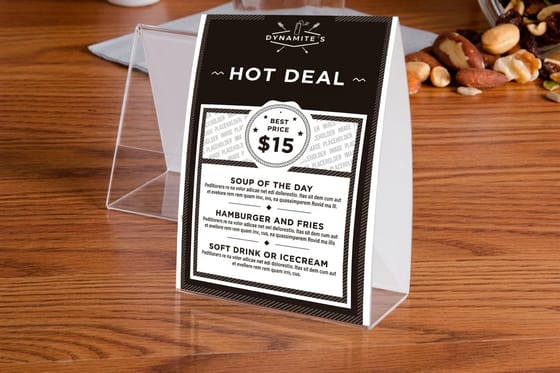
Yes, and the two faces should say different things. Face A can carry the offer for the guest who sits down first, and Face B can carry a second item, a loyalty signup, or the wifi details for the seat opposite. Printing the same artwork twice is a common waste. The one case for identical faces is a counter tent where people only ever approach from one direction and you want the piece to look right whichever way staff set it down.
How many table tents does a restaurant need?
Count the tables, then add the bar rail, the host stand, the waiting bench, and the restroom vanity if you use one there. Add roughly 15 percent on top, because tents get spilled on, bent, and taken home by children. A 30 table dining room usually lands somewhere around 45 to 50 pieces once the non table surfaces and the spares are counted, which is why table tents are ordered in runs rather than a handful at a time.
Do table tents arrive folded or flat?
They are printed and scored flat, then shipped flat so the panels do not crush in transit. You fold along the two scores and tuck the flap when the box arrives, which takes a few seconds per piece. Fold along the score with the printed face outward, press the crease along a table edge rather than with a fingertip, and the fold stays crisp instead of cracking the coating.
Get Started
Ready to put an offer on every table?
Pick your size, choose 16pt with a gloss coat so it wipes clean on a bar top, and we print and score tents that fold in seconds and stand through a full service.
Legal Disclaimer
Gold Standard guarantees apply to all standard orders placed through 4over4.com. Price match requires verifiable proof of a competitor's published price for an equivalent product with matching specifications and turnaround time. Satisfaction guarantee covers manufacturing defects and print quality issues. Contact support with order number and documentation.
