
How the Flywheel Model Replaces the Funnel and Compounds Growth


Jim Collins used a heavy wheel to explain why great companies have no breakthrough moment. The model has four turns, a known source of friction, and a point where it does not apply at all.
The flywheel model treats growth as a loop in which the output of one sale, a satisfied customer, becomes the input that produces the next one through a referral, a review or a reorder. A funnel discards the customer at the bottom and refills the top from zero every cycle, so the cost of each new customer never falls. A flywheel keeps them, which is why the same effort produces more with each turn once the wheel has mass.
Quick answer
The customer is the engine, not the finish line
A flywheel is any loop where the result of one turn powers the next. Sell well, the customer is delighted, they refer someone or come back, and that referral is the start of the following cycle rather than a fresh cost. Jim Collins used the image to explain companies with no single breakthrough decision, Amazon built an operating model out of it, and HubSpot replaced its funnel with it in 2018. The catch is that a cold wheel gives you nothing for a long time, and the same mechanism compounds bad experiences just as efficiently.
Where the Flywheel Model Came From
Jim Collins introduced the flywheel in Good to Great in 2001, and the reason it stuck is that it answered an awkward question. He kept asking executives at companies that had transformed themselves to name the single decision that did it, and they could not. There was no launch, no hire, no acquisition that anyone pointed to. Pressed, they described the same thing: a heavy disc that took enormous effort to move at all, then one turn, then two, then a speed nobody could pin on any particular push.
Amazon turned the metaphor into an operating diagram. Lower prices bring more customers, more customers attract more third party sellers, more sellers widen the selection, and a wider selection brings more customers again. A second loop hangs off the same hub: growth spreads fixed costs across more units, and the saving funds the next price cut. Neither loop is clever on its own. What makes it a flywheel is that the end of each arc is the beginning of the next.
HubSpot took the shape into marketing in 2018, put the customer in the middle, and arranged attract, engage and delight around them, replacing the funnel it had spent a decade teaching. Different industries, same structure. That structure is the test: if the last step of your loop does not physically hand something to the first step, you have drawn a checklist in a circle. A genuine flywheel produces its own fuel, and the honest way to check is to ask what the fourth step gives to the first one that it did not already have.
A Funnel and a Flywheel Are Not the Same Shape
The funnel is not wrong. It is a measurement tool that got promoted to a strategy, and the promotion is where the damage happens.
| Model | Core idea | After the purchase | Where it breaks |
|---|---|---|---|
| Sales funnel | A cohort narrows through stages until some of them buy. | Nothing. The customer leaves the diagram. | Every cycle refills the top from zero, so cost per customer never falls. |
| Marketing flywheel | Satisfied customers generate referrals, reviews and reorders. | The customer becomes the input for the next turn. | Needs a base of happy customers to spin, so it is useless on day one. |
| Cost flywheel | Scale lowers unit cost, which funds a lower price, which brings scale. | Volume itself is the input. | Only works where fixed costs dominate, and it punishes small runs. |
Read the third column. That is the whole argument. A funnel gives you a clean forecast and shows you which stage people stall at, and you should keep using it for exactly that. What it will not tell you is whether this month cost less to win than last month, because it has no memory of anyone who already bought.
The practical rule is to report in funnel language and plan in flywheel language. If your quarterly plan ends at the sale, you are running a funnel regardless of the shape on the slide. And if referrals are meant to carry a turn, the way you describe yourself has to be repeatable by a customer, which is the real job explained in the difference between marketing and branding and in brand messaging for small business.
The Four Turns and What Each One Owes the Next
Attract, engage, delight, refer. The labels vary by author and it matters less than the handoff. Judge each turn by one question: what concrete thing does it pass along?
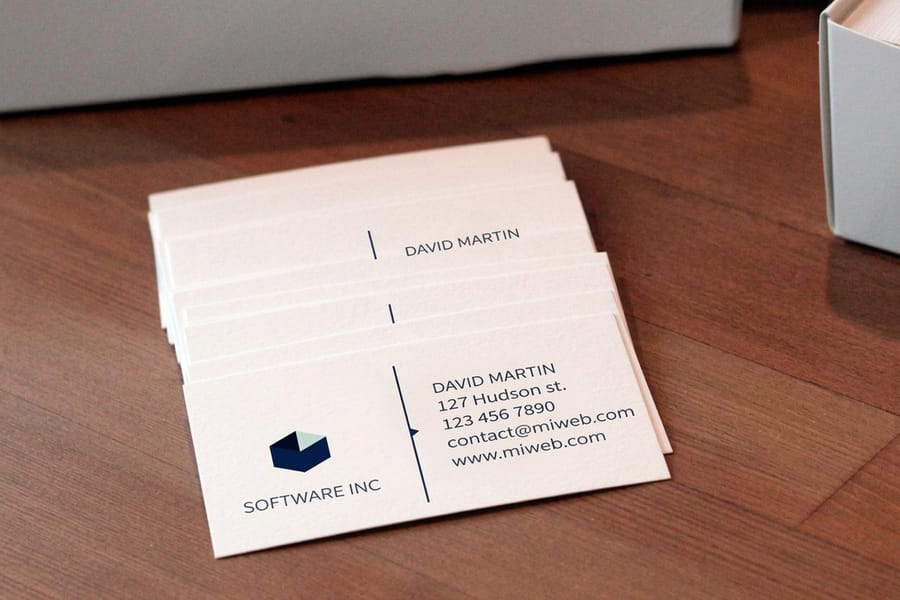
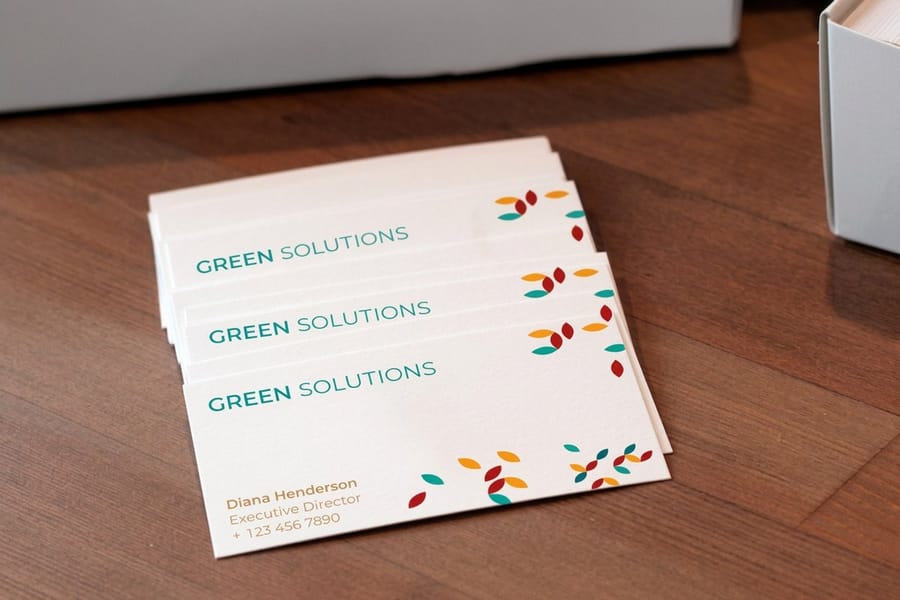
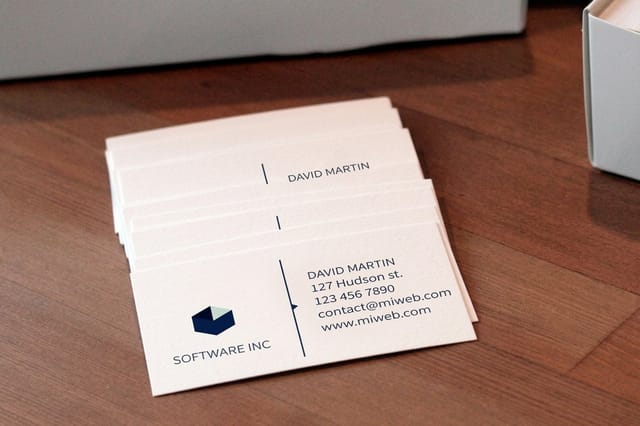
- Attract owes the next turn a name. Not impressions, a name you can contact again. That is why the piece that leaves a meeting matters more than the ad that started it. Standard business cards start at $17.57 at 4OVER4.COM, which is the cheapest way to make sure a conversation is still reachable a month later.
- Engage owes the next turn a good first transaction. Speed of reply beats polish here. Most small businesses lose this turn not to a competitor but to a two day gap between a question and an answer.
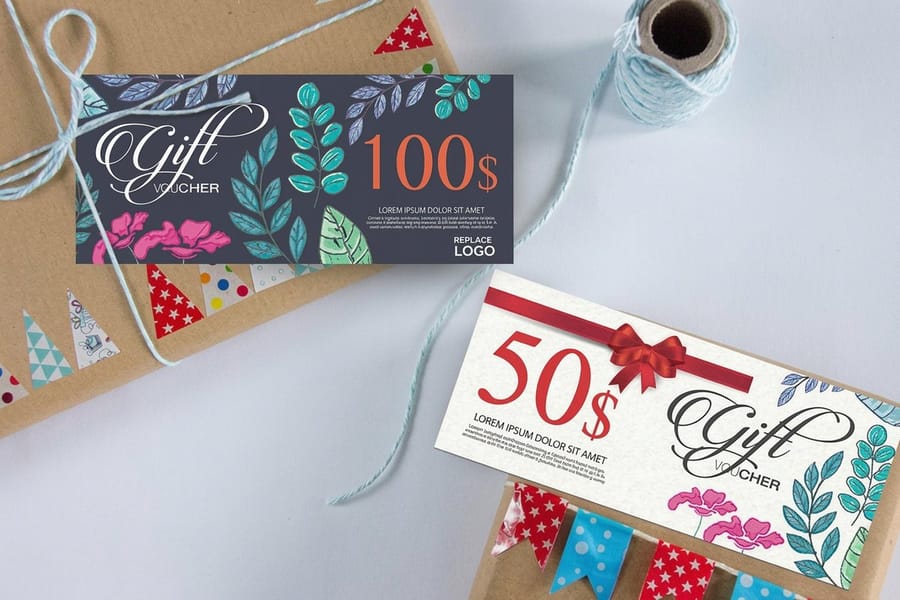
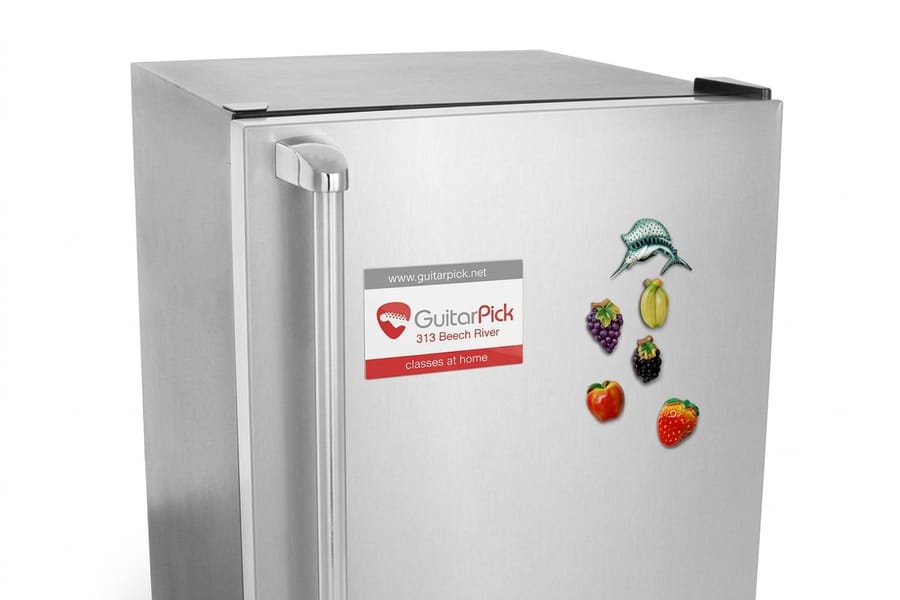
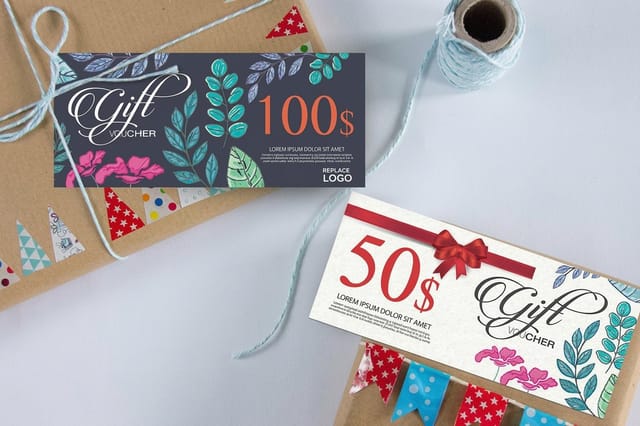
- Delight owes the next turn something the customer can act on. This is the turn almost everyone skips, and it is the only one that converts a buyer into an input. A gift certificate from $42.84 gives a happy customer a physical object to hand to a friend, which is a far lower ask than expecting them to remember your name in conversation. A printed magnet from $19.68 keeps your number where a household decision actually gets made, on the fridge, for years rather than for a scroll.
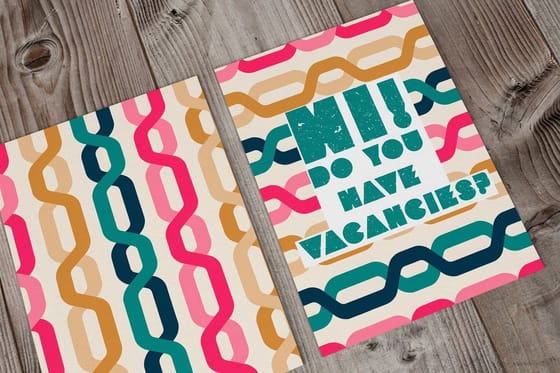
- Refer and repeat owe the first turn a warm start. Your buyer list is the cheapest list you will ever own, and it is the only one where the recipients have already paid you. Standard postcards from $16.48 are the blunt instrument for that job, and how direct mail marketing works covers list handling, sizes and postage in order.
None of that is a substitute for a good product. It is the plumbing that lets a good product travel. A brilliant service with no handoff at any turn stays a secret, and the wider set of tactics sits in our marketing strategy guides.
Remove the Friction Before You Add More Force
Collins made a point that gets quoted less than the wheel itself: momentum is the result of force applied against resistance, so you can improve it from either side. Most teams only ever push. Adding budget to a wheel with a seized bearing is expensive and it feels like effort, which is the trap.
The friction is usually mundane and specific. A first reply that takes two days. A checkout that demands an account before it will take money. No record of who bought from you eighteen months ago, so the cheapest audience you have is unreachable. A description of the business that changes every time someone in the team says it, so a referrer cannot repeat it. Packaging that arrives with nothing in it except the product, wasting the one moment when the customer is guaranteed to be paying attention.
Pick the cheapest one and fix it before you approve another campaign. Then check the number that matters: the share of new customers who arrived because of an existing one. If revenue climbs but that share stays flat, you bought traffic, you did not build momentum. The two look identical on a revenue chart and behave completely differently the month you stop spending. Paper choice sounds like a detail next to that, though the piece a customer keeps is the one that keeps working, which is the argument in choosing paper for printed marketing materials.
Where the Flywheel Model Fails
The model has three real limits, and a page that only sells you the metaphor is not being straight with you.
At zero customers there is nothing to spin. A flywheel needs mass before it holds momentum, and a new business has none. In the first year or two you are pushing a cold wheel, and flywheel language turns into a comfortable reason to avoid paid acquisition and cold outreach. Do the unscalable work, then let the loop take over.
Some purchases never repeat. Roofs, wedding dresses and mattresses are bought once a decade. The repeat arm is effectively dead, so the referral arm has to carry the entire loop, and the delight budget should go into things a customer can pass on rather than reasons to reorder. Online retail sits at the other end, where the repeat arm does most of the work, as ecommerce branding lays out.
The wheel turns both ways. Collins named the opposite case the doom loop, and it runs on the same mechanism. A bad experience is an input too: it produces a review that suppresses the next customer, who arrives already suspicious, which makes the next experience harder to get right. Compounding is neutral about direction.
There is a fourth problem that is practical rather than conceptual. A flywheel gives almost no weekly signal. Nothing looks different for months, which is precisely when teams abandon it. The fix is to stop watching the wheel and watch its inputs instead: review count, repeat rate, referral share, reactivation response. Those move early enough to keep a team honest, and they are the numbers that tell you whether the next turn will be easier than the last.
Wally explains the flywheel
One heavy push, then the wheel starts helping
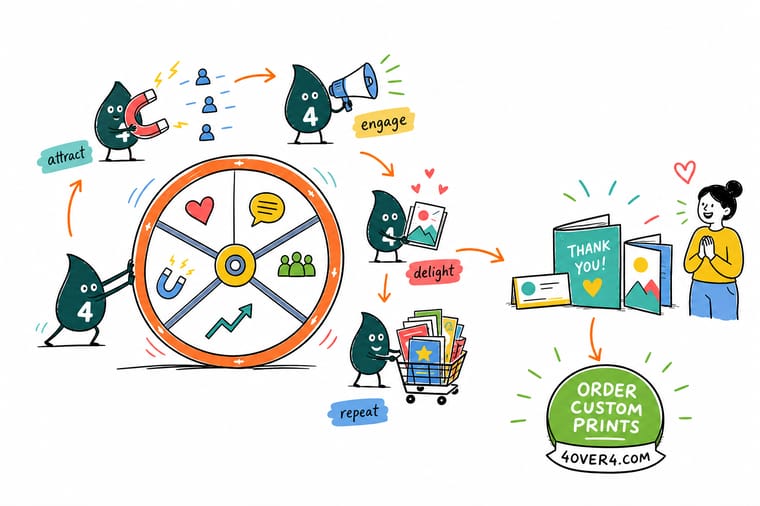
Wally leans on a huge metal wheel and nothing happens. He leans again and it creeps. By the twentieth push it is turning on its own, and he only has to keep it honest. That is the whole model. The first customer costs everything, and if she leaves happy she brings the second one, who brings the third. Wally has one rule for it: every turn must hand something real to the next turn, a card, a certificate, a magnet on a fridge, a postcard to someone who already paid him. A wheel with nothing in the handoff is just a circle he is dragging.
Print postcards for past customers →Specs and pricing
The handoff pieces, with sizes and starting prices
Each turn of the wheel passes something physical to the next one. These are the three that do the most work, with live configuration choices and starting prices straight from the 4OVER4.COM configurator.


Print it
Give every turn something to hand along

Explore more
Where to go next




By the numbers
The print side of your flywheel, handled
Common Questions
Your flywheel model questions, answered
What is the flywheel model in plain language?
It is a way of drawing a business so that the result of one sale powers the next one. A happy customer leaves a review, brings a friend, or comes back and buys again, and each of those becomes the start of another cycle. The point of the shape is that nothing gets thrown away at the end. A funnel treats the customer as the finish line, so every month you refill the top from scratch. A flywheel treats the customer as the engine, so the same amount of effort produces more each turn.
Who created the flywheel model?
Jim Collins used the flywheel and its opposite, the doom loop, in Good to Great in 2001 to describe how companies build momentum through many consistent pushes rather than one dramatic move. Amazon applied the same idea to its own business as a loop of lower prices, more customers, more third party sellers and wider selection. HubSpot popularised the marketing version in 2018 with attract, engage and delight arranged around the customer, and retired the funnel from its own diagrams.
Flywheel or funnel, which one should we actually use?
Use both, for different jobs. The funnel is a measurement tool. It describes a group of people moving through defined stages, which is exactly what you need for forecasting, for spotting the stage where people stall, and for sizing a pipeline. It fails as a strategy because it stops at the sale and never asks what the customer does next. Keep the funnel for reporting and run the flywheel for planning. The moment your plan ends at the purchase, you are running a funnel no matter what your slide says.
How do you measure a flywheel?
Measure the share of new business that came from existing customers, and watch whether that share climbs. Referral percentage, repeat purchase rate, review volume and reactivation response are the four numbers that tell you the wheel is feeding itself. If total revenue grows while the referral and repeat share stay flat, you did not build momentum, you bought traffic. That distinction usually takes two or three quarters to become visible, which is why leading inputs matter more than the wheel itself.
Does the flywheel model work for a one off purchase?
Partly. A roof, a wedding dress or a mattress will not be bought again for years, so the repeat arm of the loop is close to dead. What still works is the referral arm, and it becomes the whole strategy. That changes where you spend the delight budget: instead of building reasons to reorder, you build things the customer can hand to someone else, such as a second card, a gift certificate, or work so visibly good that neighbours ask who did it.
Where does printed material fit into a flywheel?
It sits on the handoffs, where one turn passes something concrete to the next. A card that survives the meeting, a magnet that keeps your number visible on a fridge for two years, a gift certificate a customer can hand over to a friend, a postcard to a list of people who already paid you once. At 4OVER4.COM standard business cards start at $17.57, standard magnets at $19.68, gift certificates at $42.84 and standard postcards at $16.48, so a full set of handoff pieces is a small line in most marketing budgets.
Get Started
Gift certificates run 50 for $42.84, or 86 cents each
Cards that keep a new contact reachable, magnets that stay visible for years, certificates a customer can pass to a friend, and postcards for the list of people who already bought.
Legal Disclaimer
Gold Standard guarantees apply to all standard orders placed through 4over4.com. Price match requires verifiable proof of a competitor's published price for an equivalent product with matching specifications and turnaround time. Satisfaction guarantee covers manufacturing defects and print quality issues. Contact support with order number and documentation. On-time delivery rate based on tracked orders 1999 to 2026. Individual results may vary based on shipping carrier performance.
