
When a Photo Belongs on a Business Card and When It Works Against You


An honest answer by industry, then the crop, the resolution, the safe area and the finish that decide whether a printed headshot looks sharp or looks like a flyer.
Put your photo on the card when a stranger has to recognize you later: real estate, insurance, personal training, hair and beauty, acting and modeling. Leave it off when the card sells a firm rather than a face, which covers most consulting, legal, agency and B2B work. The photo adds nothing to the print price, since cards run in full color either way. What it spends is roughly a third of one side, and a shorter shelf life, because a face dates while a phone number does not.
Quick answer
Recognition decides it, and the crop decides how it prints
A photo belongs on the card when the recipient needs to recognize a person, and gets in the way when they are buying a company. If it goes on, the face has to be about 0.6 inches tall to read at arm's length, cropped from the original camera file at 300 pixels per inch on the printed size, with the whole head inside the 0.125 inch safe area. Print it on gloss or matte coated stock. Soft touch mutes the contrast and uncoated closes the shadows, and both make a good headshot look like a bad one.
Who a Photo Helps, and Who It Quietly Hurts
Ask one question about the person receiving the card: will they need to recognize you later, or do they just need to reach your company? That single distinction sorts almost every case.
Recognition industries put the face on the card and always have. Real estate agents hand a card at an open house and hope it surfaces from a kitchen drawer six months later attached to a memory. Insurance agents, mortgage brokers, personal trainers, stylists, wedding vendors, actors and models all sell a person, and in most of those fields a card with no face looks like the exception rather than the norm.
Then there is everything else. Consultants, agencies, accountants, lawyers, engineers, anyone whose card carries a firm's name: a headshot there reads as a personal ad stapled to a company card. It also creates an awkward asymmetry the moment you hand it to someone whose own card has no photo. And if the card is going anywhere near a hiring conversation in the United States, leave the face off entirely, because convention runs hard the other way and a photo invites a question you did not want to raise.
The honest cost is space. A face big enough to be recognizable takes roughly a third of one side of a 3.5 by 2 inch card, and that space is currently doing something else. Usually the tagline goes, or the second phone number, or the physical address. Before committing, read what is already earning its place on what you should not put on a business card, then decide what the headshot is replacing on your classic business cards. If you want the ground rules first, business card basics from the ground up covers the anatomy of the card itself.
Front Panel, Full Bleed, or Back of the Card
There are three real placements, and they fail in different ways. Pick the one whose failure you can live with.
| Placement | What it costs you | Where it fails | Best for |
|---|---|---|---|
| Side panel, front | About a third of the front, so one contact line comes off. | A tight crop pushed to the trim edge loses an ear when the sheet shifts. | Agents and brokers who need the face visible the second the card is handed over. |
| Full bleed, front | Nearly the whole front. Text has to sit over the image. | Type over a face is unreadable unless the shot has a genuinely empty area to hold it. | Actors, models and anyone whose card is essentially a small comp card. |
| Back of the card | Nothing on the front, but the card must print both sides. | The face is not seen unless the card gets turned over. | Almost everyone else, including people who want a photo without a busy front. |
The back is the placement people skip and then regret skipping. The front stays clean, the photo gets a whole panel instead of a squeezed third, and there is room underneath for a line saying what you actually do. The back of a business card is dead space on most cards, and a headshot plus one honest sentence is a better use of it than a repeated logo.
Full bleed is the hardest to pull off and the one that goes wrong most often. Type set over a face has no chance, so the shot needs a flat wall, a sky, or a deliberately blurred background to carry the name. If you are already fitting a QR code or a profile link on the card, the placement decision gets tighter still, and putting your LinkedIn on a business card works through where that goes once the photo has taken its share.
The Print Specs That Keep a Headshot From Looking Cheap
Most bad photo cards are not badly designed. They are badly prepared, and the same four things go wrong every time.
Resolution, measured at printed size. 300 pixels per inch on the finished card. A face 0.6 inches tall needs about 180 pixels from chin to hairline, which any phone from the last decade produces easily. The pixels die in the crop, not in the camera: pulling a single head out of a group photo, or out of a file that social media already resized, leaves you enlarging almost nothing. Crop from the original camera file every time.
Bleed and safe area. Background runs 0.125 inches past the trim on all four sides, and nothing you care about sits within 0.125 inches inside it. A stack can shift roughly a sixteenth of an inch as it is cut, so a chin or an ear resting on the safe line is a chin or an ear that occasionally disappears. Keep the whole head inside the safe box even when the background bleeds off.
The CMYK conversion. Your monitor shows the photo in RGB, which is a wider and brighter world than four inks can reach. Skin comes back slightly darker and less saturated in print, and deep shadows on a face close up and go muddy when the total ink coverage climbs. Lift the shadows a little in the file rather than being surprised by them on the card.
The background and the retouching. A busy background collapses into visual noise at card size, so a plain wall beats an interesting location every time. And because the printed face is under an inch tall, no one will ever see a pore, which makes heavy skin retouching pure waste. Over-smoothed skin at this size just reads as waxy.
The Finish Choice That Quietly Ruins Photos

Here is the trade-off nobody mentions when they recommend a premium finish: the stock that feels most expensive in the hand is usually the worst thing you can print a face on.
Soft touch has a velvety coating that scatters light in every direction. That is exactly what makes it feel good and exactly what flattens a photograph, because it lifts the black point and mutes contrast. Skin goes slightly gray, the eyes lose their catchlight, and the shot that looked crisp on screen lands soft. Uncoated is worse in the opposite direction: the fibers drink ink, the dots spread, and the shadows on a face close up into a dark smudge. Uncoated is wonderful for type and unkind to portraits.
Gloss holds a headshot best, with the highest contrast and the most saturated skin tones, at the cost of fingerprints and glare under a phone camera. Matte coated is the sensible middle: it keeps the shadows open and the detail sharp, it does not throw glare, and you can still write on it. If you are weighing them against each other, matte, glossy or soft touch compares all three, and soft touch thickness is worth reading if you have already fallen for the feel of it.
Weight matters more on a photo card than on a plain one, because a card someone keeps is a card that lives in a wallet and gets bent. 16pt survives that noticeably better than 14pt, and business card thickness lays out where the difference actually shows. Artist business cards start at $17.57 and are built around a full color image on the front, which is the setup a photo card wants anyway.
A Photo Card Expires Sooner Than a Plain One
The phone number on your card will still be right in three years. The face probably will not. That is the one cost of a photo card that never appears in any quote, and it is the reason a box of 1,000 photo cards is a worse buy than the same box of plain ones.
The test is simple. If you would not use the shot as your profile picture today, it should not be in a stranger's wallet either. A card that no longer looks like you undoes the exact thing the photo was there to do, and it does it in the worst possible moment, when someone is trying to match a face to a name. Order photo cards in a run you will genuinely get through, and treat the reprint as scheduled rather than as a surprise.
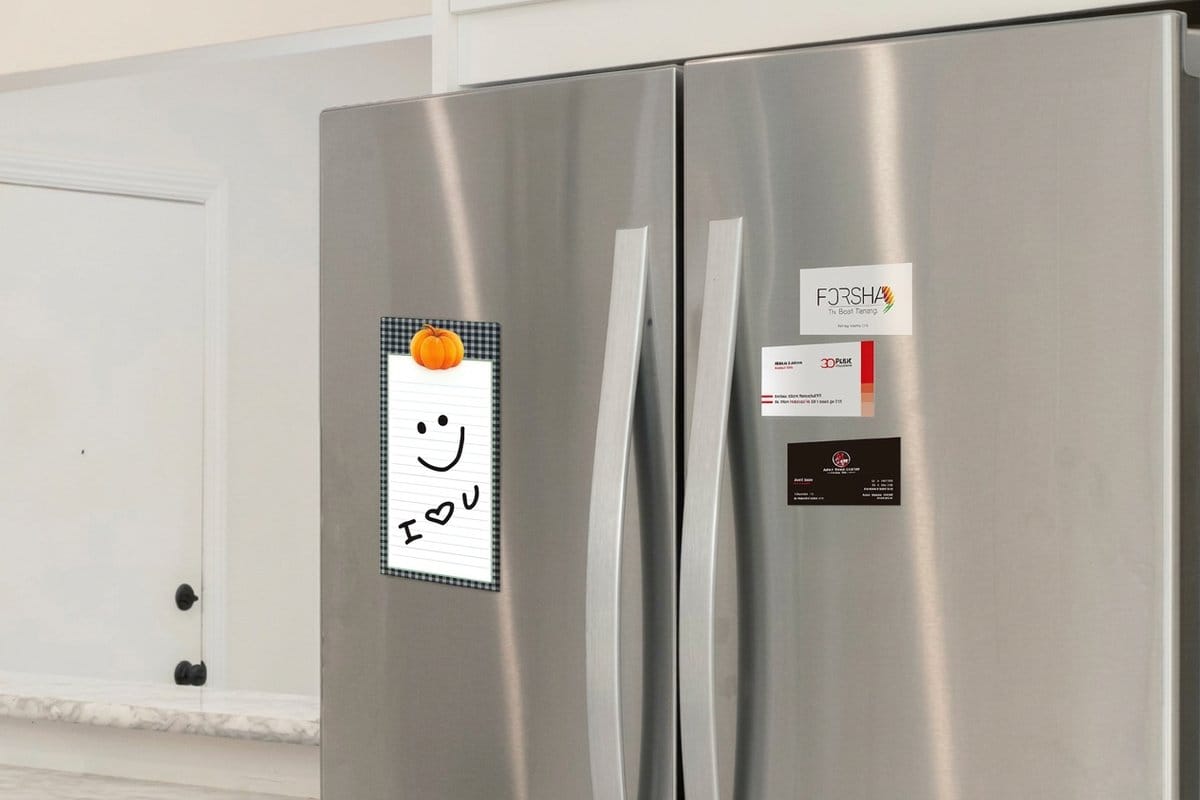
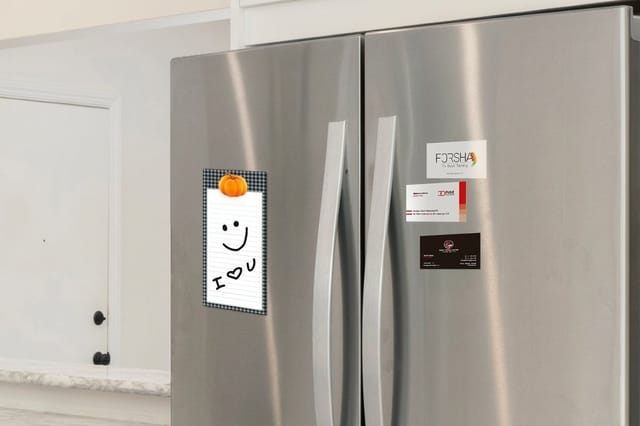
Two formats are worth knowing about here. Business card magnets start at $19.68 and stay on a fridge for years, which is a gift for an agent and a liability for an outdated headshot, so put your most current photo on those and nothing else. And if the plan is to test a layout before committing, free business cards let you see how the crop, the skin tones and the type balance actually print before you order a real quantity. Printing a test run and holding it at arm's length settles the question faster than any amount of on screen previewing.
If a face is not the right answer for your work, a picture of the work usually is. Photographers, tattooists, bakers and contractors are hired on output, not on recognition. Browse the full business card printing range for stocks and finishes, business card stickers from $10.76 if you want the same artwork to stick to packaging, and the business basics collection for the letterheads and envelopes that should carry the same look.
Wally explains the headshot card
Recognition on, resume off, and keep the ears inside the safe box
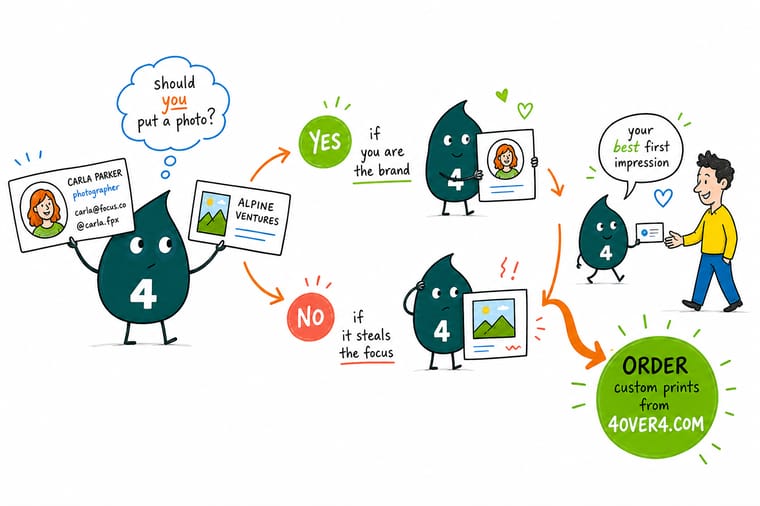
Wally asks one question before he prints a face: will the person holding this card have to spot you across a room later? Estate agent, stylist, trainer, actor, yes. Consultant handing a card to a procurement team, no. If it goes on, he wants the face about 0.6 inches tall so the eyes still read at arm's length, cropped straight from the camera file at 300 ppi, with the whole head inside the safe area so the trim never takes an ear. Then he keeps it off soft touch, because that lovely coating quietly turns skin gray.
Order classic business cards →Specs and pricing
Card stocks, sizes and starting prices
Configure the stock, the finish and the quantity, with live options and starting prices straight from the 4OVER4.COM configurator.

Print it
Cards that hold a photograph properly
Explore more
Where to go next
By the numbers
Resolution that survives a 2 inch crop
Common Questions
Your photo business card questions, answered
Do photo business cards look unprofessional?
It depends entirely on the field, not on the photo. In real estate, insurance, personal training, hair and beauty, acting and modeling, a card without a face is the odd one out, because the client is hiring a person they need to recognize. In consulting, law, accounting, agencies, engineering and most B2B sales, the card represents a firm, and a headshot on it reads as a personal advertisement rather than a company card. The photo itself is rarely the problem. A badly lit selfie cropped from a wedding picture is the problem.
What resolution does the headshot need to be?
300 pixels per inch at the size it prints, which is smaller than most people assume. A face 0.6 inches tall needs roughly 180 pixels from chin to hairline, and a photo panel filling a third of a 3.5 by 2 inch card needs about 350 pixels across. Any modern phone captures far more than that. The failure happens in the crop: pulling one head out of a group shot, or out of a file that was already resized for social media, leaves you enlarging a small number of pixels. Always crop from the original camera file.
Should the photo be color or black and white?
Color is the safer print. A grayscale headshot has to be rebuilt out of four inks on a CMYK press, and if the four do not agree perfectly the face picks up a green or magenta cast that is very visible in skin. Printing that same photo as single-channel black avoids the cast but flattens the tonal range and looks weak. If you want black and white, ask for it as a controlled duotone or a rich neutral build rather than dropping a grayscale JPEG into the layout and hoping.
Is the photo better on the front or the back?
The back, in most cases. It keeps the front clean for the name, the role and the contact details, and it gives the photo the whole panel instead of a cramped third. The exception is any card that gets handed over in the moment it matters, at an open house or after a viewing, where the face has to be visible without the card being flipped. Then put it on the front as a side panel and accept that something else comes off.
Does adding a photo cost more to print?
No. Business cards print in full color whether the artwork is a photo or a solid block, so a headshot on the front adds nothing to the sheet price. Classic business cards start at $17.57 at 4OVER4.COM, and that figure does not move because there is a face on them. The cost of a photo card is the reprint, which comes around sooner than a plain card because the face dates while the phone number does not.
How often should a photo card be reprinted?
Use the simplest test there is: if you would not use the shot as your profile picture today, take it out of people's wallets. Beards, glasses, hair color and a few years all move the picture out of date, and a card that no longer looks like you does more damage than a card with no photo at all. Practically, order photo cards in the smallest run that still makes sense for you, and print a plain version alongside for the situations where a face is not helping.
Can I use a photo of my work instead of my face?
Often it is the stronger card. Photographers, tattooists, bakers, contractors and designers are hired on the work rather than on recognition, so a sharp image of a finished piece does more than a headshot. Artist business cards are built for exactly that, with the front carrying the image and the details set on the back. The same print rules still apply: 300 ppi at printed size, the subject inside the safe area, and a coated stock so the shadows do not close up.
Get Started
100 artist business cards cost $17.57, or 18 cents each
Pick your stock, choose gloss or matte so the photo holds its contrast, and we print cards that still look like you when someone finds them in a drawer.
Legal Disclaimer
Gold Standard guarantees apply to all standard orders placed through 4over4.com. Price match requires verifiable proof of a competitor's published price for an equivalent product with matching specifications and turnaround time. Satisfaction guarantee covers manufacturing defects and print quality issues. Contact support with order number and documentation. On-time delivery rate based on tracked orders 1999 to 2026. Individual results may vary based on shipping carrier performance.
