
Men's Printed Sweatshirts That Fit Right and Print Clean


Jordan is our labels, packaging and sustainability voice, built from the knowledge of our production team, with over 20 years in printing.
The blank, the print method and the size curve decide how a sweatshirt run turns out. All three choices come down to measurements printers actually use.
A men's printed sweatshirt run rests on three choices: the blank, the print method and the size curve. Pick a midweight 8 oz crewneck for everyday merch or a 10 oz plus heavyweight for winter teams, screen print anything past about two dozen pieces, use vinyl for names and small runs and DTG for photo art, then order sizes on a curve centered on large rather than guessing per person. For print methods across the rest of the wardrobe, custom printed clothing and how to pick the right print method covers the wider line.
Quick answer
Blank, method, curve, in that order
The blank sets the feel, the run size picks the print method, and the size curve protects the budget. Midweight 8 oz fleece is the merch standard and 10 oz plus is the winter upgrade. Screen printing takes over past about two dozen pieces, vinyl covers short runs and names, DTG covers photo art, embroidery owns the left chest. Sizes come from a flat pit to pit measurement, not the letter on the tag, and a dozen pieces splits as 1 S, 3 M, 4 L, 3 XL and 1 2XL when the team cannot report real sizes.
How to Order Men's Printed Sweatshirts, Step by Step
A sweatshirt run is five decisions in a row, and making them in order prevents the expensive kind of rework.
One, pick the blank. Crewneck or hoodie, then weight. Midweight fleece around 8 oz is the merch default; a 10 oz plus heavyweight feels substantially better and costs more per piece. Check the fiber content while you are there, because it matters at step three.
Two, pick the print method for the run size. Screen printing for two dozen pieces and up, vinyl for short runs or per-piece names, DTG for photographic art. The next section covers the trade-offs in detail.
Three, size the artwork once, for the middle of the range. The press prints one art size across every garment size. A 12 by 14 inch front maximum, sized to look right on a large, works across a normal men's S to 2XL run. A left chest mark sits at 3.5 to 4 inches wide.
Four, collect sizes on a curve. Real sizes from the team beat any formula. When you cannot get them, the per-dozen curve of 1 S, 3 M, 4 L, 3 XL and 1 2XL is the standard starting point, and one or two spares cover misprints and late additions.
Five, upload and configure. Vector art or a 300 dpi raster at print size, fonts outlined. The custom apparel configurator takes the file, the garment choices and the quantity and prices the run live, the same flow used for premium t-shirts and the rest of the apparel line.
Screen Print, Vinyl, DTG or Embroidery on Fleece
All four methods decorate a sweatshirt. They split cleanly by run size and artwork type, and fleece punishes the wrong choice more than a tee does.
| Method | How it behaves on fleece | Best for | The limit |
|---|---|---|---|
| Screen printing | Plastisol sits on top of the texture and flexes with the garment. | Runs of roughly 24 and up with few ink colors. | Setup per color makes small runs and full color art expensive. |
| Heat transfer vinyl | Cut shapes pressed into the fleece, crisp edges, strong opacity. | Short runs, names and numbers, one or two colors. | Large solid areas feel heavy and can crack at flex points over time. |
| DTG | Water based ink into the fiber after pretreatment. | Short runs of photo or many-color art, a dozen pieces rather than a hundred. | Colors sit softer on 50/50 blends; slowest per piece at volume. |
| Embroidery | Stitched thread, no ink at all. | Left chest logos, 3.5 to 4 inches wide. | Not viable for large art, and dense fills pucker light fleece. |
The pattern behind the table: fixed setup costs favor screen printing as quantity rises, and per-piece methods favor small or variable runs. Our screen printing vs vinyl comparison walks the cost crossover in detail, and the DTG vs embroidery guide settles the logo question. If the design is bold single color art, vinyl printed apparel is the fastest path for a handful of pieces.
Men's Sweatshirt Sizing, Measured the Way Printers Measure
Garment sizes are not standardized between brands, so printers work from two flat measurements instead of the letter on the tag. Chest is measured pit to pit across the front of the garment laid flat. Body length runs from the highest point of the shoulder down to the hem.
Typical men's crewneck blanks run 20 inches pit to pit at small, stepping 2 inches per size to 28 inches at 2XL, with body lengths from 26 to 30 inches across the same range. The diagram above maps both measurements onto the garment. The reliable way to use them: take a sweatshirt that already fits well, lay it flat, measure it, and match those numbers to the spec sheet of the blank you are ordering. That beats guessing from a size letter every time.
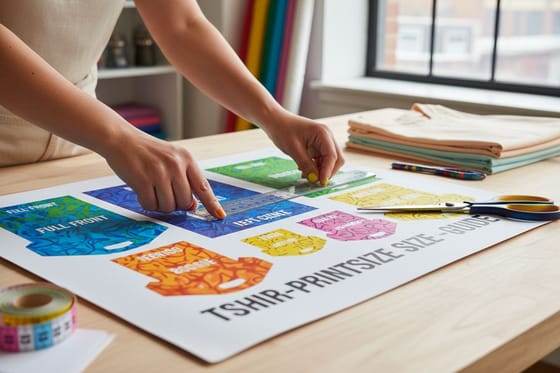
Fit interacts with the print. A front design should start about 2.5 to 3 inches below the collar seam; higher looks like a bib, lower disappears when someone sits down. And because one art size serves every garment, a print that fills a small edge to edge will float on a 2XL, which is another reason to size art for the middle of the curve. The print size guide covers placement math for every common location, and the logic carries straight from tees to fleece.
Bulk Runs for Teams, Crews and Merch Drops
Sweatshirts behave differently from tees in bulk buying, and the differences all trace to the blank costing two to three times more. A sizing mistake that wastes five tees is annoying; the same mistake in heavyweight fleece is real money. So bulk fleece rewards three habits.
Collect sizes before you order, and pad the top end. Adult male groups skew larger than people expect, which is why the curve centers on large and holds more XL than small. When a team reports its own sizes, believe them and still add a spare L and XL.
Keep the decoration simple and the blank good. On merch that people pay for, the garment quality carries more repeat wear than a complex print does. A one color front on a heavyweight crew outsells a five color print on a thin blank. Fewer ink colors also drop the screen printing setup cost directly.
Print the whole kit in one run. Teams rarely need only sweatshirts. Matching printed tees from $21.96 for warm weather, and tote bags for the merch table, print from the same artwork and ship together; tote bags vs t-shirts weighs the two for a merch table. The t-shirt printing category holds the full apparel line, the promotional products collection covers the rest of the kit, and the printed workwear guide is the companion read when the run is uniforms rather than merch.
Wally explains sweatshirt runs
Measure flat, size the art once, order on a curve
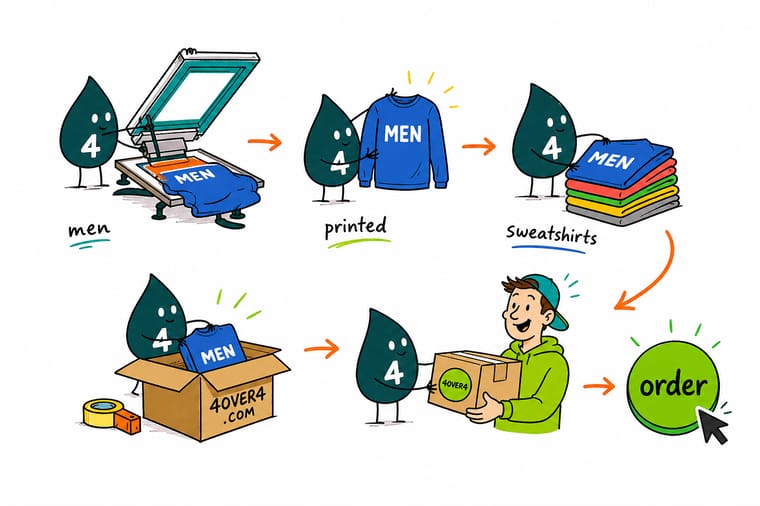
Wally lays a sweatshirt that fits well flat on the table and measures pit to pit, because the letter on the tag lies between brands and the tape measure does not. He sizes the artwork once, to look right on a large, since the press prints the same art on every garment in the run. Then he orders on the curve, 1 S, 3 M, 4 L, 3 XL and 1 2XL per dozen, and slips two spares in the box. Nobody has ever complained about the spares.
Configure custom apparel →
Specs and pricing
Custom apparel, configured and priced live
Sweatshirt runs price through the same apparel configurator as these products, by garment, print locations and quantity. The tees below print full color on white or black in sizes S to XXL, on the front, the back or both within an 8.5 x 11 inch print area, from $21.96 for one shirt in 5 business days, so a matching tee order can join the fleece run.


Tees to match the fleece
Start the apparel run
Apparel print and sizing guides
Where to go next
25+ years of print
Screen printed and vinyl apparel runs
Common Questions
Your sweatshirt printing questions, answered
What print method lasts longest on a sweatshirt?
For a small logo, embroidery, because stitched thread outlasts any surface print. For larger artwork, screen printing: properly cured plastisol flexes with the fleece and survives years of washing. Heat transfer vinyl holds up well but is the most likely to crack at high flex points such as across a seam or a pocket edge, especially when large solid areas are printed as one piece of vinyl. Whatever the method, washing inside out in cold water and skipping the dryer adds real life to the print.
Should I print on crewnecks or hoodies?
Crewnecks are the easier canvas. The front is flat and uninterrupted, so a full 12 by 14 inch print fits without compromise. A hoodie gives you the pocket and drawstrings to work around, which cuts the usable front area roughly in half; most hoodie designs either run wide across the chest above the pocket or move the big art to the back. If the design is the point of the garment, start with the crewneck.
How big should the front print be?
A full front on a men's medium or large reads well at 10 to 12 inches wide, with 12 by 14 inches the practical maximum. A left chest mark should sit at 3.5 to 4 inches wide, roughly level with where a shirt pocket would be. Remember that one art size prints across the whole size run, so size it for the middle of your curve rather than the smallest or largest garment.
How many of each size should I order for a team?
Collect real sizes if you can. When you cannot, order on a curve centered on large: for every 12 pieces, 1 S, 3 M, 4 L, 3 XL and 1 2XL covers a typical adult male group. Add one or two garments beyond headcount, because a misprint or a late roster addition is close to certain, and reprinting two pieces later costs more per piece than printing them now.
Can you print on 50/50 blend fleece?
Yes, and most sweatshirt blanks are exactly that. Screen printing and vinyl behave the same on a blend as on cotton. DTG is the method that cares: water based ink bonds to cotton fiber, so on a 50/50 blend the colors come out noticeably softer and more vintage looking than the same file printed on a 100 percent cotton garment. If you want maximum DTG vibrancy, pick a cotton rich blank.
What does a printed sweatshirt run cost?
Sweatshirts are quoted through the same custom apparel configurator as tees, priced by the garment, the number of print locations and the quantity, and the per piece price drops as quantity rises. As a reference point, custom printed t-shirts start at $21.96 at 4OVER4.COM, and fleece runs above that because the blank itself costs more. Configure the exact garment and quantity to see the live price before you commit.
Get Started
Start a sweatshirt run in the apparel configurator
Pick the blank, upload the art once, and we print the whole size curve in one pass, from a single crewneck to a full team kit with matching tees.
Legal Disclaimer
Gold Standard guarantees apply to all standard orders placed through 4over4.com. Price match requires verifiable proof of a competitor's published price for an equivalent product with matching specifications and turnaround time. Satisfaction guarantee covers manufacturing defects and print quality issues. Contact support with order number and documentation.
