
Invitation Format Explained, From Flat Cards to Gatefold Suites


Four formats, the panel counts behind them, the wording each one carries, and the small dimensional rules that decide whether a fold looks crisp or cracked.
Invitation format is three decisions: flat or folded, how many panels the fold creates, and which panel carries which line of the wording. A flat 5 by 7 card gives you two printable faces, one fold gives four, a gatefold gives six, and all three still fit an A7 envelope. Folding roughly doubles the paper, so folded invitations start at $38.22 here against $19.77 flat. Pick the format by counting your content first, then check the grain and the score.
Quick answer
Count the panels before you pick the design
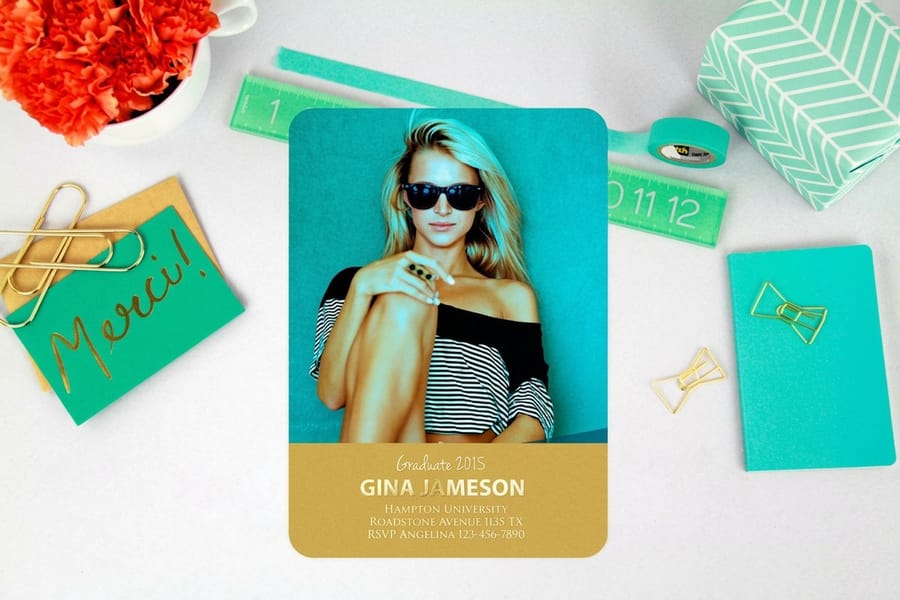
Format is a panel count. A flat card has two printable faces, a side or top fold has four, a gatefold has six, and the finished card is the same 5 by 7 in every case. Each fold roughly doubles the sheet the job is printed on, which is where the price difference comes from. The dimensional rules matter too: gate panels are cut about 1/16 inch narrower than half so the edges meet cleanly, the grain has to run parallel to the fold, and anything above roughly 100 lb cover needs a score before it is folded.
The Four Invitation Formats and What Each One Holds
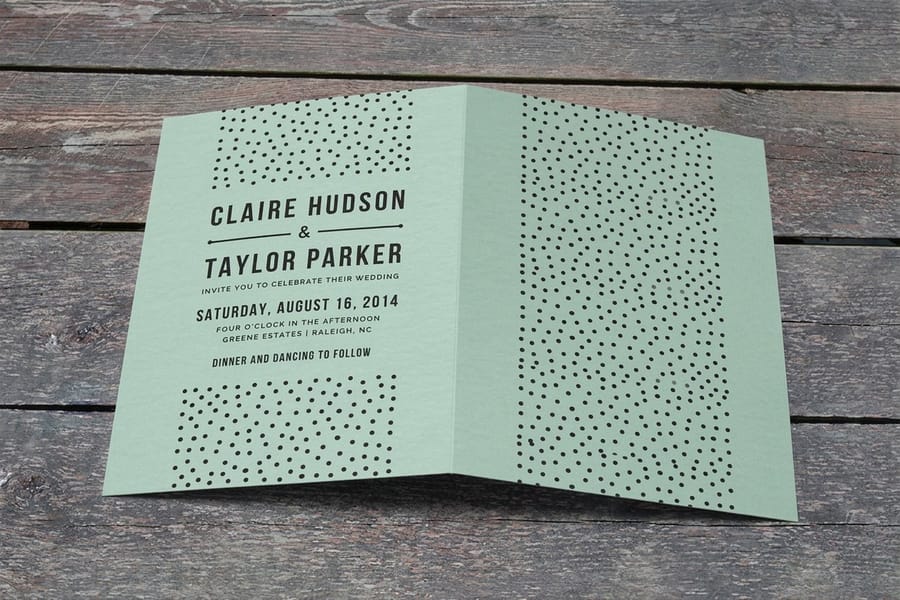
Start by counting your content, not by browsing designs. Every format below is described here at a finished 5 by 7, the size most events land on, so the only variable is how the sheet is folded.
| Format | Flat sheet behind it | Printable faces | Best for |
|---|---|---|---|
| Flat card | 5 x 7, printed one or two sides | 2 | The six standard wording lines, plus a map or a dress code on the back. From $19.77. |
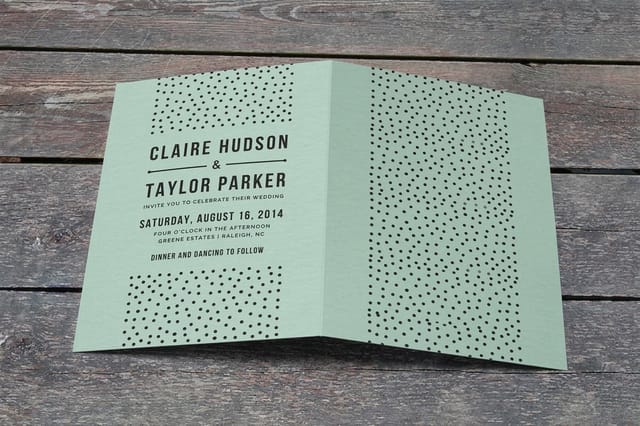
| Side fold | 10 x 7, one score down the middle | 4 | Wording on the inside right, schedule or directions on the inside left. From $38.22. |
| Top fold | 5 x 14, one score across | 4 | A portrait card that opens upward, common for formal dinners and programs. |
| Gatefold | 10 x 7, two scores, gates cut 1/16 short | 6 | Multi-day weddings and events where the reveal matters as much as the copy. |
The fourth column is the one that decides it. Two faces is more room than most people think: the six-line invitation occupies about half of a 5 by 7 front, and the back holds a map, a hashtag or a dress code without feeling crowded. Reach for a fold when you have a second genuine block of information, not to look more expensive.
The one format we do not build as a single piece is the pocketfold, the folder with a glued sleeve holding loose enclosures. The equivalent here is a folded invitation with separate RSVP cards tucked behind it, which mails at a similar thickness and costs less. If you want the whole comparison laid out, our folded versus flat invitations guide runs the numbers on both.
Panel Math, Grain, and Why Folds Crack
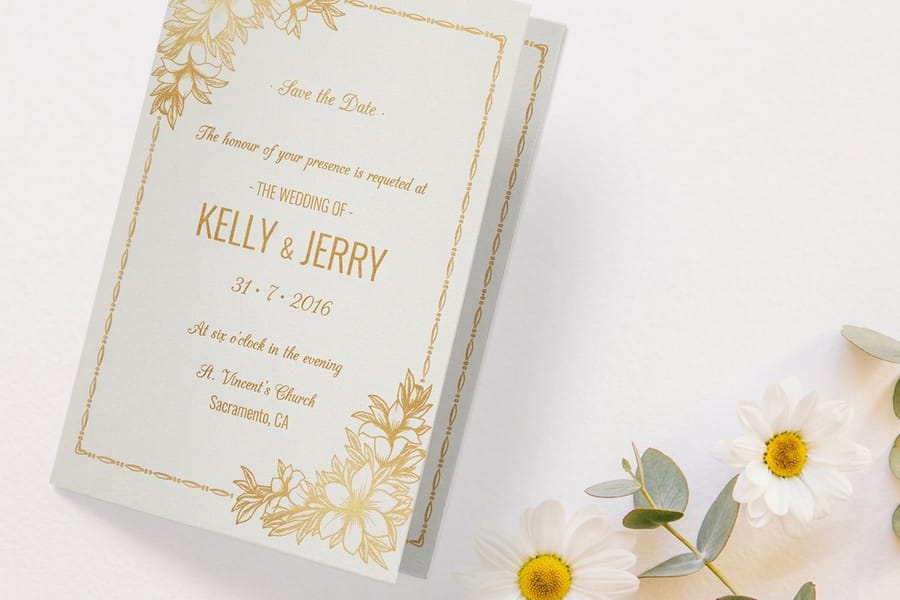
A fold is a manufacturing operation with its own tolerances, and three of them catch people out.
- Gate panels are never exactly half. Paper has caliper, so two gates cut at a true 2 1/2 inches on a 10 inch sheet will collide at the center and bow. Trim each gate to about 2 7/16 and the edges meet with a hair of daylight between them. On a heavier stock, take a little more off.
- Grain runs parallel to the fold or the spine feathers. Fibres align in one direction on the paper machine. Folded with the grain, the sheet gives cleanly. Folded across it, the fibers tear rather than bend, and the spine looks fuzzy under raking light.
- Score before you fold on anything heavy. Above roughly 100 lb cover, an unscored fold cracks the coated surface along the spine. A crease rule crushes the fibers first so the sheet has somewhere to go. Dark, heavily inked spines show the crack worst, which is why a navy folded card is the least forgiving thing you can print.
Build the artwork flat, at the full unfolded size, with the fold positions marked on a separate layer rather than drawn in ink. Keep type at least a quarter inch clear of any score, because a line of text sitting on the fold gets bent in half and reads badly no matter how well the score was made. Add the usual 0.125 inch bleed past every trimmed edge. Correctly sized starting layouts for every card in the range live in the blank template library, and the print folding options guide shows how the same rules apply to brochures and menus.
Laying the Wording Out Panel by Panel
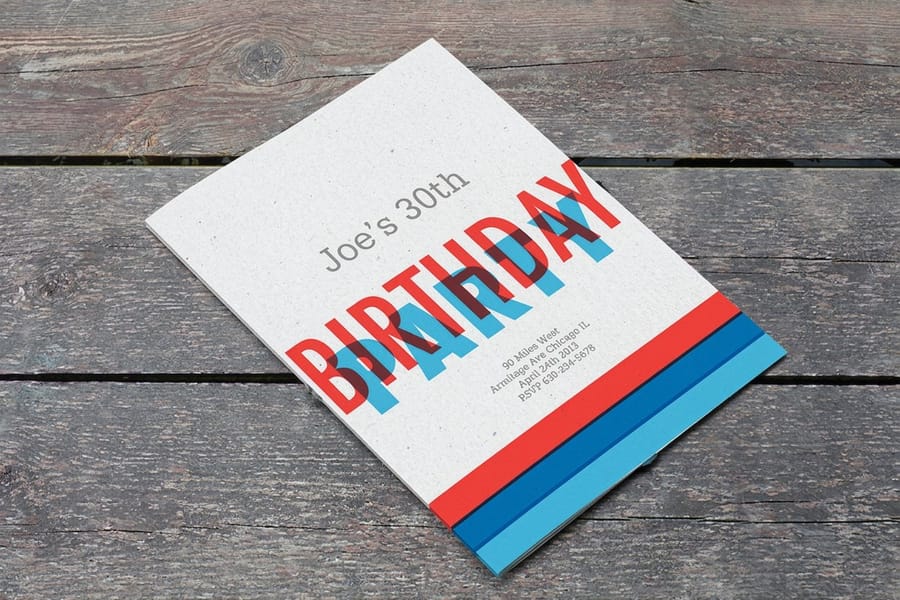
A formal invitation is six lines in a fixed order, and the order does the work of the punctuation. Host line, request line, the names, the date and time, the venue, then the reception line.
- Host line. Who is inviting. Traditionally the party paying, written out in full.
- Request line. The formality dial. "Request the honor of your presence" reads as a place of worship; "invite you to celebrate" reads as everything else.
- Names. Largest type on the card, and the only place a display face earns its keep.
- Date and time. Spelled out for formal events, numerals for casual ones. Pick one convention and hold it across the whole suite.
- Venue. Name and city. The full street address belongs on a details card, not here.
- Reception line. One line covering what follows, or a pointer to the enclosure that explains it.
On a flat card all six sit on the front and the back takes overflow. On a side fold, put the six lines on the inside right panel where the eye lands on opening, keep the front panel to a monogram or a single date, and give the inside left to the schedule or directions. Leaving the inside left blank is a legitimate choice, and a common one, but if you are paying for four faces and using two, a flat card was the cheaper answer.
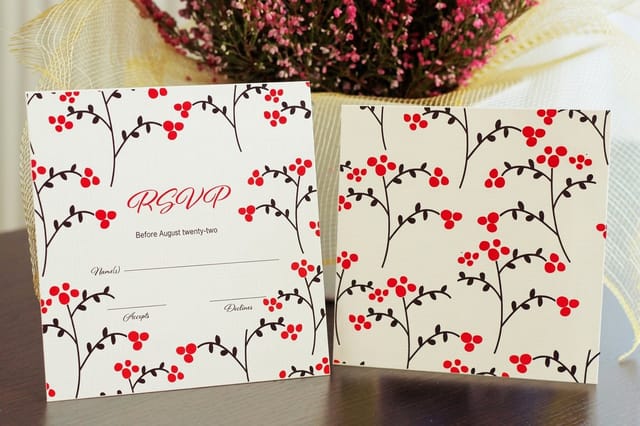
Reply wording follows its own conventions and belongs on its own card. Our guides on what to put on a wedding invitation and how to word an RSVP card cover the phrasing line by line, including the reply-by date that decides your catering numbers.
The Envelope, the Enclosures and What the Post Office Does Next
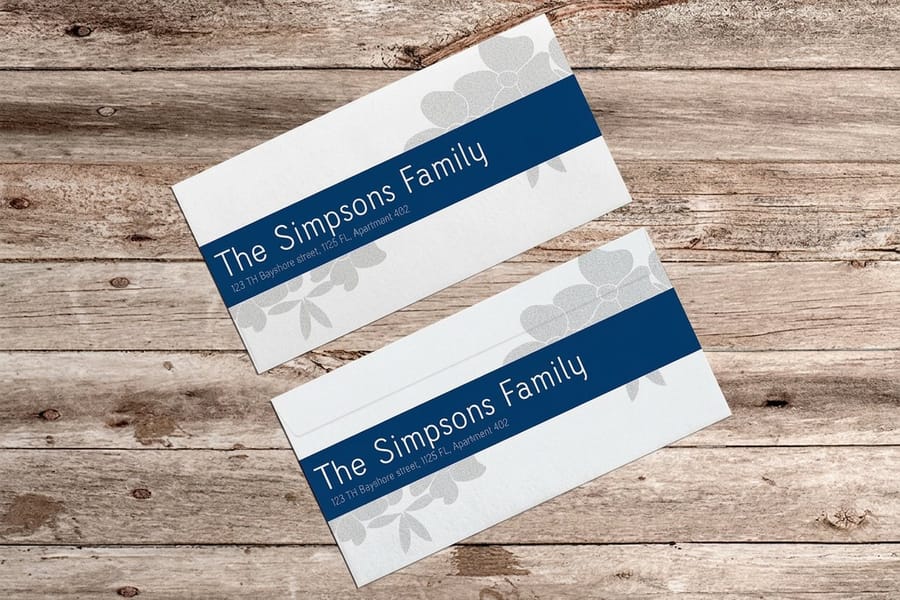
Format does not change the envelope size. A 5 by 7 card, flat or folded, goes into an A7 envelope at 5.25 by 7.25 inches. What format changes is how thick the finished, stuffed suite ends up, and thickness is what the mail stream reacts to.
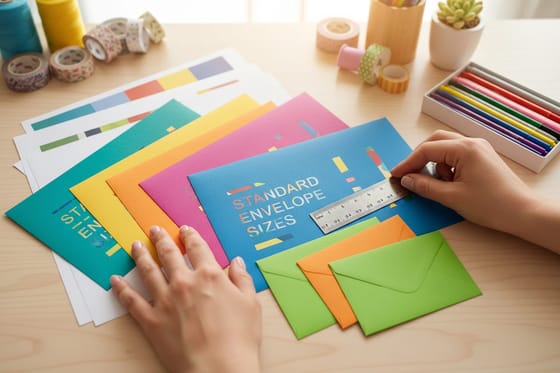
A flat invitation with a reply card and a reply envelope stays thin enough to run through automated equipment. Add a fold, a belly band and two enclosures and the same suite becomes rigid and uneven, which is the point at which it gets pulled aside, hand-canceled and surcharged. Square envelopes are treated the same way regardless of what is inside them. None of this is a reason to avoid a folded invitation. It is a reason to assemble one complete suite, take it to the counter, and have it weighed and measured before you commit to the rest of the run. Sizes and the envelope each card was cut to fit are set out in the invitation sizes guide, and the wider range in the envelope sizes guide.
Order the envelope with the card. Invitation envelopes start at $170.42 for a printed run, and buying them alongside the invitation is the only reliable way to get the flap color and the paper shade to match, since two stocks ordered months apart rarely come off the same make. If you are sending the timing out first, save the date cards start at $19.77 and are usually flat postcards, which keeps that mailing cheap and lets you spend the budget on the invitation itself.
Stock is where a format decision turns into a tactile one. Suede invitations at $251.36 have a soft, matte surface that reads as expensive the moment it is picked up, and metallic invitations at $317.44 shift color as the card turns. Both are heavier than standard cover, so if you are folding either of them the score matters more, not less. Browse the whole range on the invitation printing page.
Wally explains invitation formats
One sheet, one score, twice the panels
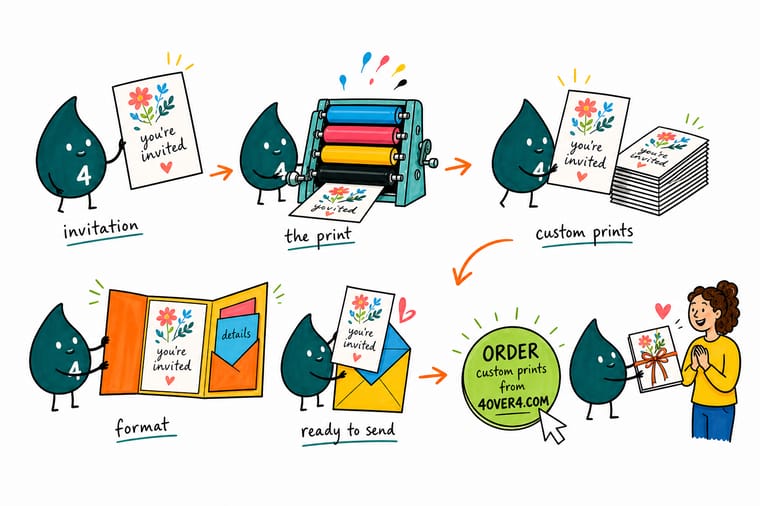
Wally lays a 10 by 7 sheet on the bench, runs a crease rule down the middle, folds it, and holds up a 5 by 7 card with four faces instead of two. He points at the spine: score first on heavy stock or the coating cracks, and run the grain the same way as the fold or the edge looks feathered. Then he checks the envelope. Same A7 either way, just thicker with the fold in it.
Configure invitation cards →Specs and pricing
Flat, folded and reply cards, side by side
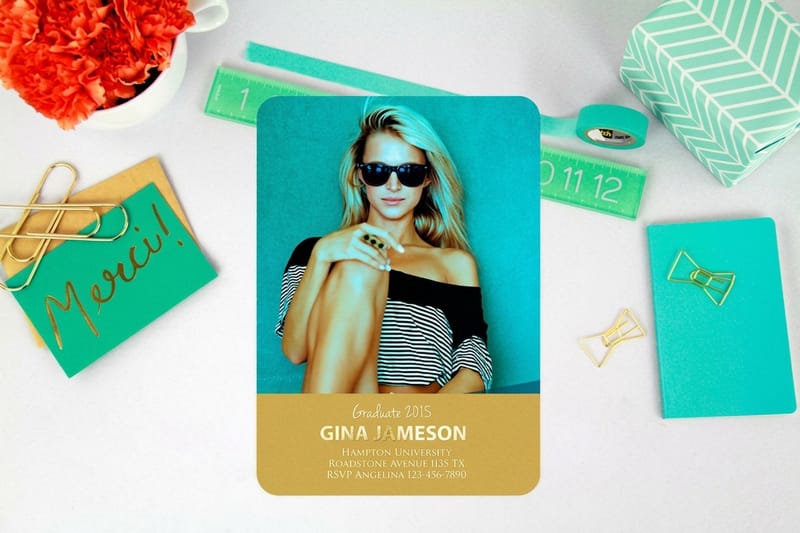
The three pieces most suites are built from, with live size and stock options and starting prices straight from the 4OVER4.COM configurator.


Print it
Order the format your wording actually needs
Explore more
Where to go next

By the numbers
Event stationery printed to spec at 4OVER4
Common Questions
Your invitation format questions, answered
What does invitation format mean?
Format is the physical construction of the card: whether it is flat or folded, how many panels the fold creates, and which panel carries which part of the wording. It is separate from size. A 5 by 7 invitation can be a flat card with two printable faces, a side-fold card with four, or a gatefold with six, and all three still slide into the same A7 envelope. When a printer asks for your format, that is the question being asked, not what color the card is.
Is a folded invitation worth the extra cost?
It is worth it when you genuinely have more than two faces of content, and a waste when you do not. Folded invitations start at $38.22 at 4OVER4.COM against $19.77 for flat invitation cards, because the folded card is printed on twice the paper and then scored and folded. If your wording is the six standard lines and nothing else, a flat card with a printed back holds it comfortably. If you are also printing a schedule, directions, a menu choice and accommodation notes, a fold saves you from inserting three loose cards.
Why do gatefold panels have to be narrower than half?
Because paper has thickness. If both gates were cut at exactly half the flat width, closing them would push the two leading edges into each other and the panels would bow outward instead of lying flat. On a 5 by 7 gatefold built from a 10 by 7 sheet, each gate is trimmed to roughly 2 7/16 inches so a small gap absorbs the caliper of the stock. The heavier the paper, the more you take off.
Which way should the paper grain run on a folded invitation?
Parallel to the fold. Paper fibers line up in one direction during manufacture, and a sheet folds cleanly along the grain and roughly against it. A side-fold 5 by 7 invitation folds on a vertical spine, so it wants short-grain stock running top to bottom. Folding across the grain on a heavy cover weight is the most common cause of a spine that looks feathered instead of crisp.
Do I have to order the RSVP card in the same format?
No, and almost nobody does. The reply card is nearly always flat, because it is meant to be filled in and posted back, and a folded reply card just makes the return envelope thicker. The convention is a flat RSVP at 3.5 by 5 inches inside a matching reply envelope. Our RSVP cards start at $19.77 and are printed on the same stocks as the invitation, which keeps the suite consistent without paying for a fold nobody needs.
Which format survives being mailed best?
A flat card in a snug envelope. Every fold adds thickness at the spine, and a thick, uneven envelope is the thing that gets pulled out of automated mail processing and surcharged. Square envelopes get pulled for the same reason. If you are mailing several hundred and want to keep the postage predictable, print a flat invitation on a heavier stock rather than a folded one on a lighter stock. Take one finished, stuffed and sealed suite to the counter and have it weighed and measured before you print the rest.
Get Started
Ready to print the suite?
Pick flat or folded, choose your stock, and we print invitations, reply cards and matched envelopes on the same run so the whole suite arrives in one shade.
Legal Disclaimer
Gold Standard guarantees apply to all standard orders placed through 4over4.com. Price match requires verifiable proof of a competitor's published price for an equivalent product with matching specifications and turnaround time. Satisfaction guarantee covers manufacturing defects and print quality issues. Contact support with order number and documentation. On-time delivery rate based on tracked orders 1999 to 2026. Individual results may vary based on shipping carrier performance.
