
How to Use a Retractable Banner Outdoors Without Losing It to the Wind


Tobias is our voice for cutting, binding and large format, built from the knowledge of our production team, with over 20 years in printing.
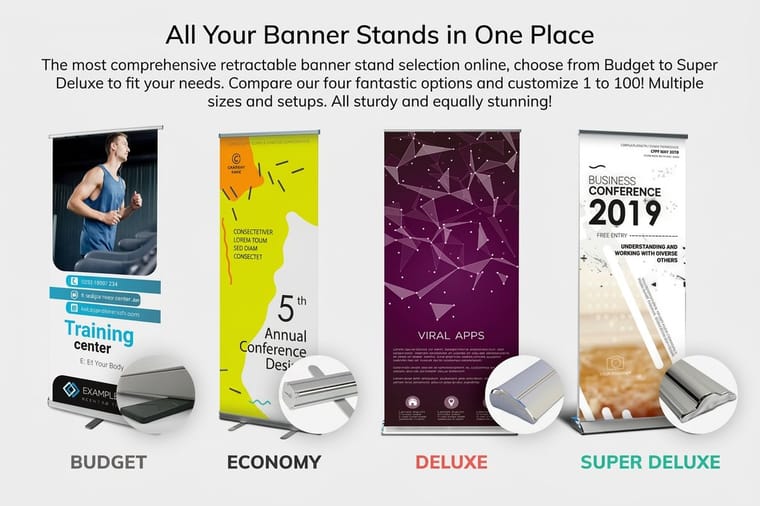
Retractable stands were built for carpeted rooms. Four things break outdoors, only some ballast holds, one gust number ends the day, and other products take over when the wind wins.
Yes, you can use a retractable banner outdoors, but only in a sheltered spot, with ballast set well back on the rear foot, and with a hard rule to take it down when gusts pass 15 mph. A standard 33 by 80 inch graphic is about 18.6 square feet of sail carrying roughly 5 pounds of push at 10 mph and 19 pounds at 20 mph, against a base that weighs under 10 pounds. The other half of the job is moisture: never retract a damp graphic, because the cassette rolls it against itself and the print bonds overnight.
Quick answer
Shelter, ballast set back, and a gust limit you honor
Treat an outdoor retractable banner as a short, supervised deployment rather than an installation. Put it against a wall, under an awning or inside a tent, load the rear support foot with weight pushed as far back as it will go, and tether the top of the mast to anything fixed within reach. Watch the gust forecast rather than the average wind speed, and take the stand down when gusts pass 15 mph. Retract the graphic only when it is dry, because moisture sealed inside the cassette does more damage over one night than a whole season of sunlight.
What Actually Goes Wrong When a Retractable Goes Outside
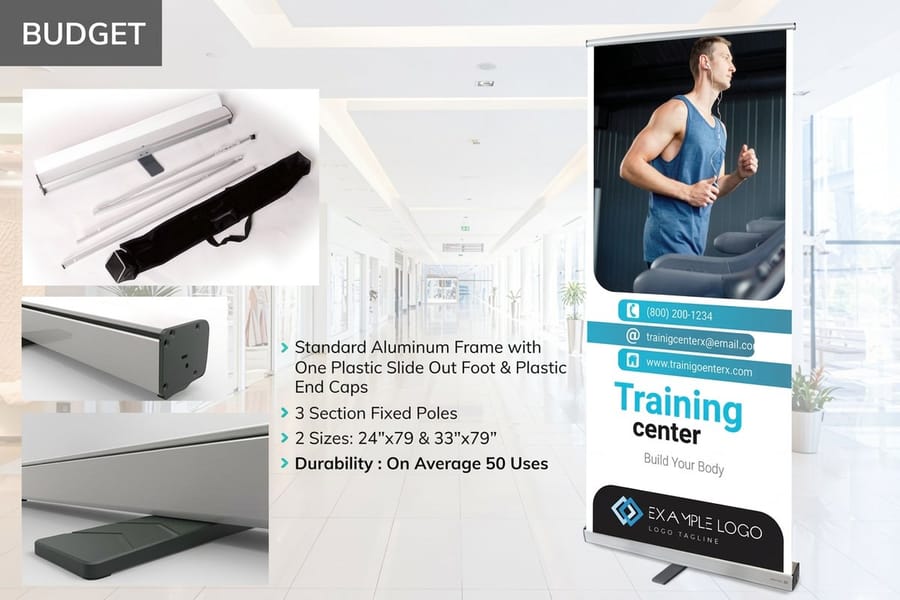
Four separate things attack the stand outdoors, and only one of them is the obvious one. Knowing which is which decides where you set it up.
Wind, which is a lever problem. A standard 33 by 80 inch graphic is about 18.6 square feet of sail. Velocity pressure runs at roughly 0.00256 times the square of the wind speed in miles per hour, so 10 mph puts around 5 pounds on the panel and 20 mph puts around 19 pounds on it. Worse, that force acts near the middle of the graphic, about 46 inches above the ground, while the base resists it across a foot that is maybe 12 inches deep. The numbers stop being close very quickly.
Water, which is a storage problem. Rain on the face of an extended banner is cosmetic. Rain on a banner you then roll up is not. The cassette winds the print against itself inside a sealed housing, and trapped moisture bonds the layers overnight. People blame the print quality. It was the retraction.
Grit, which is a slot problem. The graphic passes through a felt-lined slit every time it goes up or down. Outdoors that felt collects sand and dust, and the next retraction drags it the full length of the print. The scratches are fine, parallel and permanent.
Heat and cold, which are film problems. Direct sun on a dark graphic warms the film enough to encourage the leading edge to curl, which makes the panel track crooked on the roller. Below freezing the film stiffens and takes a crease instead of flexing. Neither shows up in a one-hour demo and both show up over a season. If the stand is going to see real weather, the retractable fabric banner stands at $159.85 use a polyester panel that flexes and dries rather than creasing and holding water.
Setting One Up Outdoors, Step by Step
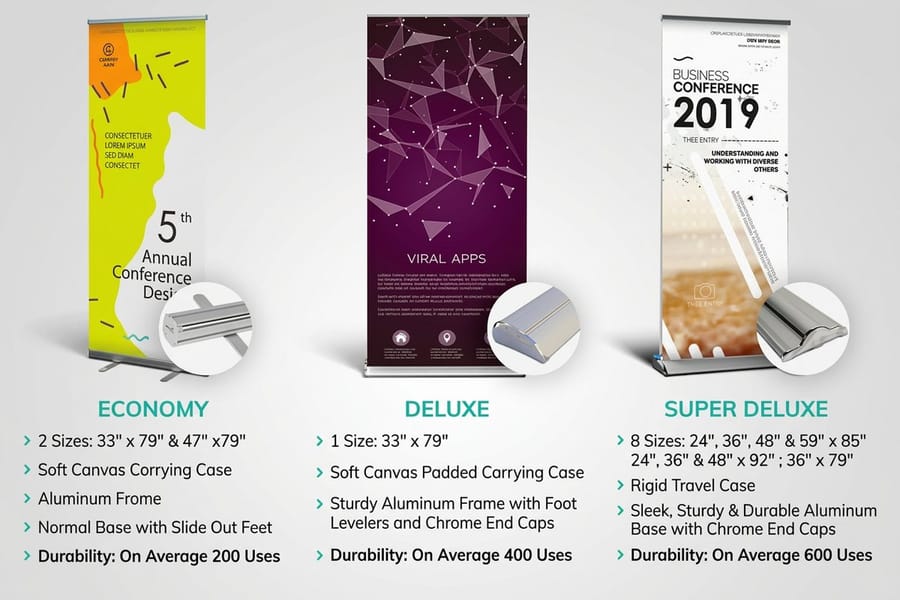
The order matters. Most outdoor failures happen because someone extended the graphic first and then went looking for something to weigh the base down with.
- Read the gust forecast, not the average. A 7 mph day with 22 mph gusts is a 22 mph day as far as your stand is concerned. If gusts top 15 mph, skip to the flag section below and save yourself a reprint.
- Pick the sheltered face of the building. Back to a wall, under an awning, inside a tent, or in the lee of a vehicle. Avoid the gap between two buildings and the corner of a structure, because both accelerate wind well past what the open forecast says.
- Set the base on hard, level ground first. Grass and gravel let one edge of the foot sink, which tilts the mast and starts the fall. If the only surface is turf, put a board under the foot.
- Extend the rear support foot and load it before the graphic goes up. Sandbags, water weights or plates, pushed as far back along the foot as they will sit. Weight on top of the base does almost nothing, because it adds no lever arm.
- Pull the graphic up slowly and lock the pole. Keep a hand on the top rail the whole way. A gust catching a half-extended panel bends the top rail, and a bent rail never sits square again.
- Tether the top if there is anything to tether to. A single line from the top of the mast to a railing, a tent leg or a post converts the whole thing from a balancing act into a braced structure. This is the single highest-value step and almost nobody does it.
- Take it down dry. If the panel is damp, leave it extended in a dry spot or lay it flat until it is dry to the touch. Never retract a wet graphic. Our retractable stand setup guide covers the indoor sequence in more detail.
Anchoring the Base, and Why Distance Beats Weight
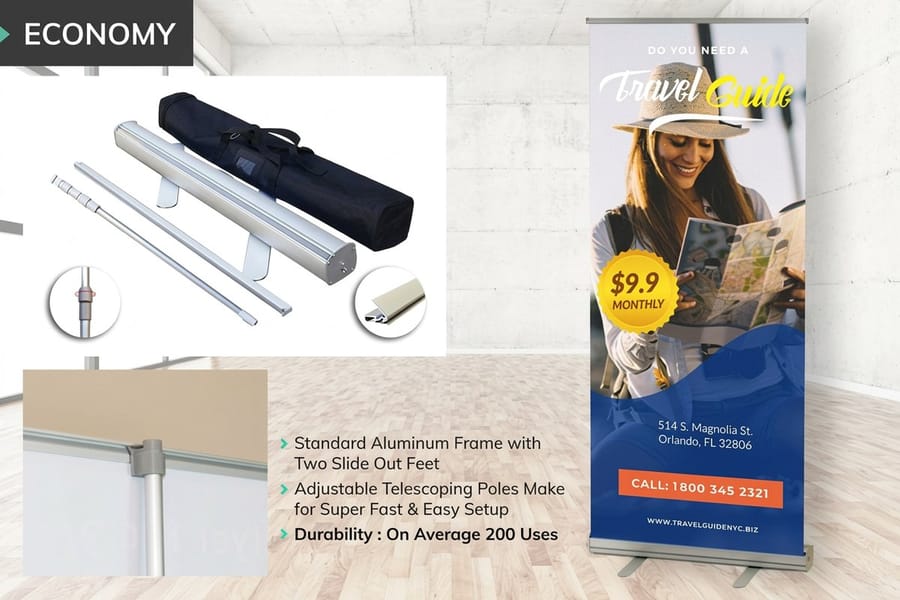
This is where most advice stops at add some sandbags, which is not enough to act on. Tipping is a moment, so it is force multiplied by distance on both sides of the pivot.
Take a 15 mph day. About 10.7 pounds of wind lands on the middle of the graphic, roughly 46 inches up, which is close to 490 inch-pounds trying to rotate the stand over the downwind edge of its foot. Now look at what is resisting. The cassette itself is around 7 pounds sitting maybe 6 inches from that pivot, so it contributes about 42 inch-pounds. That is not a small shortfall. It is an order of magnitude.
Ballast closes the gap, but where you put it matters more than how much you use. A 25 pound bag at the end of the rear foot, 18 inches behind the mast, contributes 450 inch-pounds. The same 25 pounds dropped on top of the base, 6 inches back, contributes 150. To match the far position from the near one you would need 75 pounds, which nobody is carrying to a farmers market. Move the weight out.
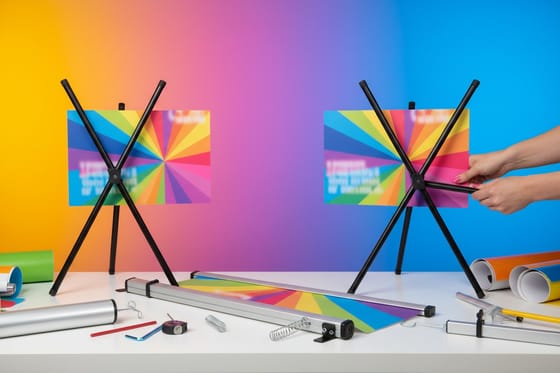
Three practical anchors, in order of how much they buy you: a strap from the top of the mast to a fixed object, which removes the problem rather than resisting it; two bags split left and right at the far end of the foot, which also stops the twisting that topples a stand sideways; and a wide-footprint stand to begin with. If the site has nothing to tie to and no shelter, an X-frame banner stand at $91 spreads its load over a much larger footprint and has no spring mechanism to protect, though it holds the graphic less flat. The retractable versus X-frame comparison lays out that trade in full, and event tent setup uses the same ballast logic at a bigger scale.
When to Stop Fighting It and Print a Flag or a Mesh Banner
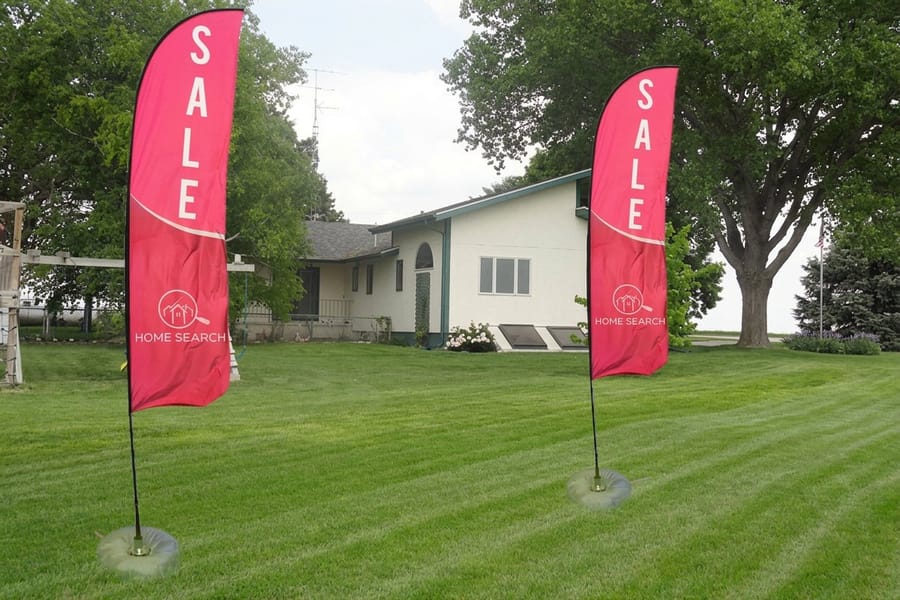
There is a point where the right answer is a different product, and reaching it early saves a ruined graphic. Flags and mesh do not resist wind. They cooperate with it.
| Option | How it handles wind | Realistic outdoor use | Starts at |
|---|---|---|---|
| Retractable stand | Resists it. Flat rigid panel on a narrow foot. | Sheltered spots, a few hours, attended, with ballast. | $139 |
| Retractable fabric stand | Resists it, but the panel flexes instead of creasing. | Same sites, repeated use, survives handling far better. | $159.85 |
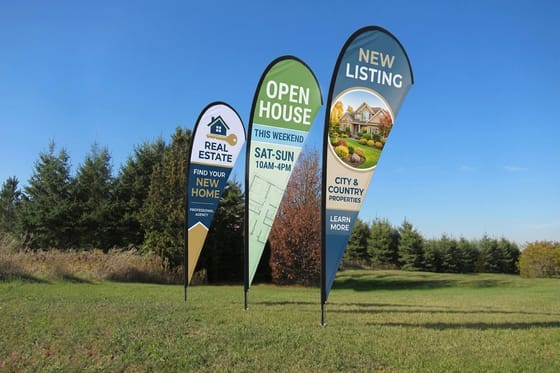
| Feather flag | Cooperates. The pole bends and the flag spills the gust. | Open ground, all day, ground spike or cross base. | $108.75 |
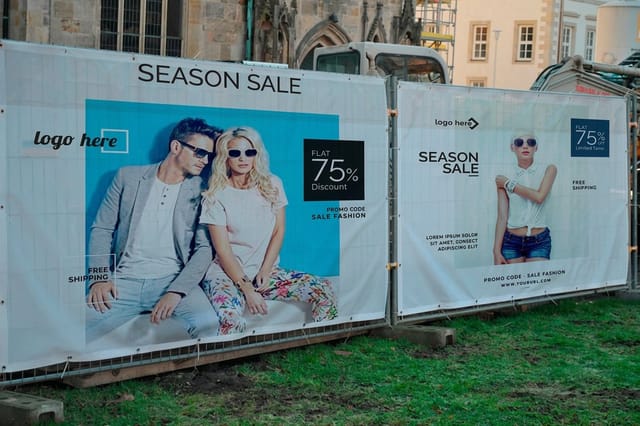
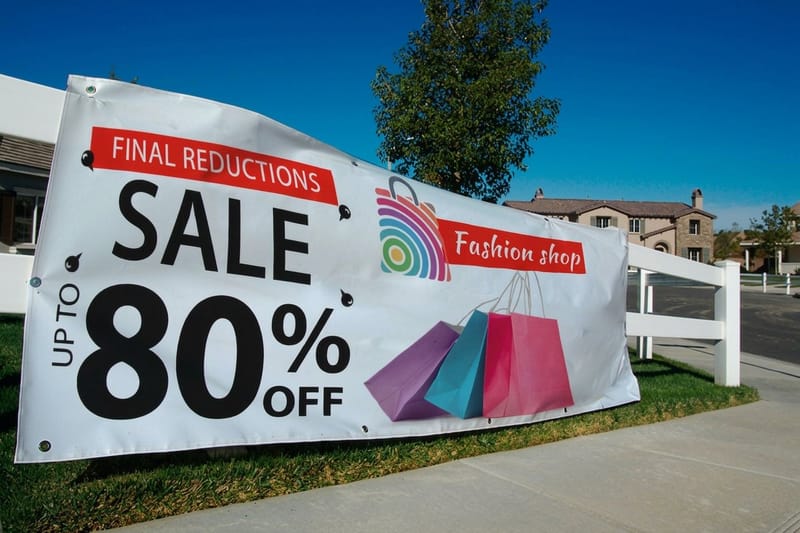
| Mesh banner | Passes it. Perforations let air through the print. | Fences, scaffolds and building faces for weeks at a time. | $75 |
Read the second column. A feather flag starting at $108.75 rides on a flexible pole that unloads itself every time a gust arrives, which is why you see them standing outside car dealerships in weather that would flatten a banner stand. Mesh banners at $75 solve a different case: bolted to a fence or a scaffold, the perforations bleed pressure through the face instead of loading the whole panel, so the same wind that would rip a solid vinyl banner off its grommets barely moves it. If the site is a wall or a fence rather than a floor, a vinyl banner at $79 with proper hems is usually cheaper and tougher than any stand, and grommet placement is what decides whether it survives.
Keep the retractable for what it is genuinely good at: a crisp, flat, portable panel at head height that sets up in a minute. Use it at the door, in the tent, and along the walkway. Send a flag out to the parking lot. Browse the full range in the banners and stands collection, or start from a correctly sized layout in the blank template library, where each retractable stand has its own blank template.
Wally explains outdoor retractable banners
Shelter it, weigh the back foot, take it down dry
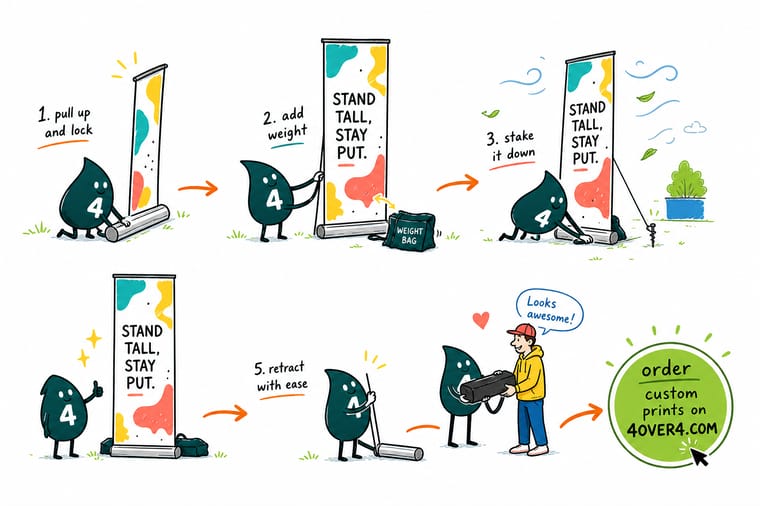
Wally puts the stand against a wall instead of out in the open, then walks the sandbag right to the end of the rear foot, because 25 pounds sitting 18 inches back holds as well as 75 pounds piled on the base. He ties the top of the mast to the tent leg, watches the gust number rather than the average, and packs up before it climbs past 15 mph. Then the part everyone forgets: he leaves the graphic out until it is dry. Roll a damp banner into that cassette and it comes out tomorrow stuck to itself.
Order a retractable banner stand →
Specs and pricing
Stand options, sizes, and starting prices
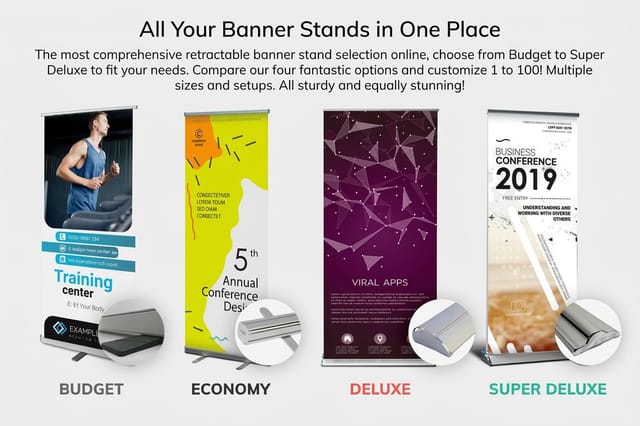
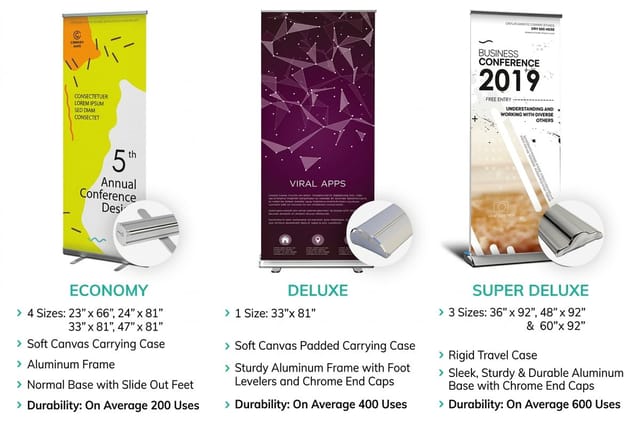
Compare the three frames that come up most often for outdoor work, with live configuration choices and starting prices straight from the 4OVER4.COM configurator. The vinyl retractable runs 24 x 79 to 59 x 85 inches on 13 oz smooth blockout, the fabric retractable 23 x 66 to 60 x 92 inches on 9 oz coated polyester, and the X-frame 24 x 60 to 48 x 78 inches on 13 oz blockout with four grommets, each from a single stand.

Print it
Order a stand that survives the day outside
Keep the vinyl or fabric retractable for the door and the tent, where it stays out of the gusts, and hand the exposed wall or fence to a mesh banner on 8 oz perforated vinyl, from 24 x 72 to 48 x 144 inches or a custom size.
%22%2F%3E%3Ccircle%20cx%3D%2234%22%20cy%3D%2219%22%20r%3D%2229%22%20fill%3D%22%2314b8a6%22%20opacity%3D%220.15%22%2F%3E%3Ccircle%20cx%3D%2233%22%20cy%3D%2229%22%20r%3D%229%22%20fill%3D%22%2314b8a6%22%20opacity%3D%220.1%22%2F%3E%3Crect%20x%3D%2274%22%20y%3D%229%22%20width%3D%2234%22%20height%3D%2219%22%20rx%3D%224%22%20fill%3D%22%2314b8a6%22%20opacity%3D%220.08%22%20transform%3D%22rotate(14%2080%2030)%22%2F%3E%3C%2Fsvg%3E)
Explore more
Where to go next
Set the pole and rail in the right order with the setup guide, see which frame packs smaller in retractable vs X-frame, and choose a ground spike, cross base or water base for a feather flag.

By the numbers
Flags and mesh banners for when the wind wins
Common Questions
Your outdoor retractable banner questions, answered
Can you use a retractable banner outdoors at all?
Yes, for a few hours at a time, in a sheltered spot, with the base weighted and someone nearby. What you cannot do is treat it like a yard sign. A retractable stand has a spring-loaded roller, a printed film graphic and a base that weighs under 10 pounds, all engineered for still indoor air. Outdoors it works fine at a shop door under an awning, along a covered walkway, inside a tent, or on a patio with a wall behind it. It fails in an open parking lot on a breezy afternoon.
What wind speed is too much for a retractable banner?
Watch the gust number in the forecast, not the average. Under about 10 mph a weighted stand in a sheltered spot is comfortable. Between 10 and 15 mph you need ballast set well back from the mast and you should not leave the stand unattended. Above 15 mph gusts, take it down. A 33 by 80 inch graphic is roughly 18.6 square feet, and at 20 mph that surface is carrying about 19 pounds of push nearly four feet off the ground, which is more tipping moment than any portable base is going to hold.
How do you weigh down a retractable banner stand outdoors?
Put the weight on the rear support foot, as far back from the mast as the foot allows, rather than on top of the base. Tipping is a lever problem, so distance counts as much as mass: a 25 pound sandbag 18 inches behind the mast does the same work as 75 pounds sitting 6 inches behind it. Water weights that hook onto the foot, a pair of gym plates, or two sandbags split left and right all work. If there is a railing, a post or a tent leg within reach, add a strap from the top of the mast to it and the whole problem goes away.
Will rain ruin a retractable banner?
A few drops on the face wipe off. What ruins the graphic is retracting it wet. The cassette rolls the print face-to-back against itself in a sealed aluminum housing, and moisture trapped in there overnight makes the layers stick, so the next pull lifts ink and leaves a matte scar down the panel. If the banner gets wet, leave it extended somewhere dry, or unclip the graphic and lay it flat until it is dry to the touch before you roll it.
Can I leave a retractable banner outside overnight?
No. Two things happen after dark that are worse than the wind. Dew settles on the graphic, which puts you straight into the wet-retract problem. And grit blows into the felt slot at the top of the cassette, so the next retraction drags sand across the print and leaves fine parallel scratches you will see the moment sunlight hits it. Take it in, or at minimum retract it and store the cassette indoors.
Is a fabric retractable graphic better outdoors than film?
It handles the abuse better and it looks worse in one specific way. Polyester fabric flexes in a gust instead of creasing, dries faster, and does not hold a permanent crimp if the wind folds it, which is why retractable fabric banner stands at $159.85 are the sensible upgrade for anything that goes outside repeatedly. The trade-off is water spotting: rain leaves visible marks on fabric that dry out unevenly, and a fabric panel is slightly translucent, so strong backlight from behind washes out dark artwork.
How long does an outdoor retractable graphic last?
Longer than you would expect if it lives indoors between events, and much shorter if it is set out daily. The failure is rarely fading. It is edge damage from handling, a crease from one bad gust, and scratches from the cassette slot, all of which accumulate per use rather than per month. If a stand is going to work outside several times a week, order a second graphic with the stand from the start and rotate them, so a scratched panel is a swap rather than a scramble the night before a show.
Get Started
Order a feather flag on a ground spike, printed in 4 business days
Pick the frame that suits your site, choose a film or fabric graphic, and we print a panel that sets up in a minute and packs back into its own case.
Legal Disclaimer
Gold Standard guarantees apply to all standard orders placed through 4over4.com. Price match requires verifiable proof of a competitor's published price for an equivalent product with matching specifications and turnaround time. Satisfaction guarantee covers manufacturing defects and print quality issues. Contact support with order number and documentation.
