
How to Choose a Postcard Printer That Handles Stock, Postage and Mailing


Most postcard quotes look identical until you ask about caliper, postage tiers and who drops the mail. Here are the checks that separate a printer with a postcard SKU from one that runs mail every day.
Choose a postcard printer on four things: the cardstock it runs as standard, which of its sizes qualify for the USPS postcard rate, whether it addresses and mails the job or only hands you boxes, and what its turnaround is measured from. Stock and size set your postage before design touches anything, since a card must be at least 0.007 inches thick and no larger than 6 by 4.25 inches to keep the postcard rate. Everything after that is service terms, and the terms are where the money moves.
Quick answer
Stock, size, mailing, turnaround, in that order
Work down the list in the order that money actually moves. Caliper comes first, because a card under 0.007 inches will not mail and a 16pt card with laminate on both sides can breach the 0.016 inch postcard rate ceiling. Size comes second, because anything over 6 by 4.25 inches jumps to letter postage on every single piece. Mailing comes third, since a printer that addresses inline, cleans the list and drops under its own permit removes a whole workflow from your desk. Turnaround comes last, and it is a service term rather than a print quality one.
Read the Stock List Before the Price List
The cheapest postcard quote you will find is usually cheap because the card is thin, and thin cards fail in two places at once: they feel disposable in the hand and they can fall under the USPS minimum thickness of 0.007 inches. Any printer serious about postcards runs 14pt and 16pt cover as standard, quotes them in points, and can tell you the caliper in inches without checking.
Fourteen point is the sensible default. It measures around 0.014 inches, survives a mail stream without curling, and leaves headroom under the 0.016 inch postcard rate ceiling. Sixteen point is the upgrade you feel, and it sits exactly on that ceiling, which is where people get caught: laminate film on both faces adds enough caliper to push a 16pt card over the limit, and the drop gets repriced as a letter. If you want the extra rigidity and the postcard rate, take a coating rather than a film, or stay at 14pt.
Coating is the other question, and it is not cosmetic. High gloss UV looks the strongest in a photograph and repels ink, so a pen skates across it and an inline inkjet address beads and smears. That is why a real postcard printer will offer gloss on the front and an uncoated or aqueous back, or a silk laminated postcard with a writable panel knocked out of the film. Ask for it by name. If the answer is a blank look, the shop does not mail much. Our postcard paper and cardstock guide goes stock by stock.
Match the Size List to the USPS Postage Tiers
Size is the single decision that moves your postage, and it moves it in steps rather than gradually. A printer who lists sizes without telling you which tier each one lands in is leaving the expensive part of the job to you.
| Size | USPS tier | What that means | Where it fits |
|---|---|---|---|
| 4 x 6 in | Postcard rate | The cheapest per piece postage available for a card. | High volume prospecting and reminders where reach beats impact. |
| 5 x 7 in | Letter rate | Both dimensions pass the postcard limits, so it is priced as a letter. | Announcements and invitations that want presence in a stack. |
| 6 x 9 in | Letter rate | Same postage as 5 x 7, with far more usable space. | Service reminders, property listings, menus. |
| 6 x 11 in | Letter rate | Still a letter, right at the 11.5 inch length ceiling. | Seasonal offers and coupon strips that need room. |
| 6.5 x 9 in and up | Flat rate | Above letter dimensions, and the only tier EDDM accepts. | Neighborhood saturation mail with no list at all. |
Two things fall out of that table. First, if you are already paying letter postage at 5 by 7, moving up to 6 by 9 or 6 by 11 oversized postcards costs nothing extra in postage and buys you a much bigger canvas. Second, Every Door Direct Mail requires flat size pieces, so a 4 by 6 can never go EDDM no matter what a sales page implies. If EDDM is the plan, read what EDDM is and who it suits first, then check the sizes against the USPS size rules. For the tier by tier detail, our postage cost by size guide lays it out, and the full size guide covers everything we cut.
Decide Whether You Are Buying Printing or Buying Mailing
These are two different services and they are quoted as if they were one. A print only shop hands you sealed boxes. A mail house prints, addresses the pieces inline as they come off the cutter, cleans the list, presorts, and drops the job under its own permit. Comparing a per piece print price against a per piece mailed price is how people end up surprised by a data processing line on the invoice.
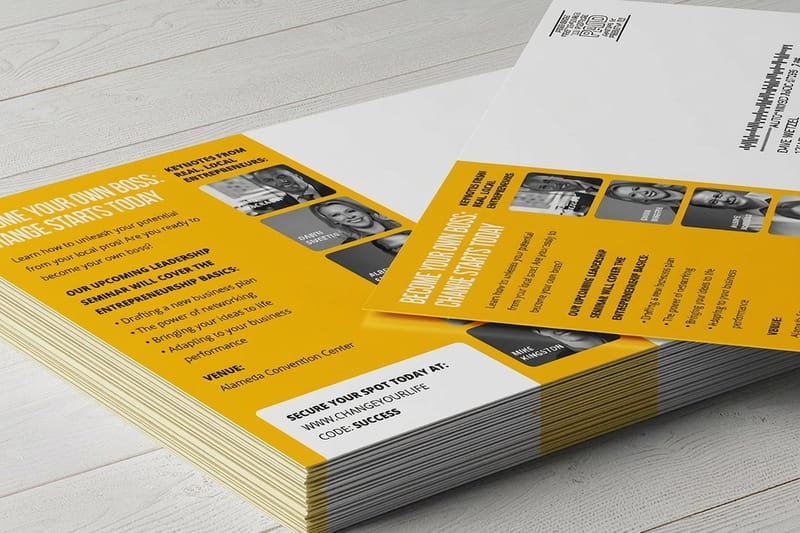
If mailing is part of the plan, four answers tell you whether the printer really does it. Do they address inline, or apply labels, because a label on a glossy card lifts in the mail stream. Do they run the list through CASS certification and NCOA, which strips undeliverable and moved addresses before you pay postage on them. Do they mail under their own permit, which saves you an application and a bulk mail acceptance appointment. And do they give you a confirmed mail date. Direct mail postcards at 4OVER4.COM start at $89.68 with all of that attached, against $16.48 for standard postcards printed and boxed.
The trade-off worth naming: once a mail house drops your job you never physically hold a piece from that run. If the artwork is new, order a small print only run first, look at it in daylight, then release the mailing. Our guides on how postcard mailing services work and how to choose a direct mail company cover the questions in more depth, and building or renting a list covers the part most people leave until last.
Turnaround, Proofs, and the Two Clocks You Are Racing
Every mailing runs two clocks. The first is production, counted in business days from proof approval. The second is USPS transit, which starts at the drop and cannot be shortened by anyone at the printing company. Rush printing compresses the first clock only, so a campaign planned around a specific in home date needs slack on both.
Get clear on what the printer counts as day one. Some start the clock at file upload, most start it at proof approval, and a file that arrives without bleed or with live fonts restarts it. A free digital PDF proof is standard and shows you trim, bleed, and content position. A hard copy proof shows you color on the real stock, costs money, and adds days to the schedule, so it earns its place on a brand launch and not on a monthly reminder card.
Setting the file up correctly removes most of the delay. Build to 0.125 inch bleed, keep text 0.125 inches inside the trim, and leave the lower right of the address side clear for the barcode and the postal markings. Bleed and trim explained covers the first part and the address side layout rules cover the second. Starting from a correctly sized layout in our blank template library removes the guesswork entirely.
Price the Whole Job, Not the Print Run
The print price is one line of a postcard budget. Postage is a second, list rental or data processing is a third, and design is a fourth if you are not supplying artwork. A quote that only wins on the first line is not the cheaper job.
| Product | Starts at | Where it earns the money |
|---|---|---|
| Standard postcards | $16.48 | Volume mailings and handouts where the message does the work. |
| Soft touch postcards | $29.44 | A velvet surface people keep holding, useful for premium services. |
| Oversized postcards | $51.62 | Letter rate postage you are already paying, with a far bigger canvas. |
| Silk postcards | $74.53 | Laminated durability with a writable panel for handwritten notes. |
| Folded postcards | $84.36 | Four panels of space when one side cannot carry the offer. |
| Direct mail postcards | $89.68 | Printed, addressed, presorted and dropped under our permit. |
Those are starting prices at the smallest quantity we run. Per piece cost drops steeply as the run grows, because plate setup and makeready are spread across more sheets, which is why a 5,000 piece order rarely costs five times a 1,000 piece order. How bulk price breaks work explains where the steps fall, and getting postcard printing cheaper covers the levers that do not damage the piece. Browse the full range on the postcard printing pages, where every option is priced live in the configurator.
Wally sizes up a postcard printer
Ruler first, price list second
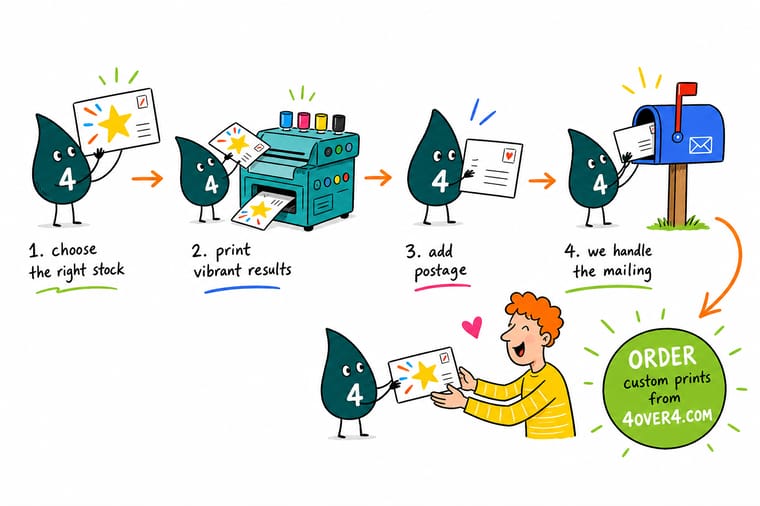
Wally puts every quote through the same three checks. He measures the card, because 6 by 4.25 inches is the line between postcard postage and letter postage. He gauges the caliper, because under 0.007 inches it does not mail and over 0.016 inches it stops being a postcard to USPS. Then he asks who drops it at the post office. A printer that can answer all three without looking anything up is a printer that mails every day, and that is the one you want on a campaign with a date attached.
Print and mail your postcards →Specs and pricing
Postcard options, sizes, and starting prices
Compare the three routes side by side, with live configuration choices and starting prices straight from the 4OVER4.COM configurator.


Print it
Order postcards from a printer that mails them too

Explore more
Where to go next


By the numbers
Postcard printing you can plan a campaign around
Common Questions
Your postcard printer questions, answered
What should I ask a postcard printer before I order?
Five questions cover most of the risk. Which stocks do you run as standard, and what are they in points and inches. Which of your sizes qualify for the USPS postcard rate. Do you mail under your own permit, or do I get boxes. Is the address side left uncoated or writable. And what is the turnaround measured from, proof approval or file upload. The answers separate a print shop with a postcard SKU from a printer who actually runs mail every day.
Is 14pt or 16pt better for postcards?
For most mailings 14pt is the sensible default, and 16pt is the upgrade you notice in the hand. 14pt measures about 0.014 inches and 16pt about 0.016 inches, which matters because the USPS postcard rate stops at 0.016 inches. A 16pt card is right at the line, so adding laminate on both sides can push it past the ceiling and reprice the whole drop as a letter. If you want thickness and the postcard rate together, take 16pt with a coating rather than a laminate film, or stay at 14pt.
Does a bigger postcard cost more to mail?
Yes, and the jump is a step rather than a slope. Up to 6 by 4.25 inches you pay the postcard rate. A sixteenth of an inch over on either dimension and the piece is priced as a letter, all the way out to 11.5 by 6.125 inches. Past that it becomes a flat. So a 6 by 9 costs the same postage as a 6 by 11, which is why 6 by 11 is such a common choice: you are already paying letter postage, so you may as well use the space.
Can I mail a 4 by 6 postcard through EDDM?
No. Every Door Direct Mail Retail requires flat size mail, which means the piece has to exceed the letter dimensions in at least one direction. Common EDDM sizes are 6.5 by 9, 6.5 by 12 and 8.5 by 11. A 4 by 6 card is far too small to qualify, so if a printer offers you EDDM on a 4 by 6, they have not run EDDM. Our guide to EDDM postcard sizes lists the sizes that clear the rule.
Should I use a printer that also mails, or handle mailing myself?
Let the printer mail it unless you already hold a permit and a mailing list you maintain. A printer that mails addresses the pieces inline as they come off the cutter, runs the list through CASS and NCOA so bad addresses drop out before they cost postage, presorts, and drops under its own permit. Doing it yourself means a permit application, a bulk mail acceptance appointment, and hand sorting. The one real trade-off is control: once the pieces leave a mail house you never physically see them, so order a short print only run first if the artwork is new.
How much does postcard printing cost?
At 4OVER4.COM standard postcards start at $16.48, oversized postcards at $51.62, silk postcards at $74.53, folded postcards at $84.36, and direct mail postcards at $89.68 with the mailing service attached. Those are starting prices at the smallest quantity, and the per piece cost falls sharply as the run grows because the press setup is spread across more sheets. Postage is never included in a print price, so budget it separately per piece.
How long does postcard printing and mailing take?
Production is counted in business days from proof approval, not from the moment you upload a file, and a file with the wrong bleed or a missing font restarts that clock. After the drop, USPS marketing mail typically moves slower than First Class, and neither is under the printer control. Plan backwards from the date you want the card in a mailbox, and add days for a hard copy proof if you order one.
Get Started
Ready to get postcards in mailboxes?
Pick your size and stock, upload the artwork, and we print, address, presort and drop the job under our own permit.
Legal Disclaimer
Gold Standard guarantees apply to all standard orders placed through 4over4.com. Price match requires verifiable proof of a competitor's published price for an equivalent product with matching specifications and turnaround time. Satisfaction guarantee covers manufacturing defects and print quality issues. Contact support with order number and documentation. On-time delivery rate based on tracked orders 1999 to 2026. Individual results may vary based on shipping carrier performance.
