
How to Get a Postcard Sample Before You Print a Full Run


A swatch pack, a free proof and a short print run each answer a different question. Here is which one to ask for, in what order, and what each one still leaves you guessing about.
Request a free sample pack for stock and finish, upload your file for the free proof that comes with every order, and print the smallest quantity in the calculator when you need your own design on real card. The pack never carries your artwork and the proof never leaves the screen, so a short run is the only sample that shows both at once, and the only one you can put a stamp on and mail.
Quick answer
One free pack, one free proof, one short run
A postcard sample is not one thing, it is three. The free sample pack settles paper weight, caliper and coating because you can flex it and hold it under daylight. The free proof included on every 4OVER4.COM order settles resolution, color mode, bleed and trim on your exact file. A short printed run settles everything else, since it is the only version that carries your design on the stock you chose and the only one you can mail to yourself as a test.
Three Ways to Get a Postcard Sample, and What Each One Shows
People searching for a postcard sample usually want one of two different things without realising it. Either they want to know what the card will feel like, or they want to know what their own design will look like once it is off a screen. No single sample answers both for free.
| Route | What arrives | Cost and wait | What it cannot tell you |
|---|---|---|---|
| Free sample pack | Stock and finish swatches plus printed examples, mailed to your address. | Free, standard mail, so plan a week or so ahead. | Nothing about your artwork, your colors or your trim. |
| Free proof | A prepress review of the exact file you uploaded, viewed in your account. | Free with every order, back within the production window. | Nothing about weight, stiffness or how a coating feels. |
| Short printed run | Real postcards, your design, the stock and finish you selected. | Priced from the calculator, and it takes a full turnaround. | Very little, which is why it is the sample worth paying for. |
The efficient order is pack first, proof second, short run last. Request the swatches from the free samples page while you are still designing, upload the file when the layout is settled so the free proof catches file problems, then print a small quantity of standard postcards once both questions are answered. Our guide to free printing samples covers the pack itself in more detail.
How to Request the Free Sample Pack, Step by Step
The request itself takes about two minutes. Getting something useful back takes a little planning.
- Decide which questions the pack has to settle. Weight against size is the common one. If the piece is a 4 by 6 handout, almost any postcard stock holds up. If it is oversized, stiffness starts to matter, so that is what you are testing for.
- Open the free samples page and fill in the shipping address. Use the address someone will actually be at, because the pack goes out by standard mail rather than a production courier.
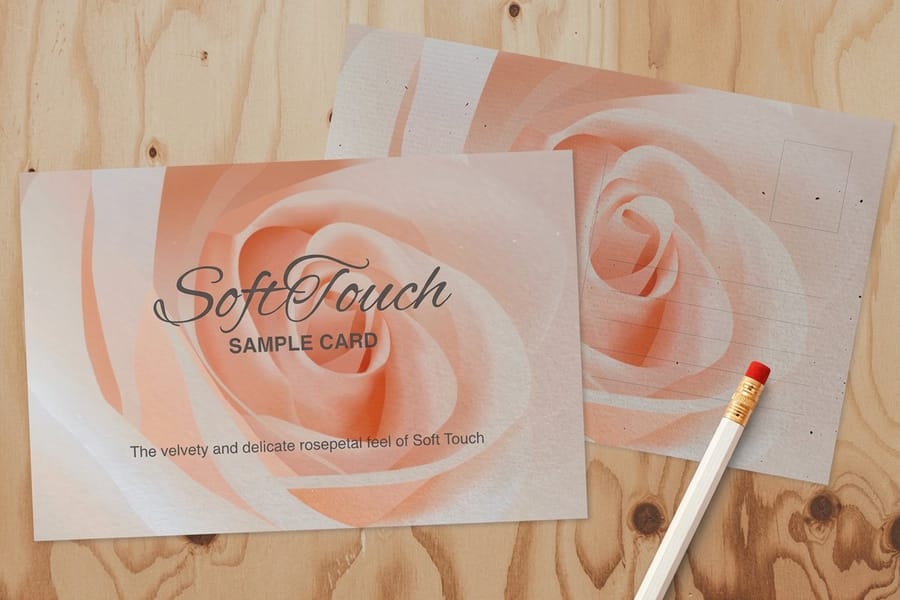
- Name the finishes you care about in the request. Gloss, matte, silk and soft touch feel nothing like each other, and asking for a specific comparison is more useful than a generic assortment.
- Keep designing while you wait. The pack answers a stock question, not a layout question, so nothing about it should hold up artwork. Start from a correctly sized file in the blank template library.
- Upload the file and read the proof. The free proof comes back with resolution, color mode, bleed and trim checked. Approve it or send changes, because the job holds at that step until you do.
One thing worth saying plainly: if your deadline is inside a week, skip the pack. Order the short run instead, or work from the published specs and let the proof carry the risk. A sample pack that lands after the campaign has shipped has cost you nothing except the chance to make the decision properly.
How to Read a Postcard Sample Once It Is in Your Hand
A sample is only worth the checks you run on it. Five minutes with the swatches on a desk near a window settles most of the argument.
Flex it at the size you are actually printing. Card thickness is quoted in points, where a point is one thousandth of an inch, so 14pt is 0.014 inch and 16pt is 0.016 inch. On a 4 by 6 card the difference is barely noticeable. On a 6 by 11 the lighter stock bows in the hand and arrives with a curl, which is where the heavier stock earns its price.
Check the address side, not the pretty side. A gloss laminate will not take ballpoint ink and can smear under an inkjet address block, so a laminated card is a card that has to be addressed at the press. Uncoated and matte surfaces absorb ink and take a handwritten note. This single check has saved more campaigns than any color decision, and it is covered in our guide to addressing a postcard correctly for mailing.
Watch the USPS ceiling if you want the postcard rate. The postcard rate applies between 3.5 by 5 inches and 4.25 by 6 inches, and requires a thickness of at least 0.007 inch and no more than 0.016 inch. A 16pt card sits exactly at that upper limit, which is fine, but a thicker card or a card larger than 4.25 by 6 inches is billed as a letter. Read the size question and the postage question together, never separately.
Judge color in daylight, next to your brand colors. Coated stock lifts saturated color and darkens deep tones, uncoated dries them back and softens contrast. Put a printed brand piece beside the swatch and look at them together rather than trusting memory. If the layout itself is still open, the anatomy of a postcard covers where each element has to sit.
When to Stop Sampling and Print a Real Postcard
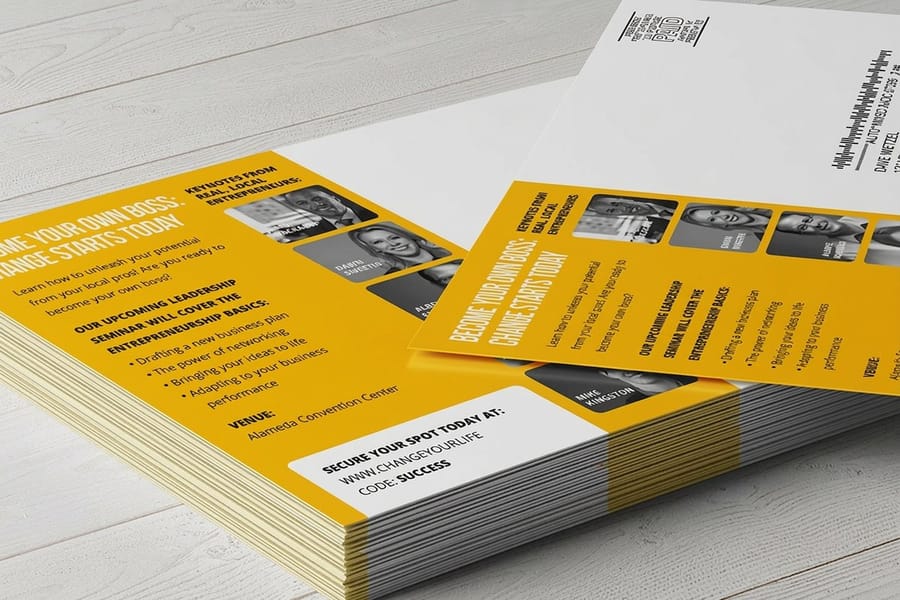
There is a point where more swatches stop helping. Once you know the stock and the file is clean, the honest next move is to print your own design at the smallest quantity the calculator offers and look at the finished card.
Standard Postcards start at $16.48, which makes a short run of your real artwork one of the cheapest decisions in the whole campaign. If the piece is meant to feel expensive, Soft Touch Postcards start at $29.44 and Silk Postcards start at $74.53, and the difference between those three is genuinely something you have to hold rather than read about. For a campaign that we address and mail for you, Direct Mail Postcards start at $89.68 and the sample step matters more, because a fault multiplied across a mailing list is expensive to undo.
Then mail one to yourself. Stamp it, post it, and see what the sorting equipment does to the corners and what the coating did to the address ink. That round trip is the only test that covers the whole chain, and it is why we push the short run before a mailing rather than after. The five steps for sending direct mail postcards covers the rest of the sequence, and why print samples first makes the wider case across other products.
Browse the full range on the postcard printing pages, where every size, stock and finish carries live pricing from the same calculator you will order from.
Wally explains postcard samples
Feel the paper, check the file, then print one for real
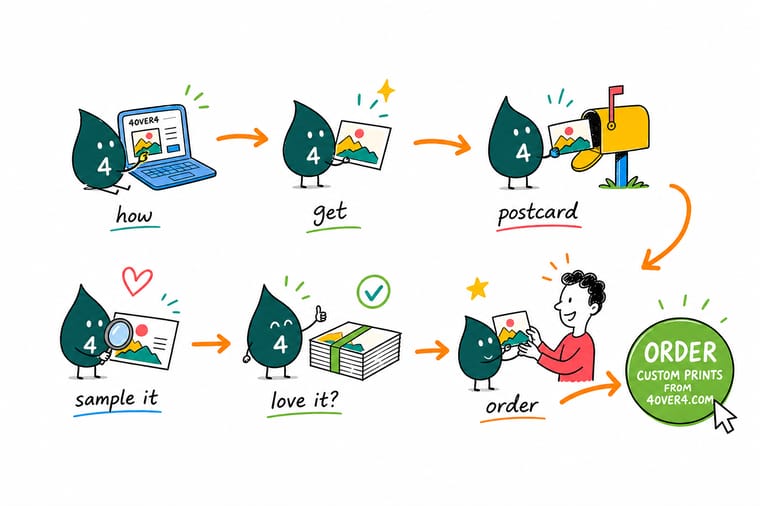
Wally mails you swatches so you can flex the card and see how gloss, matte and soft touch behave in daylight. He checks your file on screen for free and tells you if the resolution is short or the bleed is missing. What he cannot do is put your design on paper without printing it, so when both answers are in, run the smallest quantity in the calculator, stamp one, and post it to yourself. Whatever comes back through your own letterbox is the truth.
Price a short postcard run →Specs and pricing
Postcard sizes, stocks and starting prices
The same configuration choices you will sample, with live options and starting prices straight from the 4OVER4.COM instant price calculator.



Print it
Print the sample you can actually mail

Explore more
Where to go next


By the numbers
Postcard printing you can count on at 4OVER4
Common Questions
Your postcard sample questions, answered
How do I get a postcard sample from 4OVER4.COM?
There are three routes and they answer different questions. Request a free sample pack on the free samples page and stock and finish swatches are mailed to you, which settles weight, caliper and coating. Upload your artwork to any postcard product and a free proof comes back from prepress before anything prints, which settles resolution, color mode, bleed and trim. Print the smallest quantity in the configurator and you get the real thing in your hand, on the real stock, with your design on it. Most people do the first two, both free, then print the short run once the decision is close.
Will the free sample pack arrive with my design printed on it?
No. The pack is a set of stock and finish swatches plus printed examples, sent so you can judge the physical qualities a screen cannot show: how heavy the card feels, how stiff it is when someone holds it, and how gloss, matte and soft touch behave under real light. Your artwork is never part of it. If what you actually want is your own layout on card, that is a short print run, not a sample pack.
What is the difference between a postcard sample and a free proof?
A sample is paper you can touch. A proof is a check on your file. The free proof at 4OVER4.COM is a prepress review of the exact artwork you uploaded, flagging images under 300 DPI, RGB color that will shift on a CMYK press, missing bleed, and text drifting into the trim. It catches the errors that cost you a reprint. It cannot tell you whether 14pt feels too flimsy for a 6 by 11 mailer, because that is a question only paper answers.
How many postcards do I have to print to get a physical sample?
Whatever the smallest quantity in the instant price calculator is for the product and size you picked, which is usually far less than a campaign run. Standard Postcards start at $16.48, so a short run of your real design costs less than most people expect, and the leftovers are not wasted since they are printed to the same file you will reorder. Check the live quantity and price on the product page before you assume a sample run is expensive.
Can I mail a postcard sample to myself?
Yes, and it is the test most people skip. Put a stamp on one, address it by hand or run it through whatever printer will address the real batch, and post it. What comes back tells you three things a swatch cannot: whether the coating took the address ink, whether the corners survived the sorting equipment, and whether the card arrived flat or bowed. A card that reads beautifully on a desk and arrives creased is a card that failed.
Which postcard finish should I ask to see first?
Start with the three that behave most differently. Standard Postcards at $16.48 give you the plain coated or uncoated baseline. Soft Touch Postcards at $29.44 have a velvety coating that people notice in the hand, though it does mark on heavy dark coverage. Silk Postcards at $74.53 sit between matte and gloss with a smooth low-glare surface that holds photographic color well. Feel those three and the rest of the finish range makes sense by comparison.
Get Started
See it before the whole run prints
Pick your size, stock and finish, upload the file for a free proof, and print a short run you can hold, hand over and drop in a mailbox.
Legal Disclaimer
Gold Standard guarantees apply to all standard orders placed through 4over4.com. Price match requires verifiable proof of a competitor's published price for an equivalent product with matching specifications and turnaround time. Satisfaction guarantee covers manufacturing defects and print quality issues. Contact support with order number and documentation. On-time delivery rate based on tracked orders 1999 to 2026. Individual results may vary based on shipping carrier performance.
