
How to Create a Custom Nutrition Label That Prints Clean


The Nutrition Facts box follows a format you cannot redesign. Here is what goes in it, which of the five layouts your package qualifies for, where it has to sit, and how to print it so the smallest line still reads.
A custom nutrition label is a Nutrition Facts panel built to the FDA format in 21 CFR 101.9, then printed on a stock that survives the product it wraps. Work it in four passes: get the nutrient data and the serving size from the Reference Amount Customarily Consumed, choose the panel format your available label surface allows, place the box on the information panel with the ingredients and address and nothing between them, then set the artwork in 100 percent black vector type so 6 point lines print sharp.
Quick answer
Fixed box, fixed placement, and a stock that matches the product
You do not design a Nutrition Facts panel, you build one to spec and design around it. The nutrient order, the bar weights and the black-on-neutral rule come from 21 CFR 101.9. The serving size comes from the Reference Amount Customarily Consumed for your food category. The layout you may use, from standard vertical down to linear, depends on how much label surface the package gives you. Placement is set too: the panel, the ingredient list and the manufacturer address run together on the panel immediately right of the front, with nothing printed between them.
What the FDA Fixes Inside the Box, and What Is Left to You
Open any Nutrition Facts panel in the country and the parts sit in the same order, because 21 CFR 101.9 fixes that order. Serving information first, then Calories, then the fats, cholesterol, sodium, carbohydrates with dietary fiber and both sugar lines under it, protein, and finally the four mandatory micronutrients: vitamin D, calcium, iron and potassium. Vitamins A and C came off the required list in the 2016 rule. Added Sugars went on, with compliance running from January 1, 2020 for manufacturers with $10 million or more in annual food sales and January 1, 2021 for everyone smaller.
The percent Daily Value column runs against the current reference values, not the ones printed on labels from a decade ago. Sodium is 2,300 mg, dietary fiber is 28 g, added sugars is 50 g, saturated fat is 20 g. If your nutrition data came from an old spreadsheet, the percentages are the first thing to recheck, because the numbers can look plausible and still be wrong.
Serving size is where most first-time labels go sideways. You do not pick it. Each food category has a Reference Amount Customarily Consumed, and the serving on your label is the household measure closest to that reference amount for your product. A bag holding less than 200 percent of the reference amount is one serving, full stop, even if you would rather it read as two.
Everything outside the box is yours. Brand, photography, claims, the story on the side panel. Our FDA food labeling guide covers the statements that live around the panel, and shelf appeal for food labels covers the half of the package that has to earn the pickup.
Pick the Panel Format That Fits the Space You Have
There is not one Nutrition Facts layout, there are five, and the one you are allowed to use depends on how much label surface the package gives you. Measure the available panel before the designer starts, not after.
| Format | When it applies | Type floor | The catch |
|---|---|---|---|
| Standard vertical | The default whenever the panel fits. Calories set bold and far larger than any other line. | 8 pt body, 6 pt footnote | Eats roughly 2 by 3 inches of panel. Plan the rest of the layout around it. |
| Tabular | Packages with less than 40 sq in of available label surface where the vertical box will not fit. | 6 pt | Runs wide instead of tall, so it fights a narrow wrap label. |
| Linear | Under 40 sq in only, and only when neither vertical nor tabular fits at all. | 6 pt | A run-on string of type. Legal, and the hardest of the five to read. |
| Simplified | When the food holds insignificant amounts of eight or more of the required nutrients. | 8 pt body, 6 pt footnote | Still owes the Not a significant source of footnote listing what you dropped. |
| Dual column | Packages holding between 200 and 300 percent of the reference amount, which a person could reasonably finish at once. | 8 pt body, 6 pt footnote | Two full value columns, per serving and per package. Nearly doubles the width. |
The practical order is: work out the servings first, then measure the panel, then choose the format, then set the label size. Doing it backwards is how a 2 by 3 inch label ends up needing a dual column it has no room for. If you are still sizing the container, choosing the correct label size walks through measuring a curved surface honestly, and a blank template gives you the die line to lay out against.
Where the Panel Has to Sit on the Package

The front of the package is the principal display panel: the face a shopper sees on shelf. It carries the product name and the net quantity of contents, and the net quantity goes in the bottom 30 percent of that panel. Everything regulated that is not the net quantity goes on the information panel, which is not a design decision either. It is the panel immediately to the right of the principal display panel as the consumer faces the package.
On that information panel, three blocks travel together: the Nutrition Facts box, the ingredient list with its Contains allergen statement, and the name and address of the manufacturer, packer or distributor. The rule people miss is that nothing else may be printed between them. A recipe, a QR code, a batch box or a strip of brand copy dropped between the ingredients and the panel is intervening material, and it is a defect even though the label looks tidier for it.
Two shapes make this awkward. On a cylinder, the panel to the right of the front curves away, so type near the wrap seam distorts and the box has to be positioned to stay on the readable arc. On a pouch or a small jar there may not be room at all, and then the required statements are allowed to move onto the front panel rather than be split up. Splitting the block is never the fix.
Keep the finished box at least 1/8 inch inside the die line. Labels shift slightly on the roll during application, and a Nutrition Facts panel clipped by the cut edge is a reprint. Any layout starting from a die-cut label shape needs that margin measured against the real cut path, not the artboard.
Printing the Panel So the 6 Point Type Survives
A nutrition panel is the smallest type most brands ever print, sitting next to the thinnest rules. Four file habits carry almost all of the quality.
- Build the box in 100 percent K. A rich black or four-color build needs all four plates to land perfectly. They rarely do, and the first thing a fraction of a millimetre of registration drift ruins is 6 point type.
- Keep the panel as live vector type. A screenshot of a panel from nutrition software, placed as a PNG, softens every stem and rounds the hairline rules even at 300 dpi. Export it as vector or rebuild it.
- Do not set rules below 0.25 pt. The thin separator lines are structural to the format. Under a quarter point they either drop out or thicken unpredictably depending on the press.
- Choose the lamination for legibility, not for feel. Gloss laminate over a nutrition panel throws glare straight back under retail lighting. Matte keeps the small type readable, which matters more on the back than the shine does.
Then match the stock to where the product actually lives. This is the part a spreadsheet will not tell you, and it is the most common reason a good label fails in the field.
| Where the product lives | What we print it on | Why | Starts at |
|---|---|---|---|
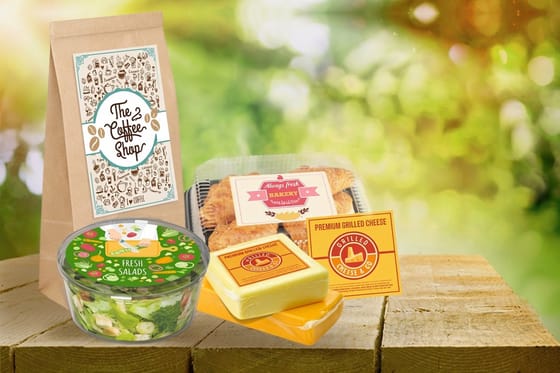
| Premium Food Labels | Paper face, matte or gloss | Shelf-stable dry goods, bakery, coffee, snack bags kept at room temperature. | $29.16 |
| Premium Waterproof Labels | Synthetic film face | Jars, sauces, drinks and anything that meets condensation or a wet hand. | $84.68 |
| Premium Clear Labels | Clear film face | Glass and clear bottles where you want the product itself to read through. | $86.17 |
| Die-Cut Labels | Cut to your own outline | Shapes a stock rectangle or circle cannot hold, including tapered jars. | $93.37 |
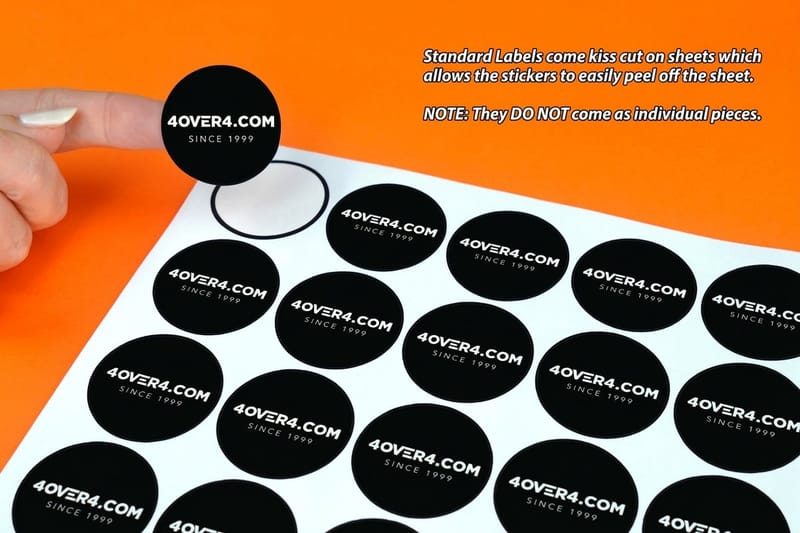
| Standard Labels | Paper face, stock shapes | Batch codes, internal marking, and short runs while you finalize the artwork. | $23.88 |
Order a short run and live with it for a week before you commit to thousands. Stick one on a jar, put it in a fridge, take it out, wipe it, read the panel at arm's length in a supermarket aisle. Everything you learn there is cheaper than learning it on a pallet. Browse the full range on product labels or across the food and beverage collection, and our art director walks through a label layout if you want to see the decisions in sequence.
Wally explains the nutrition panel
The box is fixed. Where it sits is fixed too.
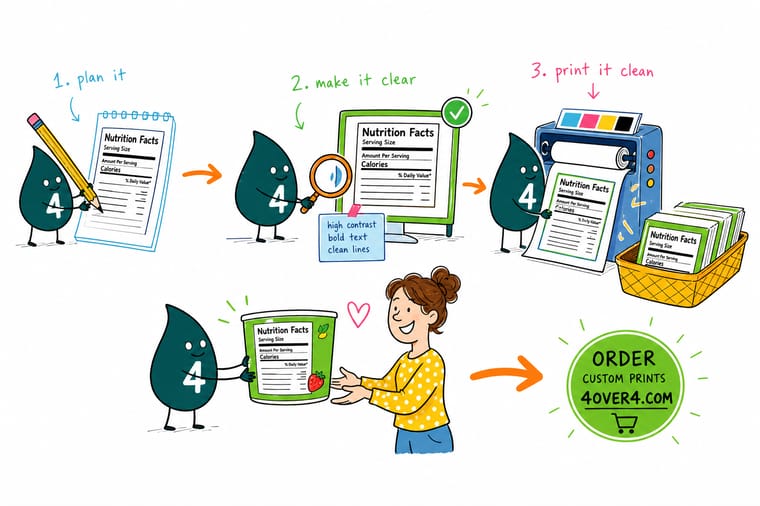
Wally treats the panel as a block he is not allowed to move. Nutrition Facts, ingredients, then the name and address, all together on the panel to the right of the front, with nothing squeezed between them. Net weight stays on the front, in the bottom third. Then he checks the file: black built from one plate, type kept as vector, no rule thinner than a quarter point, and the whole box an eighth of an inch inside the cut. Do that and the smallest line on the label still reads on a shelf.
Order premium food labels →Specs and pricing
Label sizes, materials and starting prices
Configure the size, shape and face stock, and see the starting price straight from the 4OVER4.COM configurator before you commit a run.


Print it
Labels built for food packaging

Explore more
Where to go next


By the numbers
Label printing you can count on at 4OVER4
Common Questions
Your nutrition label questions, answered
Does my food product legally need a Nutrition Facts panel?
Most packaged foods offered for sale do, but there are real exemptions. A firm with fewer than 100 full-time equivalent employees that sells fewer than 100,000 units of that product in the United States over twelve months can file a small business nutrition labeling exemption notice with the FDA. Food sold by a very small firm is exempt without filing when annual gross sales to consumers stay under $500,000, or food sales stay under $50,000. Making a nutrient content claim on the package, such as low fat or high fiber, cancels the exemption immediately, and so does asking a co-packer to add one. Raw produce and single-ingredient seafood are covered by a voluntary program instead.
How small can the type on a nutrition label be?
Inside the Nutrition Facts box, most lines are set at 8 point or larger and the footnote may drop to 6 point. Packages with less than 40 square inches of available label surface may run the whole box at 6 point in the tabular or linear format. The other required statements on the information panel, meaning the ingredient list and the manufacturer address, must be at least 1/16 inch measured on a lowercase o, and packages with 12 square inches or less of total surface area may use 1/32 inch. Those are floors, not targets. On a jar label we would rather set 7 point and lose a line of marketing copy than ship something a shopper has to squint at.
Where does the allergen statement go?
Directly after the ingredient list, or inside it. The Contains statement names the major food allergens present: milk, eggs, fish, crustacean shellfish, tree nuts, peanuts, wheat, soybeans, and sesame, which became the ninth major allergen on January 1, 2023. If you name an allergen in the Contains line it has to match the wording used in the ingredient list, and nothing may be printed between the ingredient list and the Nutrition Facts panel, so plan that block as one continuous run of type.
Can I print the Nutrition Facts panel in my brand color?
The panel has to be black or one color type printed on a white or other neutral contrasting background whenever it is practical. In practice, build the whole box in 100 percent black and place it on the lightest area of your artwork. A brand-colored panel on a tinted background is where a label gets rejected by a retailer buyer long before the FDA has an opinion, because the contrast collapses under warehouse lighting. Keep the color on the front of the pack where it does its job.
What label material should I use for a jar that lives in a fridge?
A film label, not paper. Condensation on a cold jar creeps under a paper face stock and lifts the edges within a week, and the ink wicks. Our waterproof labels use a synthetic face that shrugs off moisture and handling, which is why they cost more than paper. Two habits help beyond the stock: apply labels at room temperature before the product is chilled, because most permanent adhesives will not key properly onto a cold damp surface, and choose matte lamination over gloss so the small type stays readable behind fridge glass.
What do custom nutrition labels cost to print?
At 4OVER4.COM, premium food labels start at $29.16 and standard labels start at $23.88, both on a paper face suitable for dry goods. Premium waterproof labels start at $84.68 and premium clear labels start at $86.17, since both use a film face stock. Die-cut labels, where the shape is cut to your own outline rather than a stock rectangle or circle, start at $93.37. The panel itself costs nothing extra to print. What moves the price is quantity, size, material, and whether the shape needs its own cutting die.
Get Started
Ready to print a label that holds up on shelf?
Pick your size and face stock, upload artwork with the panel built in vector, and we print labels sharp enough to read the footnote.
Legal Disclaimer
Gold Standard guarantees apply to all standard orders placed through 4over4.com. Price match requires verifiable proof of a competitor's published price for an equivalent product with matching specifications and turnaround time. Satisfaction guarantee covers manufacturing defects and print quality issues. Contact support with order number and documentation. On-time delivery rate based on tracked orders 1999 to 2026. Individual results may vary based on shipping carrier performance.
