
How to Choose a Label Printing Company You Can Trust With Your Brand


Materials, adhesives, proofs, die shapes, pricing tiers and the real in-hand date. This is the checklist buyers use to separate a label printer that will hold color across every reorder from one that only looks cheap on the first quote.
Choose a label printing company on materials first, price last. Confirm the face stock and laminate suit where the product lives, confirm the adhesive suits the container surface and temperature, insist on a printed proof rather than a screen preview, check which shapes and sizes they can cut and whether a die charge applies, and get a committed in-hand date instead of a production estimate. For bottles, shortlist wine label specialists who soak test their stocks.
Start here
Vetting a label printing company in one paragraph
The right label printing company is the one that can name your material before it names your price. Start by describing the container, the storage environment and the quantity. Judge the answers on face stock and laminate, on adhesive suited to that surface, on whether a printed proof is offered, on the shapes and sizes they can cut, and on a committed delivery date. Compare landed totals at your real quantity, then place a small first run before you scale.
Why the label printer you pick shows up on every product you sell
A label is the only part of your packaging a customer touches at the moment of decision. If the laminate scuffs in a shipping box, if the adhesive lifts at the corner after a week in a cooler, if the green on the second run does not match the green on the first, the product looks cheap no matter how good it is inside. That failure is almost always a vendor choice, not a design choice.
Choosing a label printing company is therefore a sourcing decision with a shelf life. You are not buying one run, you are buying repeatability: the same stock available next quarter, the same color numbers hit, the same die on file so reorders do not restart from zero. The seven-point infographic further down compresses the whole checklist into one frame you can keep next to your quote requests.
What a label printing company actually does for you

Behind the quote, a label vendor is running four separate operations. They print your artwork onto a face stock, they apply a protective coating or laminate, they cut the shape with a steel die or a digital knife, and they finish the order onto sheets or a roll wound in the direction your applicator needs. Any one of those four can go wrong independently.
The vendors worth shortlisting will tell you which of those four they do in house and which they subcontract. In-house finishing usually means tighter tolerances and shorter turnaround, because the job never leaves the building or waits in someone else's queue. Subcontracted die cutting is not disqualifying, but it should show up honestly in the quoted schedule.
Ask a simple question early: what do you recommend for my product, and why. A shop that answers with a material, a coating and a reason has technical staff. A shop that answers with a price has a web form. Vetting a print vendor works the same way in adjacent categories, which is why the checklist in how to choose a direct mail company reads so similarly.
Start with the material, because the label lives where the product lives

Every material conversation starts with one question: where does this label spend its life. A dry pantry shelf, a refrigerated case, a shower shelf, a warehouse pallet outdoors and a bottle in an ice bucket are five different engineering problems, and they call for different face stocks.
Uncoated and matte papers look premium and take a pen mark well, but they absorb moisture and stain. White or clear BOPP film shrugs off water, oils and refrigeration, which is why so much food, beverage and personal care packaging uses it. Textured and felt papers carry a craft signal that film cannot fake, and they are the default for wine, spirits and small-batch goods that want to feel handmade.
The laminate on top is a second decision, not an afterthought. Gloss lifts saturated color and resists scuffing, matte kills glare and reads as understated, and soft-touch adds a velvet hand feel that people notice before they read a word. Whatever you choose, ask the printer whether that laminate has been run on that stock before, because unusual combinations are where curling and delamination start.
Adhesive and application, the failure nobody puts in the quote

Adhesive is the most common cause of a label order that technically arrived correct and still failed. Permanent adhesive is the default and is what most products need. Removable adhesive is for promotions, dating and anything a customer is meant to peel. Freezer-grade adhesive stays tacky at temperatures where standard adhesive turns brittle and lets go at the corners.
Surface energy matters as much as temperature. Glass and coated cardboard accept labels easily. Untreated plastics such as HDPE squeeze bottles are low energy surfaces where a standard adhesive can look fine on day one and creep off by week three. If your container is plastic, say so in the very first email and ask which adhesive the printer recommends for it.
Then ask how the label will be applied. Hand application tolerates sheets and loose tolerances. A machine applicator cares about roll direction, core size, outside diameter and gap between labels, and a vendor who cannot quote those numbers is not set up for automated lines. Getting the format wrong turns a perfect print job into an unusable one.
Proofs and color, how to test a vendor before the full run
The single most useful thing you can ask any label printing company is for a printed proof. A PDF proof confirms layout and spelling. A printed proof confirms the things that actually cause reprints: how the ink sits on a textured stock, whether the laminate dulls the brand color, how the die lands relative to the artwork, and how the finished label feels between two fingers.
Bring color numbers, not adjectives. Supply a Pantone reference or a converted CMYK build and ask what the printer can realistically hold on your chosen stock. Uncoated and textured stocks absorb more ink and shift color noticeably compared with coated film, so the same file will look different across materials. A vendor who explains that shift before the run is a vendor who will not surprise you after it.
Set up the file correctly and half of the risk disappears: artwork extended past the cut line, live text pulled well inside it, images at high effective resolution, and a clear die line on its own layer. Comparison pages like this look at PrintRunner and this look at GotPrint are useful here, because proofing policy is exactly where online print vendors differ most.
Wine label printing companies and what makes them a separate category
Wine label printing companies solve a problem general label shops often do not. A bottle label has to survive condensation, an ice bucket, wet hands and a chiller, all while sitting on a heavily textured paper that buyers chose precisely because it feels traditional. Moisture resistance and craft texture pull in opposite directions, and handling that tension is the specialty.
Ask a wine label vendor three specific questions. Which stocks do they keep on hand for bottles, and have those stocks been soak tested. How do they hold foil registration on a textured surface, where a fraction of a millimetre of drift is visible on a thin serif. And what adhesive do they use for wet glass application, since a label that slides during application ruins the bottle, not just the label.
Also ask about the label set. A bottle usually needs a front label, a back label with regulatory copy, and sometimes a neck label or a capsule wrap, all printed to match. A specialist quotes those as one coordinated job with shared color control. A generalist quotes three unrelated items and lets you discover at delivery that the whites do not match.
Sizes, shapes and finishes worth putting in the request for quote
Before you compare vendors, lock the size. Measure the flat printable area of the container, not the container itself, and leave a margin so the label does not fight a curve or a seam. Wraparound labels need an overlap allowance. Round containers punish tall rectangular labels, because the top and bottom edges lift first.
Then decide the shape. Rectangles and rounded rectangles are the cheapest because most shops hold standard dies for them. Circles and ovals are almost as common. Truly custom shapes require a new die, which is a one-time cost worth paying only when the silhouette is doing real branding work. Ask whether the shop can cut digitally, since digital cutting removes the die charge on short runs.
Finishes are the last layer. Spot gloss over a matte laminate makes a logo catch light without shouting. Foil adds metallic weight. Embossing adds physical texture the hand registers before the eye does. Each of these adds a production pass, so ask for their cost separately rather than in a single bundled number. The sizing method is worked through in detail in how to choose the correct label size.
What label printing costs and how printers build the number

Label pricing has four inputs: setup, material, printing and finishing, and quantity. Setup covers file prep, plates if the job is flexographic, and any new die. Material is the face stock plus laminate plus liner. Printing and finishing scale with how many passes the job needs. Quantity then spreads the fixed costs across the run.
That structure explains the pricing behavior buyers find confusing. Doubling the quantity rarely doubles the price, because the fixed portion does not repeat. It also explains why one vendor looks cheap at 250 labels and expensive at 10,000, or the reverse. Always request tiered pricing at three quantities you would genuinely consider, then compare the curves rather than a single number.
Watch for the costs that live outside the unit price: rush fees, custom die charges, proof charges, reorder minimums and shipping. A quote that looks ten percent lower and carries a separate die charge and a proof fee is not lower. Ask for one landed total, delivered, at your quantity, and compare those totals only.
Turnaround and shipping, read the clock the way the printer reads it
Turnaround quotes hide an assumption. Most printers count production days from artwork approval, not from the moment you place the order, and most quote production separately from transit. A three day turnaround with three day ground shipping is a six business day wait, and if you approve the proof on a Friday afternoon the real answer is longer still.
So ask for one number: the in-hand date. A vendor who can commit to a delivery date, and who tells you the cutoff time for same-day production, is running a real schedule. A vendor who only quotes a vague range is telling you their queue is unpredictable.
Build slack for the things that reliably add time: a new custom die, foil or embossing, a specialty stock that has to be ordered in, and any physical proof you asked to review. Those are worth the days they cost, but only if you planned for them rather than discovered them.
The vetting checklist and how to place a first order with confidence
Put every candidate through the same seven questions. What material and laminate do you recommend for my product and why. What adhesive suits my container surface and storage temperature. Will you send a printed proof before the run. What color can you hold on this stock. What shapes and sizes can you cut, and is there a die charge. What is the in-hand date. And what happens, in writing, if the order arrives wrong.
Then order small before you order big. A short first run at your real specification is the cheapest possible due diligence: it tests the material, the color, the die, the packing and the schedule at once, for a fraction of what a failed full run costs. Apply those samples to real containers and leave them in the real environment for a week before you commit.
When the specification is settled, the ordering itself should be uneventful. Upload artwork with the cut line on its own layer, confirm the quantity tier you priced, approve the proof quickly so the production clock starts, and keep the approved file and die reference for reorders. If you want to feel the stock before committing, request free paper samples first, and see how a finished 4OVER4 run looks in the product configurator.
Wally explains vendor vetting
Pick the printer who asks about your container first
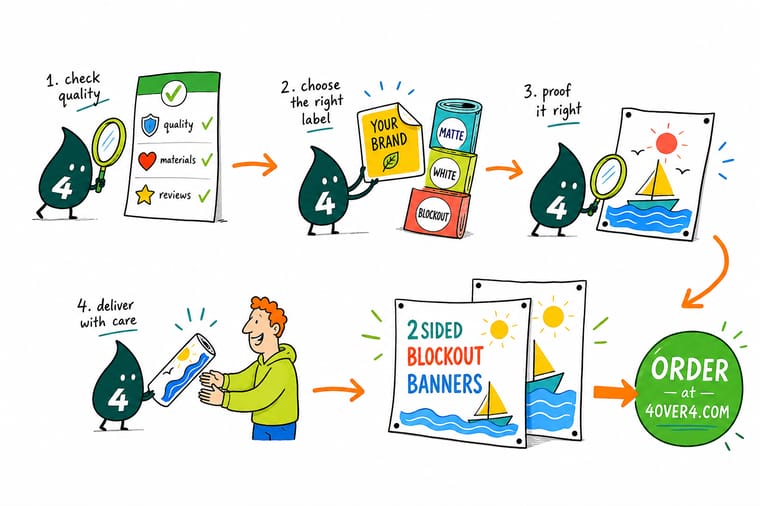
Wally has watched plenty of label orders fail for reasons that had nothing to do with the artwork. His rule is simple: the printer who asks where the label will live, what the container is made of and how cold it gets is the printer who will still be right on your fourth reorder. Price is the last question, never the first one.
Configure your order →Infographic
Seven checks before you sign with a label printer
One frame, seven questions. Save it, send it with your next request for quote, and score every vendor on the same seven answers instead of on the quoted unit price alone.
No single check decides a vendor. Score all seven, weight material and adhesive highest, and treat price as the tiebreaker between the shops that already passed the first six.
Specs and pricing
Specs and live pricing you can check before you commit
A vendor worth shortlisting shows its specification and its price tiers openly. Here is what that looks like at 4OVER4, with the full stock, size and quantity breakdown visible before you place an order.

| Quantity | Price Per Unit | Total |
|---|---|---|
| 1 | $108.75 | $108.75 |
| 2 | $108.74 | $217.47 |
| 3 | $108.74 | $326.22 |
| 4 | $97.76 | $391.02 |
| 5 | $97.76 | $488.78 |
| 6 | $97.76 | $586.53 |
| 7 | $89.28 | $624.98 |
| 8 | $86.77 | $694.18 |
Print it
Popular products printed in-house at 4OVER4
See it in use
Real customer work, printed and shipped by us
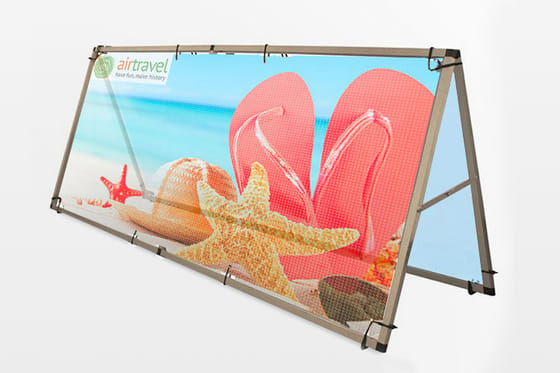
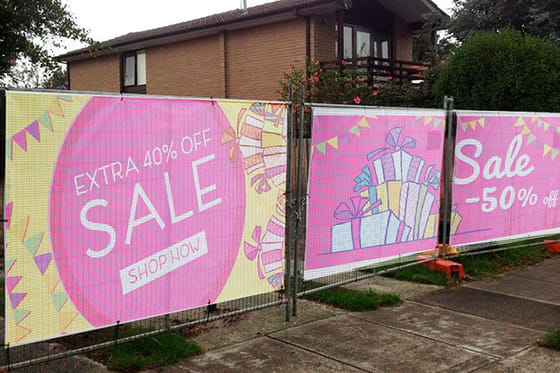
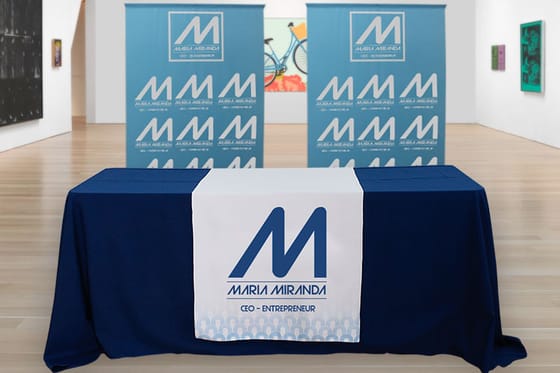
Explore more
Where to go next
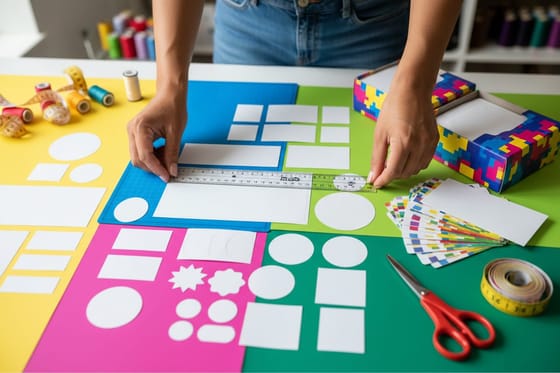
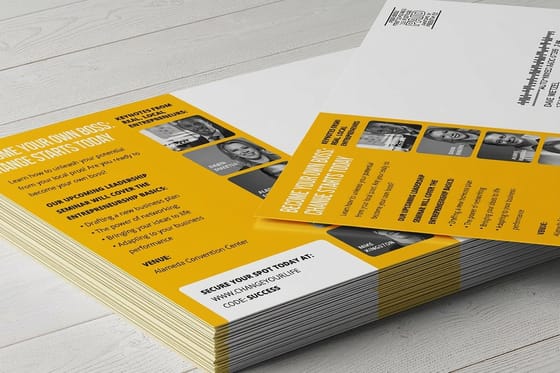

By the numbers
A print partner you can hold to a delivery date
Common Questions
Common questions about label printing companies
What is a label printing company?
A label printing company prints adhesive labels onto a face stock, laminates or coats them, cuts them to shape with a die or a digital cutter, and delivers them on sheets or on a roll. The good ones also advise on the parts buyers forget: which adhesive survives a freezer, which laminate resists a scrubbed bottle, and how far artwork has to extend past the cut line so no white slivers appear.
How do I choose the right label printing company?
Judge four things in order. First, materials: can the vendor name a face stock and laminate for your exact application. Second, proofing: will they send a printed sample before the full run. Third, tolerances: what die shapes, sizes and roll specs they support, and how tight their cut registration is. Fourth, the in-hand date and the reprint policy. Price is the tiebreaker after those four, never the filter before them.
What does label printing cost and how are prices set?
Price is built from setup, material, printing method, finishing and quantity. Setup and any custom die are one-time costs spread across the run, which is why unit price drops sharply as volume rises. Special finishes such as foil, spot gloss, white ink on clear stock or embossing each add a pass and add cost. Ask for tiered pricing at three quantities so you can see where the curve flattens.
What sizes, stocks and finishes are available for labels?
Common sizes run from small 1 by 1 inch seals up to full wraparound panels several inches tall, in rectangles, squares, circles, ovals and custom die shapes. Stocks include white and matte paper, textured and felt papers for wine and spirits, clear and white BOPP films, and metallic bases. Finishes include gloss, matte or soft-touch laminate, UV spot gloss, foil stamping and embossing.
How long does label printing take to print and ship?
Most digital label runs print in one to five business days once artwork is approved, and transit adds one to five more depending on the shipping service and distance. Custom dies, foil, embossing and specialty stocks add a day or more. Always confirm whether the quoted turnaround starts at order or at proof approval, because the difference is often a full business day.
What should I ask a wine label printing company specifically?
Ask which stocks they hold for bottles, whether the laminate or coating survives an ice bucket, how they handle foil registration on textured paper, and whether their adhesive releases cleanly on wet glass during application. Ask for a printed sample applied to a bottle rather than a flat sheet, because curvature changes how a heavy textured stock behaves at the seams.
Are digital and flexographic label printing different for buyers?
Yes, mainly in economics. Digital printing skips plates, so short runs, variable data and multiple designs in one order stay affordable. Flexographic printing costs more to set up but rewards very large single-design runs and gives access to specialty inks. If you are ordering a few hundred to a few thousand labels, or several SKUs at once, digital is normally the better fit.
Get Started
Ready to work with a printer that answers all seven questions?
Bring your specification to 4OVER4.COM and get live pricing, in-house finishing and a committed delivery date, with paper samples available before you commit to a full run.
Legal Disclaimer
Gold Standard guarantees apply to all standard orders placed through 4over4.com. Price match requires verifiable proof of a competitor's published price for an equivalent product with matching specifications and turnaround time. Satisfaction guarantee covers manufacturing defects and print quality issues. Contact support with order number and documentation. On-time delivery rate based on tracked orders 1999 to 2026. Individual results may vary based on shipping carrier performance.
