
How to Choose a Catalog Printing Company You Can Reorder From


Five questions separate catalog printers, and price is not one of them. Ask about binding, proofs, reprints, turnaround and shipping, and learn what a good answer sounds like.
Judge a catalog printer on five answers: whether it runs both saddle stitch and perfect binding, whether a proof comes with every order, what an unchanged reprint costs, whether production days are quoted apart from transit days, and whether it will split the shipment. Compare price last, and only once page count, trim size, cover stock, text stock and coating are identical on every quote, because the cheapest bid is usually the one that swapped the paper.

Quick answer
Five answers, then the price
A catalog printer is worth using when it binds both ways, proofs every order, holds the reprint price, quotes production and transit separately, and will split a shipment. Those five answers are checkable in one email. Price becomes meaningful only after the specs match across every bid, and the specs that matter are page count, trim size, cover stock, text stock and coating. Get the binding decision right first, because it sets the page count you are allowed to have.
The Five Things That Actually Separate Catalog Printers

Most catalog printers publish the same page of promises, so the promises are useless for choosing between them. Five questions are not, because each one has an answer that is either specific or evasive, and there is no middle ground.
| What to ask | The answer you want | The answer that should worry you |
|---|---|---|
| Which bindings do you run | Saddle stitch and perfect bound, both priced on the same quote | One binding only, with a reason why your page count suits it |
| What proof do I get | A PDF proof on every order, named in the order confirmation | Proof on request, or a proof that only appears if you chase it |
| What does the reprint cost | The same price, no new setup, for an unchanged file | We will requote when you are ready |
| How long is the turnaround | Production days and transit days as two separate figures | A single number that quietly includes shipping |
| Can you split the shipment | Yes, to several addresses, priced before you order | One address only, or a shipping cost revealed at checkout |
Run those five past three printers and the field usually thins to one. Notice that price is not on the list. Price is the easiest thing to compare and the last thing you should compare, because a catalog quote only means something once page count, trim size, cover stock, text stock and coating are identical across every bid. The cheapest quote in a stack is very often the one that swapped 80lb gloss text for 70lb.
Our own catalog pricing sits in the open on the standard catalogs configurator: change the page count or the stock and the number moves in front of you, which is a faster way to see what drives cost than a week of emails. The full bound range is on the booklets and catalogs category page.
Match the Binding to Your Page Count, Then Read the Turnaround
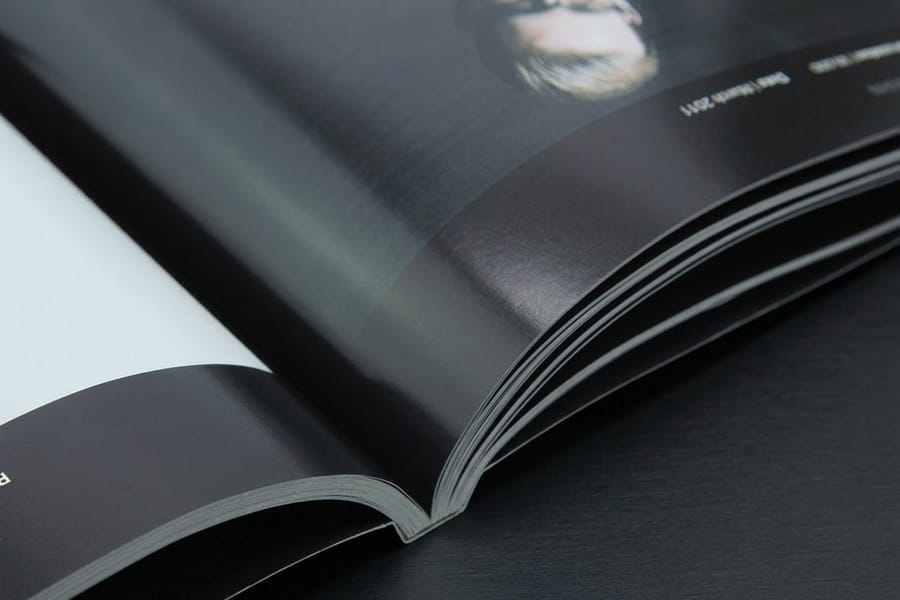
Binding is the decision that quietly sets your page count, your spine, and part of your schedule, so make it before you ask anyone for a price.
Saddle stitch folds the sheets, nests them, and staples through the fold. Every saddle stitched book therefore has a page count divisible by four, which is why a 30 page catalog does not exist and a designer who planned one is about to add two pages or cut two. It lies flat when open, costs less to bind, and stops being a good idea somewhere around 64 pages on standard text stock. Perfect binding glues the trimmed interior into a wrapped cover. It needs enough bulk to hold glue, roughly an eighth of an inch of spine or about 40 pages of text weight, and it gives you a printable spine that a catalog on a shelf actually needs.
| Binding | Page range | Spine | Behavior in hand |
|---|---|---|---|
| Saddle stitch | 8 to about 64, in multiples of 4 | Folded, nothing to print on | Opens flat, spreads cross the gutter cleanly |
| Perfect bound | About 40 and up | Flat and printable | Holds shape on a shelf, needs gutter margin on spreads |
| Either one | 40 to 64 | Your call | Price both. This is the band where the two quotes are close |
Between 40 and 64 pages you have a genuine choice, and that is exactly where a single binding printer will lean on you. Price saddle stitch booklets against perfect bound books at your real page count and let the numbers argue. The binding types guide covers wire-o and the other options if a lay flat spine matters more than shelf presence.
Turnaround has the same trap in a different costume. Ask for production days and transit days as two figures. Bound work goes through bindery after press, and bindery is scheduled in slots, so a catalog that misses its slot waits rather than jumping to another machine. That is why booklets quote longer than flyers at the same quantity. Our shipping and postage guides cover how ground transit stacks on top of production time.
Where Catalog Cost Actually Comes From
Four inputs move a catalog quote more than anything else, and page count is only the first of them.
- Page count, in signatures. Presses print in signatures, so cost steps rather than slopes. Going from 32 pages to 36 can cost less per page than going from 32 to 34, because the second option wastes half a signature.
- Text stock. This is the line that most often explains a gap between two quotes. Lighter text feels cheaper in the hand and mails for less; heavier text holds dark photography without show through. Our paper weight guide walks through what each weight feels like.
- Cover treatment. A self cover, where the cover uses the same stock as the interior, is the cheapest option and reads as a booklet. A separate heavier cover with coating reads as a catalog. That single change often costs less than adding four pages.
- Quantity, non linearly. Setup is fixed and paper is variable, so the per unit price falls hard between 250 and 1,000 copies and then flattens. If you expect to reorder inside six months, the larger single run is usually cheaper than two small ones, provided nothing in the file is going to change.
That last point is where honest advice cuts against a bigger order. If your prices, product line or staff photos are likely to change this quarter, print fewer and reprint. A pallet of accurate catalogs beats two pallets of catalogs with an old price list, and the storage cost of the extra copies is real even when it does not appear on the invoice.
Set the file up correctly and none of this gets more expensive at the last minute. Start from a correctly sized layout in the blank template library, keep 0.25 inch of safety inside the trim on every page, and add gutter margin on perfect bound spreads so the glued edge does not swallow the middle of an image. If you want the same vetting logic applied to general commercial work rather than bound books, the choosing a print shop guide covers it, and the pricing and cost guides go deeper on what drives a print invoice.
How 4OVER4 Answers the Same Five Questions

It would be strange to publish a checklist and then dodge it, so here are our own answers, in the same order.
We bind both ways, and both are priced in the open. Standard catalogs start at $240.55, standard booklets at $240.55, and perfect bound books at $375.05, all configurable before you speak to anybody. Every order gets a PDF proof. Reorders run from the same file at the same configuration, so the price you see is the price you see again. Production time is quoted as production time, with shipping calculated separately at checkout rather than folded into a headline number.
The parts we are less good at are worth saying too. We are an online printer, so there is no counter to walk up to with a paper dummy in your hand, and if you need a bound hard copy proof in your hands before a very large first run, that adds days to any online schedule. Order free paper samples early and the stock decision stops being guesswork. If your catalog is a retail piece with seasonal reprints, retail catalogs is the configuration built for it.
Wally vets a catalog printer
Five questions, asked before anyone quotes a price
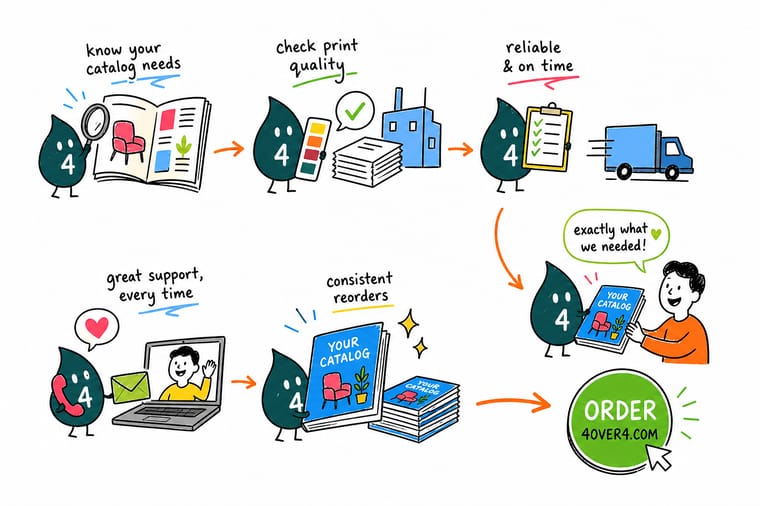
Wally does not start with price. He asks which bindings run in house, whether a proof comes with every order, what the reprint costs with the same file, how many days are production and how many are transit, and whether the load can go to more than one address. Then he lines up the quotes with identical page count, trim size, cover stock, text stock and coating. Only then does he look at the number, because until the specs match, the cheapest quote is just the lightest paper.
Configure your catalog →Specs and pricing
Catalog formats, page counts, and starting prices
Set your page count and stock and watch the price move, straight from the 4OVER4.COM configurator. This is the comparison a quote by email takes a week to give you.


Print it
Order the catalog once the binding is settled


Explore more
Where to go next




By the numbers
Catalog printing you can plan a season around
Common Questions
What buyers ask before they place a catalog order
What do I need to send to get a real catalog quote?
Six numbers and nothing else, at first: page count including the cover, trim size, quantity, cover stock, text stock, and coating. Everything else is negotiable later. Page count is the one people get wrong, because a saddle stitched catalog has to divide by four and most designers count the cover separately from the interior. Say 32 pages plus cover or say 36 pages total, but say which one you mean, or the quote you get back will be for a different book than the one you designed.
How many pages can a saddle stitched catalog have?
The mechanical limit is where the folded spine stops closing cleanly, and on ordinary text weight that is around 64 pages. The practical limit is lower on heavy stock, because the inside sheets push outward as the book thickens and the outer trim eats into the inner pages. That shift is called creep, and it is why page numbers and rules near the outer edge drift on a thick saddle stitched book. Past roughly 64 pages, or sooner on 100lb text, ask for a perfect bound price instead.
Why did my catalog reprint cost more than the first run?
Usually because the first quote bundled setup into an introductory price, or because the paper changed. Text stock pricing moves, and a printer holding a paper position in the spring may be buying differently in the autumn. Ask two questions before the first order: does a reprint of the identical file carry a new setup charge, and is the quoted price held for a set period. A printer that answers both plainly is the one to keep.
Is a hard copy proof worth the extra days?
For a first run with heavy photography, yes. A PDF proof catches text, position, page order and trim; it cannot show you how a dark image looks printed on uncoated stock, and dark images on uncoated paper are where most catalog disappointment lives. For a reprint of a file that has already been on press, a PDF proof is enough. Weigh the extra days against the cost of binding several thousand copies of a book you do not like.
How far ahead should I order catalogs for a trade show?
Take the production estimate, add the transit estimate, then add a week you never spend. Catalogs are bound, and bindery is where a schedule slips, because a job that misses a bindery slot waits for the next one rather than moving to another machine. If the show is on a Tuesday, aim to have the boxes at your own address the Tuesday before, not at the venue.
Should the same printer do my catalogs and my brochures?
It helps, for one specific reason: color match. A photograph that runs on the same presses, on paper from the same house, on the same day, matches across the two pieces in a way that two separate vendors will not reliably reproduce. If your catalog and your leave behind carry the same product shots, order them together and say so on the order.
Get Started
Order 25 catalogs from $240.55
Set your page count, trim size and stock, see the number move as you go, and order saddle stitch or perfect bound from the same configurator.
Legal Disclaimer
Gold Standard guarantees apply to all standard orders placed through 4over4.com. Price match requires verifiable proof of a competitor's published price for an equivalent product with matching specifications and turnaround time. Satisfaction guarantee covers manufacturing defects and print quality issues. Contact support with order number and documentation. On-time delivery rate based on tracked orders 1999 to 2026. Individual results may vary based on shipping carrier performance.
