
How to Choose a Brochure Printing Company Before You Commit to a Full Run


A buyer checklist for brochure printers: the proof, the stock, the fold, the real turnaround clock, and the reprint terms. Five questions that tell you more than five quotes.
Judge a brochure printing company on five things: whether it sends a free proof before it prints, whether the stock weight and finish are stated in the quote, whether folding and scoring are included, when the turnaround clock starts, and what its reprint policy actually covers. Price is the easiest number to compare and the least useful, because the cheapest quote is usually a lighter sheet, unfolded, with shipping counted separately.
Quick answer
Five checks, in the order that matters
Proof, stock, fold, clock, recourse. Insist on a proof before the press run, get the paper weight and finish written into the quote, confirm folding and scoring are included rather than assumed, find out whether the quoted days start at checkout or at proof approval and whether shipping sits inside that number, and read the reprint policy before you read the price. A quote that comes in far under the others is normally describing a different product, not a better deal.
What to Look For in a Brochure Printing Company
Five things decide whether a brochure order goes well, and none of them is the headline price. Work through them in this order and the shortlist tends to sort itself out.
| Check | What to ask for | What it costs you to skip |
|---|---|---|
| Proof | A free PDF proof showing trim, bleed and fold marks before anything prints. | The error is found in the delivered box instead of on screen. |
| Stock | The weight and finish written down: 100lb gloss text, 80lb matte text, cover weight. | A brochure that feels thin and ghosts the back side through the sheet. |
| Fold | Confirmation that folding and scoring are included, and which fold you are buying. | A flat sheet arrives and someone in your office folds 2,000 of them. |
| Turnaround | Production days, the daily cutoff, and whether transit is inside that number. | A launch date missed by the three shipping days nobody counted. |
| Recourse | The written reprint policy and the tolerance the printer works to. | An argument about a quarter inch, with no agreed standard to point at. |
Two of those deserve a warning. Bindery tolerance is real: fold placement typically drifts up to about a sixteenth of an inch, so a design with a thin rule sitting exactly on the crease will show that drift on some copies no matter who prints it. Move the rule, or accept the variation. And a quote that beats every other quote by half is almost never the same specification, so put the four specs side by side before you compare the numbers at all.
If you are still deciding between formats, the brochure, booklet and flyer comparison settles it faster than a quote does. Standard brochures at 4OVER4.COM start at $57.11, and the full range of sizes and folds sits on the brochure printing page.
Proofs Are the Cheapest Insurance You Will Ever Buy
A proof is a rendering of the exact file the press will use, imposed the way it will be printed. It exists to catch the four mistakes that account for most brochure reprints: type that sits outside the safety margin and gets trimmed, artwork built without bleed so a white sliver appears at the edge, panels arranged for the wrong fold, and images placed at screen resolution.
Read the proof in that order rather than reading the copy again. Check the crease marks first, because a trifold panel is not three equal thirds. On an 11 by 8.5 inch trifold the panel that tucks inside is cut roughly a sixteenth of an inch narrower than the other two, so it does not buckle against the fold, and a file built as three exact 3.667 inch panels will fold with a visible step. The specifics are laid out in the brochure sizes and fold options guide.
Here is the limit worth naming: a PDF proof tells you nothing reliable about colour. Your monitor emits light and coated paper reflects it, so a rich blue on screen routinely prints closer to navy. If a brand colour has to match, ask for a hard-copy proof printed on the production stock, and expect it to add cost and at least a day. Most brochures do not need one. A rebrand launch does.
Two habits make the proof round painless. Set up the file with a 0.125 inch bleed and keep live type 0.125 inch inside the trim, which the bleed and trim guide covers in detail, and start from a correctly sized layout in the blank template library rather than a page you resized by hand.
Turnaround, and When the Clock Actually Starts

Almost every missed brochure deadline traces back to the same misreading. The printer quotes production days. The buyer hears delivery days. Those are different numbers, and the gap between them is the shipping transit.
The clock normally starts when you approve the proof, not when you pay. That means your own file quality and your own response time sit inside the schedule: a file that fails preflight waits for you, and a proof approved after the daily cutoff rolls into the next production day. On a tight launch, the single most useful thing you can do is approve the proof the morning it arrives.
Ask three questions and you can compare two printers honestly. Does the count include the approval day. What time is the cutoff. Is transit inside or outside the number. A printer quoting three days plus ground shipping across the country is slower in practice than one quoting four days with two day delivery, even though the first number looks better. When the date is genuinely fixed, price the rush tiers early rather than late, because rush and same day options cost far less booked at the start than bought as a rescue.
One more practical note: folding and binding are separate operations after the press. A folded brochure has one more step than a flat flyer at $39.54, and a saddle stitched booklet at $240.55 has several more. Compare turnaround within the same format, never across formats.
The Pricing Checklist That Stops the Surprise
Brochure quotes differ mostly because they describe different products. Before comparing two prices, force both onto the same line by writing down these six items for each.
- Flat size and folded size. An 11 by 8.5 inch sheet folded to 3.667 by 8.5 inches is a different job from an 8.5 by 11 inch flat sheet, even though both get called an A4 brochure.
- Stock weight and finish. 100lb gloss text, 100lb matte text, 80lb text, or a cover weight. This single line explains most price gaps.
- Sides printed. A brochure printed 4/4 costs more than 4/0, and a folded piece printed on one side only wastes half the panels.
- Fold included or not. Scoring and folding are bindery operations with their own cost, and cover weight stock must be scored or the coating cracks along the crease.
- Quantity break. Print pricing steps down hard with volume because setup is fixed. Ask for the price at the next quantity up before you commit to the lower one.
- Shipping, quoted separately. Weight and destination change this more than most buyers expect on a 5,000 piece run.
Run those six against each quote and the outlier usually turns out to be a lighter sheet, a flat sheet, or a price that excludes shipping. Our guide on cutting brochure printing costs covers where it is safe to save and where saving shows in the finished piece.
The last item on the checklist is the one people skip: what the printer does when something goes wrong. Read the reprint terms and the price policy in writing before you order, not after. Ours are set out under our guarantees, and if a term in a quote is unfamiliar, the printing terms page defines it.
Wally checks the printer, not the price
Proof first, then stock, fold, clock and reprint terms
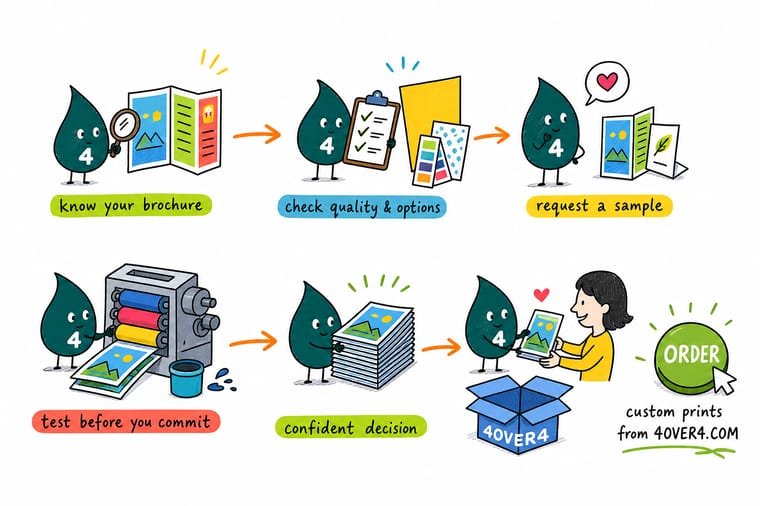
Wally asks for the proof before anything else, because that is where a trimmed headline or a missing bleed gets caught for free. Then he makes the quote say the paper weight out loud, checks that folding and scoring are in the price rather than assumed, and asks the one question most buyers forget: do your production days start when I pay, or when I approve the proof. Last he reads the reprint terms, because that is the only part of a quote that matters on the day something goes wrong.
Configure your brochures →Specs and pricing
Brochures, flyers and booklets with live specs
Sizes, stocks, folds and starting prices straight from the 4OVER4.COM configurator, so you can put a real specification next to any quote you are comparing.



Print it
Order brochures with the proof included


Explore more
Where to go next




By the numbers
Brochure printing you can plan a launch around
Common Questions
Questions buyers ask before picking a printer
What should I ask a brochure printer before I place the order?
Five questions cover most of the risk. Do I get a proof before you print, and is it free. When does the production clock start and what time is the daily cutoff. Is shipping transit inside or outside the quoted days. Which paper weight and finish is in this price. What happens if the fold or the color comes back wrong. A printer that answers all five in plain language is usually the one that also prints the job correctly.
Is a free PDF proof the same as a press proof?
No, and the difference is worth knowing. A PDF proof is generated from your imposed file and it catches the errors that actually ruin brochures: text sitting outside the safety margin, a missing bleed, panels ordered wrong for the fold, a low resolution logo. It cannot show you color, because your monitor is backlit and coated paper is not. If exact color match matters, ask for a hard-copy proof printed on the production stock and expect it to add cost and a day or two.
How long does brochure printing actually take?
Standard brochure runs at 4OVER4.COM move in business days that start once you approve the proof, and shipping is quoted separately on top. The step people forget is their own: a file that fails preflight sits still until it is fixed, and a proof approved after the daily cutoff rolls to the next production day. If a date is fixed, build in one spare day for the proof round and check the rush options in our guide to same day and rush printing.
Why do brochure quotes vary so much between companies?
Usually paper, folding and press method rather than margin. A quote on 80lb gloss text, flat, on a ganged sheet will always beat a quote on 100lb gloss text, scored and folded, and the two are not the same product. Ask each printer to state the stock weight, the finish, the fold, and whether folding is included. Once those four match, the prices come much closer together.
What paper weight should I choose for a brochure?
100lb gloss text is the standard for a folded brochure: it holds saturated color, folds without scoring, and does not show through the sheet. Drop to 80lb text and you save money but the piece feels thin in the hand and the reverse side ghosts through on light backgrounds. Go up to a cover weight and you get a rigid piece that must be scored before folding or the coating cracks along the crease. Our guide to brochure paper types compares the stocks side by side.
What happens if the fold is off or the color is wrong?
Ask before you order, not after. A fold that drifts a sixteenth of an inch is normal bindery tolerance and will not be reprinted anywhere. A fold that crosses a panel, a trim that cuts into type, or color that does not match an approved hard-copy proof are production faults and should be reprinted. Keep the shipping box and photograph the piece next to a ruler, because a printer resolving a claim needs to see the deviation, not a description of it. Our satisfaction guarantee sets out how we handle it.
Get Started
Ready to put a real spec next to that quote?
Pick your size and fold, choose the stock weight, and see the price and the production days before you commit. The proof comes before the press run.
Legal Disclaimer
Gold Standard guarantees apply to all standard orders placed through 4over4.com. Price match requires verifiable proof of a competitor's published price for an equivalent product with matching specifications and turnaround time. Satisfaction guarantee covers manufacturing defects and print quality issues. Contact support with order number and documentation. On-time delivery rate based on tracked orders 1999 to 2026. Individual results may vary based on shipping carrier performance.
