
How 3D Postcards Work and Why They Grab Attention


A 3D postcard moves because of a lenticular lens over interlaced frames. At 31pt it is thicker than a standard card, which changes what the post office charges.
A 3D postcard works with a lenticular lens: a ridged plastic sheet over interlaced images. Each ridge directs different image slices to each eye and at each angle, so your brain reads depth or motion. The same lens can flip between images, animate a short loop, or give a flat scene real 3D depth, all decided by how the frames are built.

Start here
Interlaced frames under 31pt lens
A 3D postcard uses a lenticular lens over interlaced images. Tiny ridges in the lens send different slices of the printed art to each eye and at each viewing angle, and your brain fuses those views into depth or motion. Build the frames one way for a flip, another for animation, another for true depth. The diagram below shows how the lens and the interlaced strips line up.
The lenticular lens: where the illusion comes from

A 3D postcard is not a trick of ink alone. It works because of a lenticular lens, a thin sheet of clear plastic covered in tiny parallel ridges. Under that lens sits a printed image that has been sliced into narrow strips and interlaced, meaning strips from two or more pictures are woven together in a precise order.
Each ridge in the lens bends light so that, from any given angle, your eye sees only certain strips. Because your two eyes sit a few inches apart, they see slightly different strips at the same moment, and your brain fuses those differing views into the sense of depth. Tilt the card and the angle changes, so a new set of strips reaches your eye and the image appears to flip or move.
That is the whole secret: the lens controls which slice of the printed art you see, and clever slicing turns a flat print into something that appears to have depth and motion. Our 3D lenticular postcards put that physics to work, and the deeper mechanics live in our guide on what lenticular printing is.
Flip, motion, and depth: three effects from one lens

The same lens can produce three very different effects, and which one you get depends entirely on how the artwork is built. A flip interlaces two or three separate images so the card switches cleanly between them as you change the angle, which suits a before-and-after, a reveal, or a logo that appears. An animation interlaces a short sequence of frames so a small motion loops as you tilt, like a wink, a spin, or a product rotating.
The third effect is true 3D depth, where a single scene is interlaced from layered viewpoints so the foreground appears to float in front of the background. This is the effect people usually mean by a 3D postcard, and it gives a flat card a genuine sense of dimension.
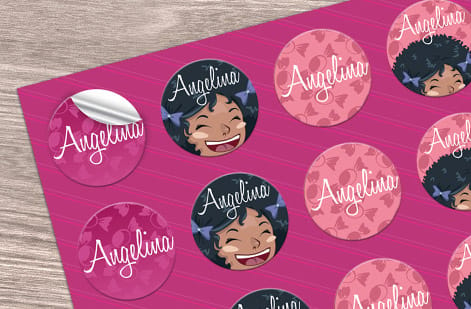
None of these requires a different lens, only a different plan for the frames behind it. If you want to see the technique applied beyond postcards, our range includes 3D lenticular business cards and lenticular stickers that use the same principle.
Can you mail a 3D postcard?
For most campaigns, yes. A lenticular postcard mails like a standard postcard as long as it stays within the postal size and thickness limits for your mail class. The lens adds a little rigidity and thickness, so it is worth confirming the finished dimensions against postal rules before a large mailing, and an oversized or heavier card may land in a different postage tier.
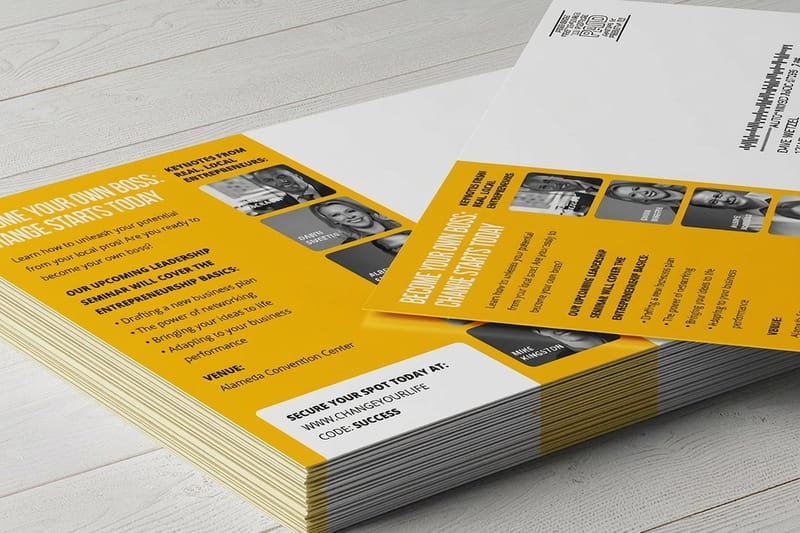
Used as direct mail, a 3D postcard has a clear advantage: it refuses to be ignored. Where a flat mailer gets sorted with the rest of the stack, a card that moves in the hand gets picked up, tilted, and shown to someone else. That extra dwell time is exactly what a mailing is fighting for. Pair it with a flat run of direct mail postcards for a campaign that mixes reach with standout impact.
Because the effect changes how the card behaves, laying the piece out in our online designer and proofing it first keeps the mailing on track.
How a 3D postcard is made
Making a lenticular card is where design meets precision. It starts with clean, separated frames: each image in a flip, each frame of an animation, or each depth layer built on its own at full resolution. The more careful that separation, the crisper the finished effect.
Next comes interlacing, the specialized prepress step where the frames are sliced into strips and woven together to match the pitch of the lens exactly. The ridges and the printed slices have to line up so that each ridge shows the right strip at the right angle. This alignment is what separates a sharp lenticular from a blurry one, which is why proofing matters more than on a flat card.
Finally the interlaced art is printed and bonded to the lens so every copy carries the effect. Our specialty metallic and lenticular services handle this alignment for you, and our guide on making lenticular prints walks the process end to end.
Lenticular artwork recommendations

Lenticular art is built for the lens from the start, not flattened first and repaired later. Give the frames real separation: on a flip, the two or three images should differ in shape, tone, and position, not in one small detail, because a change your eye has to hunt for reads as a printing fault instead of an effect. On a depth build, pull the subject clear of the background and keep its edge clean, since the foreground is the part that appears to float.
Keep fine text off the moving frames. The ridges run in one direction across the card, and small type set across that direction picks up the ridge line and softens as you tilt, so hold headlines, phone numbers, and legal copy on a frame that stays put, or place them on the flat back of the card where no lens sits. Bold, high contrast type survives the tilt. Hairline rules, thin serifs, and tight repeating patterns do not, and they shimmer at the transition angle.
Contrast is the other thing the lens eats. Two frames that share the same value and the same color cast ghost into each other at the halfway angle, so give every frame its own tonal footing and avoid pale detail on a pale ground. Check the frames in grayscale before you send them: if you cannot tell them apart with the color switched off, the finished card will look smeared rather than sharp.
Send the file layered, never flattened. Each flip image, each animation frame, and each depth layer belongs on its own layer at full resolution, named in the order it should play, with the background finished behind the subject so nothing has to be invented where a layer moves. That is exactly what our prepress team interlaces to the lens pitch, and our guide on making lenticular prints shows the same file prep applied end to end.
What 3D postcards cost, and when they are worth it
Lenticular postcards cost more than flat cards because of the lens material and the interlacing work, so the honest question is when the extra impact earns its keep. The answer is any moment when attention is scarce and standing out matters more than raw volume: a product launch, a high-value direct-mail piece, a trade-show handout, or an invitation you want kept rather than tossed.
Like all our products, the price scales with quantity, size, and finish, and larger runs bring the unit price down as the setup spreads across more pieces. You set the options in the configurator and the total updates live, so you can weigh a moving card against a flat mailer before you commit. For high-volume reach at a lower unit cost, standard postcards stay the cheaper route.
Use the live specs and pricing below to see the exact sizes and options for 3D lenticular postcards, then decide where a card that moves fits in your campaign.
Custom 3D lenticular postcard printing options

A 3D postcard is specified in the same order every time: size, lens, effect, then run length. Size comes first because it decides how much room the effect has to work in. A standard postcard size keeps the card inside postal size and thickness limits and is the safe choice for a mailing; a larger card gives a depth build more front to back room and reads from further away, which is what you want on a trade-show table rather than in a mailbox.
The lens is the next decision. A finer pitch packs more ridges into the same inch and holds small detail when the card is read in the hand; a coarser pitch carries further across a room and is more forgiving on a large flip. Choose the pitch for the distance you actually expect, because the art is interlaced to that pitch in prepress and cannot be moved onto a different lens afterwards.
Then the effect. A flip of 2 to 3 images for a reveal, a before and after, or a logo that appears; a short animation for a wink, a spin, or a product turning; or a layered depth build for real dimension. One lens covers all three, so the choice costs you nothing but the artwork plan behind it. The back of the card prints flat, which leaves the address panel, the indicia, and your message exactly where a postcard needs them.
Quantity and turnaround close it out. Price scales with quantity, size, and finish, and a longer run drops the unit price as the lens and interlacing setup spreads across more pieces, so settle the mailing list before you settle the quantity. Set your options on 3D lenticular postcards and the total updates live next to the turnaround choices, so a moving card and a flat mailer can be compared before you commit. The same lens work is available on 3D lenticular business cards when you want the effect in a hand-out size.
Wally shows the lens doing the work
Interlaced frames plus a ridged lens equals motion
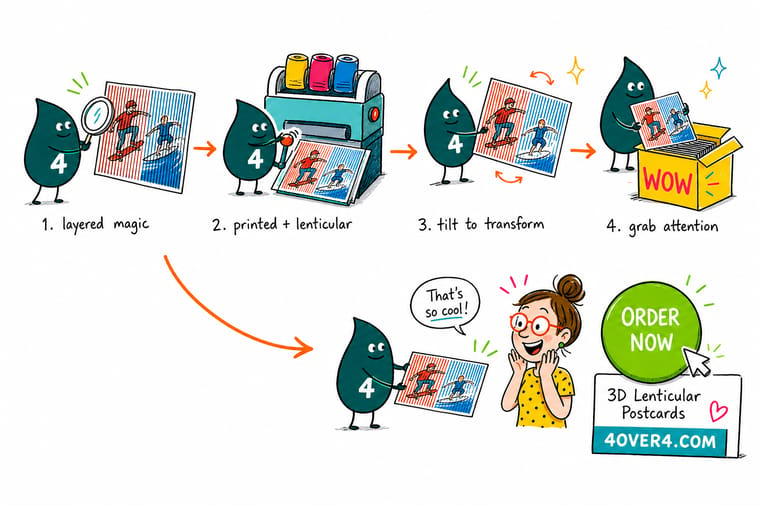
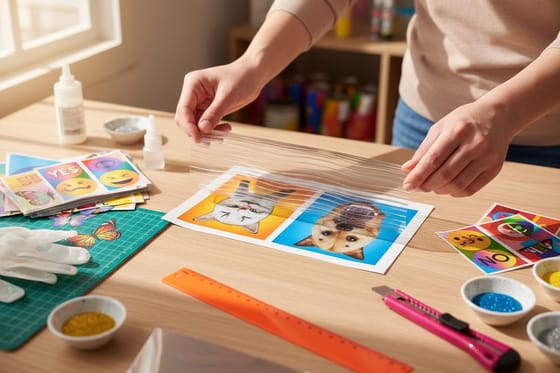
Wally tilts the card so you can see it: the lens sends a different slice of the art to each eye, and layered frames turn flat ink into a flip, an animation, or real depth. Plan the frames, let 4OVER4 interlace and bond the lens, and every card in the run carries the effect that makes a mailer impossible to set down.
Order 3D postcards →Quick reference
3D postcard effects and setup at a glance
Every 3D postcard is the lens and the frames behind it, and each effect is built differently.
| Element | What it is | Why it matters |
|---|---|---|
| Technology | Lenticular lens | A ridged plastic overlay bends light so each eye sees a different interlaced frame. |
| Flip effect | 2 to 3 images | The card switches between images as the viewing angle changes. |
| Animation | Short frame sequence | A few frames play in order to create a looping motion as you tilt the card. |
| Depth (3D) | Layered scene | Foreground and background layers separate to give a flat image real depth. |
| Mailability | Standard postcard sizes | Most 3D postcards mail like regular postcards within postal size and thickness limits. The lens makes the card thicker than a flat one, so confirm the finished caliper against the rate you plan to mail at. |
| Art setup | Interlaced to lens pitch | Frames are woven together to align with the lens, which is done in prepress. |
| File format | Layered art with a plan | Provide clean separated frames or layers so the effect can be built correctly. Keep them unflattened so each frame can still be pulled apart. |
Step by step
How a 3D postcard comes together in 7 steps
- Pick the effect you want Decide whether the card should flip between two images, animate a short motion, or show 3D depth. The effect drives how the artwork is built.
- Design each frame separately Build each image or motion frame on its own layer at full resolution. Clean, separated frames are what make a crisp lenticular result.
- Keep key elements aligned For depth effects, plan which elements sit in the foreground and background. For flips, make sure both images register in the same space.
- Interlace to the lens In prepress the frames are sliced and interlaced to match the lens pitch, so the ridges line up with the right slices. This is the step that turns flat art into motion.
- Proof the effect Because a 3D card behaves unlike a flat one, a proof confirms the flip is clean and the depth reads before the full run prints.
- Print on the lenticular lens The interlaced art is printed and bonded to the ridged lens so the finished card carries the effect in every copy.
- Mail or hand it out Send it as direct mail within postal size rules, or hand it out at events where a moving card gets picked up and kept.
Specs and pricing
3D lenticular postcard specs and live pricing
Once you know the effect you want, size, quantity and finish are what is left. Lenticular postcards run 500 for $1,097.28, which is $2.19 each.

| Quantity | Price Per Unit | Total |
|---|---|---|
| 500 | $2.19 | $1,097.28 |
| 1,000 | $1.32 | $1,316.96 |
| 2,000 | 93.3¢ | $1,866.15 |
| 3,000 | 69.5¢ | $2,085.82 |
| 5,000 | 57.1¢ | $2,854.69 |
| 10,000 | 54.9¢ | $5,490.79 |
Order it
Order postcards that grab attention at 4OVER4

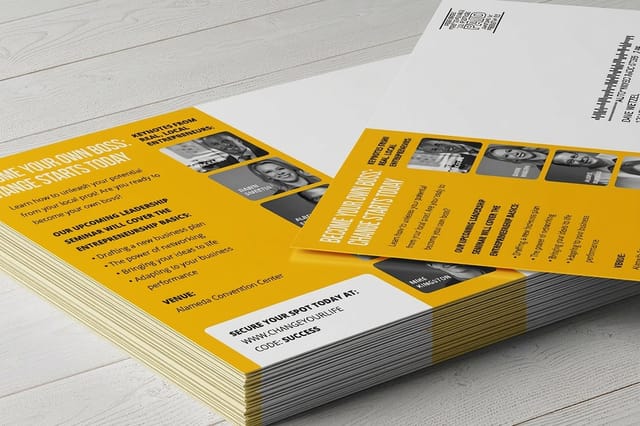

See it in use
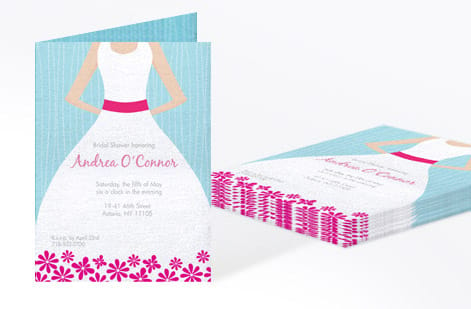
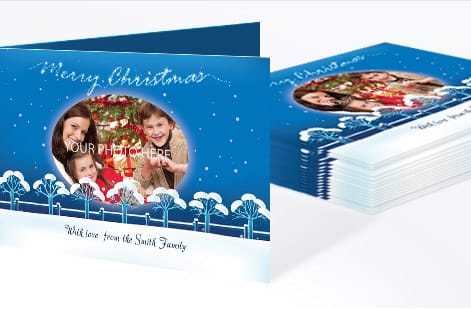
Cards that move in the hand






Explore more
Where to go next




By the numbers
A lens postcard is one of 1,000+ products on the site
Common Questions
Common questions about 3D postcards
How do 3D postcards actually work?
A 3D postcard uses lenticular technology: a sheet of clear plastic with tiny parallel ridges, called a lenticular lens, sits over an image that has been sliced and interlaced. Each ridge acts like a tiny lens that directs slightly different slices of the image to each eye or at each viewing angle. Your brain combines those differing views into the impression of depth, or, as you tilt the card, into a flip or a short animation. The whole effect comes from controlling which slice of the printed art your eye sees at any given angle.
What is the difference between a flip, animation, and 3D depth?
All three use the same lenticular lens, but the art behind it is built differently. A flip interlaces two or three separate images so the card switches between them as the angle changes, ideal for a before-and-after or a reveal. An animation interlaces a short sequence of frames so a small motion loops as you tilt the card. True 3D depth interlaces layered views of a single scene so the foreground appears to float in front of the background. The lens is identical, the illusion depends on how the frames are prepared.
Can you mail 3D lenticular postcards?
In most cases yes. A lenticular postcard mails like a standard postcard as long as it falls within the postal size and thickness limits for the class of mail you are using. Because the lens adds a little rigidity and thickness, it is worth confirming the finished dimensions against postal rules before a large mailing, and heavier or oversized cards may fall into a different postage tier. Used as direct mail, a card that moves in the recipient hand stands out sharply from the flat pieces around it.
What sizes do 3D postcards come in?
Lenticular postcards are offered in familiar postcard footprints so they slot into standard mailings and racks, and the exact sizes available appear in the product configurator. Because the effect and the lens matter as much as the trim size, the sizing is kept close to conventional postcard dimensions so mailability stays simple. If you are planning a direct-mail run, match the size to your postal goals first, then build the artwork frames to that trim.
How do I design artwork for a 3D postcard?
Design starts by choosing the effect, then building each image or motion frame as its own full-resolution layer. For a flip, both images must occupy the same space so they register cleanly. For depth, plan foreground and background layers so they separate convincingly. The frames are then interlaced in prepress to match the lens pitch, which is the specialized step that aligns the printed slices to the ridges. Providing clean, separated frames or layers is the single most important thing you can do for a sharp result.
What do 3D lenticular postcards cost?
Lenticular postcards cost more than flat postcards because of the lens material and the interlacing work, and like all our products the price scales with quantity, size, and finish. Larger runs bring the unit price down, so a direct-mail campaign spreads the setup across more pieces. You set the options in the configurator and the price updates live, so you can weigh the extra impact of a moving card against a flat mailer before you commit. For flat direct mail, standard postcards remain the budget option.
Do 3D lenticular postcards need extra postage?
Not automatically. A 3D postcard mails at standard postcard rates as long as it stays inside the postal size and thickness limits for a card. The lens is what pushes it close to the edge, because a lenticular card is thicker and stiffer than a flat one, and two things move it out of the standard rate: a finished thickness above the limit for the class you are mailing, and a card too stiff or too large to run through automated sorting equipment, which gets billed as nonmachinable. Take the finished card, not the artwork spec, to your mail house or post office before the full run prints, and keep the trim at a standard postcard size when the postage rate matters more than the size of the effect.
What file format do you need for a lenticular postcard?
Layered artwork, not a flattened image. Supply each flip image, each animation frame, or each depth layer on its own layer at full resolution, named in the order it should play, with the background finished behind the subject so nothing is missing where a layer moves. A layered PSD or TIFF works, and so does a PDF with the layers still intact; a single flattened JPG cannot be interlaced because the frames can no longer be pulled apart. Keep small text and any fixed element on one layer so it does not travel with the effect, and supply the address side as flat art for the back of the card.
Get Started
Order 50 die-cut postcards at $0.68 each
Bring your frames to 4OVER4.COM and print a 3D lenticular postcard that flips, animates, or shows real depth. Configure size and quantity and watch your price update live.
Legal Disclaimer
Gold Standard guarantees apply to all standard orders placed through 4over4.com. Price match requires verifiable proof of a competitor's published price for an equivalent product with matching specifications and turnaround time. Satisfaction guarantee covers manufacturing defects and print quality issues. Contact support with order number and documentation. On-time delivery rate based on tracked orders 1999 to 2026. Individual results may vary based on shipping carrier performance.
