
Horizontal Banner Sizes That Still Read From the Street


Every standard landscape size we print, what each one is actually for, and the one calculation that tells you whether the size you picked can be read from where your customer is standing.
The standard horizontal banner sizes run from 2 by 4 feet up to 8 by 20 feet, and four of them cover most jobs: 2′ x 4′ for a table front, 3′ x 6′ for a storefront, 4′ x 8′ for a fence, 8′ x 20′ for a building face. Pick the height first, because height decides legibility: one inch of capital letter height reads at 10 feet, and a headline takes about a third of the banner height. Width only decides how much you can say.
Quick answer
Pick the height for the reader, the width for the wall
A horizontal banner fails at the wrong height, not the wrong width. One inch of capital letter height buys about 10 feet of comfortable reading distance, and a headline with a subline under it takes roughly a third of the banner height. That makes a 2 foot tall banner an 80 foot banner, a 3 foot tall banner a 120 foot banner, and a 4 foot tall banner a 160 foot banner, whatever their widths. Measure the span for the width, pace out the distance for the height, then round up to a stock size.
The Standard Horizontal Banner Sizes and What Each One Fits
Twenty three fixed sizes sit in the vinyl banner configurator, from 2′ x 4′ to 8′ x 20′, plus Any Size. Most of them are half steps between the six below, which is why the six below cover the majority of real jobs.
| Size | Shape | Where it fits | Headline caps it supports |
|---|---|---|---|
| 2′ x 4′ | 1:2 | Table front, indoor doorway, small booth backwall. | About 8 in, readable to roughly 80 ft. |
| 3′ x 6′ | 1:2 | Storefront window, sidewalk railing, church hall. | About 12 in, readable to roughly 120 ft. |
| 3′ x 8′ | 1:2.7 | Fence panel, event entry, long narrow wall. | Same 12 in, with room for a subline beside it. |
| 4′ x 8′ | 1:2 | Construction fence, parking lot frontage, grand opening. | About 16 in, readable to roughly 160 ft. |
| 4′ x 12′ | 1:3 | Long fence run, dealership frontage, field sponsor board. | 16 in plus a logo and a phone number on one line. |
| 8′ x 20′ | 1:2.5 | Building face, stadium fence, warehouse exterior. | 30 in and up, readable across a highway. |
Read the last column before the third one. Width is cheap and it only buys you more words. Height is what makes the words legible, and it is the thing people cut when the quote comes back high. If a 4 by 8 is out of budget, drop to a 3 by 8 rather than a 2 by 12, because the 2 by 12 loses a third of its reading distance while costing about the same. Vinyl banners start at $79 and price follows square footage, so the trade is real money either way.
How to Pick the Size in Five Steps

Work backward from the person who has to read it. The wall tells you the maximum, but the reader tells you the minimum, and the minimum is the number that matters.
- Measure the mounting gap and subtract a foot. Between two posts, under an awning, across a railing: measure the clear span, then take twelve inches off so the banner is not fighting the frame and the zip ties have somewhere to land.
- Pace out the reading distance. Stand where your reader actually stands. Not at the wall, at the crosswalk, at the far side of the lot, in the right hand lane.
- Divide that distance by ten. That is your capital letter height in inches. Eighty feet gives you 8 inch caps. A hundred and sixty feet gives you 16 inch caps.
- Multiply the cap height by three. That is your minimum banner height, because a headline plus a subline plus clear margin fills about three times the cap height. Sixteen inch caps need a 4 foot banner.
- Round up to the nearest stock size, or order Any Size. Stock sizes print off standard roll widths and are the fastest path through the shop. Any Size exists for the fence gap that refuses to cooperate.
Two things this procedure quietly settles. It stops you buying a very wide, very short banner for a long fence, which is the single most common sizing mistake we see. And it tells you when the real answer is two banners instead of one, because a 20 foot span with a 30 foot reading distance needs 3 inch letters and a lot of white space, not 20 feet of type. Our banner placement guide works through the same decision from the mounting side, and the blank template library has correctly sized layouts to start from.
Where the Material Overrides the Size You Picked
Vinyl gives you twenty three sizes because 13 oz scrim comes off wide rolls and cuts to almost anything. Mesh banners and fabric banners do not work that way. Both stock exactly three sizes, and all three are the same 1:3 shape.
| Material | Stock sizes | Starting price | What it is for |
|---|---|---|---|
| 13 oz scrim vinyl | 23 fixed sizes, 2′ x 4′ to 8′ x 20′, plus Any Size | $79 | The default. Solid, opaque, holds color outdoors. |
| Mesh | 24″ x 72″, 36″ x 108″, 48″ x 144″, plus Any Size | $75 | Exposed fences and rooftops where wind would tear a solid sheet. |
| Fabric | 24″ x 72″, 36″ x 108″, 48″ x 144″, plus Any Size | $57.20 | Indoor and photographed events. No glare, folds instead of creasing. |
So a 4 by 8 in mesh is not a stock pick, it is an Any Size order. Plan for that before you promise a client a size. The other constraint the material sets is the mount: mesh needs the wind to pass through it, which means it wants grommets on all four sides and ties on every one of them, not just the corners. Our grommet placement guide covers the spacing, and vinyl versus mesh settles which material the location calls for. If you want the material science behind the 13 oz number, scrim vinyl explained goes into the weave.
One setup detail that applies to every material and every size: the hem folds roughly an inch of material back along each edge and the grommets punch through that fold. Keep type, logos and anything you care about at least 3 inches inside the trim, and build the file at full size at 100 ppi. That is plenty for something read from 20 feet, and it keeps the file small enough to upload. Ordering large banner printing walks through the file handoff for the oversize end of the list.
When Horizontal Is the Wrong Shape Entirely

Some jobs read as banner jobs and then turn out to need a portrait format or a square one. Three cases come up constantly.
Street poles. Pole banners only exist in portrait, from 18″ x 24″ up to 30″ x 72″, because they mount into brackets that clamp top and bottom around a round pole. A horizontal banner on a pole catches wind like a sail and pulls the bracket loose. Thirteen sizes, from $97.76, and the height you pick is set by the bracket spacing the city allows.
Trade show aisles. A booth has more vertical room than horizontal room once the neighbors set up. Retractable banner stands run 24″ x 79″ through 59″ x 85″ and start at $139 with the hardware included, which is a different calculation to a $79 length of vinyl you still have to hang. The banner stands range lists the frames.
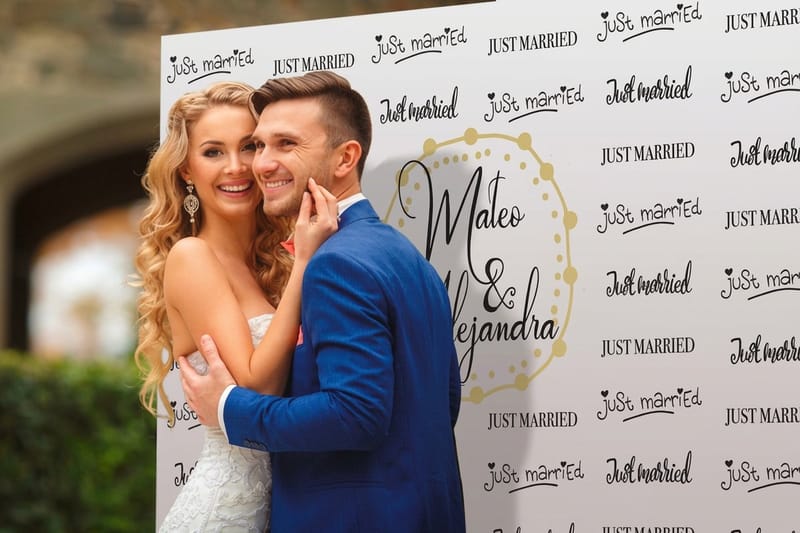
Photo backdrops. A logo wall wants to be near square so the crop works in portrait and landscape shots. Step and repeat banners come as 8′ x 8′ and 8′ x 10′ for exactly that reason, from $217.50. Sizing one as a wide horizontal banner puts your logo above the frame in every vertical photo taken all night. The step and repeat backdrop guide covers logo tiling and spacing.
If the shape is genuinely horizontal, stay horizontal and browse the full vinyl banner range or the wider banners collection. If you are still deciding how it goes on the wall, ten ways to hang a banner is the practical follow-up.
Wally sizes the banner
Stand where the reader stands, then measure back
Wally does not start at the wall. He walks out to where the customer will be, counts the feet, and divides by ten to get his letter height in inches. Three times that number is the banner height he needs. Only then does he measure the gap between the posts and take a foot off for the width. That order is why his banners get read and why the very wide, very short one somebody talked him into once did not.
Configure a vinyl banner →Specs and pricing
Sizes, materials, and starting prices side by side
The live size lists and starting prices straight from the 4OVER4.COM configurator, so you can see how many fixed sizes each material actually carries before you commit to one.


Print it
Order the size that reads from where it matters

Explore more
Where to go next

By the numbers
Banner sizes inside a catalog of 1,000+ products
Common Questions
Your horizontal banner size questions, answered
What is the most common horizontal banner size?
2 by 4 feet and 3 by 6 feet handle indoor and storefront work, and 4 by 8 feet is the size most fence and parking lot jobs land on because it is tall enough for 16 inch capitals and still light enough for two people to mount without a lift. The full vinyl list runs from 2′ x 4′ up to 8′ x 20′, twenty three fixed sizes plus Any Size.
Is a banner size listed width first or height first?
Our size list always writes the smaller dimension first, so 3′ x 8′ means 3 feet by 8 feet with the 3 as the height when the banner hangs horizontally. That convention holds across every fixed size we stock, from 2′ x 4′ to 8′ x 20′. If you need a banner that is taller than it is wide, order Any Size and type the dimensions you want rather than trying to reverse a stock size.
How big should the letters be on a horizontal banner?
One inch of capital letter height for every 10 feet you want people to read from. Three inch caps carry a sidewalk, six inch caps carry a parking lot, ten inch caps carry four lanes of traffic. A single dominant headline plus a subline and a logo fills about two thirds of the banner height, so plan on the headline taking roughly a third: 8 inches on a 2 foot banner, 16 inches on a 4 foot banner.
Can I order a horizontal banner in a size that is not on the list?
Yes. Any Size is an option on vinyl, mesh and fabric banners, and it is the right call when the mounting gap is fixed by something you cannot move, like the span between two fence posts or the width of an awning. Price follows square footage, so a custom 4 by 9 costs close to the 4 by 10 next to it on the list.
Do mesh and fabric banners come in the same sizes as vinyl?
No, and this catches people out. Vinyl offers twenty three fixed sizes. Mesh and fabric each offer three, all in the same 1:3 shape: 24 by 72, 36 by 108 and 48 by 144 inches. Those are the sizes that cut cleanly from the roll widths those materials come in. Anything else on mesh or fabric goes through Any Size.
How much does a horizontal banner cost?
Fabric banners start at $57.20, mesh banners at $75 and vinyl banners at $79. Price climbs with square footage rather than with the number of colors, so a 4 by 12 costs meaningfully more than a 4 by 8 while a full bleed photographic design costs the same as plain type at the same size. Pole banners start at $97.76 and retractable banner stands at $139 because both include hardware.
Get Started
Order a pole banner from $97.76
Pick a stock size or enter your own, choose 13 oz vinyl, mesh or fabric, and we print it with hemmed edges and grommets ready to hang.
Legal Disclaimer
Gold Standard guarantees apply to all standard orders placed through 4over4.com. Price match requires verifiable proof of a competitor's published price for an equivalent product with matching specifications and turnaround time. Satisfaction guarantee covers manufacturing defects and print quality issues. Contact support with order number and documentation. On-time delivery rate based on tracked orders 1999 to 2026. Individual results may vary based on shipping carrier performance.
