
How to Hire the Right People and Keep Them Longer


A hiring and retention playbook for teams under fifty people. What to write down before you post, which steps actually predict the work, and what has to be on the desk before the new person arrives.
Hire against three to five written outcomes, test the real work with a short paid task before you make an offer, and treat the first ninety days as the second half of the hire. In a company under fifty people, most turnover traces back to a role nobody defined and a first week where nobody owned the new person. Pay matters, but it is rarely the first thing that breaks.

Quick answer
Half the hire happens before the offer, half after it
Selection and retention are the same project, split by the day someone says yes. Before the offer you write the role as outcomes, screen for deal breakers in fifteen minutes, ask every candidate the same questions, and buy two to four hours of real work. After it you hand over a desk that was ready, name one person who owns them for week one, get something shipped by day thirty, and ask at day ninety what would make them leave. A mismatch caught on the left of that line costs one more interview round. The same mismatch caught on the right costs the whole search again.
Write the Role as Outcomes Before You Write the Ad
An outcome is a sentence with a verb, a number and a clock in it. "Close the books within five business days of month end." "Answer every support ticket inside four working hours." "Ship two customer-facing pages a month." Three to five of those describe a job better than a page of responsibilities, and they survive contact with reality because you can check them.
Adjectives do the opposite. Detail oriented, self starter, wears many hats, rockstar: every candidate claims all of them, none of them can be scored, and six months later nobody can say whether the hire worked. The afternoon you spend converting the wish list into outcomes is uncomfortable on purpose. It is where you find out that two people already do half of this job, or that the role you were about to post is actually two roles.
The limit is worth naming. Outcomes work badly for a genuinely new function, because you cannot honestly predict what the first year holds. Write ninety-day outcomes instead, agree to rewrite them in month four, and tell the candidate that is the deal. It is a better offer than pretending you know.
Once the outcomes exist, the ad writes itself and so does the scorecard. Keep the voice consistent with everything else the company publishes; the same discipline that makes a good careers page makes a good sales page, which our guide to brand messaging for a small business works through in detail.
The Steps That Actually Predict How Someone Will Work
Every hiring signal tells you one thing well and several things badly. The mistake is not using the wrong step, it is expecting a step to answer a question it cannot reach.
| Step | What it tells you | What it cannot tell you | Your time cost |
|---|---|---|---|
| Resume | Whether they have been near this kind of work, and whether they can write clearly. | Whether any of it was their contribution. | Two minutes each. |
| Screening call | The deal breakers: salary band, location, notice period, hours. | Skill. It is not an interview and should not become one. | Fifteen minutes. |
| Structured interview | How they reason out loud, and how they describe a project that went wrong. | Whether they can do the work unsupervised. | Forty-five minutes plus scoring. |
| Paid work sample | The actual output, and how they handle a brief with a gap in it. | How they behave in month six, or on a bad week. | Two to four paid hours, one hour to review. |
| Reference call | Specifics, if you ask about one named outcome instead of asking in general. | Anything the candidate did not choose to expose. | Twenty minutes each. |
Two rules make the middle of that table work. Ask every candidate the same core questions in the same order, and write the score down before you speak to the next person, because memory rewrites itself in favor of whoever you liked. On the reference call, skip "would you rehire" and ask something narrow: "she says she cut your invoice turnaround to two days, what was it before?" Vague questions get vague answers by design.
The work sample has a real cost beyond the fee. Some strong candidates will decline one, especially senior people juggling a job and a family, and treating that as a red flag will cost you good hires. Offer an alternative in that case, such as walking you through a piece of past work in detail while you ask why at every turn. Have the offer paperwork ready before the last interview so an accepted yes does not sit waiting on a form; if your team still runs on paper, our business form printing guide covers the formats that hold up in a file.
The First Day Is Part of the Hire, Not the Aftermath

A new hire forms a view of the company in the first three days, well before they have done anything useful. What they are reading is simple: did anyone prepare for me. A laptop that is not set up and a manager in back-to-back meetings say more than any values slide.
The fix is a checklist owned by one named person, finished the Friday before. Access and equipment ready. One person assigned to answer the stupid questions, which is a real job and should be told to them in advance. A first task small enough to finish by Wednesday, because shipping something in week one is what turns a visitor into a member of the team. And a physical kit on the desk.
Print earns its place here because paper does not need a password on the first morning. A handbook printed as bound booklets, which start at $240.55, gets read on a couch in a way a shared drive link never does, and it settles time off, expenses and hours in writing before anyone has to ask. Put the signing paperwork in gloss presentation folders, from $844.54, so nothing arrives loose; folders come in commercial quantities, so most small teams order once and draw down the same box for onboarding and sales for a couple of years. A name badge from event badges, starting at $49.88, matters most in a shop, clinic or warehouse where the rest of the team will not learn the name for a fortnight otherwise.
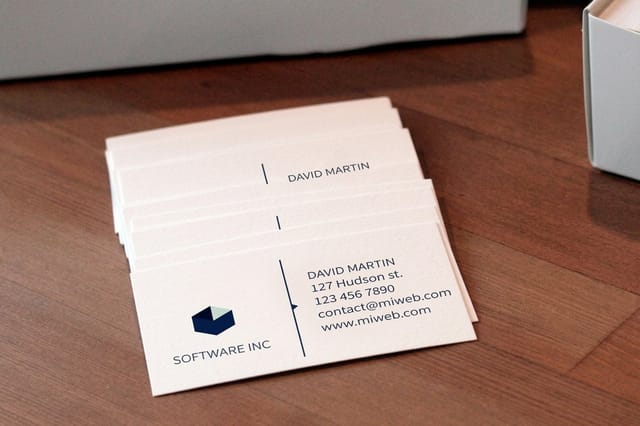
The cheapest item does the most work. Standard business cards start at $17.57, and handing someone a box with their own name on it on day one is the clearest possible statement that they are staying. Print them before the start date, not after the probation period, and check the spelling against the offer letter rather than the resume. For the full desk-by-desk list, see our guide to the employee welcome pack, and the business basics printing collection holds the handbooks, folders and cards in one place.
Why Good People Leave Small Companies
Resignations rarely have one cause, but in a company under fifty people they cluster into four, and three of them are yours to fix.
- The job was not the job in the ad. Someone hired to build ends up firefighting. This one is decided during hiring, not during employment, which is why the outcomes have to be honest even when honesty costs you applicants.
- Nobody owned them. A new person with no clear manager gets pulled by whoever is loudest that week, and after a month they cannot tell you what they are responsible for.
- There is no visible next step. In a small company there is often no promotion to offer. There is always a next skill, a bigger account, or a piece of the business they can own, and saying so out loud costs nothing.
- The pay is genuinely under market. This is the fourth, and no amount of culture work fixes it. If you are a band below the market for a role, either close the gap or accept that you are running a training ground for competitors, and plan your hiring around a shorter tenure.
Small signals carry more weight than they should, because there is no HR department diluting them. Kit that fits, clothing in the right size for the person rather than whatever was left in the box, a desk that was ready. Our guide to branded work apparel covers the sizing and fabric decisions that separate a shirt people wear from one that lives in a locker.
The Habits That Keep People Past Year One
Retention is a set of small recurring habits, and each one takes less than an hour a month. None of them are expensive. All of them are easy to skip in a busy quarter, which is why they need a date in a calendar rather than good intentions.
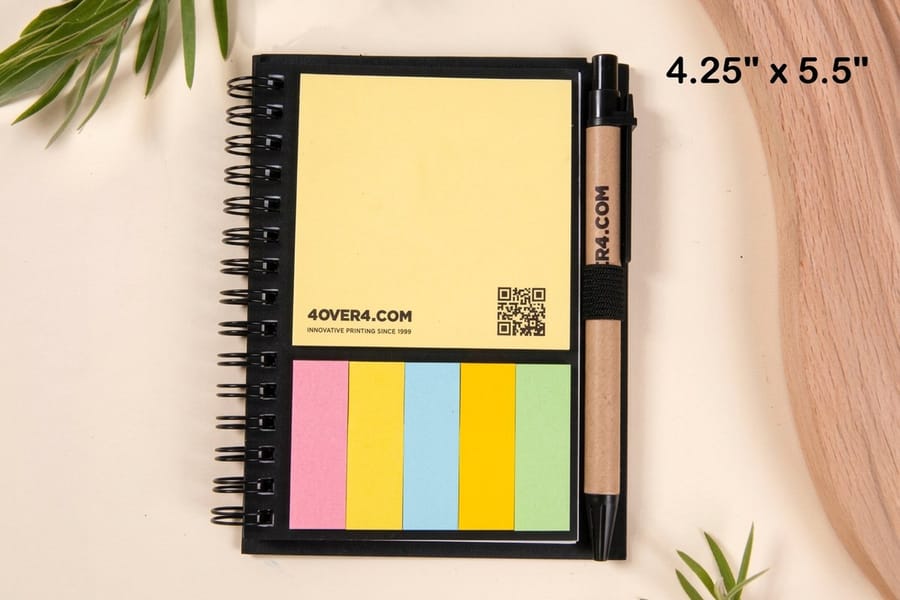
A stay conversation at day ninety, then twice a year. Two questions, asked with a straight face: what would make you leave, and what would make you stay. Write the answers down and act on one of them within a month, or the conversation becomes theater and you have taught them that talking is pointless. A notebook kept for one-to-ones, such as a deluxe spiral notebook from $5.00, means last quarter's answers are in front of you at the next meeting.
Review pay bands on a schedule. Pick a month, review every level against what the same role pays locally, and move people before they ask. A raise given in March lands as respect. The identical raise given the week after someone resigns lands as a bribe, and both of you know it.
Recognize the specific thing. "Great work this quarter" evaporates. "You caught the pricing error on the Ashford order before it shipped" is remembered for a year because it proves someone was paying attention. Where a company does milestone awards, a printed certificate outlasts a message in a chat channel; sizes and framing options are covered in our certificate sizes guide.
Give the ownership away in public. Naming the person who owns something, in front of the team and in front of a customer, is the cheapest promotion available to a small business. Cards carrying the new title are part of that, which is why company business card branding and a branded notebook tend to get reordered the week someone takes on a bigger role. It is not the paper doing the work. It is the fact that the company bothered to reprint it.
Wally explains the day-one desk
Prepared beats impressive, every time
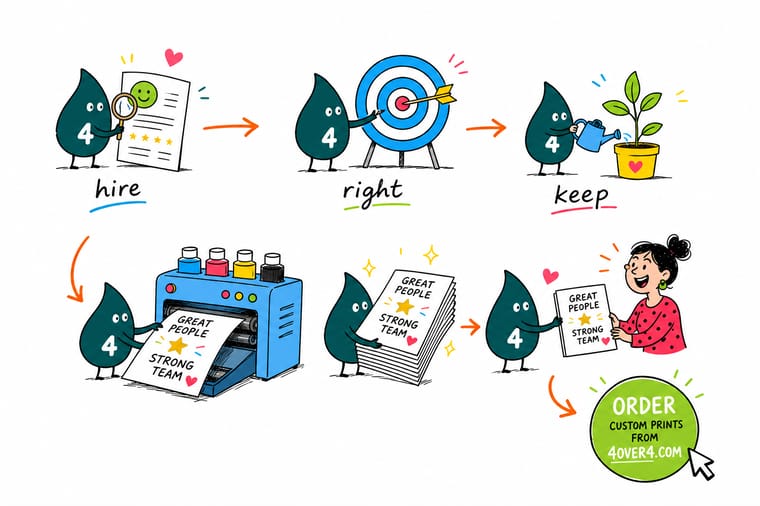
Wally sets the desk the Friday before, not the Monday morning. Handbook printed and dated. Paperwork in a folder so nothing arrives loose. A badge with the name spelled the way it is on the offer letter. A box of cards with their own name on it, because that is the clearest way to say you are staying. It costs an afternoon and a small print order, and it is the part of onboarding a new hire actually describes to other people that evening.
Print the handbook and welcome kit →Specs and pricing
Onboarding print, sizes and starting prices
The three pieces most small teams order for a new starter, with live configuration choices and starting prices straight from the 4OVER4.COM configurator.



Print it
Get the desk ready before the start date


Explore more
Where to go next





By the numbers
The print behind your team, done on time
Common Questions
Your hiring and retention questions, answered
How long should hiring take in a small business?
Aim for three to four weeks from posting to offer, and protect that timeline rather than the number of candidates you see. Small teams lose good people to slowness far more often than to money, because a strong candidate is usually talking to two or three employers at once and takes the first clear yes. A workable shape is one week collecting applicants, one week of screens and structured interviews, one week for the paid work sample and references, and a decision inside two days of the last conversation. If you cannot decide in two days, another interview will not help. It usually means the outcomes were never written down.
Should I pay candidates for a work sample?
Yes, if the task takes more than about an hour or if you would use any part of the output. Pay a flat fee at your normal contractor rate, tell them the fee up front, and cap the task at two to four hours. Paying changes who is willing to do it: without a fee you filter for people with free time rather than people who are good, and you push away the strongest candidates, who already have jobs. Keep the task close to the real work, give the same brief to every finalist, and score it against the outcomes you wrote for the role.
What actually goes in a new hire welcome pack?
The paperwork they have to sign, a printed handbook they can read away from a screen, a badge with their name spelled correctly, business cards if they will ever meet a customer, a notebook, and one piece of branded clothing if your team wears any. Put the paperwork in a folder so nothing arrives loose. The point is not the gifts. It is the signal that somebody prepared for them, which is exactly what a person who left a stable job to join you is looking for on the first morning.
Is a counteroffer ever the right answer when someone resigns?
Rarely, and never as your first move. By the time a person hands in notice they have already done the emotional work of leaving, and a raise treats a symptom that has usually been building for months. The exception is a genuine market correction: if you discover you have been paying someone well under band for work you cannot replace, fix the band for everyone at that level rather than for the one person who threatened to go. Otherwise you teach the whole team that resigning is the way to get paid.
How do I write a job ad that filters instead of attracting everyone?
Say the salary band, name the three outcomes, and describe one hard part of the job honestly. A band cuts out everybody who was never going to accept your number and saves two rounds of interviews. Naming the hard part, whether that is weekend coverage, a long commute, or the fact that the role has no team under it yet, loses you applicants who would have quit in month three anyway. Volume is not the goal. Ten applicants who understand the job are worth more than a hundred who read a paragraph of adjectives.
Do we need a written handbook if we are only eight people?
Yes, and it can be short. Eight people still need one written answer to time off, sick days, expenses, hours, and how someone raises a problem, because without it every answer becomes a private negotiation and people compare notes. Twelve to twenty pages covers a small company. Employment rules vary by state and change, so have an employment attorney in your state read it before it goes out, and date the version on the cover so you know which copy is on which desk.
Get Started
Ready for the next start date?
Print the handbook, the folders, the badges and the cards in one order, and have the desk set the Friday before they walk in.
Legal Disclaimer
Gold Standard guarantees apply to all standard orders placed through 4over4.com. Price match requires verifiable proof of a competitor's published price for an equivalent product with matching specifications and turnaround time. Satisfaction guarantee covers manufacturing defects and print quality issues. Contact support with order number and documentation. On-time delivery rate based on tracked orders 1999 to 2026. Individual results may vary based on shipping carrier performance.
