
Foam Board Photo Prints That Stay Flat on the Wall


Tobias is our voice for cutting, binding and large format, built from the knowledge of our production team, with over 20 years in printing.
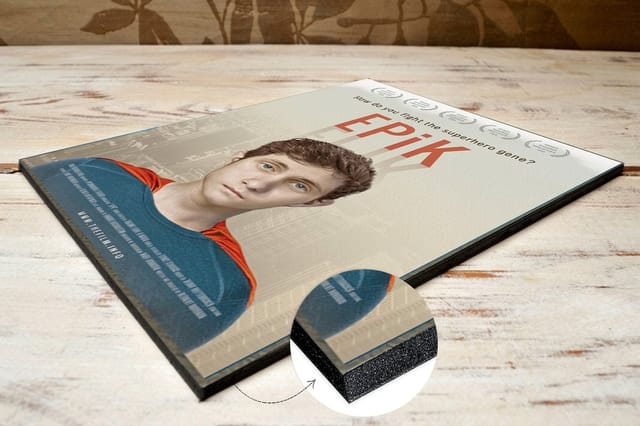
A custom print foam board mount is your image printed and bonded to a 3/16 inch foam core panel, ready to hang without a frame. This guide covers thickness, sizes, mounting, and the point where a foam board print stops being the right material, written for event boards and wall decor, not for a spec sheet.
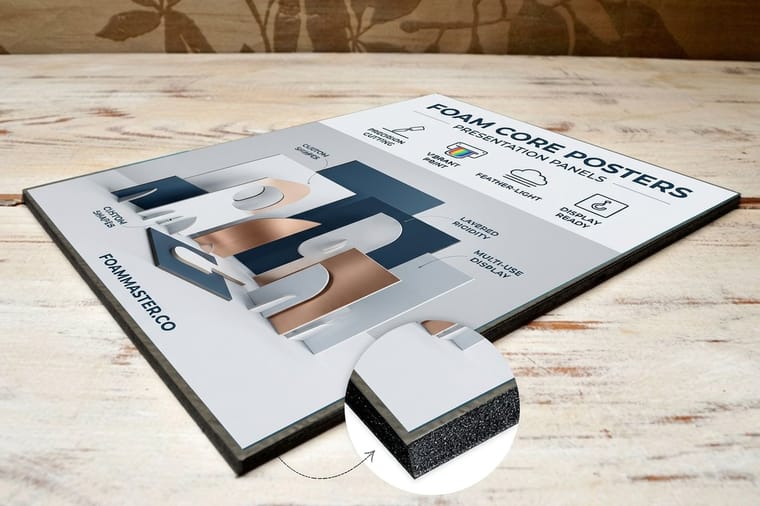
A foam board photo print is your image bonded to a lightweight polystyrene panel, normally 3/16 inch thick, so it hangs frameless and weighs almost nothing. Up to about 24 by 36 inches that standard board stays flat on a wall; at 30 by 40 and above, order half inch or the center will bow. It mounts with adhesive strips, an easel back or a glued cleat, never a screw, and it is an indoor material in every case.
Quick answer
Thickness decides the size, and the size decides the mount
Foam board is a polystyrene core between two paper faces, and a photo print on it is either cured straight onto that face or printed on paper and bonded to it. The standard 3/16 inch board holds flat to roughly 24 by 36 inches. Past that, stiffness rather than adhesive is the problem, and half inch board is the fix. Adhesive strips, an easel back or a glued cleat all spread the load; a screw or a sawtooth hanger tears straight through. Keep it indoors and away from steam, and it lasts for years. For wall hanging ideas read foam board prints on the wall, 4 damage-free display ideas, and for a table display see how foam board easel backs hold a sign up on a table.
Custom Print Foam Board Mounts, Sizes and Options
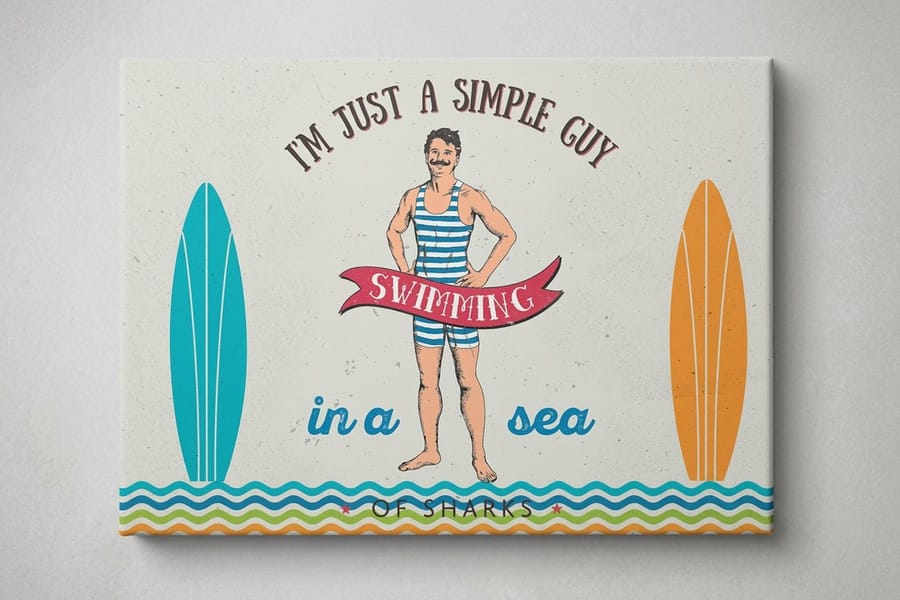
A custom print foam board mount is your image printed on a photo or poster face and bonded to foam core, and the order form comes down to six choices.
- Size. Mounted prints run from 8 by 10 to 40 by 60 inches, and foam core boards from 16 by 20 to 40 by 60 inches, both with any custom size as well.
- Board. 3/16 inch foam core in white or black.
- Face. 10.4 mil semi gloss, 10.4 mil hi gloss, or 32# bright white uncoated.
- Lamination. None, or a 3 mil gloss laminate on the front.
- Quantity and time. From a single print, produced in 4 business days.
- Proof. A free online proof, or straight to production when the file is final.
Putting Photos on Foam Core Board
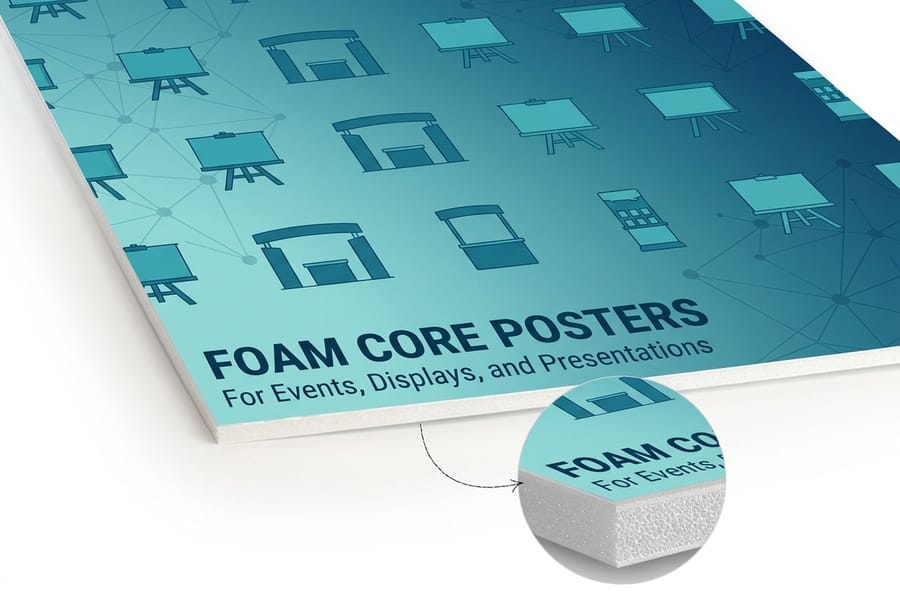
Photos on foam core board come out best when the file and the face suit the size. At the 150 pixels per inch this guide uses, an 8 by 10 print wants about 1200 by 1500 pixels, a 16 by 20 about 2400 by 3000, and a 24 by 36 about 3600 by 5400. The semi gloss face keeps skin tones natural under room light, the hi gloss face deepens blacks and saturates color, and the uncoated face removes glare for a board read under event lighting.
Order one small mounted print of the same file before a full set, then ship the finished boards flat with corner protection.
What Foam Board Is, and Which Thickness You Need
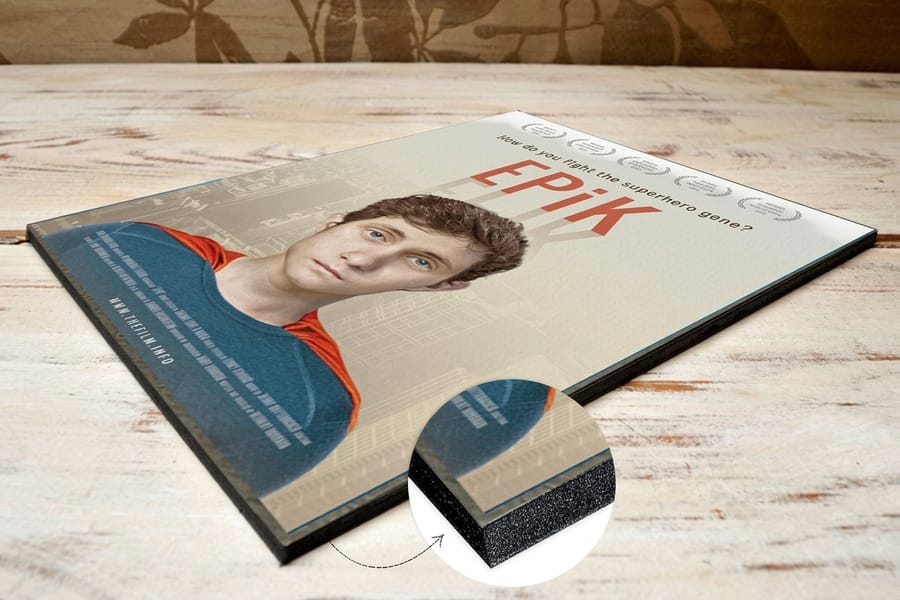
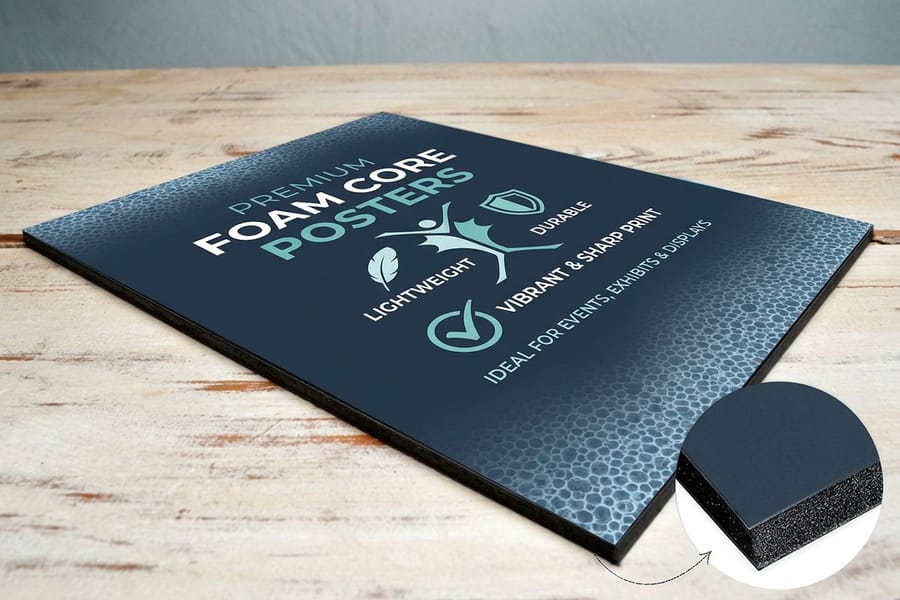
Foam board is a sheet of extruded polystyrene with a clay-coated paper face bonded to each side. The core is mostly air. That is the whole reason it works as a photo print: a 24 by 36 panel weighs about as much as a hardback book, so it hangs on adhesive strips, stands on an easel, and travels in a car trunk without a frame.
Two thicknesses cover nearly every photo job. Standard 3/16 inch is what most prints come on and it is rigid enough for anything you hang in a room. Half inch is the same sandwich with a deeper core, and the difference matters once the print gets large, because bending stiffness in a panel like this climbs with roughly the square of the thickness. The board is not 2.7 times stiffer, it is several times stiffer, which is why the upgrade solves a bowing problem that adding more adhesive never will.
The other decision is how the image gets onto the board. On a direct-printed panel the ink is cured onto the paper face with UV lamps, which is quick, dead flat, and the cheaper route. On a mounted print the image goes onto photo or poster stock first and is then bonded to the board, which lets you choose the paper surface independently of the substrate. Photographic work usually benefits from the second route. Graphics, type and poster reproductions rarely do, and foam core boards handle them well printed direct. If you want to see how different papers behave under the same image, our guide to photographic paper types goes through the surfaces one by one. Every foam board poster size and shape we cut is listed in the sizes guide.
The Sizes That Stay Flat, and the One Where 3/16 Gives Up

Size and thickness are one decision, not two. Below is the pairing we would give you across the counter, along with how each size usually ends up on a wall.
| Print size | Board | Where it usually goes | How it hangs |
|---|---|---|---|
| 11 x 14 in | 3/16 in | Desk, shelf, a print given as a gift | Easel back, or leaning on a shelf |
| 16 x 20 in | 3/16 in | Gallery wall, welcome sign, portrait | Two pairs of adhesive strips |
| 18 x 24 in | 3/16 in | Event signage, seating chart, menu board | Floor easel, or four strips |
| 24 x 36 in | 3/16 in | Feature print, trade show panel | A strip at every corner |
| 30 x 40 in | 1/2 in | Large decor, backdrop panel | Glued cleat, or four heavy strips |
| 36 x 48 in | 1/2 in | A print that owns the wall | Cleat, or step up to gator board |
The row that catches people out is 30 by 40. On 3/16 inch board, stuck down at the corners only, the center pulls away over a few weeks and you get a visible belly in the middle of the image. It is not a defect and no adhesive fixes it. The panel simply needs more depth or more support across the back.
The second thing size changes is your file. A 16 by 20 print asks for roughly 2400 by 3000 pixels at 150 per inch; a 36 by 48 asks for four times the pixel count for the same sharpness. Check that before you commit to the size rather than after. Sizes and set-up dimensions for every board we cut are listed in the foam board sizes and shapes guide, and you can start from a correctly proportioned layout in the blank template library.
Ordering a Foam Board Photo Print in Six Steps
Most of the prints that come back disappointing were decided in the first two steps, before anyone opened the configurator.
- Start from the original file. Not a screenshot, not a picture pulled off a social feed. Those have already been resized down once and no amount of enlargement puts the detail back.
- Check the pixels against the size. Divide the long pixel edge by the long print edge in inches. Around 150 pixels per inch at final size is comfortable for a board you look at from a few feet. Below roughly 100 the softness starts to show at normal viewing distance.
- Pick the board thickness. 3/16 inch up to about 24 by 36. Half inch above that, or anywhere the print will be handled, carried between rooms, or stood on an easel all day.
- Choose the surface. Matte kills reflections under downlights and event spots, which is why almost every seating chart and gallery board is matte. Gloss deepens the blacks and saturates color, and mirrors every light in the room.
- Keep the subject away from the edge. Boards are trimmed after printing and the cut can wander a hair, so add bleed and leave about an eighth of an inch of breathing room around anything you cannot afford to lose. A face or a line of text sitting tight to the trim is the one mistake that cannot be fixed after the fact.
- Order it flat-shipped and protected. Foam board never rolls. It ships flat with corner protection, because a crushed corner on a foam core panel does not spring back the way a paper print does.
One habit worth adopting on event work: order a small proof of the same file before you commit to the full set. An 11 by 14 costs a fraction of a 30 by 40 and it will tell you whether the skin tones and the shadow detail hold on this board, which no monitor can. For a broader walk through from camera file to finished panel, the guide on turning photos into custom prints covers the file preparation in more depth.
Mounting: Easels, Strips, Cleats, and What Tears It
Foam board has no structure to grip. Every method that works spreads the load across a wide area, and every method that fails puts it on one point.
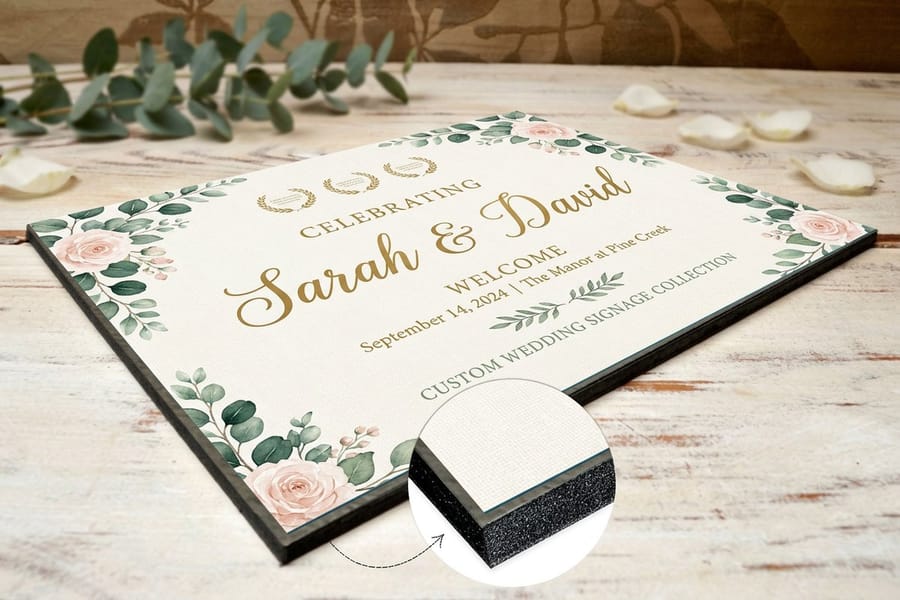
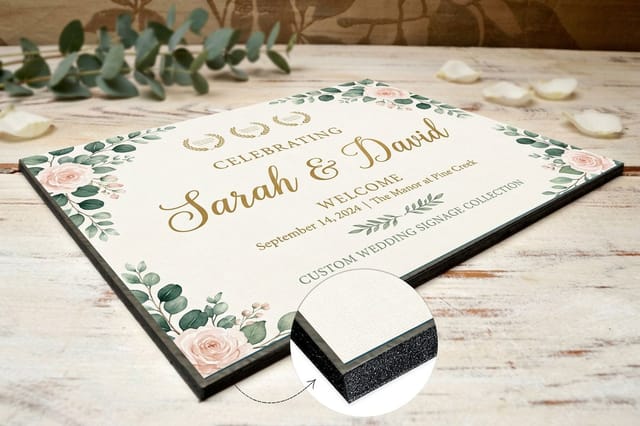
Easel backs are the event standard. A folding kraft easel glued to the back holds a board upright on a table comfortably up to about 18 by 24; larger than that and the center of gravity moves behind the foot and the board tips. Anything above 24 by 36 belongs on a floor easel. Wedding foam core boards ship for exactly this use, and they are the reason seating charts and welcome signs are almost always this material rather than something rigid and heavy.
Adhesive strips are how these prints go on walls. A pair at each corner for a 16 by 20, an extra pair at the center of the top edge once you pass 20 by 30. Press the strips to the board first, then to the wall, then pull the board off and leave both halves an hour before hanging. Skipping that cure is the reason boards land on the floor at two in the morning.
A glued cleat is the answer for large panels. A thin wooden batten bonded across the width of the back, hooked over a matching batten on the wall, distributes the weight along a line instead of at four dots. It takes ten minutes and it is the only permanent mount we would recommend on a half inch board.
What tears it: screws, nails, sawtooth hangers, staples, and anything hung from a single hole. The core crushes under a fastener and the paper face rips outward from the hole. Standoff hardware is the same trap, since it needs a substrate that resists compression around the drilled hole. If the design calls for standoffs, read how standoff signage works and specify a rigid panel such as PVC or gator board instead of foam core.
Where Foam Board Is the Wrong Material

The honest limits are worth more than another paragraph of benefits, because every one of them is a job we would talk you out of.
Outdoors, in any form. Water gets under the exposed paper edge, the facing separates from the core, and the panel ripples permanently. Lamination slows it and does not stop it, because the edges are still open. Covered patios and tents count as outdoors on a humid day. Our guide on whether foam board is waterproof goes through what actually happens to the material.
Anywhere corners get knocked. A crushed foam core corner never recovers. If a print is being carried between venues, stored in a van, or leaned against a wall in a busy room, the wood-fiber veneer on gator board resists the same abuse for years. The gator board and foam board comparison lays the two facings side by side.
Reusable signage. A board that has to survive a dozen events is a PVC or corrugated plastic job, not a foam core one. Foam core signs are excellent for a run of indoor displays that live on a wall; they are not built to be packed and unpacked twenty times.
Long spells in direct sun. A print in a south-facing window fades and the paper face yellows, the same as any other print, and there is no board thickness that changes it.
If one of those describes your job, the alternatives are straightforward. A flat poster is the right call when the print is going into a frame later, since a rigid board cannot be trimmed to fit a mount. Stretched canvas starts at $59 and suits a photograph you want to read as artwork rather than as a print. Everything else in the family, including foam core posters and mounted prints, sits in the foam core printing collection. The foam core posters video overview shows a board coming off the press.
Wally explains foam board prints
Light enough for strips, stiff enough to hang bare
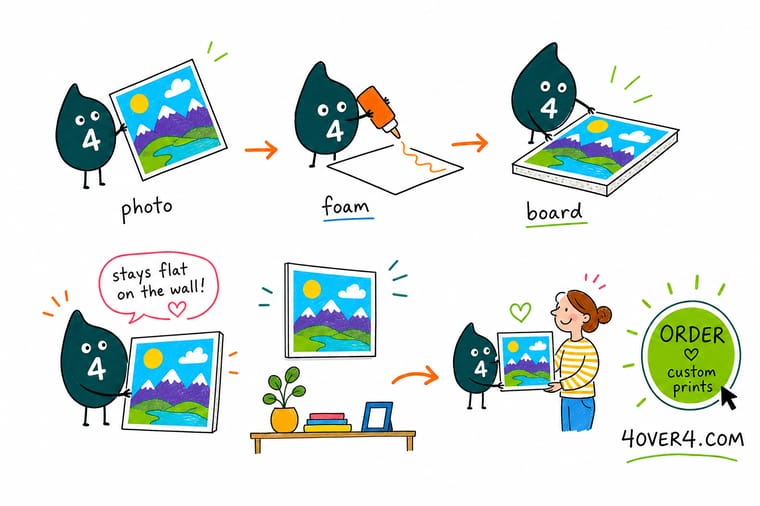
Wally cuts the board and shows you the edge: two paper faces with a core of foam in between, which is why the panel is stiff but almost weightless. Up to 24 by 36 he sticks it up with a strip at each corner. Bigger than that he swaps to half inch board, because the center of a thin panel pulls away from the wall no matter how much adhesive you add. What he will not do is put a screw through it, and he will not let it near a bathroom.
Order foam core photo prints →
Specs and pricing
Boards, sizes, and starting prices
Foam core boards and foam core posters run 16 by 20 to 40 by 60 inches, and mounted prints 8 by 10 to 40 by 60 inches, all with any custom size, on 3/16 inch white or black foam core with a semi gloss, hi gloss or uncoated face and optional gloss lamination, from one print in 4 business days.


Print it
Order a photo print that hangs without a frame
Order a mounted print from 8 by 10 inches for a desk or a gift, a foam core board at 16 by 20 or 24 by 36 inches for a wall, and wedding foam core boards for seating charts and welcome signs on an easel.

Explore more
Where to go next
The cards below list foam board sizes and shapes, cover damp and waterproofing, compare gator board with foam board, walk from a photo file to a print, and give standard frame sizes.


By the numbers
Foam board photo work across 25 years
Common Questions
Your foam board print questions, answered
What size foam board photo print should I get for a wall?
Measure the wall space, then take about two thirds of its width. A 16 by 20 reads as a single framed photo above a desk or a console. A 24 by 36 is the size that stops being decor and becomes the thing you notice when you walk in, and it is still comfortable on 3/16 inch board. Above 30 by 40 the board matters more than the size: order it on half inch, or the middle of the print will pull away from the wall within a few weeks.
Is a foam board photo print the same as a mounted print?
They overlap but they are not identical. Foam core is the substrate; mounting is the method. A direct-printed foam board has the ink cured straight onto the clay-coated paper face, which is fast, flat and the cheaper route. A mounted print is printed on photo or poster stock first and then bonded to a rigid board, so you pick the paper surface separately from the board. If the image is photographic and you care about how the blacks sit, order mounted prints. If it is graphics, type or a poster reproduction, direct-printed foam core is the sensible choice.
Will a foam board photo print warp?
It can, and there are two causes. The first is span: too little thickness across too much width, which shows as a slow bow through the center. The second is humidity, which is the more common one. The paper facing takes on moisture faster than the core does, the two sides of the board move by different amounts, and the panel curls toward the drier face. Keep it out of bathrooms, unheated basements and garages, hang it flat against the wall rather than leaning it, and a board will stay true for years indoors.
How do you hang foam board without damaging the wall?
Adhesive mounting strips, one pair at each corner and a fifth pair at the center of the top edge once you go past 20 by 30. Press the strip onto the back of the board first and let it grab, then press the board to the wall, then peel it off and let both halves cure for an hour before you hang it for good. Skip the curing step and it will drop overnight. On old flat paint, test one strip in a hidden spot: the strip is often stronger than the paint bond.
Can foam board photo prints go outside?
No. Foam board is an indoor material and there is no laminate or coating we would sell you that changes that. Rain gets under the paper edge, the facing separates from the core, and the print ripples. For anything that has to face weather, use a corrugated plastic or PVC panel instead; both stay flat wet and neither one delaminates. The one gray area is a covered patio or a tent for a single afternoon, and even there a humid day will show at the corners by the end of the event.
How much do foam board photo prints cost?
At 4OVER4.COM mounted prints start at $39.99 and foam core boards start at $49.99, with the price moving on size, board thickness and quantity. The jump from 3/16 inch to half inch costs less than most people expect, and on anything 30 by 40 or larger it is the cheapest insurance on the order. Ordering several prints together drops the unit cost noticeably, which is why event and gallery sets are worth batching into one job rather than ordering one board at a time.
Get Started
Foam core prints ship in 4 business days
Pick the size, choose 3/16 or half inch board, and we print it flat, trim it clean and ship it with the corners protected.
Legal Disclaimer
Gold Standard guarantees apply to all standard orders placed through 4over4.com. Price match requires verifiable proof of a competitor's published price for an equivalent product with matching specifications and turnaround time. Satisfaction guarantee covers manufacturing defects and print quality issues. Contact support with order number and documentation.
