
Foam Board Printing Guide for Popular Sizes and Shapes


Tobias is our voice for cutting, binding and large format, built from the knowledge of our production team, with over 20 years in printing.
Most foam board work lands on a short list of standard sizes, from 11x17 up to a 48x96 sheet. Here is the full size chart, the thinking behind custom shapes and thickness, and how to convert the size you choose into a printed foam core board.
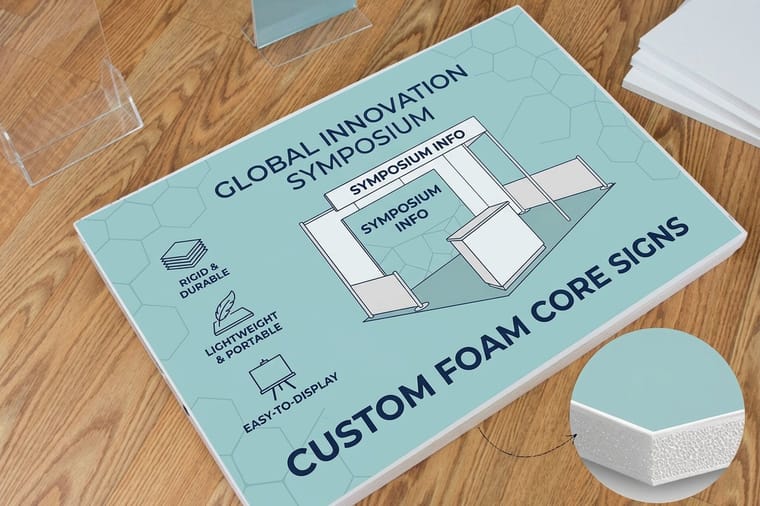
The most popular foam board sizes are 18x24, 24x36, and 36x48 inches, with 11x17 for tabletop use and a full 48x96 sheet for large-format signs. Pick the size by viewing distance, pair larger boards with a half-inch thickness so they stay flat, and add a custom contour cut when you want a shaped display. Foam core is an indoor board, so choose coroplast or aluminum for outdoor signage.
Quick answer
Foam board sizes at a glance
Standard foam boards run 18x24, 24x36 and 36x48 inches, up to a full 48x96 sheet, with 3/16 in and 1/2 in the two common thicknesses.
Reach for 18x24, 24x36, or 36x48 inches for most foam board jobs. Use 11x17 for tabletop displays and handouts, 16x20 for mounted photos, and a 48x96 sheet for large-format backdrops. Pick the size by how far away it will be read, step up to a half-inch board once you pass roughly 30x40, and add a contour cut when a rectangle feels too plain. Foam core is built for indoor use, so switch to coroplast or aluminum the moment a sign has to face the weather.
Watch it printed
See foam core posters on the press, in 109 seconds
The standard foam board size chart
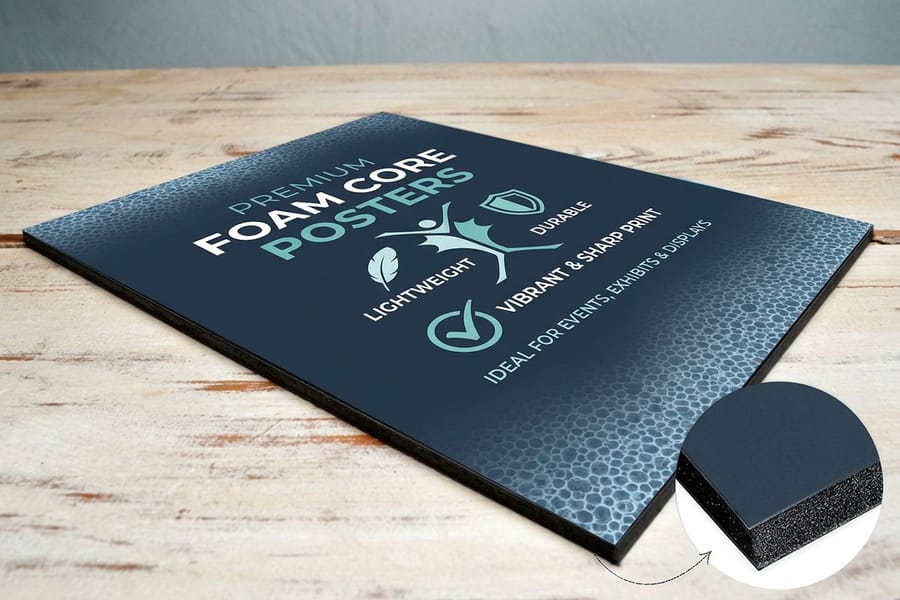
Foam board sizing looks like a long list until you notice the pattern: almost every finished board traces back to a handful of standard dimensions. Learning that short list is the whole game, because once you know the popular sizes you can pick one in seconds and move straight to design.
| Size (inches) | Reads well from | Typical use |
|---|---|---|
| 11 x 17 | Up to 3 ft | Tabletop display, counter card, handout board |
| 16 x 20 | 3 to 5 ft | Mounted photo, framed-look print |
| 18 x 24 | 4 to 8 ft | Easel presentation board, lobby notice |
| 20 x 30 | 6 to 10 ft | Mounted poster, retail counter sign |
| 24 x 36 | 8 to 15 ft | Retail and event sign, poster-style display |
| 30 x 40 | 10 to 20 ft | Booth panel, seating chart, floor plan |
| 36 x 48 | 15 to 30 ft | Trade-show board, science fair, welcome sign |
| 48 x 96 | 25 ft and beyond | Large-format backdrop, full wall panel |
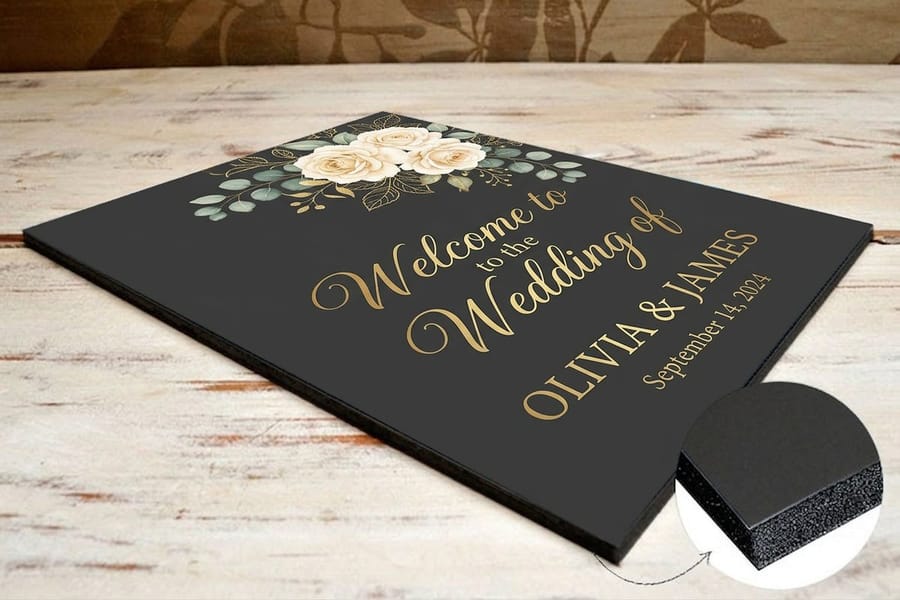
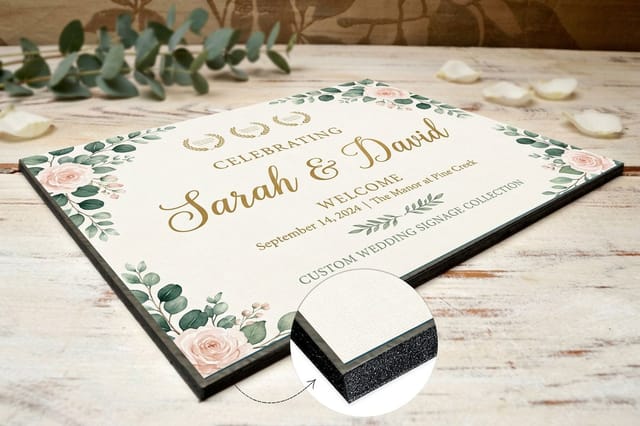
Picking a size by product is just as quick. Mounted artwork and poster-style prints run on foam core posters. Ceremony seating charts and welcome boards run on wedding foam core. When the board has to stay readable in low light, the same artwork goes on reflective foamcore.
The three you will reach for most are 18x24, 24x36, and 36x48 inches. An 18x24 is the classic presentation and easel board. A 24x36 is the go-to retail and event sign, big enough to read across a room without dominating it. A 36x48 is the trade-show and science-fair standard, and it doubles as a backdrop when you group two or three together.
Underneath those, 11x17 covers tabletop displays and handouts, and 16x20 is the sweet spot for a mounted photo or a framed-look print. At the top, a full 48x96 sheet handles large-format signage. Retail foam board is usually stocked in 20x30, 30x40, and 32x40 sheets, which is exactly why so many finished displays land near those numbers. When you print foam core posters through 4OVER4.COM, you set the finished size yourself, so you are never boxed into a stock cut.
The same boards in centimeters and feet
Foam board is sold in inches in the US, but the sizes get asked for in metric often enough to be worth converting once.
- 18x24 in is about 46 by 61 cm.
- 24x36 in is about 61 by 91 cm, or 2 by 3 feet.
- 36x48 in is about 91 by 122 cm, or 3 by 4 feet.
- 48x96 in is a full 4 by 8 foot sheet, about 122 by 244 cm.
Thickness converts the same way. The 3/16 in everyday standard is about 4.8 mm and a 1/2 in board is about 12.7 mm, which is the step you take once a board passes roughly 30x40 in or has to stand unsupported.
Order in inches whichever way you think in, since that is how the configurator is set. Round to the nearest standard rather than converting a metric size back into an odd inch measurement, because a stray fraction costs you material without buying any more usable board.
Foam board thickness, and why it changes the size you can print
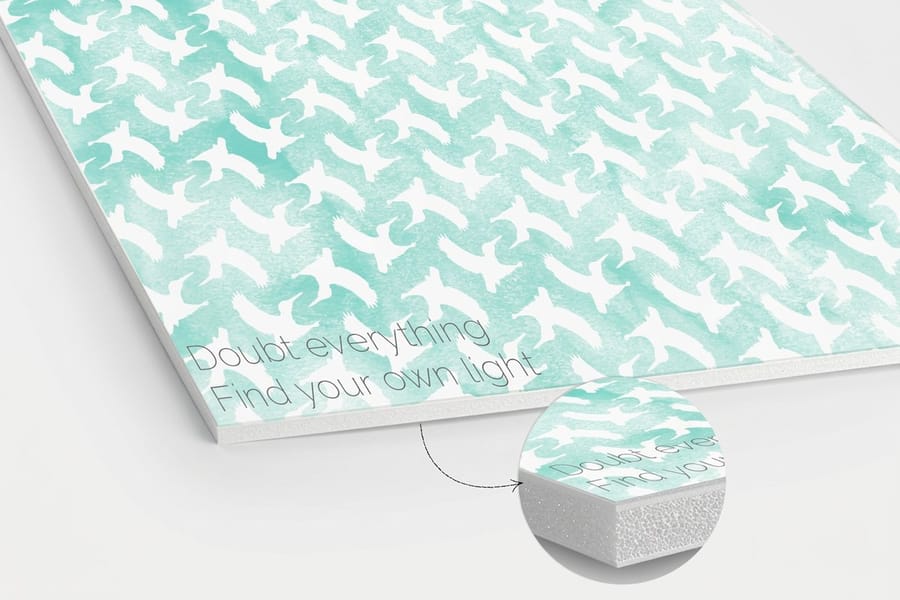
Size is only half the decision. The other half is how thick the board is, because thickness is what keeps a large panel from bowing under its own weight.
- 3/16 inch is the everyday standard. It is rigid enough for presentations, mounted prints, and signs up to roughly 30x40 while staying light and affordable.
- 1/2 inch is the step up. Choose it when a board has to stand on an easel without a backer, when it runs larger than 30x40, or when it will be handled and moved repeatedly.
- 1 inch and denser substrates are for the long haul. If a board will hang, live outdoors under cover, or stay up for months, a heavier board or gator board resists dents and warping far better.
- 1/8 inch is thin and best reserved for small, fully mounted pieces where rigidity matters less than a slim profile.
| Thickness | Use it for |
|---|---|
| 3/16 in | Presentations and easel boards, mounted photos, and indoor signs up to about 24 x 36 |
| 1/2 in | Large signage and anything over 24 x 36, plus boards that stand unsupported or get moved often |
The rule of thumb: the bigger the board, the thicker it should be. A 36x48 sign on 3/16 stock will flex if it is only supported at the bottom, while the same size on a half inch board holds its shape. When in doubt, our team pairs each foam core product with a recommended thickness, and you can compare options in the foam core collection.
Custom shapes and contour cuts
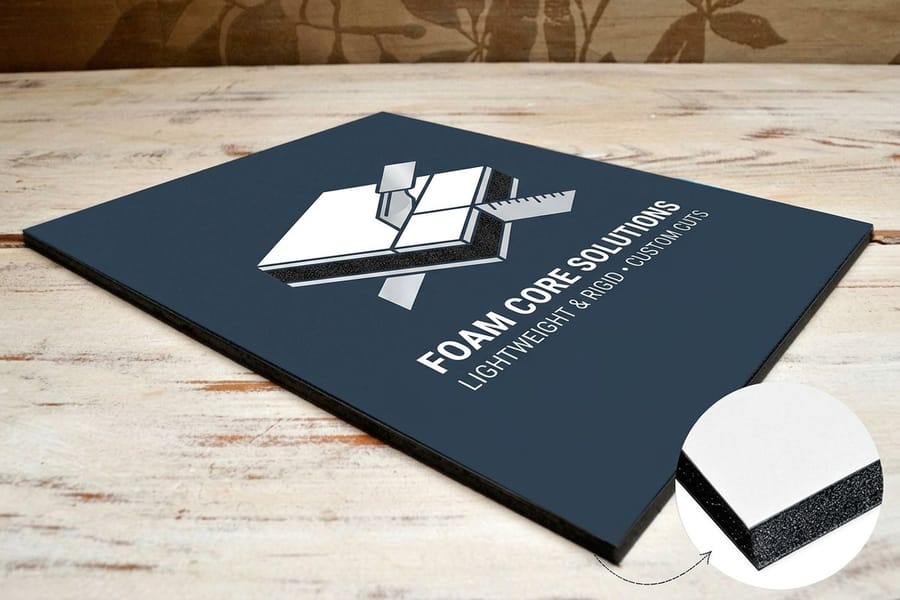
A rectangle is the default, not the limit. Because foam core is soft under a blade, it takes a clean custom cut, and that is where a board stops looking like a stock sheet and starts looking like a designed object.
The common custom shapes are contour cuts that follow the outline of a logo or product, silhouettes such as a bottle, a house, or a mascot, and rounded-corner rectangles that soften a display without changing its footprint. Freestanding standees add a folded foot so a shaped board can stand on its own on a counter or floor.
To cut cleanly, your file needs one thing: a vector cut path that marks exactly where the blade should travel, kept as a separate layer from the artwork. Hold important text and graphics at least a quarter inch inside that line so nothing crowds the edge. If you would rather not build the path yourself, the online designer lets you lay art out at the finished size, and our prepress team confirms the cut before anything runs. For inspiration on shaped rigid work, browse the rigid sign showcase.
Where foam board earns its keep: presentations and mounted prints

Foam board became a studio and boardroom staple for one reason: it is stiff, flat, and light enough to carry under one arm. That combination makes it the default for anything that has to look clean up close.
For presentations, an 18x24 board on an easel keeps a slide-worth of content readable from a seat at the table, and it will not curl the way a bare print does. For mounted photos and posters, foam core gives a gallery-flat surface without the cost or weight of framing, which is why 16x20 and 24x36 are such common photo sizes. When the goal is a premium, edge-to-edge print, our foam core posters mount your artwork directly to the board so there is no glass, no glare, and no sag.
Planning a whole set of materials for the same event or pitch? A matched size across your boards, handouts, and wall posters reads as one deliberate system rather than a pile of odds and ends.
Signage, displays, and events
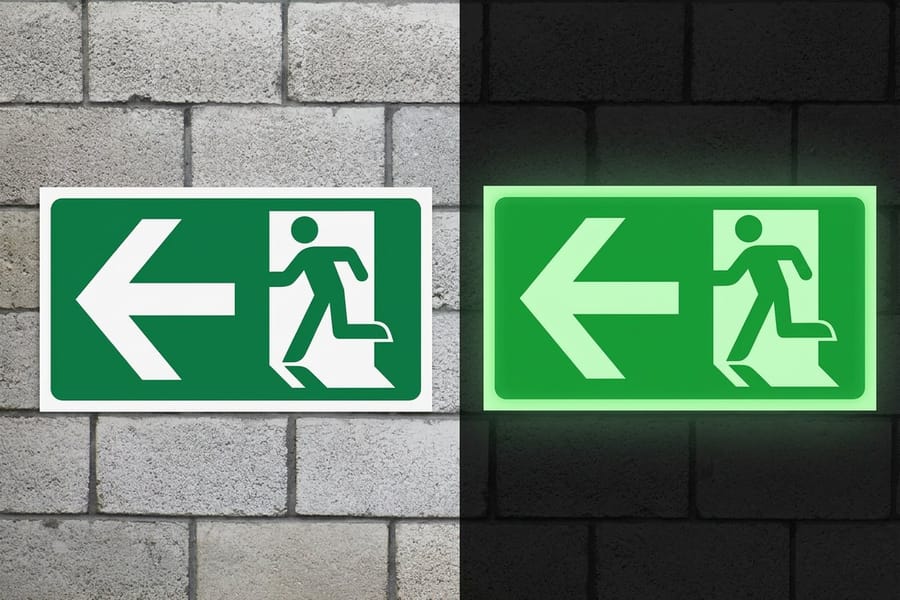
Step out of the boardroom and foam board turns into a signage workhorse. Indoors, it is one of the most cost-effective ways to put a large, sharp graphic in front of people.
The usual jobs: retail and directional signs at 18x24 or 24x36, trade-show and booth panels at 36x48, real estate and open-house boards, and event and wedding signage where a clean white board sets off elegant type. For a ceremony or reception, our wedding foam core boards hold seating charts and welcome signs beautifully, and for anything that needs to catch the eye in low light, reflective foamcore bounces light back at the viewer. The wedding foam core web story and the reflective foamcore web story show both boards in use.
One honest caveat: standard foam core is an indoor material. For outdoor and longer-run signage, pair it with a weatherproof option like coroplast or aluminum, or plan the full display through the trade shows and events category so every piece is built for where it will actually stand.
Foam core versus gator board and other rigid boards
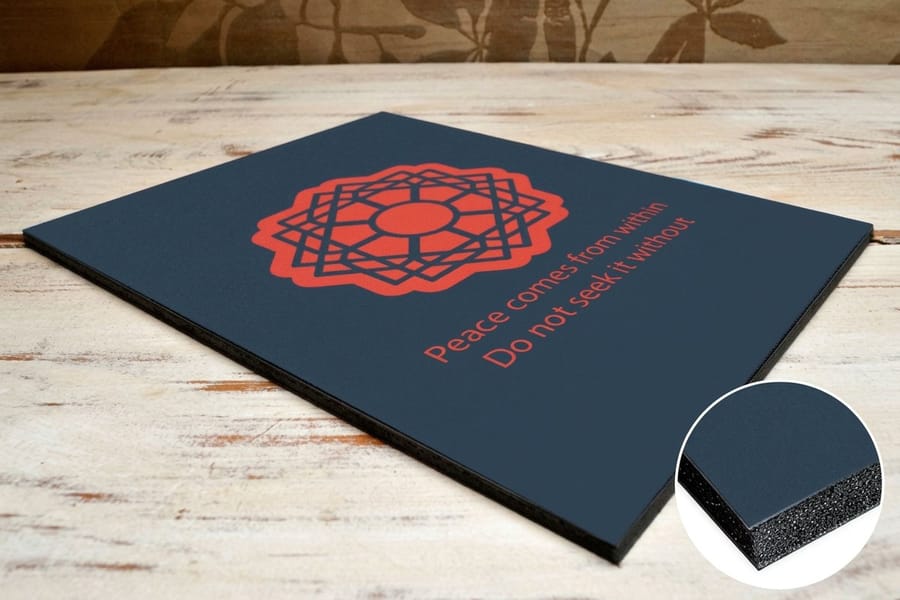
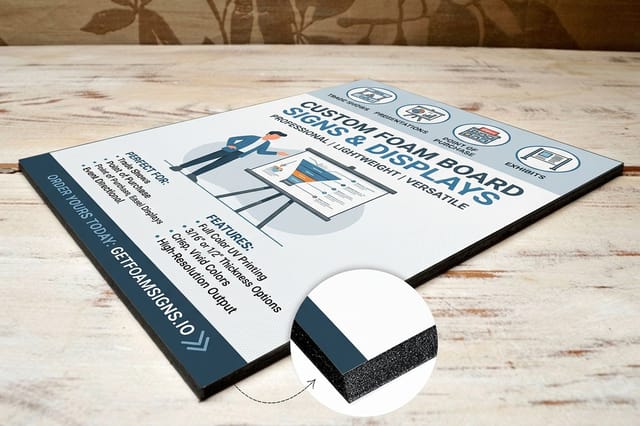
Foam core is not the only rigid board, and picking the right one saves you money on some jobs and heartbreak on others. Our foam core boards print on 3/16 inch white or black board from 16 by 20 to 40 by 60 inches, reflective foamcore comes on 3/16 or 1/2 inch white board at any size, and PVC signs run 11 by 17 to 36 by 36 inches or any size for damp spots.
Foam core is the light, affordable choice for short-term indoor work: presentations, mounted prints, and event signage that goes up for a day or a season. Gator board wraps a denser core in a hard wood-fiber veneer, so it shrugs off dents and warping and is the better pick for hanging displays or anything that stays up for months. Coroplast is a fluted plastic that survives rain and stakes into the ground, which is why it owns the yard-sign category. Canvas and aluminum serve the two ends of the spectrum, one artful and one industrial.
If you are weighing foam core against its closest rival, the gator board and foam board guide lays the two side by side. For a full-color print on a wall-art surface instead of a board, compare a canvas print. The point is simple: match the board to the environment first, then choose the size.
How to choose the right foam core size
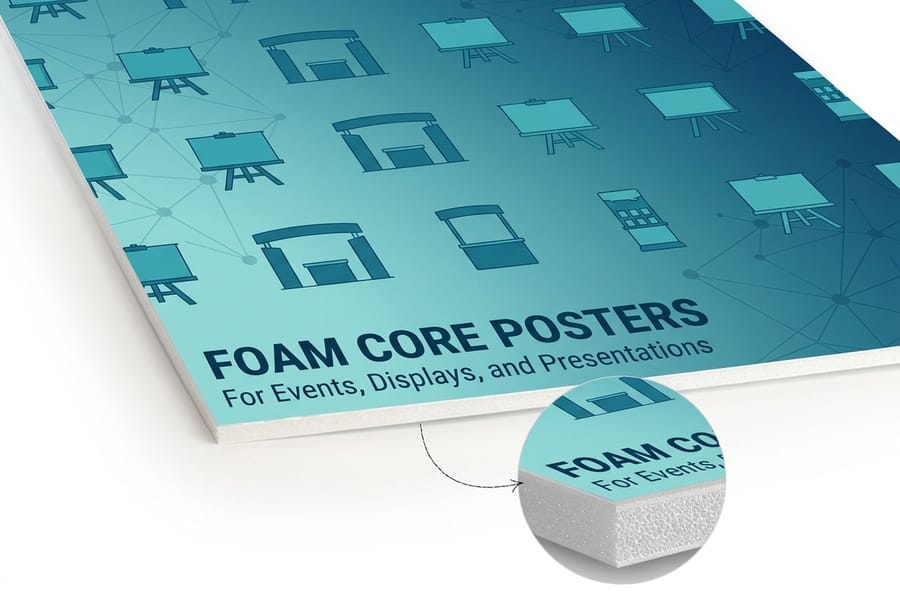
When you are stuck between two sizes, stop guessing and work through five quick questions.
- Measure the space first. Note the easel, wall, or table the board will occupy, and leave breathing room around it. A board should never fill its space to the last inch.
- Decide the viewing distance. Arm’s length reads fine at 18x24. Across a room or a booth aisle wants 24x36 or 36x48. As a loose guide, add roughly an inch of headline height for every ten feet of distance.
- Count your content. A single image and a headline can go small. A chart, a floor plan, or a seating list needs the room a larger board gives.
- Check the thickness pairing. Larger sizes want a half inch board so they stay flat, especially on an easel.
- When between two sizes, go larger. Generous margin always looks more deliberate than type crammed to the edges, and foam core is cheap to size up.
Once you have landed on a size, the online designer and free design templates let you build to that exact dimension so what you see is what prints.
Setting up your print file for a clean cut
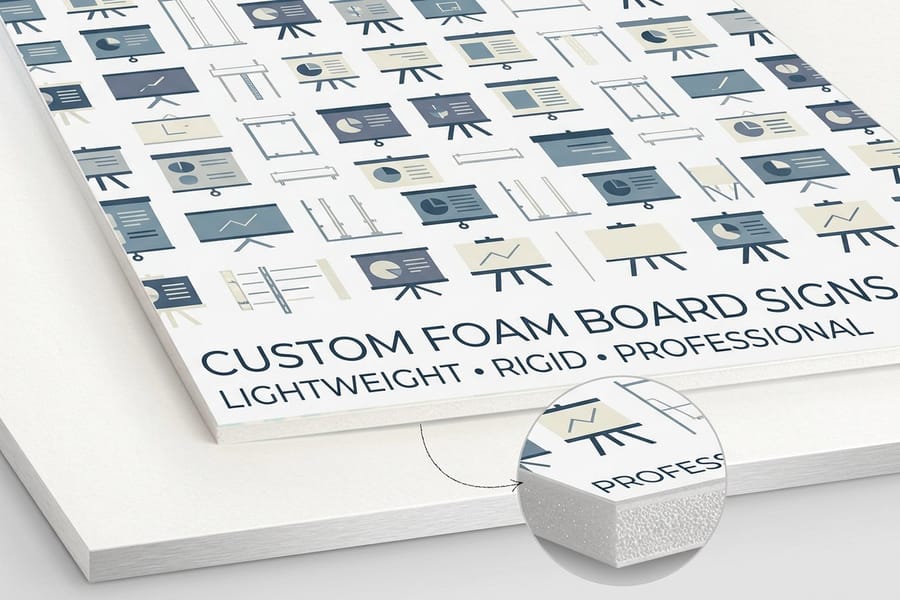
A great size choice still needs a clean file behind it. Foam board is forgiving to print but unforgiving at the edge, so a few setup habits keep the finished board sharp.
Build at the finished size and add a bleed, usually an eighth of an inch on every side, so color runs right to the trim with no white slivers. Keep critical text and logos inside a quarter-inch safety margin. Set images to at least 100 to 150 DPI at full size, which is plenty for a board viewed from a few feet away and far lighter than a business-card file. If you want a custom shape, include the vector cut path on its own layer as covered above.
Not sure your file is ready? Order free paper samples to feel the stock before you commit, and skim the printing FAQs or the printing terms glossary if a spec word trips you up. Getting the file right the first time is the difference between one proof and three.
What foam board printing costs and how prices are set
Four levers set a foam board price, and nothing else moves the number much. On our foam core posters those levers are a finished size from 16 by 20 up to 40 by 60 inches or any size, 3/16 inch white or black board, a semi gloss, hi gloss or uncoated face with an optional gloss laminate, and the quantity.
Finished size is the biggest driver, since more board means more material and more press time. Thickness comes next, with half inch and heavier stock costing more than the 3/16 standard. Quantity works in your favor, because the per-unit price drops as the run grows, so a set of ten signs costs far less each than a one-off. Finishing such as lamination or a custom contour cut adds a step and a small premium.
Rather than quote ranges that go stale, 4OVER4.COM shows the real number in the configurator: pick your size, thickness, and quantity and the price-per-unit updates as you choose. The live specs and pricing for foam core sit right below, and you can compare adjacent options across the signs and banners lineup or read large-format advertising examples to see where a well-sized board pays off.
Wally explains foam board sizing
Right size, right thickness, right board for the room
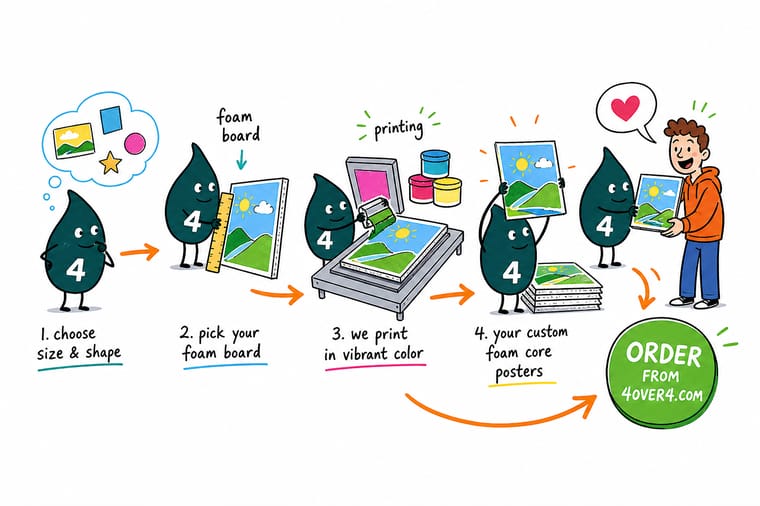
Wally treats a foam board like a small stage: pick the size for how far people stand back, give a big board a half-inch spine so it does not slump, and only shape it when the shape earns attention. Foam core loves indoor duty, so send anything facing the weather to coroplast or aluminum. Land on your size, then let 4OVER4 print it flat, sharp, and ready to stand up.
Print foam core posters →
Specs and pricing
Foam core specs and live pricing
Foam core posters print from 16 by 20 to 40 by 60 inches or any size on 3/16 inch white or black foam core, with a 10.4 mil semi gloss, hi gloss or 32# uncoated face and an optional 3 mil gloss laminate, in 4 business days. The panels show the live specs and price per board.

| Quantity | Price Per Unit | Total |
|---|---|---|
| 1 | $49.99 | $49.99 |
Print it
Order foam core signs, posters, and boards at 4OVER4
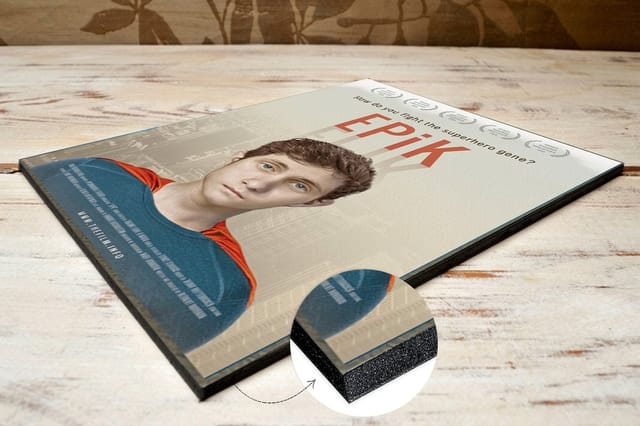
See it in use
Rigid sign jobs, foam board among them
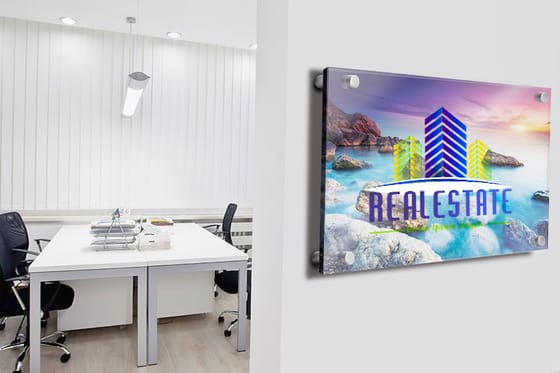






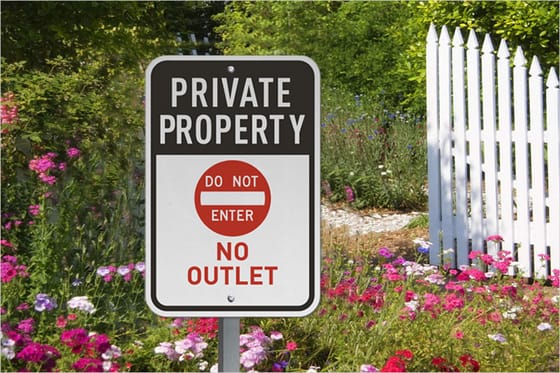

Explore more
Where to go next



By the numbers
Sixty plus paper and board stocks in the catalog
Common Questions
Common questions about foam board sizes and shapes
What is foam board thickness in mm?
The 3/16 in everyday standard is about 4.8 mm, and the 1/2 in board you step up to for large or unsupported panels is about 12.7 mm. Thin 1/8 in stock is about 3.2 mm and is best kept to small mounted pieces. We quote and cut in inches, so pick the nearest standard thickness rather than asking for a metric figure in between.
What size foam board fits a standard easel?
18x24 in is the classic easel and presentation size. It holds a slide worth of content that reads from a seat at the table, and it will not curl the way a bare print does. Once you go past about 30x40 in, or the board has to stand without a backer behind it, move up to a 1/2 in thickness so it does not bow on the rail.
How big is a 48x96 foam board in feet?
That is a full 4 by 8 foot sheet, the largest standard size and the one used for backdrops and large format signs. It has the same footprint as a sheet of plywood, so measure the doorway and the vehicle before you order one. If the space cannot take a single panel, two 36x48 in boards set side by side reach the same 96 inch width and are far easier to carry.
What are the most popular foam board sizes?
The three workhorse sizes are 18x24, 24x36, and 36x48 inches. They cover the vast majority of presentation boards, mounted posters, and event signage. Below those, 11x17 suits tabletop displays and handouts, and 16x20 is a favorite for mounted photos. At the top end, a full 48x96 sheet handles backdrops and large-format signs. Retail foam board is typically stocked in 20x30, 30x40, and 32x40 sheet sizes, which is why so many finished displays land near those dimensions.
What foam board thickness should I choose?
For most prints, 3/16 inch is the standard and it balances rigidity against weight and cost. Choose a half inch when the board has to stand on an easel without bowing, when it is larger than about 30x40, or when it will be handled repeatedly. A one inch board or a denser substrate like gator board makes sense for long-term or hanging displays. Thin 1/8 inch stock is best kept to small, fully mounted pieces.
Can foam board be cut into custom shapes?
Yes. Beyond straight rectangles, foam core can be contour cut around a logo, a product silhouette, or a rounded-corner rectangle, and it can be built into freestanding standees. The one requirement is a clean vector cut path in your file so the blade knows exactly where to follow. Keep important text and artwork at least a quarter inch inside the cut line so nothing lands too close to the edge.
How do I choose the right foam core size?
Work backward from where the board will live and how far away people will read it. Measure the space, decide the viewing distance, then size so your headline is legible from that distance. A tabletop board at arm’s length is happy at 18x24. A board seen from across a booth or lobby wants 24x36 or 36x48. When you are between two sizes, go larger, because empty margin always looks more deliberate than cramped type.
What does foam board printing cost and how is pricing set?
Price is driven by four things: the finished size, the board thickness, the quantity, and any finishing like lamination or a custom cut. Larger boards and thicker stock cost more, while per-unit price drops as quantity climbs. The most accurate number comes from the live configurator, where you pick your exact size and options and the price-per-unit updates as you go. You can see current foam core specs and pricing further down this page.
What sizes does foam board come in?
Foam board comes in 11x17, 16x20, 18x24, 20x30, 24x36, 30x40, 36x48 and full 48x96 sheets, and you can order a custom size in between. Retail stock sheets are usually 20x30, 30x40 and 32x40, which is why so many finished boards land on those numbers. Printing to order removes that limit: you set the finished dimensions in the configurator and the board is cut to them.
Is foam core the same as gator board?
They are close cousins but not identical. Foam core has a paper-faced polystyrene center that is light, affordable, and ideal for short-term indoor use. Gator board wraps a denser foam core in a hard wood-fiber veneer, so it resists dents and warping and holds up for hanging or longer runs. Our guide on what gator board and foam board are walks through when each one is the better call.
Get Started
Ready to print your foam board?
Pick your size, set the thickness, drop in your artwork, and we print a flat, rigid foam core board that stands up clean and reads sharp from across the room.
Legal Disclaimer
Gold Standard guarantees apply to all standard orders placed through 4over4.com. Price match requires verifiable proof of a competitor's published price for an equivalent product with matching specifications and turnaround time. Satisfaction guarantee covers manufacturing defects and print quality issues. Contact support with order number and documentation.
