
Tote Bag Materials and Minimums Before You Commit to a Run


Fabric weight, handle drop and gusset in plain numbers, why the minimum comes from the print method rather than the bag, and which turnaround your date can actually take.
Choose the fabric by weight: 5 to 6 ounce cotton for handouts, 8 to 10 ounce for a bag people reuse, 12 ounces and up for canvas retail bags, and non woven polypropylene only when unit price decides everything. The minimum quantity comes from the decoration, not the bag: screen printing charges a screen per color so it needs a run to justify setup, digital and transfer skip that and allow short runs at a higher price each, and custom sewn bodies carry the largest minimum and the longest lead time. Decorating blank stock bags ships in days. Manufacturing bags to your own spec takes weeks.
Quick answer
Weight picks the bag, the press picks the minimum
Fabric weight is the one spec that predicts everything else. Ounces per square yard tells you whether the bag sags under a laptop, whether thin strokes in your logo stay sharp, and how much it costs to ship a pallet of them. Handle drop and gusset decide who carries the bag and what fits in it. The quantity floor, meanwhile, has nothing to do with the bag at all: it comes from whether your decoration needs a screen per color, and custom sewn bodies sit in their own tier with the longest lead time on the list.
Cotton, Canvas and Non Woven Compared by Weight
Every tote quote starts with a fabric name and a number, and the number is the part that tells you how the bag will behave. Cotton and canvas are sold by ounces per square yard. Non woven polypropylene is sold by gsm. They are not the same material and they do not fail the same way.
| Material | Typical weight | How it behaves | Best use |
|---|---|---|---|
| Light cotton | 5 to 6 oz per square yard | Folds flat, sags when loaded, handles stress first. | Conference handouts and mailer inserts where volume beats life span. |
| Mid weight cotton | 8 to 10 oz per square yard | Holds its shape with weight in it, washes and keeps printing. | The bag people actually reuse: workshops, memberships, staff kits. |
| Canvas | 12 to 16 oz per square yard | Stiff and structured, stands open on a table, heavy to ship. | Retail bags you sell, and premium client gifts. |
| Non woven polypropylene | Roughly 80 to 100 gsm | Bonded plastic sheet, prints bright, creases permanently, heat sensitive. | Large giveaway counts where unit price is the whole decision. |
Read the third column before the second. The trade off nobody puts in the quote is that heavier fabric costs more to buy and more to ship, while lighter fabric costs less of both and gets thrown away sooner. A 5 ounce bag handed out at a trade show has done its job by the time the attendee reaches the car park. A 10 ounce bag is still doing it eighteen months later, which is the only reason a tote outperforms a flyer at all.
Weight also changes the print. Ink sits on top of a dense canvas weave and stays crisp. On an open, light weave it sinks between the threads, and fine lines lose a little of their edge. If your logo has thin strokes, put it on the heavier body. Our canvas tote bags start at $22.73, the same entry price as our standard tote bags, so the choice between them is about use rather than budget.
Duck canvas, plain canvas and the blends, which one takes ink best
Two bags sold as canvas can print nothing alike, because weave and fiber decide how sharp a logo comes out.
Duck canvas is a plain weave with a tight, doubled warp, graded by a number that falls as the fabric gets heavier: a #12 duck is about 11.5 ounces, a #10 about 14.7. Its dense flat surface keeps screen ink on top, so fine strokes stay crisp. Plain canvas is a looser weave at the same weight, and ink sinks into the gaps and softens thin lines. Poly cotton blends, usually 65 percent polyester, hold color well under digital and transfer printing and shrink less, but they need a cooler cure under a screen print. 100 percent polyester is the only body that takes dye sublimation, the route for a full photo on a white tote.
| Fabric | Typical weight | Best print method | What to expect |
|---|---|---|---|
| Light cotton | 5 to 6 oz | Screen, one or two colors | Open weave softens fine detail |
| Cotton canvas | 8 to 12 oz | Screen or transfer | Crisp logos, good opacity |
| Duck canvas | #12 to #8, 11.5 to 18 oz | Screen | Sharpest edges, heaviest to ship |
| Poly cotton blend | 6 to 8 oz | Digital or transfer | Bright color, low shrink, cooler cure |
| 100 percent polyester | 6 to 8 oz | Dye sublimation | Full color photos, white body only |
Duck for a thin stroke logo, polyester for a photo, and an 8 to 10 ounce cotton body for everything in between. Our canvas tote bags start at $22.73.
Handle Drop, Gusset and Size Decide How the Bag Gets Used
Two bags with the same printed area can be completely different products. The specs that separate them are handle drop, gusset, and body size, and only one of them ever shows up in a design brief.
Handle drop is the distance from the top edge of the bag to the top of the handle loop. Around 10 to 12 inches clears a shoulder, including over a winter coat. Around 5 to 7 inches is a hand carry bag. Buyers order the short drop by accident all the time, because a flat photo of a tote does not show which one you are looking at, and then the bags arrive and nobody at the event can carry one over a shoulder while holding a coffee.
The gusset is the depth of the base. A flat tote with no gusset folds to nothing and is perfect for paper, badges and a shirt. A gusset of roughly 4 to 6 inches lets the bag stand open on a table and hold a boxed product upright. If you are packing anything with a footprint, ask for the gusset before you ask for the print area.
Body size follows the contents rather than the artwork. Measure the largest thing going in the bag, add an inch, and size from there. Print area then sits inside that, always with clearance from the seams and the base, because a design that runs to the edge on screen ends up creased across a seam in real life. For the full file handoff, our guide to how online printing works covers proofs, bleed and what we need from you.
Why the Print Method Sets the Minimum, Not the Bag
Ask a printer for a minimum and the honest answer is a question back: which process. The bag has no minimum. The decoration does.
Screen printing makes a stencil for every color in the artwork, then pulls ink through it once per color per bag. That setup is real work whether you order twenty bags or two thousand, so it gets spread across the run, and short runs carry a painful share of it. This is why screen printed totes have a floor, and why the price per bag falls steeply as the count climbs. It is also the most durable result, with the best opacity on dark fabric.
Digital and transfer decoration skips the stencil entirely. There is nothing to set up per color, so a run of a dozen is possible and full color artwork costs no more than one color. The trade off is a higher price per bag that barely improves with volume, and a print that generally sits on the surface rather than in the fibers.
Custom manufacturing is the third tier, where the bag itself is cut and sewn to your fabric, size and gusset. Minimums there are the largest of the three by a wide margin, because a factory is setting up a production line rather than a press.
One extra cost catches people every time: a light design on a dark bag needs a white underbase printed first, because textile ink is translucent and yellow on navy without a base reads as olive. That base counts as a color. A two color logo on a natural bag can quietly become a three pass job on a black one. If budget is tight, the cheapest genuine fix is to put the artwork on a natural or light body and spend the saving on fabric weight instead.
Turnaround, and What to Pack Alongside the Bags
Two clocks run on a tote job. Decorating blank stock bags means the bags already exist, so the schedule is proof approval, press time and cure. Having bags manufactured to your own spec means fabric gets cut and sewn before a press is involved, and that path is measured in weeks. If your date is fixed, take the stock body and put the extra time into approving artwork, because a proof round that waits on one person is the delay that actually sinks tote jobs.
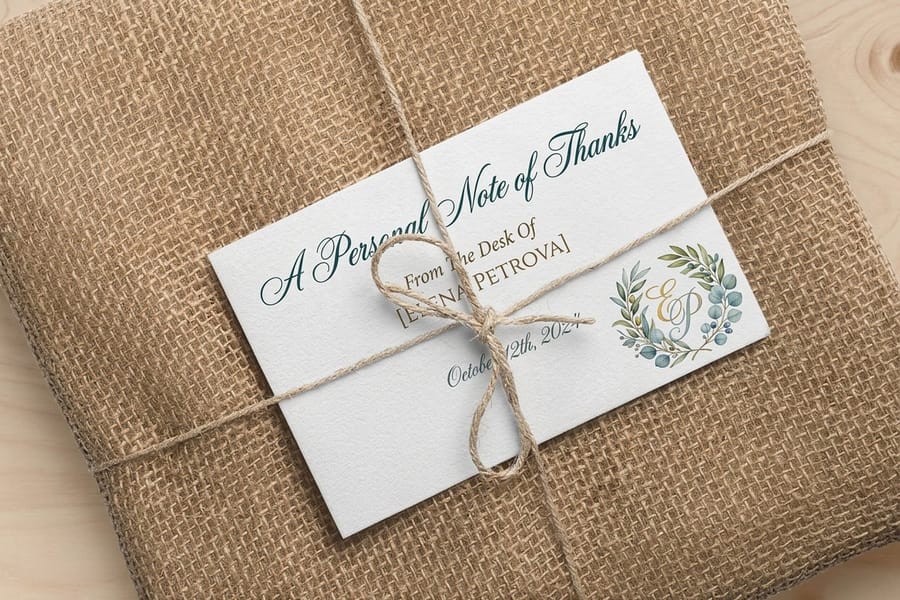
Order the whole kit at once rather than in three separate jobs. The bag is the carrier, and what goes in it is what people keep. Custom t shirts at $21.96 pair naturally with totes for staff and giveaways, and a thank you card at $19.77 slipped into a retail bag is the one insert people read, because it is the only item written to the person holding it. For a booth or a market stall, add business cards from $17.57 so the lead survives past the bag.
If you are packing product rather than paper, the bag is only half the job. The custom box printing range covers the rigid packaging that goes inside a gusseted tote, and the custom shape and die cut collection handles hang tags and inserts cut to a shape instead of a rectangle. Retailers usually want both: a bag with the logo on the outside, and a tag on the product inside.
Two more reads worth the time: custom gift bags if a paper bag would actually suit the occasion better, and why branded totes work for a business if you are still building the case for the spend.
Wally explains tote bag specs
Weigh the fabric, measure the drop, then ask about the minimum
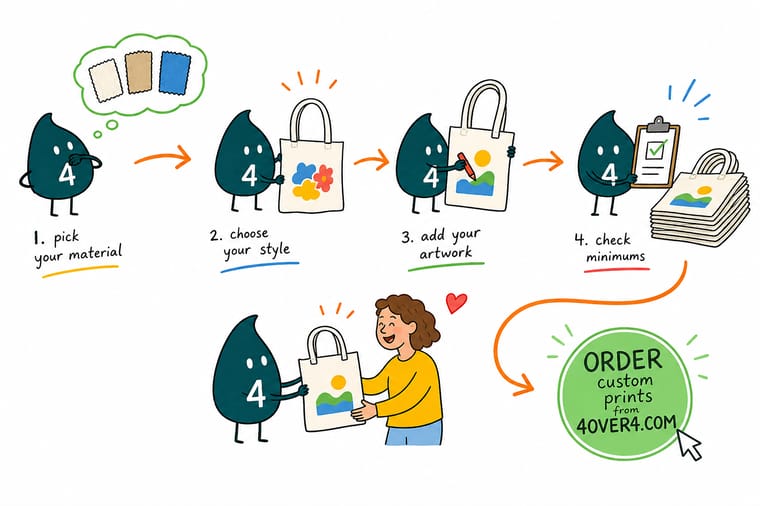
Wally puts two bags on the scale. The 5 ounce one folds into a pocket and is gone by the weekend. The 10 ounce one is still carrying groceries next year. Then he runs a tape from the top edge to the top of the handle: 10 inches or more and it goes over a shoulder, less and it is a hand carry bag. Only then does he ask about quantity, because the minimum belongs to the printing method, not to the bag.
Configure custom tote bags →Specs and pricing
Tote and apparel options, sizes, and starting prices
Compare the bag bodies side by side with the shirt most people order alongside them, using live configuration choices and starting prices from the 4OVER4.COM configurator.

Print it
Order the bag people keep carrying
Explore more
Where to go next
By the numbers
Tote runs beside 1,000+ other products
Common Questions
Your tote bag printing questions, answered
Which material is best for tote bags?
An 8 to 10 ounce cotton canvas, if the bag is meant to be carried again. It holds its shape with books or a bottle inside, survives a wash, and its dense weave keeps a screen printed logo sharp. Go to 12 ounces and up for a retail bag that stands open on a table, and down to 5 or 6 ounce cotton only when the bag is a conference handout. Non woven polypropylene is the cheapest body and prints bright, but it creases for good and does not wash, so it is a giveaway, not a keeper.
What materials are needed to make tote bags?
A body fabric, thread, handles and the small parts. The body is cotton, canvas, a poly cotton blend or non woven polypropylene, cut as two panels plus a gusset strip if the bag needs a flat base. Handles are the same fabric folded and stitched, or cotton or polypropylene webbing, at a 10 to 12 inch drop for a shoulder bag. Add heavy polyester thread, a bar tack at each handle end, and an interfacing panel or a baseboard if the bag has to stand. Custom sewn bodies like this carry the largest minimum and the longest lead time.
Which tote bag material is best for screen printing?
A dense, flat, natural or light colored cotton canvas at 10 ounces or heavier. Screen ink sits on top of a tight weave and stays crisp, while an open 5 ounce weave lets it sink between the threads and fine lines lose their edge. Natural or white bodies skip the white underbase that a dark bag needs, which saves a screen and a pass. Polyester and blends need a cooler cure, and non woven polypropylene can gloss or pucker at a standard screen print temperature.
What weight cotton tote bag should I order?
Match the weight to how long the bag has to survive. A 5 to 6 ounce cotton tote is thin enough to fold into a badge holder and cheap enough to hand out by the box, but it sags under a laptop and the handles are the first thing to give. An 8 to 10 ounce bag is the usual sweet spot for anything people take home, because it holds its shape with books or a bottle of wine inside. At 12 ounces and above you are into true canvas: stiff, structured, the weight a store charges money for. Heavier fabric also holds a screen printed image better, because the ink sits on a denser surface instead of sinking into an open weave.
What is the minimum quantity for custom tote bags?
There is no single number, because the floor comes from the decoration method rather than the bag. Screen printing burns a screen for every color in the artwork, and that setup has to be paid for by the run, so screen printed totes carry a real minimum. Digital and transfer decoration skips the screen, which is why short runs exist at all, at a higher price per bag. Custom manufactured bags, where the bag itself is cut and sewn to your size and fabric, sit in a different tier again with the largest minimum and the longest lead time. The live quantity ladder and price for each option is on the tote bags configurator.
Can you print full color photographs on a tote bag?
On cotton and canvas, yes, with a digital or transfer process rather than screen printing. Screen printing separates artwork into flat spot colors, so a photograph would need a halftone process that most bag runs do not justify. The honest limit is the fabric: a canvas weave is coarse next to paper, so fine detail and small type lose definition, and a photo on a dark bag needs a white base under it that slightly dulls the color. Bold marks, two or three flat colors, and heavy type all reproduce far better on fabric than a detailed image does.
How long does custom tote bag printing take?
Two clocks, and only one of them is printing. Decorating blank stock bags is the fast path, since the bags already exist and only the press time and cure are ahead of you. Having bags manufactured to your own size, fabric and gusset is the slow path, because the fabric has to be cut and sewn before anything gets printed, and that is measured in weeks rather than days. If an event date is fixed, order decorated stock bags and spend the saved time on approving the proof rather than on chasing a custom body.
Do non woven polypropylene bags print the same as cotton?
No, and the difference catches people out at the proof stage. Non woven polypropylene is a bonded plastic sheet, so ink sits on the surface instead of soaking in, which makes colors look brighter and flatter than the same file on cotton. Polypropylene is also heat sensitive, so a curing temperature that is routine for a cotton tote can gloss or pucker the surface of a non woven bag. It is the cheapest bag on the list and it looks good on day one. It is not the bag someone still carries next year.
What should I hand out with the bags at an event?
Whatever goes inside the bag is what people keep after the bag itself gets folded into a drawer. The pairing that works is a bag plus one wearable plus one card: totes at $22.73, custom t shirts at $21.96, and something with your details on it so the lead survives the walk to the car. A thank you card at $19.77 dropped in each retail bag does more work than another flyer, because it is the only item in the bag that was clearly written to the person holding it.
Get Started
Ready to put your name on a bag people reuse?
Pick the fabric weight, set the quantity, and we print totes that hold their shape long after the event is over.
Legal Disclaimer
Gold Standard guarantees apply to all standard orders placed through 4over4.com. Price match requires verifiable proof of a competitor's published price for an equivalent product with matching specifications and turnaround time. Satisfaction guarantee covers manufacturing defects and print quality issues. Contact support with order number and documentation. On-time delivery rate based on tracked orders 1999 to 2026. Individual results may vary based on shipping carrier performance.
