
How to Size and Print Custom Belly Bands That Fit


A belly band is the cheapest way to make a loose stack of paper look assembled. Here is the sizing formula, the stocks that survive four bends, and the three ways to actually buy one.
A belly band is a printed paper strip that wraps the middle of a piece and holds it together. Size it with one formula: flat length equals twice the piece width, plus twice the stack thickness, plus half an inch of glue overlap and an eighth of an inch of ease. Band height runs about a quarter of the piece height, so a 5 by 7 inch invitation suite takes a band 10.75 by 1.75 inches. No printer sells a product called a belly band, so you order it as a custom die-cut strip, as a bookmark-sized strip, or as a glued packaging sleeve.
Quick answer
Twice the width, twice the thickness, half an inch of glue
The band is a rectangle, and its length is a wrap measurement rather than a design choice. Add twice the piece width to twice the finished stack thickness, then add half an inch for the glue overlap and an eighth of an inch of ease so the band slides instead of bowing the card. Height sits at roughly a quarter of the piece height. Everything after that is stock: text weight wraps unscored, cover stock needs four scores, and coated sheets crack white at a corner where uncoated ones only crease.
What a Belly Band Does, and What It Is Not

A belly band holds things in register. Drop a wedding invitation, a response card, a details card and an envelope into a box loose and they arrive as a shuffled pile. Put a band around the middle and the set stays square, in order, and reads as one object rather than four.
That job explains most of the design rules. The band only needs to be strong enough to resist sliding, so weight is not the point. It needs to grip evenly across its height, so a band under an inch tall on a large piece looks accidental. It gets removed, usually once, by someone whose hands are already full, so anything that has to be torn or unpicked is a mistake.
Three things get called belly bands and only one of them is. A packaging sleeve is a wider tube, die-cut and glued into shape before it ships, covering most of the face of the product. A wrap label is adhesive and sticks to the item, so removing it leaves residue. A belly band touches nothing but itself: it is a plain strip closed on the back with a glue dot, and the piece inside comes out clean. If you are still deciding which of the three the job wants, our guide to the nine types of packaging lines them up next to cartons and mailers.
Where they earn their keep: invitation suites, soap and candle bars, notebooks and journals, folded linens, subscription box contents, hotel amenity sets, and any retail item where the manufacturer wants the product visible and the branding legible at the same time. The full packaging printing collection covers the rest of the box once the band is settled.
The Belly Band Sizing Formula, With the Numbers Worked Out
Flat length equals twice the piece width, plus twice the stack thickness, plus half an inch of glue overlap, plus an eighth of an inch of ease. Height runs about a quarter of the piece height. Those two lines cover almost every band anyone orders.
Work a real one. A 5 by 7 inch flat suite, stacked a sixteenth of an inch thick: two fives make ten, two sixteenths make an eighth, the glue tab adds half an inch, ease adds another eighth, and the band is 10.75 inches long. Height at a quarter of seven inches is 1.75 inches. Order 10.75 by 1.75 and it fits.
The term people get wrong is the thickness. They measure the invitation card and forget that the finished suite is a card plus two inserts plus an envelope, which stacks nearer an eighth of an inch and adds a full sixteenth to the wrap. A band cut short does not close, and there is no fixing it after the fact. Stack the real set, hold a ruler against the edge, and use that number.
| Piece | Wrap width | Stack thickness | Band height | Flat band length |
|---|---|---|---|---|
| 5 x 7 in flat suite | 5 in | 1/16 in | 1.75 in | 10.75 in |
| A7 folded invitation, 3 inserts | 5.125 in | 1/8 in | 2 in | 11.125 in |
| 4-bar card, single sheet | 3.5 in | 0.02 in | 1.25 in | 7.75 in |
| Soap bar, 3.5 x 2.25 x 1 in | 3.5 in | 1 in | 1.5 in | 9.625 in |
| 5.5 x 8.5 in notebook | 5.5 in | 0.35 in | 2.5 in | 12.375 in |
Two adjustments are worth knowing. If the band will be slid on and off rather than glued around the piece, raise the ease from an eighth to a quarter of an inch, because a slip band that needs persuading will tear at the seam. If the piece is soft, a folded towel or a bundle of napkins, drop the ease to zero and let the band compress it slightly, otherwise the wrap sags.
Folded invitations stack thicker than flat ones at the same trim size, which changes the band length before you have printed a thing. Our comparison of folded and flat invitations covers what that does to the rest of the suite, and the sizes themselves live on flat wedding invitations and the wider invitation printing range.
Stock, Grain, and the Cracking Nobody Warns You About
A belly band bends four times. Those four corners are where a good design goes wrong, and the reason is the coating rather than the paper.
Coated stock carries a mineral layer on top of the fibre. Bend it and the fibre creases while the coating splits, which is the white line you see along the fold of a gloss business card. Uncoated and kraft stocks have no separate layer to split, so they crease grey and the crease reads as a fold rather than damage. That is the whole reason an 18pt recycled kraft band survives handling better than a 14pt gloss band, despite being the thicker of the two.
Weight sets the second rule. Text weight around 70 to 100 lb wraps unscored and holds its shape. Cover stock does not: 14pt gloss cover is the default on most short-run strip products, ours included, and it will crack at an unscored corner every time. Ask for four scores on the band, at the two fold lines and the two spine lines, and the same stock folds cleanly. Scoring is the difference between a band that looks manufactured and one that looks bent.
Grain runs a distant third but it decides how the flat panels sit. Paper folds cleanly along the grain and fights you across it, so on a belly band the grain wants to run parallel to the fold lines, which means along the height of the strip rather than its length. On a short run nobody will cut it to order for you, so the practical version is simpler: score it, and the grain stops mattering. If you want to test a scrap, bend it both ways and keep the direction that curves smoothly.
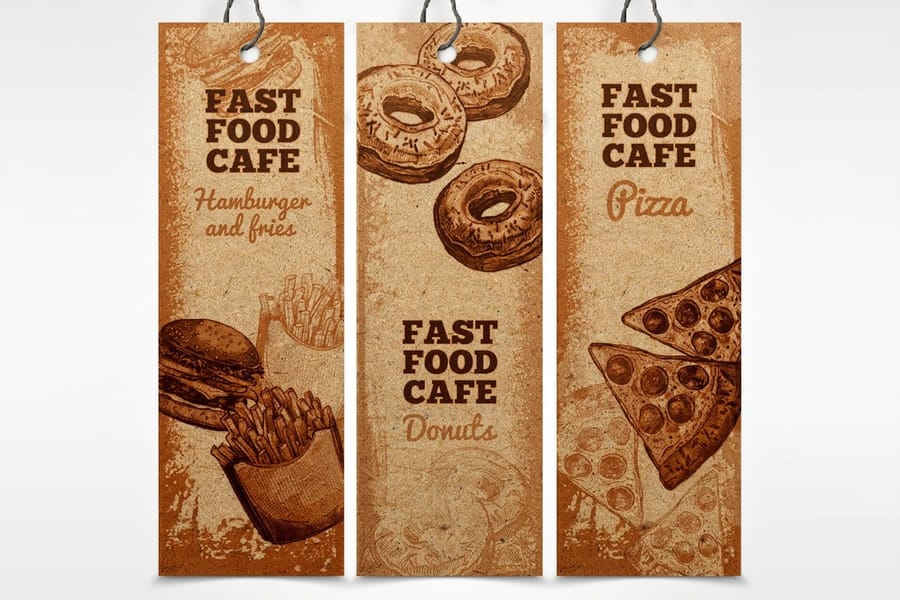
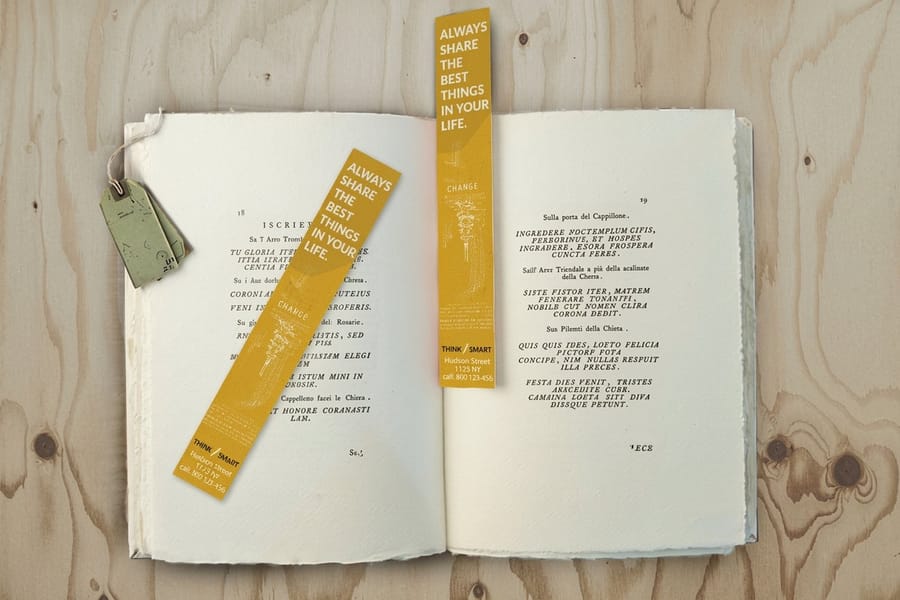
Finishes follow the same logic. Foil and raised ink are hard layers, and hard layers flake off a bend, so keep decoration inside the middle third of the front panel where the band stays flat. Kraft bookmarks show what an uncoated strip looks like in the hand, and our breakdown of cardstock weights in points explains why 14pt and 16pt behave so differently at a fold.
How to Order a Belly Band When There Is No Belly Band Button
No printer stocks a product called a belly band, ours included, and that trips up more people than the sizing does. What you are buying is a printed strip in a size you specify, so you order it through a product that lets you choose the size.
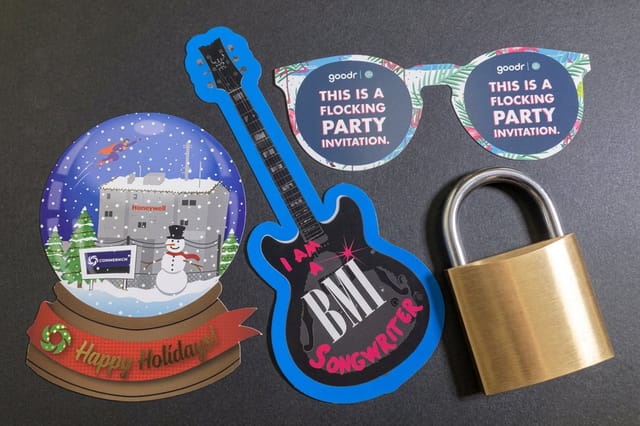
Route one, the custom strip. Any Shape Size Paper Die-Cut starts at $87.00 and takes any length and width you give it, on stocks from 14pt gloss cover through 18pt one hundred percent recycled kraft and metallic pearl. This is the route for a 10.75 by 1.75 inch band, or for a band with a shaped edge. Specify the four score lines in the order notes.
Route two, the bookmark trick. Standard Bookmarks are 2 by 6 inches on 14pt gloss cover and start at $16.48. That fits a 4-bar card, a soap bar, or anything with a wrap under about 7 inches. It will not reach around a 5 by 7 suite, so check your number against the table above first. For a design test before a real run, it is the cheapest hundred pieces you will buy.
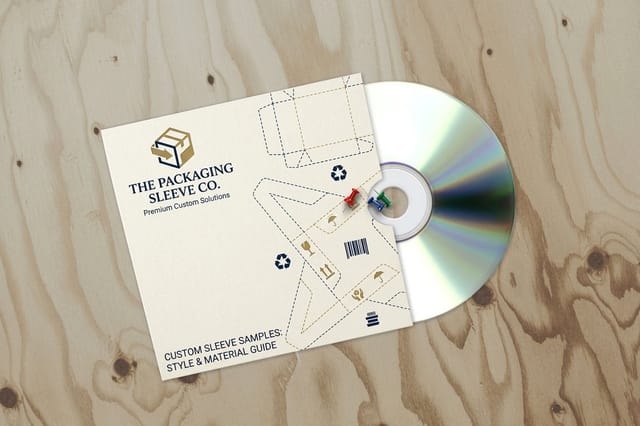
Route three, the finished sleeve. Packaging Sleeves start at $438.25 on 14pt gloss, 15pt with 30 percent post-consumer content, or 16pt cover, die-cut and glued into a tube before they ship. Nobody on your side glues anything: the sleeve slides on. That is the right call for retail volume where assembly labour costs more than the sleeve.
Set the file up like any other print job. Full bleed art needs an eighth of an inch past the trim, and type needs to sit an eighth of an inch inside it, because a strip this narrow makes a crooked trim obvious in a way a postcard never does. Mark the fold positions on a separate layer rather than printing them. The blank template library gives you correctly sized artboards to start from, and how online printing works walks the file from upload to delivery.
Closing them is the last decision. Glue dots are faster than tape and hold better on uncoated stock; double sided tape is cleaner on gloss. Put the seam on the back, centred, so the front panel stays unbroken. Never staple a band, and never glue it while the piece is inside unless you are prepared to lose a few to squeeze-out.
Wally explains belly bands
Twice around, plus the glue tab
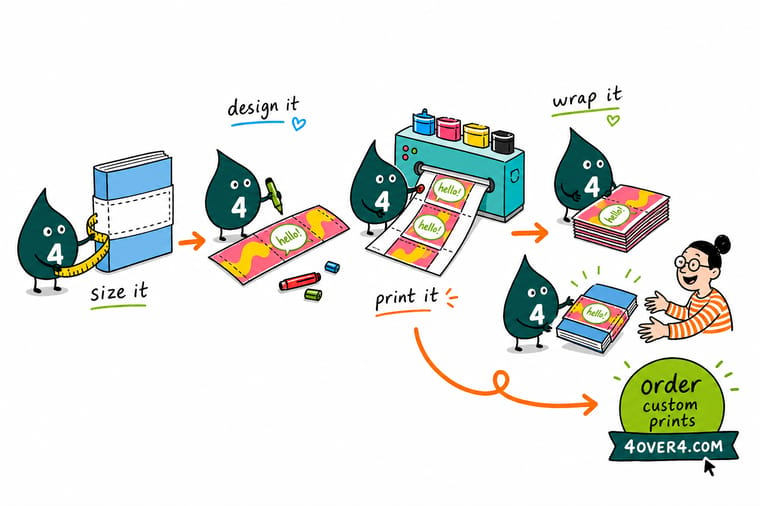
Wally stacks the whole suite first, card and inserts and envelope together, then runs a ruler along the edge for the thickness. Twice the width, twice that thickness, half an inch for the glue tab, an eighth of an inch of ease. He marks four score lines so the corners fold instead of cracking, glues the seam on the back where nobody looks, and slides the suite in. The band that fits is the one measured around the finished stack, never around the card.
Order a custom die-cut belly band →Specs and pricing
The three ways to buy a band, side by side
Each of these prints the strip a different way. Configure the size, stock and quantity to see the exact number before you order.



Print it
Order the strip that fits your wrap

Explore more
Where to go next

By the numbers
Packaging printing you can count on at 4OVER4
Common Questions
Your belly band questions, answered
What size belly band fits a 5 by 7 invitation?
A band 10.75 inches long by 1.75 inches tall fits a standard 5 by 7 inch flat suite about a sixteenth of an inch thick. The length comes from twice the 5 inch width, plus twice the stack thickness, plus half an inch of glue overlap and an eighth of an inch of ease so the band slides rather than bows the card. If your suite carries a folded invitation and three inserts it will measure closer to an eighth of an inch thick, which pushes the band to 11.125 inches. Cut a paper strip to your number and wrap the real suite before you order a thousand of them.
What paper should a belly band be printed on?
Text weight if you want it to wrap without a score, cover stock if you want it to feel substantial and are willing to score it. The band bends four times around a flat piece, and every bend is a chance for a coated surface to split. Uncoated and kraft stocks crease grey rather than white, which is why an 18pt recycled kraft band still looks clean after a hundred people have slid it off, while a 14pt gloss band shows every corner. Ask for four scores on any cover stock and the problem goes away.
Do you glue a belly band or leave it loose?
Both work and they solve different problems. A glued band is closed with a glue dot or a strip of double sided tape on the overlap, positioned so the seam sits on the back of the piece. It holds a loose stack in register and it cannot be removed without tearing, which is why product packaging uses it. A slip band is cut a little longer, closed the same way, then slid on and off, which is what most invitation assemblers prefer because the piece goes in after the band is made rather than while the glue is setting.
Can a belly band have foil or raised ink?
It can, as long as the finish stays off the fold lines. Foil and raised finishes sit on the surface as a hard, brittle layer, and a hard layer bent around a corner flakes along the crease. Keep the decoration inside the middle third of the front panel, which is the part of the band that stays flat against the face of the piece. A foil monogram centred on the front reads beautifully. A foil rule running the full length of the band will show breaks at all four corners.
How much do custom belly bands cost?
A die-cut strip in your exact size starts at $87.00 through Any Shape Size Paper Die-Cut, which covers 14pt gloss cover up to 18pt one hundred percent recycled kraft and metallic pearl. If your band happens to fit within 2 by 6 inches, Standard Bookmarks start at $16.48 and are the cheapest way to test a design before you commit. A glued, finished sleeve is a different product and starts at $438.25, because the die and the gluing pass are doing work the flat strip leaves to you.
What is the difference between a belly band and a packaging sleeve?
A belly band is a narrow strip that covers a band across the middle and leaves most of the piece showing. A sleeve is a wider tube that covers most of the face and is usually die-cut and glued into its finished shape before it ships. Choose the band when the product or the invitation is the thing you want seen. Choose the sleeve when the printed surface is the thing you want seen, or when the piece needs a little structural protection on the way to a shelf.
Get Started
Ready to wrap it?
Give us the length, the height and the stock, and we cut the strip to your wrap. Add four scores and the corners fold clean instead of cracking.
Legal Disclaimer
Gold Standard guarantees apply to all standard orders placed through 4over4.com. Price match requires verifiable proof of a competitor's published price for an equivalent product with matching specifications and turnaround time. Satisfaction guarantee covers manufacturing defects and print quality issues. Contact support with order number and documentation. On-time delivery rate based on tracked orders 1999 to 2026. Individual results may vary based on shipping carrier performance.
