
The Brand Voice Breakthrough That Makes Every Message Sound Like One Company


Stop describing how you want to sound. Pull the voice out of writing you have already done, write it down in one page, and put it on the surfaces customers actually touch.
The brand voice breakthrough is extraction, not invention: gather twenty pieces of your own past writing, highlight only the sentences that felt right, and name the three patterns that repeat. Turn those three into a one-page guide where every trait carries a we-do line, a we-never line and one rewritten sentence, then set a range rather than a single point on each tone dial so the voice survives a refund email as well as a launch.
Quick answer
Extract it from your archive, then write the range
A brand voice you can enforce comes out of writing you have already published, not out of a workshop. Read twenty of your own pieces, mark the sentences that sound like you, and three repeating patterns will fall out. Write them as traits with a we-do line, a we-never line and a rewritten example each. Then set how far you are willing to move on formal to casual, serious to funny, respectful to irreverent, and matter of fact to enthusiastic, so the guide still works on the day you have to write an apology.
What a Brand Voice Actually Is, and What It Is Not
A brand voice is the set of choices that stay the same in every message you send. Word choice, sentence length, how much you hedge, whether you use humor, what you refuse to say. Tone is the part that moves. Voice is the range, tone is the point you pick inside it for one piece of writing.
That distinction is not academic. It is the single reason most voice guides fail. A guide that says "we are playful and bold" fixes one dot on the map, so when the team has to write a data breach notice or a price increase, the guide is useless and everyone falls back on legal boilerplate. Write the band instead: how playful, at the most, and how plain, at the least.
The four dials worth arguing about are formal to casual, serious to funny, respectful to irreverent, and matter of fact to enthusiastic. Mark where your range starts and stops on each. A brand can sit anywhere on that map and be coherent. What breaks coherence is having no range written down, so every writer guesses.
One more thing a voice is not: it is not your positioning and it is not your promise. Those are messaging, and they belong in a separate document. Our guide to brand messaging components covers what you say. This page is about how it sounds when you say it.
The Two Hour Audit That Finds the Voice You Already Have
The breakthrough almost never comes from a workshop with sticky notes. It comes from reading your own archive and noticing that you already sound like something, at least some of the time. Here is the sequence that works.
- Pull twenty pieces. Sales emails, support replies, your best three social posts, a founder note, a landing page, an internal announcement. Mix formats deliberately, and include at least three pieces you were not proud of.
- Mark, do not analyze. Read them once and highlight only the sentences that made you think yes, that is us. Do not stop to explain why. The explanation contaminates the sample.
- Sort the highlights into piles. Twenty to forty sentences will collapse into three or four repeated moves. Short declarative openers. Admitting a limit before selling. Concrete nouns instead of category words. Whatever yours are, they will repeat.
- Name each pile in your own words. Not adjectives. "We say the awkward part out loud" beats "transparent" because a writer can act on it.
- Read the bad pieces again. The pieces you flinched at are the banned list. Write down the specific words and constructions that caused the flinch.
Two hours, one person, no meeting. If your archive is thin because the company is new, use the founder's own writing, including messages that were never meant to be marketing. That is usually where the real voice is hiding.
The trade-off worth naming: extraction gives you a voice that is authentically yours but not necessarily differentiated. If your archive reads like every other company in your category, extraction will faithfully reproduce that. When that happens, pick the one pile that is least like your competitors and push it further, rather than inventing a fifth trait nobody has ever used.
Write the One Page Guide, Then Put It Where People Meet You
Three traits. One page. Every trait gets four things: what it means, what we do, what we never do, and one rewritten sentence from your own copy showing the before and after. Anything longer gets skimmed and then ignored.
| Trait | We do | We never do | How to check it |
|---|---|---|---|
| Plain | Use the word a customer would use on the phone. | Say solutions, leverage, seamless, or best in class. | Search the draft for the banned words. Zero hits or rewrite. |
| Direct | Put the answer in the first sentence, then explain it. | Open with a rhetorical question or a scene set. | Cover everything but sentence one. Is the answer still there? |
| Candid | Name the limit before the benefit when there is one. | Claim a benefit we cannot show evidence for. | Count the limits named. A page with none is selling, not helping. |
Now the part most teams skip. The guide is worthless until the voice appears on the surfaces where customers actually meet you, and a good number of those are physical. A printed piece has no edit button, no scroll and no analytics, which is exactly why it exposes a weak voice fast. If the copy on the back of your card only works because the reader can click something, it was never doing any work.
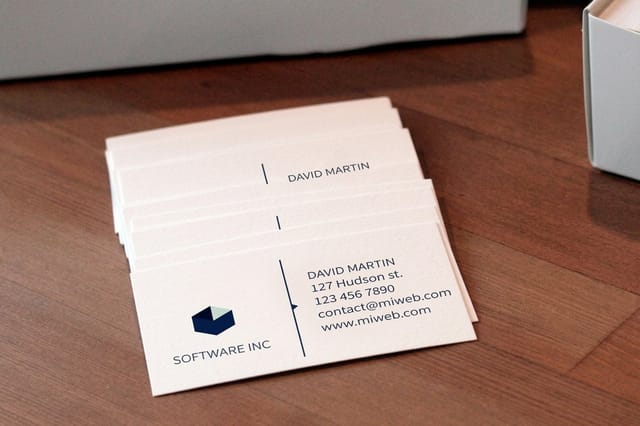
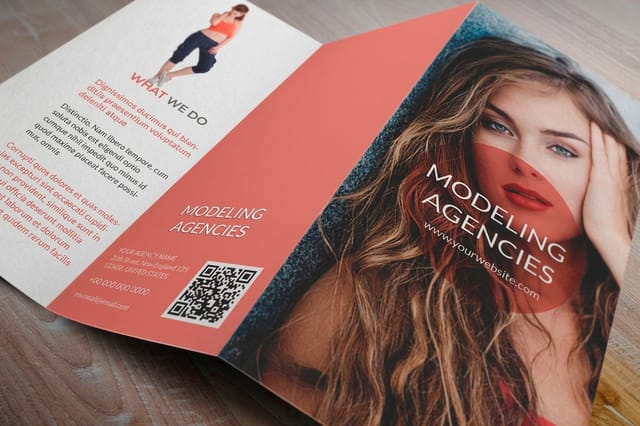
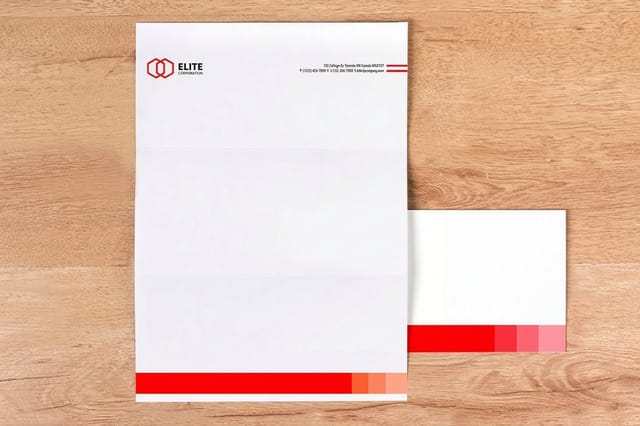
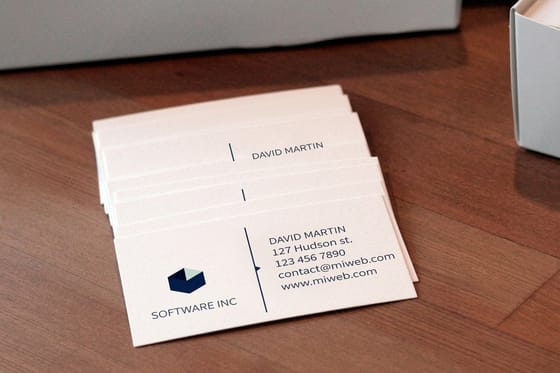
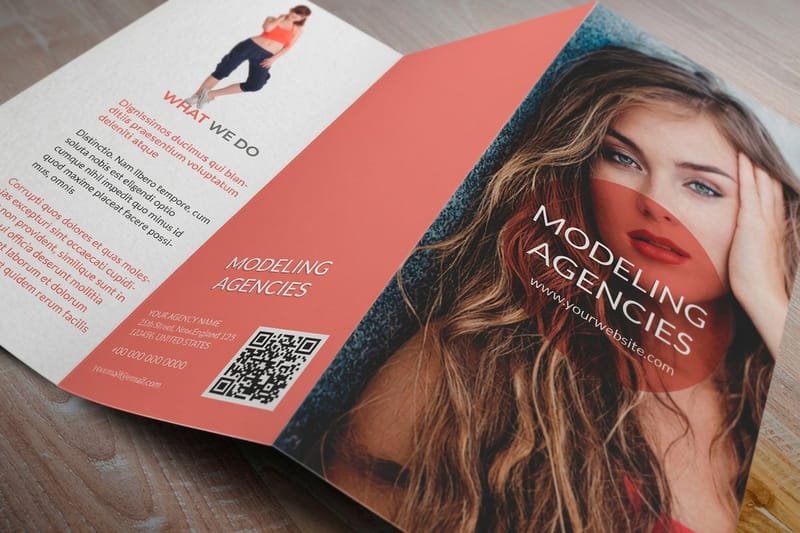
Start with the pieces that get handed over. Standard business cards start at $17.57 and give you roughly eight words to prove the voice exists. Standard postcards at $16.48 give you a headline and two sentences, with no navigation to hide behind. Standard brochures at $57.11 are the first place a voice has room to breathe across panels, and the first place inconsistency between panels becomes obvious. For anything on company stationery, standard letterheads at $99.95 carry the voice into contracts, invoices and letters that outlast any campaign, and standard flyers at $39.54 are the cheapest way to test two versions of a message with real people before it goes anywhere else.
Set the files up once and reuse them. Correct sizes and bleed live in the blank template library, and the color pairings guide covers the palette side so the tone of the words and the tone of the ink do not fight each other. Browse marketing materials to see what else carries the voice, or start with the business card range if you want the smallest possible test.
The Three Ways a Brand Voice Quietly Dies

Every voice decays in the same three ways, and all three are predictable enough to plan against.
Committee softening. Every reviewer adds one hedge. Nobody removes any. After four rounds, "we will not have this ready before March" has become "we anticipate potential availability in the first quarter." The fix is procedural, not creative: name one person who can delete hedges without asking, and give reviewers comment rights rather than edit rights.
Surface drift. The homepage gets the attention. The shipping notification, the invoice footer, the 404 page, the hold script and the back of the card do not, because nobody owns them. Make a list of every place words reach a customer, put a name next to each one, and you will usually find a dozen surfaces that have never been read by anyone in marketing.
Growth dilution. The founder wrote everything at three people. At thirty, six people write and none of them have the reference. This is where the one-page guide pays for itself, and where before and after rewrites beat adjectives by a wide margin, because a new hire can copy a rewrite and cannot copy a feeling.
Run one recurring check instead of an annual audit. Once a quarter, pull ten pieces of recent writing at random, including two that nobody thinks of as marketing, and mark them against the three traits. Ten pieces takes twenty minutes and catches drift while it is still cheap to fix. If you are due a larger reset, the brand refresh checklist sets the order to work in, and the logo design principles guide covers the visual half of the same identity. More on the whole subject sits in our logo and branding guides.
Wally explains brand voice
Read your old writing before you write a new manifesto
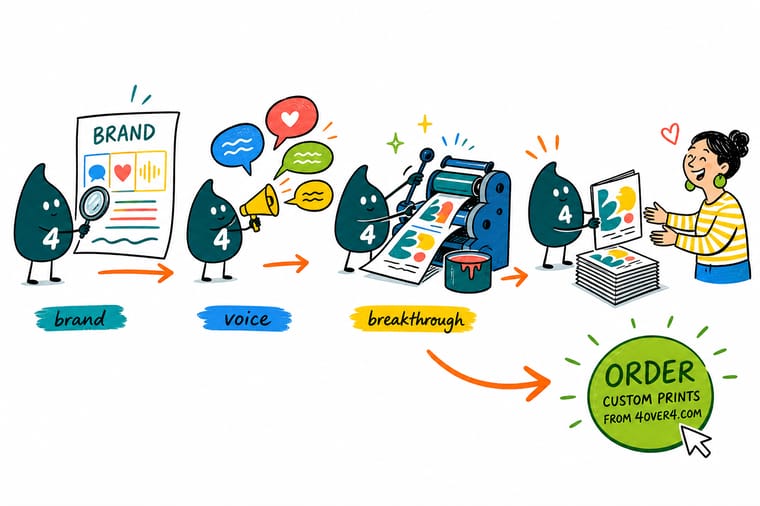
Wally does not start with adjectives. He prints out twenty things the company already wrote, marks only the sentences that made someone nod, and finds the same three habits repeating in all of them. Those three become the guide. Then he draws a band on each tone dial instead of a dot, so the same voice can announce a launch on Monday and admit a delay on Friday. Last step, he puts it on a card, because a voice that cannot survive eight words on paper was never a voice.
Order business cards that carry it →Specs and pricing
The pieces that carry a voice, sized and priced
Cards, postcards and brochures give you three very different amounts of room. Configure each one live and see what the starting price covers.



Print it
Put the voice somewhere people can hold
Explore more
Where to go next


By the numbers
The surfaces a customer reads
Common Questions
Your brand voice questions, answered
What is the difference between brand voice and tone?
Voice is what stays the same in every message you send. Tone is what shifts to suit the moment. A brand whose voice is direct and dry stays direct and dry in a launch announcement and in an apology, but the launch runs warmer and the apology runs plainer. The practical test: if you could change it between two pieces without anyone noticing, it is tone. If changing it would make readers think they were dealing with a different company, it is voice.
How long does it take to define a brand voice?
The extraction takes about two hours if you have an archive to read. Writing the one-page guide takes another hour. What actually takes months is enforcement, because the voice only becomes real once three or four people have written in it, been corrected, and rewritten. Teams that spend six weeks on the document and one afternoon on enforcement end up with a beautiful PDF nobody opens.
Can a small team have a brand voice without hiring a copywriter?
Yes, and small teams often do it better because one person still writes most of the copy. The founder voice is usually the honest starting point. The risk is the opposite one: the voice lives in a single head, so nothing is written down, and the first hire has nothing to copy. Write the page while it is still easy, not after the drift starts.
How do you keep freelancers and AI drafting tools on voice?
Give them the banned list and three before and after rewrites, not the adjectives. Adjectives like approachable produce the same generic output from a person or a model. Concrete instructions like "no sentence over 25 words", "never open with a question", and "we say customers, never clients" are checkable, and a reviewer can catch a violation in seconds instead of arguing about feel.
Should the voice change between social media, email and print?
The voice should not. The format constraints will do plenty on their own. A social post has to land in one line, an email can breathe, and a printed piece has no scroll and no edit button, so it forces you to cut. Many teams find the printed version is where the voice gets sharpest, because you cannot pad a business card or the back of a postcard.
How do you know the voice is working?
Two signals, both cheap to watch. First, new writing needs fewer edit passes because people know what fits. Second, people outside the company start using your phrasing back at you in support tickets, reviews and referrals. Neither is a dashboard metric, and any agency promising you a brand voice percentage is selling something.
Get Started
50 brochures cost $57.11, where the voice gets tested
Pick a size, upload the file, and print the version of your message that has to work without a scroll bar or a second chance.
Legal Disclaimer
Gold Standard guarantees apply to all standard orders placed through 4over4.com. Price match requires verifiable proof of a competitor's published price for an equivalent product with matching specifications and turnaround time. Satisfaction guarantee covers manufacturing defects and print quality issues. Contact support with order number and documentation. On-time delivery rate based on tracked orders 1999 to 2026. Individual results may vary based on shipping carrier performance.
