
Boarding Pass Invitation Design, From Field Map to Tear-Off Stub


A boarding pass invitation turns event details into ticket fields and hands guests something they want to keep. Here is the exact layout, the sizes that fit real envelopes, and the three ways to get the tear-off stub.
A boarding pass invitation is laid out like an airline ticket: the guest is the passenger, the date becomes the flight number, the venue is the gate, and the ceremony time is the boarding time. Print it 9 by 4 inches so it slides into a standard #10 envelope, and place the tear-off stub behind a perforation about 2.5 inches from the right edge. Real perforation is a bindery pass; a printed dashed line is the budget version, and a die-cut ticket shape is the premium one.
Quick answer
A ticket layout, a #10 envelope, and one honest decision about the stub
The whole build comes down to three choices. The layout is a field map: passenger, flight, gate, boarding time, each filled with a real event detail. The size is 9 by 4 inches, because it keeps airline proportions and fits a #10 envelope without folding. And the stub is a budget decision: a printed dashed line costs nothing, real perforation comes on event ticket stock, and a die-cut ticket shape costs the most because it needs a custom cutting die.
The Field Map: What Every Ticket Line Becomes
The boarding pass conceit only lands when every field is filled with something real. A card that says BOARDING PASS across the top and then lapses into normal invitation wording reads as a costume. Commit to the format.
| Ticket field | What it becomes | Example |
|---|---|---|
| Passenger | The guest, or the couple hosting. | AVA + MARCO |
| Flight | The date, coded with your initials. | MJ-0614 for June 14 |
| Gate | The venue name. | THE FOUNDRY, LIC |
| Boarding time | The arrive-by time, not the ceremony time. | 4:30 PM for a 5:00 ceremony |
| From / To | Your city and the destination city. | NEW YORK to SAN JUAN |
| Seat / Class | Table assignment, or a playful upgrade. | TABLE 7, FIRST CLASS GUEST |
| Barcode | Decorative, or a QR to the RSVP page. | Scan to RSVP |
Two of these fields carry real consequences. The boarding time should sit about 30 minutes ahead of the ceremony, because guests treat the printed time literally. And the coded date needs a plain-text backup: one quiet line with the actual date, somewhere on the card, saves the phone calls from relatives who never flew on flight MJ-0614. If the barcode is a working QR code, point it at the RSVP page and scan it from the proof before you approve anything. A dead code on 150 printed invitation cards is not fixable.
Sizing, Stock, and the Envelope It Has to Fit
Pick the envelope first, then the card. A boarding pass is a wide format, and wide formats mail in business envelopes, so the choice of size decides how the whole piece arrives.
| Card size | Envelope | How it reads | Watch out |
|---|---|---|---|
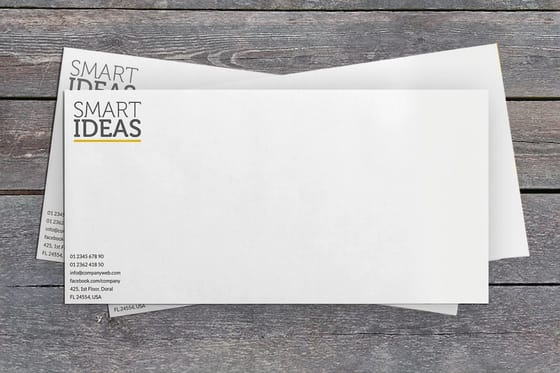
| 9 x 4 in | #10 (4.125 x 9.5 in) | Closest to a real airline pass; the full field layout plus a 2.5 in stub fits comfortably. | A plain #10 looks like a utility bill. Print the envelope so the theme starts at the mailbox. |
| 8.5 x 3.5 in | #9 or #10 | Slimmer ticket proportions, slightly cheaper to print. | Fields get tight; drop the From/To row rather than shrinking type below 8pt. |
| 5 x 7 in | A7 (5.25 x 7.25 in) | Classic invitation proportions with boarding pass styling. | The wide layout compresses; run the stub across the bottom instead of the side. |
On stock, the choice is 14pt or 16pt, and the stub decides it. Tearing along a perforation stresses the card, and on 14pt the stub often creases before it separates. If the design has a working tear-off, order 16pt. If the dashed line is printed and decorative, 14pt is fine and saves money across the run.
Build the file with 0.125 inch bleed on all four sides and keep type and rules at least 0.125 inch inside the trim. Ticket designs love thin border rules, and a thin rule near the trim is exactly what shifts visibly if the cut wanders a hair. The invitation sizes guide covers the full size and envelope matrix if none of these three fits the plan.
The Stub, the Perforation, and the Die-Cut Shape
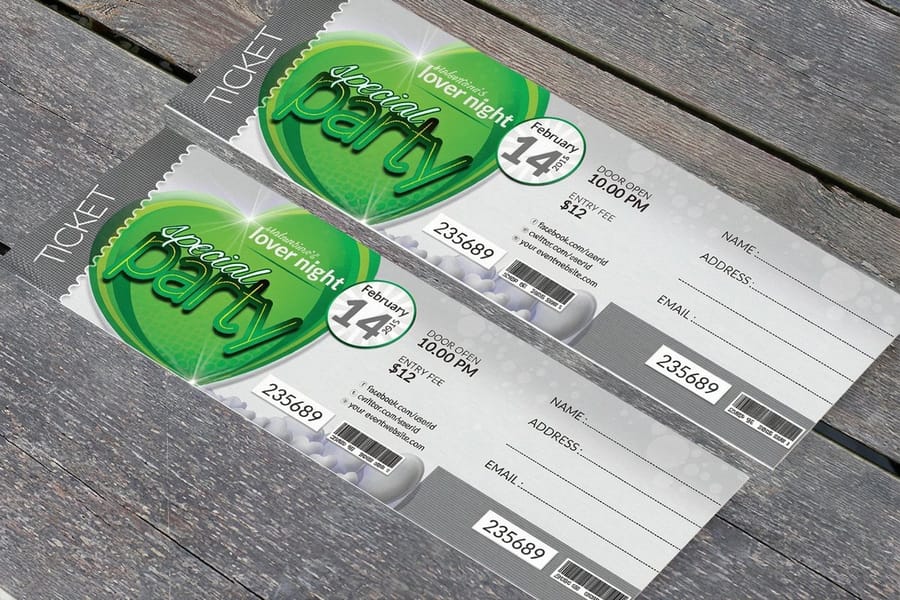
The tear-off stub is what separates a boarding pass invitation from a rectangle with airline styling, and there are three honest ways to get it, at three different prices.
Real perforation. Perforation is a bindery pass: a machine punches the tear line into the printed sheet. The direct route is event tickets, which are built around the perforated stub and start at $25.27. Couples use them as boarding-pass save-the-dates, and the guest genuinely tears the stub off and keeps it. The limit is format: ticket stock and sizes, not the full invitation range.
The printed tear line. A dashed rule printed where the perforation would sit. Nobody can tear it, but at arm's length it reads as a ticket, it works at any invitation size, and it costs nothing beyond the print. Most boarding pass invitations ship this way on flat invitation cards from $19.77, and there is no shame in it.
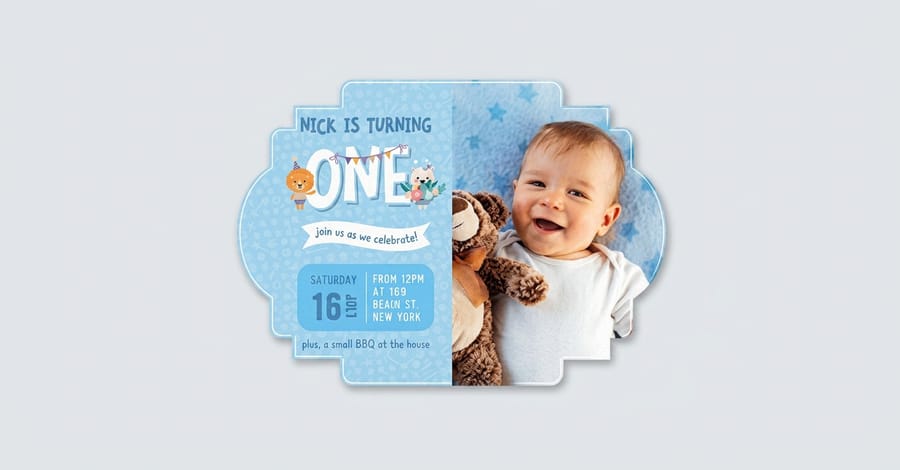
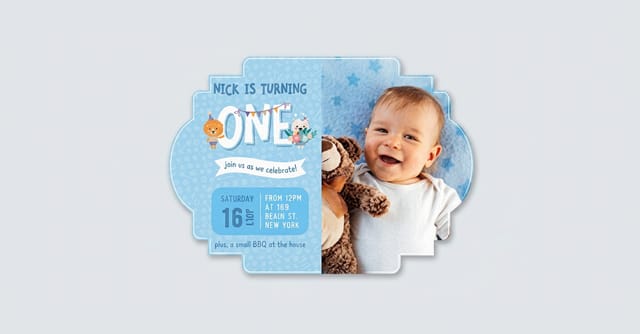
The die-cut shape. Rounded ticket ends, a notched stub, or a full custom outline come from a cutting die, which is why shaped invitations start at $185.63. The shape is what people photograph, so it earns its cost on a destination wedding suite and rarely on a birthday party.
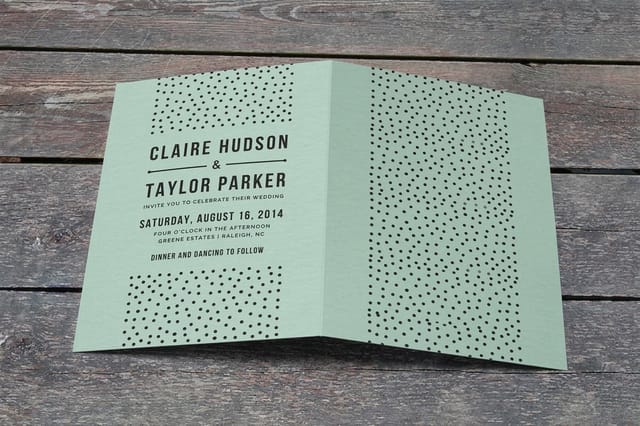
One mailing caution: a real perforation is a structural weak line, and a heavy card can fold at the stub during postal sorting. The fix is a folded invitation used as a ticket jacket, from $38.22: the pass rides inside its own printed sleeve, the way paper tickets used to arrive in a travel wallet, and the jacket takes the handling instead of the perf. The folded vs flat invitations guide walks through when the jacket format is worth it.
Designing and Ordering It Without Design Software
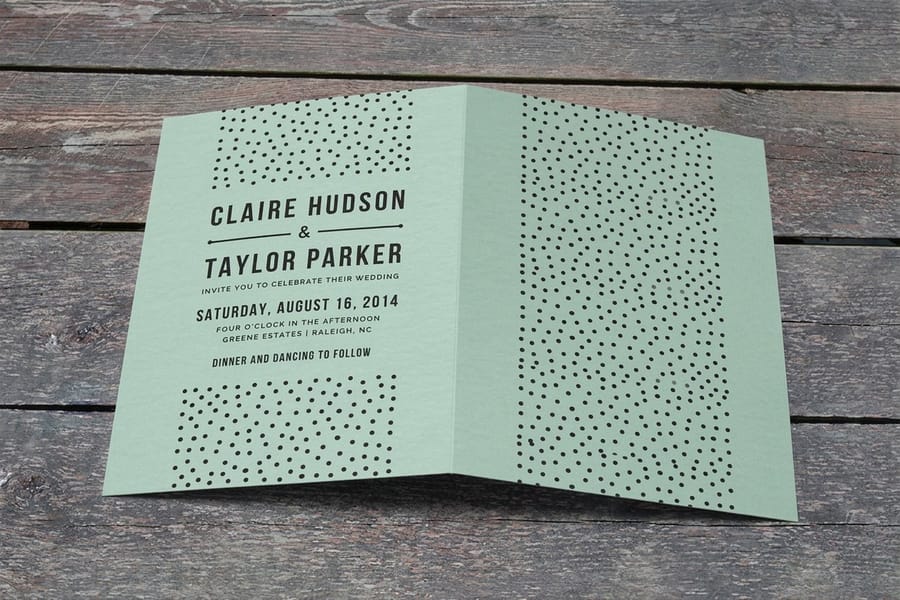
You do not need Illustrator to build this. Open the product page, choose the size and stock, and click Design Online: the free Designer runs in the browser, and a boarding pass is one of the friendlier layouts to build there because it is typography in boxes, not photography. Set the field labels small and tracked out in capitals, set the answers big, and keep one accent color against a light background so the barcode zone stays crisp.
If you would rather start from a file, the blank template library has correctly sized layouts with trim and bleed already marked, and the design template gallery has styled starting points you can edit in the Designer. Either way, convert display fonts to outlines before upload; condensed ticket faces are exactly the fonts most likely to be missing on another machine.
Order the envelope at the same time, not after. A 9 x 4 card needs a #10, and a printed #10 with your return address and a hint of the destination turns the businesslike envelope into part of the invitation; printed envelopes start at $142.99. If you are undecided between 14pt and 16pt, free samples settle it faster than any description, and the difference matters most on the tear. The rest of the process, from file check to proof to delivery, works like any other job in our guide to how online printing works, and the full format range lives in invitation printing.
Wally explains boarding pass invitations
Fill every field, then decide how the stub tears
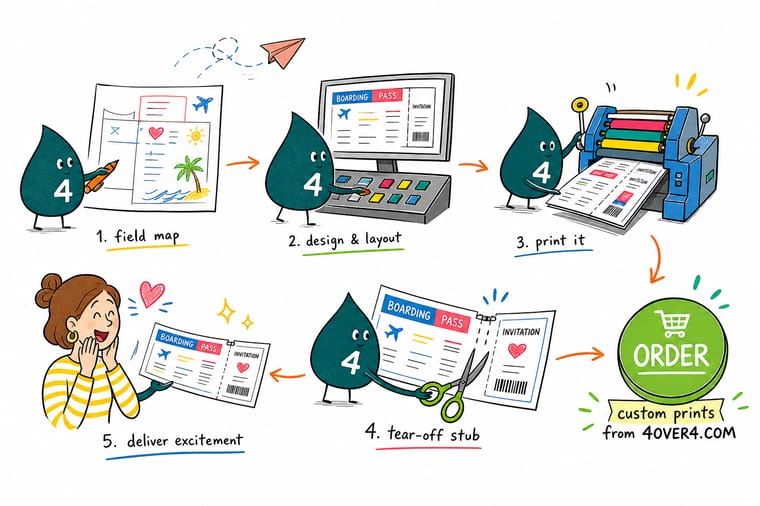
Wally lays the card out like a real ticket: your guest as the passenger, your date hiding in the flight number, the venue at the gate. He prints it 9 by 4 so it slides into a #10 envelope, and he asks one question before anything goes to press: does the stub really tear? If yes, he runs it on 16pt with a punched perforation. If not, he prints the dashed line, saves you the bindery pass, and nobody at the party knows the difference.
Order shaped invitations →Specs and pricing
The three formats, sizes, and starting prices
Compare the shaped, folded, and ticket routes side by side, with live configuration choices and starting prices straight from the 4OVER4.COM configurator.

Print it
Order an invitation guests will actually keep
Explore more
Where to go next
By the numbers
Invitation printing you can count on at 4OVER4
Common Questions
Your boarding pass invitation questions, answered
What size is a boarding pass invitation?
The size that works best is 9 x 4 inches. It is close to real airline pass proportions, it holds the full field layout plus a 2.5 inch tear-off stub, and it fits a standard #10 envelope, which measures 4.125 x 9.5 inches. A slimmer 8.5 x 3.5 inch card also works and mails in a #9 or #10. If you want classic invitation proportions instead, a 5 x 7 in an A7 envelope can carry the boarding pass styling, but the wide ticket layout gets compressed and the stub works better as a bottom tear than a side tear.
Can a boarding pass invitation have a real tear-off stub?
Yes, but real perforation is a bindery operation: a machine physically punches the tear line after printing. The most direct route is event tickets, which are built around the perforated stub as their native format and start at $25.27 at 4OVER4.COM. For an invitation card, the alternative is printing a dashed line where the perforation would be. Nobody can tear it, but it reads as a ticket at arm's length and costs nothing extra, which is why most printed boarding pass save-the-dates take that route.
What should the flight details say on a boarding pass invitation?
Map every field to a real piece of event information. Passenger is the guest or the couple, the flight number encodes the date, the gate is the venue, boarding time is the arrive-by time, seat is the table assignment or open seating, and the from and to cities work as your hometown and the destination. Two cautions: set the boarding time 30 minutes before the actual ceremony so guests arrive when you need them, and print the real date in plain text somewhere on the card, because not every guest will decode a flight number.
What envelope fits a boarding pass invitation?
A 9 x 4 inch card fits a standard #10 envelope, which is 4.125 x 9.5 inches. The #10 is a business envelope, so on its own it reads like a bank statement. Printing the return address and a destination-styled design on the envelope fixes that; printed envelopes start at $142.99 at 4OVER4.COM. The other fix is a folded invitation used as a ticket jacket, so the pass arrives inside its own printed sleeve the way a paper ticket used to arrive in a travel wallet.
How much do boarding pass invitations cost?
It depends on which route carries the design. Flat invitation cards start at $19.77, folded invitations that can work as a ticket jacket start at $38.22, event tickets with the true perforated stub start at $25.27, and die-cut shaped invitations with rounded ticket ends start at $185.63 at 4OVER4.COM. The die cut is the expensive step because it needs a custom cutting form, so if the budget is tight, keep the rectangle and spend the difference on 16pt stock.
Can I design a boarding pass invitation without design software?
Yes. Open the product page, pick the size, and use the free online Designer to build the card in the browser: type the field labels, set your names and dates, and drop in a barcode graphic. If you prefer starting from a file, the blank template library has correctly sized layouts with the trim and bleed lines already placed, so the artwork you build in Canva or Illustrator lands at the right dimensions.
Get Started
Ready to hand your guests a ticket?
Pick the size, choose flat, folded, or a die-cut ticket shape, and design the whole pass in the free online Designer. We print it on cardstock that survives the tear.
Legal Disclaimer
Gold Standard guarantees apply to all standard orders placed through 4over4.com. Price match requires verifiable proof of a competitor's published price for an equivalent product with matching specifications and turnaround time. Satisfaction guarantee covers manufacturing defects and print quality issues. Contact support with order number and documentation. On-time delivery rate based on tracked orders 1999 to 2026. Individual results may vary based on shipping carrier performance.
