
The History of Advertising, From Print Posters to Digital Screens


Tobias is our voice for cutting, binding and large format, built from the knowledge of our production team, with over 20 years in printing.
Advertising began as painted wall notices and carved shop signs, became an industry when the printing press made the handbill cheap in the 1400s, turned into an art form when chromolithography put the poster in full color after 1837, and moved onto screens after the first web banner ran in October 1994. Print never left the story. It changed job, from the only way to reach people into the format people still hold, pin up and keep. A small handbill advertising a product is still the first piece to print: the oldest one in English is Caxton's notice of around 1477, and its modern form is a flyer, 50 from $39.54. A bakery handing out a half-page flyer for a new loaf, then a poster from $108.75 in the window, runs the same two steps the press made possible five centuries ago.
Five eras of advertising at a glance
| Era | How it was made | The format it created | What it cost | What it could not do |
|---|---|---|---|---|
| Before 1450 | Painted, carved, shouted | Wall notice, shop sign, town crier | A sign writer or a crier, by the day | Reached only the people already walking past |
| 1450 to 1830 | Letterpress, movable type | Handbill, newspaper notice, trade card | Composition, paper and press time per run | No picture without a hand cut woodblock |
| 1830 to 1900 | Stone and chromolithography | Color poster, billboard, advertising column | One stone per color, plus the artist | Nothing could change once the stone was drawn |
| 1900 to 1990 | Offset litho, then broadcast | Magazine spread, mailed piece, TV spot | Media buy plus plate and press | No way to know who actually saw it |
| 1994 onward | Screens and live auctions | Banner, search, social, video | A bid per impression or per click | Blocked, skipped, or gone when the tab closes |
Read the last column first. Every era in advertising ended when a new machine removed the limit the old one lived with, and the format followed the machine within a generation: movable type in the 1440s, chromolithography in 1837, the first web banner in October 1994. You can order posters in the sizes the third row created straight from the configurator.
Origins of advertising, before the press
Before print, an advertisement had to be where the customer already was. Pompeii's walls carry painted notices for gladiatorial games, apartments to let and candidates for office, lettered by professional sign writers who worked at night on somebody else's plaster. The wall was the medium and the walk past it was the distribution.
Shop signs did the same job with a picture instead of a sentence. A hanging boot, a striped pole, a bunch of grapes: each one reads instantly to a population that could not all read words, and each one still works today for the same reason. That is the first real lesson the trade ever learned, and every good poster since has obeyed it.
The modern version of the shop sign is the A-frame on the pavement and the printed banner over the door. Same idea, better weatherproofing, and our sidewalk signage guide covers what actually changed.
Advertisements are now so numerous that they are very negligently perused, and it is therefore become necessary to gain attention by magnificence of promises.
Samuel Johnson, The Idler, 1759
The town crier was paid media before there was a medium
A crier was hired, given a message and a route, and paid for the round. Merchants competed for the loudest and the most trusted, which is media buying in every respect except the paperwork.
The limits were brutal. One street at a time, one message per round, no record that it ever ran, and no way to say it again after the crier went home. Reach was capped by how far a voice carries and how long a man can walk.
Why nothing scaled until the second copy got cheap
A hand copied notice costs the same on the hundredth as it did on the first. That single fact kept advertising local for most of recorded history, because there was no way to make volume cheaper than craft.
The press did not just invent the printed letter. It invented the second copy costing almost nothing, and that is the moment advertising becomes an industry rather than a service.
The print advertising era
Movable type reached Mainz in the 1440s and the handbill followed within a generation. William Caxton, printing at Westminster around 1477, produced a small notice telling clergy where to buy his Sarum Ordinal and asked that it not be torn down. It is the oldest printed advertisement in English that survives, and it already carries the two moves every advertisement has used since: here is what you can get, here is where to go for it.
Newspapers turned that into a trade. English papers were selling paid notices by the 1620s, the Boston News-Letter ran the first American newspaper advertisement in 1704 for a Long Island estate, and by the middle of the 1800s many front pages were nothing but classified columns set in agate type.
The agency arrived before the copywriter did. Volney Palmer opened in Philadelphia in 1841 and wrote nothing at all. He bought newspaper space in bulk and resold it, which is why agencies were paid by the medium rather than by the client for the next hundred years. Words came later, added by firms that noticed the copy sold more than the placement did. If you want the modern equivalent of what Palmer was pricing, our breakdown of print shop prices shows where the money goes in a run today.
Type only, and why that shaped the look
For roughly four centuries a printed advertisement was mostly type, because a picture meant a woodcut or an engraved plate cut by hand and charged by the square inch. So printers competed with what letterpress gave them for free: bigger capitals, more rules, more weight, more different faces in one column.
The Victorian handbill looks like it is shouting because shouting was the only visual instrument available. Once that is clear, the 1890s poster stops looking like a change of taste and starts looking like a change of machine.
The mailed piece is the line that never broke
Direct mail is the one print format that has run continuously from the trade card to this morning. It survived the poster, television and the web, because a card in a hand is not competing for a slot on a screen. It only competes with the rest of that day's post.
The economics are still friendly. Standard postcards start at $16.48 at 4OVER4.COM, and our letter printing and mailing guide covers the layout rules that keep a piece inside postal automation rates. Browse the whole format at postcard printing.
Posters and signage
Lithography changed advertising more than any idea inside advertising ever did. Drawing on limestone instead of cutting a block let one artist put picture and lettering down in a single gesture, and Godefroy Engelmann's 1837 chromolithography patent made that possible in full color by printing one stone per ink. The poster stopped being an announcement with a decoration on it and became a picture that happened to be selling something.
Jules Cheret was printing large color posters in Paris from the 1860s and effectively invented the format as a job. Toulouse-Lautrec's Moulin Rouge poster of 1891 finished the argument: people stole them off the hoardings. An advertisement that the audience wants to own is still the rarest outcome in the trade, and it has never been achieved by adding more copy.
Cities answered with regulation rather than a ban. Ernst Litfass got a Berlin concession in 1855 for cylindrical advertising columns, giving the poster a legal address for the first time. Cities did not invent the poster. They invented where you were allowed to put it, which is what outdoor media has been selling ever since.
The rule that still decides poster size
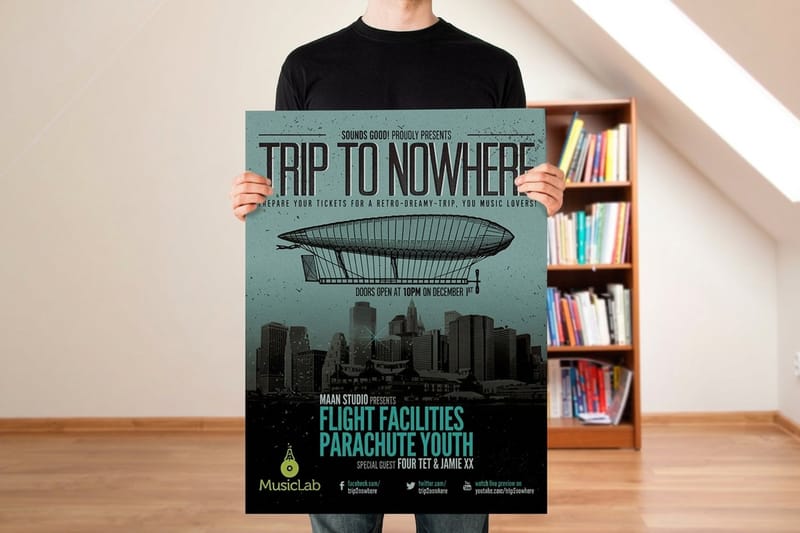
Roughly one inch of capital letter height per ten feet of reading distance. It is the oldest working number in signage and it settles the size question before budget gets involved. Eleven by seventeen suits a window or a corridor where people pass at arm's length, eighteen by twenty four holds a storefront or an event wall at fifteen to thirty feet, and twenty four by thirty six is the one that survives a street crossing.
Standard posters start at $108.75 and go up with size, stock and quantity. If the piece has to be taller than it is wide, or longer than a standard sheet, our long posters guide covers the sizes and the fold problems. For political and civic work, the campaign posters guide covers the disclaimer rules that catch first time printers, and our political posters print from 11 x 17 up to 48 x 96 inches.
Where paper stops and vinyl starts
A paper poster outdoors is a one rain product. Bill posters worked around it by pasting fresh sheets every few days, which is a labor cost most businesses will not carry now.
For anything outdoors and unattended, print on vinyl instead. Vinyl banners start at $79 with hemmed edges and grommets, and the full range sits under vinyl banner printing and large format printing. Keep the paper for glass, walls and interiors where it belongs.
The digital shift

Broadcast moved first. A Bulova watch spot on WNBT in July 1941 was the first commercial on American television, and for the next fifty years the biggest advertising budgets bought time rather than space. Print did not shrink so much as change job, from the only way to reach people to one channel among several.
The web arrived on the same commercial logic. The AT&T banner on HotWired in October 1994 was 468 by 60 pixels, it was called a banner because that is precisely what a printed banner across the top of a shopfront looks like, and it was sold the way newspaper space had been sold for two hundred years: a flat fee for a fixed period.
What actually changed was the accounting, not the format. Pay per click made an advertiser stop buying exposure and start buying a response, and live auctions then priced every single impression separately. For the first time a buyer could see what an advertisement did. That is the one thing print had never been able to offer, and it is why the money moved.
What measurement bought, and what it quietly cost
Attribution is real and it is valuable. It is also rented. A placement bought in an auction exists for as long as the bid clears, the platform keeps the rules, and the reader does not close the tab. Ad blockers, skip buttons and scrolling all remove it at no cost to the person removing it.
A printed piece has the opposite profile. You cannot measure it well, and you cannot change it once it is on press, but nobody can block it, and it stays where you put it for as long as it is there. Neither profile is better. They fail in opposite directions, which is the actual argument for running both.
Why print still works
Print holds three advantages that a screen cannot take away. It is physical, so it can be handed over, pinned up and kept. It cannot be blocked, because there is no software between the poster and the eye. And it persists: a poster in a window works on everyone who passes it for a month, while an impression works once and then is gone.
The honest side of that ledger is short and it matters. Print cannot be corrected. A typo in an email costs a resend, a typo in five thousand flyers costs the run. Print cannot be targeted finer than a postal route, cannot be split tested cheaply, and will not tell you who acted on it. If the entire case for a campaign rests on attribution, print loses that argument and should.
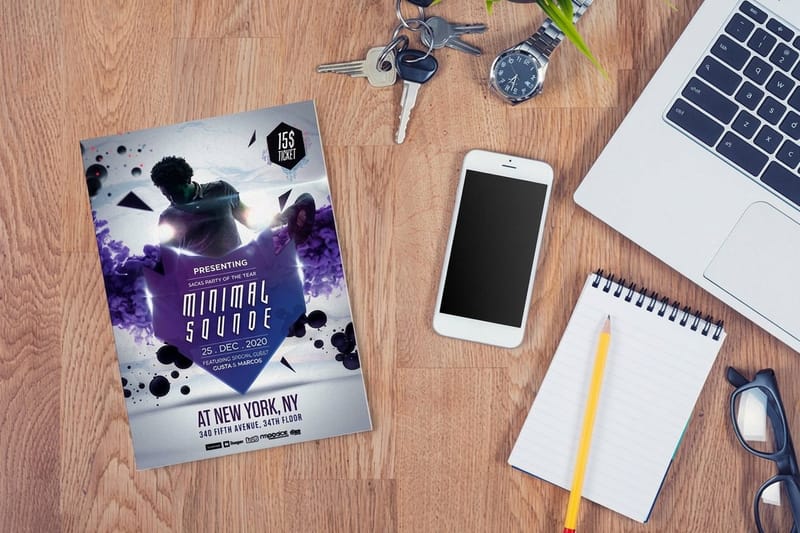
So the sensible split is not old against new. Use print for the things that need to persist or be handed over, and digital for the things that need to be tested and counted. Standard flyers start at $39.54, the full range sits under flyer printing, and our nightclub flyer design guide shows how much of that hierarchy comes straight from the poster era.
The formats that earn their place now
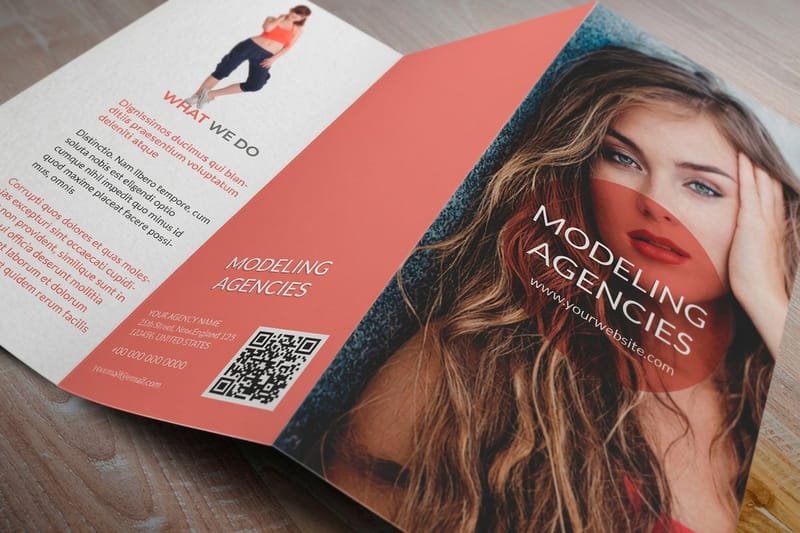
Posters for a fixed audience in a fixed place. Flyers for a hand to hand moment where a URL will not survive. Postcards for a mailbox where you already know the address. Banners for outdoor work that has to stand a season. Standard brochures, from $57.11, for the piece somebody takes away and reads at their own pace.
What none of them are is a substitute for measurement. Give each printed piece one job and one destination, put a specific landing page or phone line on it, and you get most of the accountability back without giving up any of what makes print work.
Modern print advertising with 4OVER4.COM
The chromolithograph poster now costs less than its 1890s printer could have imagined: 50 standard posters at sizes from 11 x 17 to 22 x 28 inches cost $108.75, and 500 cost $317.44, on 14pt gloss or uncoated cover. The live numbers below let you size the budget before you commit artwork.
Quantity and price
Poster pricing and specs
Real configurator numbers on poster stock, where a larger run drops the price of every sheet in it.
| Quantity | Price Per Unit | Total |
|---|---|---|
| 50 | $2.18 | $108.75 |
| 100 | $1.64 | $163.67 |
| 200 | $1.01 | $202.11 |
| 300 | 80.2¢ | $240.55 |
| 400 | 69.7¢ | $278.99 |
| 500 | 63.5¢ | $317.44 |
You can also earn coins on every order and redeem them against future printing, which is a modern version of the bulk space discount Volney Palmer was reselling in 1841.
Picking the format by the job it has to do
Each format in this history solved a specific problem, and each one still solves it. Match the piece to the moment where your customer meets you: a flyer from $39.54 for the hand, a poster from $108.75 for the wall, a postcard from $16.48 for the mailbox, a vinyl banner from $79 for the street.
- Posters. A fixed audience in a fixed place. Size from the reading distance, one message, and keep the paper indoors or behind glass.
- Flyers and handbills. The hand to hand moment, direct descendant of the Caxton notice. Cheap enough to test three versions on three streets in one week.
- Postcards and direct mail. The only print format that has run unbroken since the trade card. Works because it competes with the post, not with a feed.
- Vinyl banners. Outdoor and unattended, for a season rather than a week. This is the object the web borrowed the word banner from.
- Brochures. The piece somebody takes away. Room for the argument that a poster has no space for and a screen gives no attention to.
Print it
Posters, ready to hang
Preset sizes on poster stock, the fastest route from a layout to something on a wall.
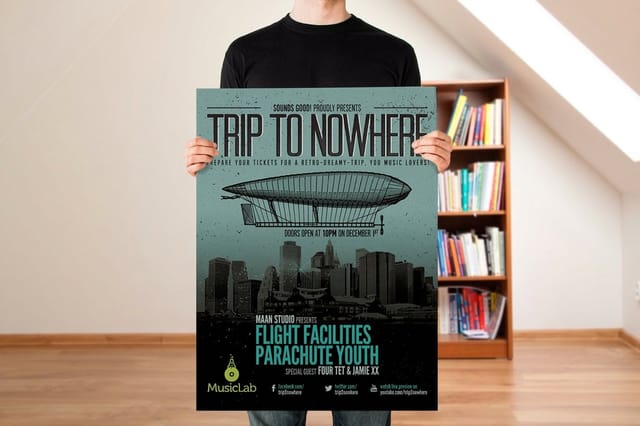
Stock and finish still change how a printed advertisement reads, exactly as they did on stone. Gloss lifts photography and color, matte cuts glare and holds up under bright retail lighting, and uncoated stays writable when the piece doubles as a form or a voucher. For anything that lives outdoors, move off paper entirely and onto vinyl, which is the modern equivalent of what bill posters solved with fresh paste every few days.
Blanks so a poster never starts from an empty artboard
You do not need to build a poster from an empty artboard. 4OVER4.COM sizes its blanks to exact product specs, from an 11 x 17 to a 22 x 28 inch poster, with the 0.125 inch bleed marked, so artwork set at 300 DPI in CMYK lines up with the cut lines. Grab a print ready blank from the blank template library, or start from a layout in the design template library.
Start fast
Blanks so a poster never starts from an empty artboard
Poster blanks with the cut line drawn, so a wall piece does not lose its edge.
Wally reads five hundred years of advertising in one wall
The machine decides what the advertisement can look like
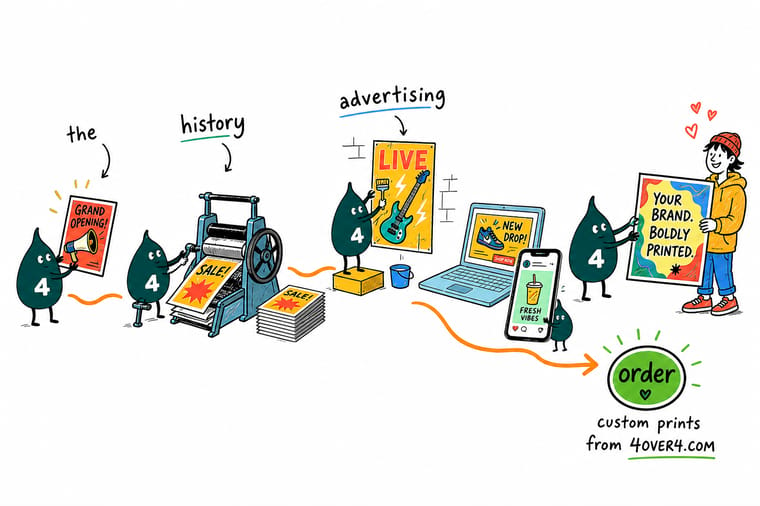
Letterpress gave printers type, so Victorian handbills shouted in capitals. Chromolithography after 1837 gave them a color picture, so the poster took over. Size a poster from the reading distance, about one inch of capital height per ten feet, add 0.125 inch bleed on every side, and set it up at 300 DPI in CMYK. 4OVER4.COM prints posters, flyers, postcards and vinyl banners on the same press schedule.
Order posters →What five hundred years keeps proving
Lessons the last five hundred years actually taught
- Symbol before sentence. The hanging boot outsold the painted paragraph in 1600 and it still does. Decide what the piece looks like from thirty feet before you write a word of it.
- One message per piece. Every era that crowded the format lost to the era that stripped it. The Victorian handbill shouted because it had no picture, not because shouting worked.
- Size follows reading distance. About one inch of capital height per ten feet. Set the size from where the reader stands, then find out what it costs.
- Contrast is the real color decision. Chromolithography charged by the stone, so color was rationed and every choice had to earn its place. Full color is standard now, which means contrast, not color count, is what still makes a piece legible.
- Print what people keep. The Lautrec posters were stolen off the hoardings. If the piece is worth keeping it works long after the campaign budget stops.
Explore more
More ways to print and promote
Standard posters run 50 for $108.75 in 5 business days and vinyl banners print in 3.
Product Standard Posters The format chromolithography invented, printed in full color today. Product Standard Flyers The direct descendant of the printed handbill. Product Vinyl Banners The object the web borrowed the word banner from. Product Standard Postcards Direct mail, unbroken from the trade card to now. Product Standard Brochures The piece a reader takes away and finishes later. Category Poster Printing Every poster size, stock and finish in one place. Ready to print the modern version?
Posters print on 100# gloss or silk text in 5 business days, at the sizes a wall actually takes.
Common questions about advertising history
What was the first printed advertisement?
The oldest printed advertisement in English that survives is a handbill William Caxton printed at Westminster around 1477, telling clergy where they could buy his Sarum Ordinal and asking that the notice not be pulled down. Printed advertising is older than that in other languages and older still as a practice, since Roman wall notices in Pompeii were doing the same job by hand. What makes the Caxton piece the useful landmark is that it is a printed sheet made purely to sell something, produced on a press within about thirty years of movable type reaching Europe.
Why did color posters take over advertising in the 1890s?
Because the machine changed, not because taste did. Chromolithography, patented in 1837, let a printer lay down one stone per color and let an artist draw the whole design directly rather than have a block cutter translate it. That made a large full color picture affordable for the first time, and artists such as Jules Cheret and Toulouse-Lautrec built a whole visual language on it. Before that, an illustrated advertisement meant a hand cut woodblock charged by the square inch, so most printed advertising was type with a rule around it.
Did digital advertising kill print advertising?
No, it took the measurable part of the budget. Digital can prove what a placement did, and money follows proof, so response driven spending moved to search and social. What stayed with print is everything that has to be physical, unblockable or durable: the poster in the window, the flyer handed over at an event, the mailed card, the banner that has to hold a storefront for a season. Print lost the attribution argument and kept the presence argument, which is why most working campaigns now run both rather than choosing.
Where does the term banner ad come from?
From the printed banner, the long horizontal cloth or vinyl sheet hung across a shopfront or a street. When the AT&T advertisement ran on HotWired in October 1994 it sat in a 468 by 60 pixel strip across the top of the page, which is the same proportion and the same position as the physical object. The early web borrowed almost all of its commercial vocabulary from print in the same way, including copy, page, column, masthead and impression.
Which print formats are still worth buying for a small business?
Start with the format that matches how the customer meets you. If they walk past a fixed location, buy posters and size them from the reading distance. If you meet people at events or on the street, buy flyers, because they are cheap enough to test more than one version. If you already have addresses, mail postcards, which start at $16.48 at 4OVER4.COM. If you need something outdoors for a season, buy a vinyl banner rather than paper. Give each piece one message and one destination, and it will report back better than most people expect from print.
