
Small Business Marketing Ideas That Still Work on a Startup Budget


Marcus is our print marketing voice, built from the knowledge of our production team, with over 20 years in printing.
Small business marketing ideas that still work on a startup budget put a cheap physical piece in front of a specific group of people, carrying a code that tells you who responded. Postcards start at $16.48 and flyers at $39.54, so a first test costs less than a week of ad spend, and unlike an ad it leaves something in a hand or a kitchen for days.
What each tactic costs and what it is good for
| Tactic | Starts at | Where it lands | Best for | The catch |
|---|---|---|---|---|
| Flyers | $39.54 | Counters, noticeboards, hand to hand | Testing an offer in a week | People bin them without a reason to keep one |
| Postcards | $16.48 | Mailboxes on a chosen route | Reaching a defined neighborhood | Postage is a second cost, budget it up front |
| Door hangers | $290.41 | Front doors, no postage | Home services with a walking route | The minimum run is large, so commit or skip |
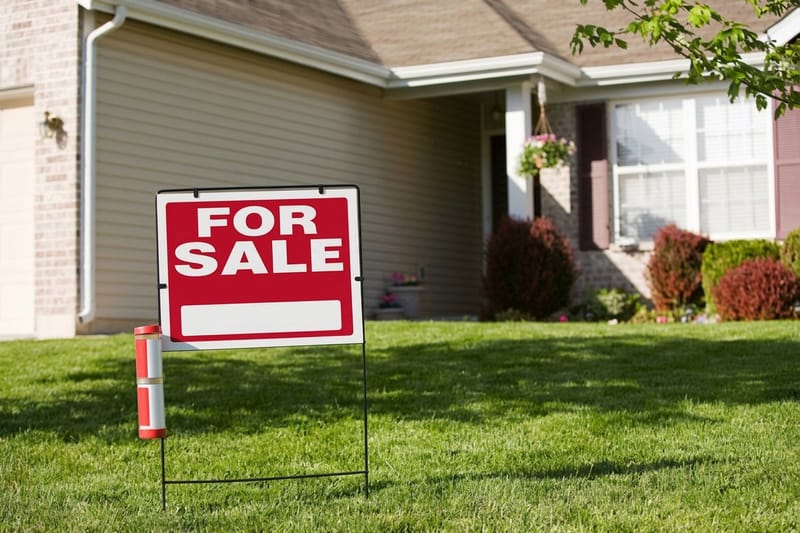
| Yard signs | $25.00 | Verges, lawns, event entrances | Anything with a location and a date | Check local rules before you plant them |
| Vinyl stickers | $25.00 | Laptops, bottles, toolboxes | Brands people actually want to display | A bare logo gets thrown away, give it a reason |
| Business cards | $17.57 | Hand to hand, and as a loyalty card | Referrals and repeat visits | A card with no offer on the back is half wasted |
Prices are the live starting price for the smallest run in the configurator, 50 postcards or flyers, 100 business cards, 250 door hangers or one yard sign, and move with size, stock, finish and quantity. Postage on any mailed piece is a separate cost, so add it before you compare a postcard against a flyer. Browse the full promotional range under marketing materials.
Marketing on a startup budget
A startup marketing budget is really two numbers: what you can afford to lose this month, and how long you can wait before you know whether it worked. Print scores badly on the first number per impression and very well on the second, because a piece that lands in a hand or a mailbox produces an answer within days rather than after a quarter of algorithm learning.
The honest weakness of print is that it has no undo. Change a headline in an ad account and the new version runs in ten minutes. Print 500 flyers with the wrong offer and you own 500 flyers. That single fact should shape how a small business buys print: short runs, one variable changed at a time, and a way to count the response before the reorder.
Everything below has a real starting price from our catalog attached to it, because a tactic without a number is not a plan. Start with the cheapest thing that reaches the people you actually want, and read our local print marketing campaign breakdown if you want the neighborhood version of the same argument.
Work out the cost per conversation, not the cost per piece
Per-piece cost is the number every printer advertises and the least useful one you have. What matters is the cost of one real conversation. Take the print cost plus the distribution cost, then divide by the number of replies you can genuinely count. A $39.54 flyer run that produces four calls costs about ten dollars a call, and that is a number you can compare against anything else you are buying.
The trap is counting replies you cannot attribute. If someone walks in the same week the flyers went out and you never asked how they heard about you, that walk-in belongs to no channel. Ask, or print a code, or accept that the run taught you nothing.
Pick one tactic and finish it before you add a second
Running flyers, postcards and stickers at once feels productive and destroys your ability to read the result, because each one hides the others. Run one for a fixed window, count, then decide. A month per tactic is slow enough to be honest and fast enough that a year still covers most of the list on this page.
The exception is anything that costs nothing to keep running, like a sticker on your own vehicle or a sign outside your own door. Those are permanent furniture, not experiments, so put them in place once and leave them out of the test.
Local print tactics that punch above their cost
Local print wins where digital targeting is worst: a specific set of streets, a specific building, a specific queue of people. Nobody is competing for the noticeboard in a laundromat, and the cost of owning that space for a month is one printed sheet.
Three formats do most of the work. Standard flyers from $39.54 are the cheapest way to test an offer. Yard signs from $25.00 hold a message at a fixed spot for weeks. Door hangers from $290.41 skip the mailbox entirely and land on the handle, which is why home services keep buying them.
Flyers: the cheapest honest test you can run
A flyer earns its place when it carries one offer, one deadline and one way to respond. Three offers on a sheet reads as a menu and gets read as nothing. The version that works is usually uglier than the version a designer wants to make, because the headline is large enough to read from the other side of a counter.
Where you leave them matters more than the paper you print them on. Our list of places to leave flyers for local promotion covers the venues that still allow it, and the flyer distribution guide covers the timing. Print 100 first, walk the route yourself, and see how many are still on the board after three days.
Door hangers and yard signs: the ones with a minimum
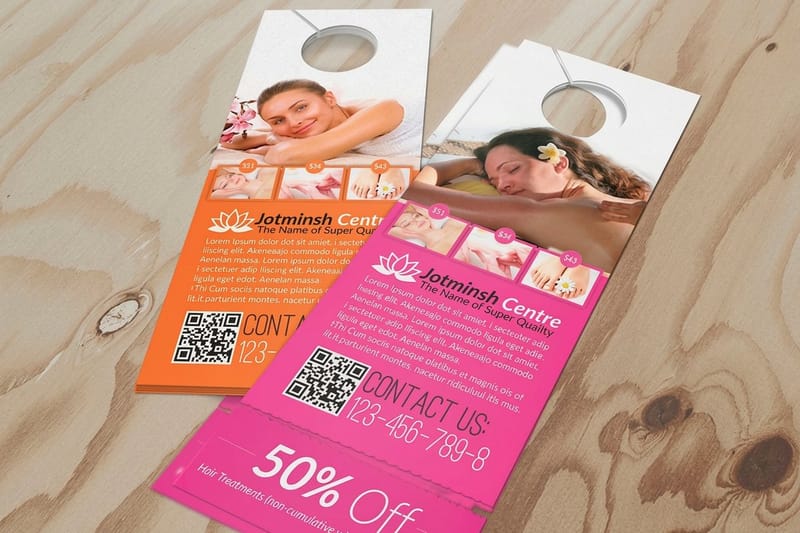
Door hangers cost more to start than anything else on this page, and the reason is the run size rather than the piece. At $290.41 the smallest order is big, so they suit a business with a defined walking route it will cover more than once: cleaning, lawn care, pest control, roofing after a storm. If you cannot name the streets, buy postcards instead. We compare the two formats directly in door hangers versus flyers.
Yard signs are the opposite trade. Cheap to start at $25.00, but they need permission and they need weather. Check the local rules for verges and rights of way before you plant anything, and put the sign where a driver reads it at a stop rather than at speed. Four words and a phone number is the whole design. For the shop-front version of the same idea, see storefront sign ideas.
Postcards and direct mail for targeting
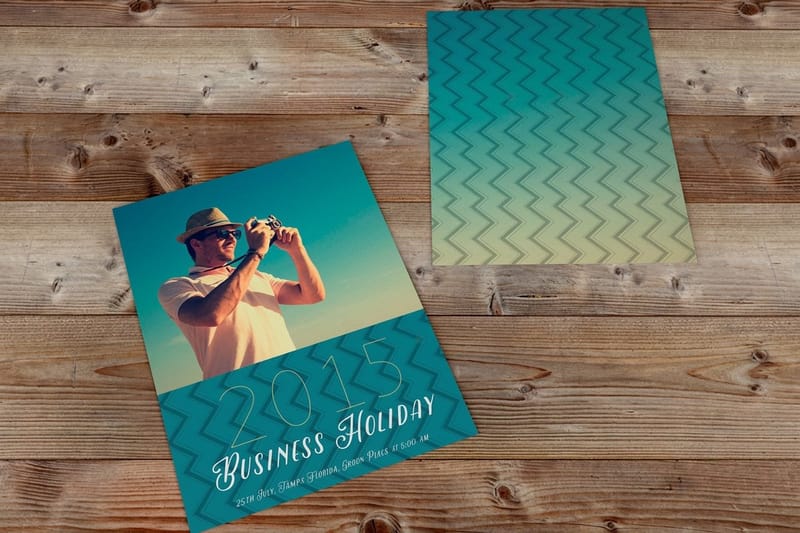
A postcard is the cheapest piece of print that arrives at a named address, and it is the only format on this page where you choose exactly who receives it. Standard postcards start at $16.48, which makes the print the small half of the budget. Postage is the other half, and new businesses forget it constantly.
There are two ways to send them. A saturation route through Every Door Direct Mail hits every address on a carrier walk with no list at all, which suits a restaurant, a salon or anything where the whole neighborhood is a plausible customer. A targeted mailing goes to a list you own or rent, which suits anything with a narrow buyer. Our EDDM setup and size requirements covers the file rules, and sending direct mail postcards in five steps covers the process end to end.
The trade-off is blunt. EDDM is cheap per address and wasteful, because most of the route is not your customer. A rented list is precise and expensive, and the list quality decides everything. If you have a customer list of your own, mail that first: it is the highest-response mail most small businesses will ever send, and it costs nothing to build.
What actually goes on the card
The back of the card is the working side, because that is what faces up in a stack of mail. Put the offer, the deadline and the response method there. The front carries one image and a headline you can read at arm’s length while walking from the letterbox.
Response rates vary far more by industry than by design, and we published the breakdown in direct mail response rates by industry. Use it to set an expectation before you print, so a run that pulls a modest response is judged against a real benchmark rather than a hope. If you want layouts to borrow from, postcard examples for small businesses is the shortest route.
Branded swag and stickers that travel
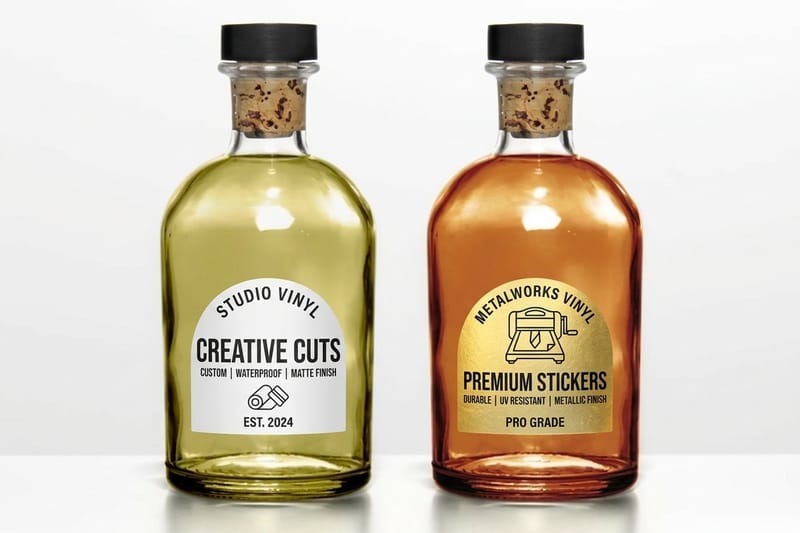
Vinyl stickers start at $25.00 and they are the only piece of marketing on this page that a customer will carry around for you for free. That is the whole case for them, and it comes with a condition: people display things they want to be seen with. A bare company logo is not one of those things.
What gets stuck on a laptop is a joke, a neighborhood, a shared frustration, or a design good enough to stand alone with the brand small in a corner. A roastery that prints its street name travels further than one that prints its wordmark. Give the sticker a reason to exist that is not you, and your logo rides along.
Durability decides where it can live. Vinyl with a laminate survives a water bottle, a toolbox and a bumper. Paper stock does not survive any of them. If the sticker is going outdoors or anywhere wet, pay for the vinyl and skip the cheaper option, because a sticker that peels after a fortnight is worse than no sticker. More ideas in logo sticker promotion ideas, and the full range sits under sticker printing.
Where to hand them out so they travel
Put one in every order that ships, leave a bowl on the counter, and give a handful to anyone who works with you. Do not mail stickers on their own as a campaign, because a sticker with no context goes in the bin. It works as a bonus, not as the message.
Track them the same way you track everything else here: a short URL on the sticker sheet, not on the sticker itself. Nobody types a URL off a laptop lid, but they will read the card the stickers arrived on.
Pairing print with digital and QR
Print becomes measurable at exactly one point: the moment somebody scans a code or types a URL. Everything before that is unverifiable, and everything after that is ordinary web analytics. So the rule is simple. Every print run gets its own destination, and no two runs share one.
That means a distinct short link or QR target per flyer version, per postcard route, per sign location. If the flyers and the postcards both point at your homepage, you have spent money on two campaigns and bought one number that tells you nothing about either. Our guide to QR codes on flyers, brochures and postcards has the placement rules, and the complete QR code guide covers generation and error correction.
Two practical limits. Keep the printed code at roughly 0.8 inches square or larger for arm’s length scanning, and leave the quiet zone clear around it, because a code crowded by artwork fails on older phone cameras in poor light. And point it somewhere that matches the print: a code from a discount flyer should land on that discount, not on a homepage carousel. A code that wastes someone’s time teaches them not to scan the next one.
The one QR destination worth building first
If you only set up one, make it a review link. A code that opens your Google review form, printed on the receipt, the bag or the counter card, compounds in a way no flyer does, because the reviews keep working after the print is thrown away. We wrote the setup in how to make a QR code for Google reviews.
Print and paid ads also reinforce each other when they run on the same streets in the same fortnight. That combination is the subject of direct mail and online ads for small business, and it is the cheapest version of a multi-touch campaign a two-person company can run.
Referral and loyalty plays
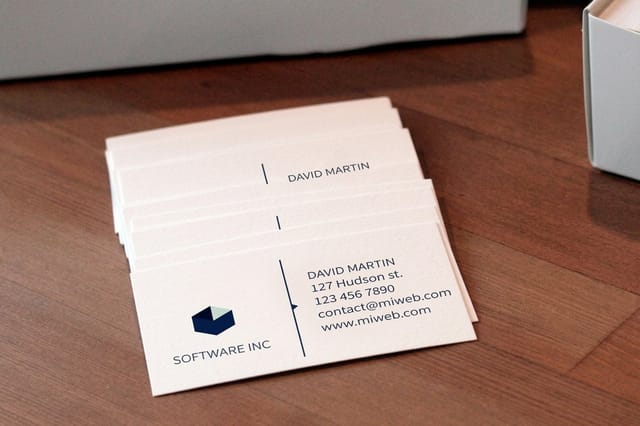
Referral is the only channel on this page where the cost per customer falls as you use it, because the person doing the work is already a customer. The print job is small: give them something to hand over. Standard business cards from $17.57 work as referral cards when the back carries the offer and a blank line for the referrer’s name, so both sides get credited and you can count the returns.
Loyalty is the same piece of card doing a different job. A stamp card printed on 16pt stock survives a wallet for months, where a thin card is soft and illegible by the fourth visit. Keep the reward reachable: ten stamps for a free coffee gets abandoned faster than five, and an abandoned card stops being a reminder. The full card range sits under business card printing if you want a thicker stock or a matte finish that takes a pen.
Hand it over
Business cards for referrals and loyalty
16pt stock that survives a wallet, with the back left free for the offer and the referrer’s name.
Events, pop-ups and trade shows
An event is the one place where a small business gets a queue of interested people standing still. The mistake is bringing a table and nothing else. You need something that pulls people from ten feet away, something that explains you in thirty seconds, and something they take home. That is a sign, a brochure and a sticker, and the whole set costs less than the stand fee.
Yard signs from $25.00 mark the entrance and the stand. Standard brochures from $57.11 carry anything that needs explaining before it can be sold, which is most professional services. Stickers do the taking-home. For the giveaway side of the decision, trade show giveaway ideas lists what people actually keep, and the display formats live under trade shows and events.
Bring more print than you think you need for a first event and fewer product samples. Running out of cards on day one of a two-day show costs you the second day, and print is the cheapest thing on the invoice.
Measuring what works
Measurement for a small business is not analytics, it is bookkeeping. Three columns in a spreadsheet: what you spent, what you can count, and the date. One row per run. That is enough to kill a bad tactic after two attempts and to double a good one, which is the entire point.
- Spend. Print cost plus distribution or postage plus your own hours if you walked the route. Leaving your time out makes a flyer run look cheaper than it is.
- Countable responses. Scans of that run’s code, calls to that run’s number, redemptions of that run’s offer. Not walk-ins you did not ask about.
- Window. Print responses arrive over about two weeks, with most in the first four days. Judging a run after 48 hours reads as a failure when it is not finished.
- Verdict. Repeat, change one thing, or stop. Writing the verdict down is what stops you repeating a losing run out of habit.
Set the expectation before you print rather than after. Our numbers by sector are in direct mail response rates by industry, and the tactic-by-tactic comparisons continue in small business hacks from founders.
Getting print done fast and cheap at 4OVER4.COM
Pricing steps down as quantity climbs, which is exactly the tension in everything above: the cheapest unit price wants a big run, and a first test wants a small one. Fifty postcards cost $16.48, about 33 cents each, while 500 cost $51.62, about 10 cents each, and flyers run from $39.54 for 50 to $126.32 for 1,000. The configurator numbers below let you see where that curve bends before you commit, so you can pick the smallest run that still gets you a sensible per-piece cost.
Quantity and price
Flyer pricing and specs
Live configurator numbers on premium gloss stock, showing exactly where the per-piece cost drops as the run grows.
| Quantity | Price Per Unit | Total |
|---|---|---|
| 50 | 79.1¢ | $39.54 |
| 100 | 57.1¢ | $57.11 |
| 200 | 37.3¢ | $74.69 |
| 300 | 28.6¢ | $85.68 |
| 400 | 24.4¢ | $97.76 |
| 500 | 21.8¢ | $108.75 |

Every order earns coins you can put against the next run, which matters more to a small business than it sounds: the second test in a sequence is the one that usually gets canceled on budget. See how the balance builds on earn coins, and compare the mailed formats side by side in effective direct mail formats.
Choosing by business type
The right first tactic depends on whether your customers are defined by geography, by industry, or by a list you already hold.
- Home services. Door hangers on a route you will walk twice, yard signs at every completed job, and a magnet or sticker for the van. The sign at a finished job is the highest-intent placement you will ever get for $25.00.
- Restaurants and cafes. EDDM postcards to the surrounding carrier routes, a counter card with a review QR, and flyers for the offices within a ten-minute walk. Lunch trade is a geography problem, not an audience problem.
- Retail and e-commerce. A sticker and a card in every shipped box, plus postcards to your own past customers before any rented list. The people who already bought are the cheapest list you own.
- Professional services. Business cards that carry an offer on the back, referral cards for existing clients, and brochures for anything that needs explaining before it can be sold.
- Events and pop-ups. Yard signs pointing at the entrance, flyers for the table, and stickers as the giveaway. Print the date large enough to read from the pavement.
Where to start when nobody designs
If nobody on the team designs, start from a template rather than a blank artboard. 4OVER4.COM sizes its blanks to the exact product spec, a 4 x 6 postcard, an 8.5 x 11 flyer or a 3.5 x 2 business card, so bleed and trim are already marked and your headline does not get cut off at the edge. Pick a layout from the design template library or take a print-ready blank from blank templates.
Start fast
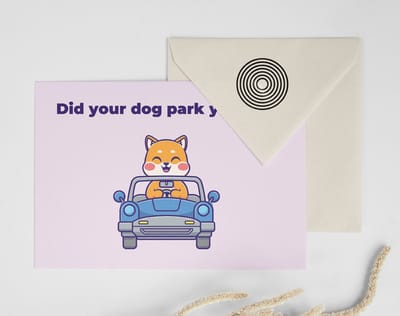
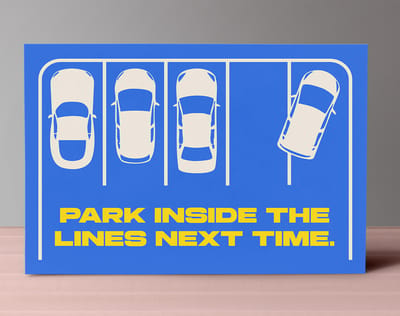
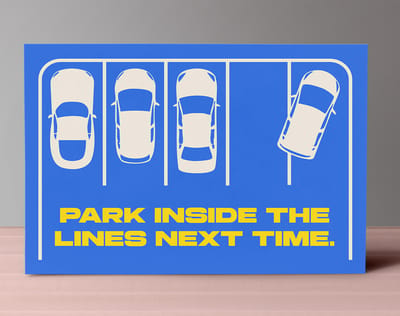
Postcard templates and print-ready blanks
Editable promotional layouts and exact-size blanks so your artwork lands inside the cut line the first time.


Wally gives every print run its own code
One destination per run, or the numbers merge
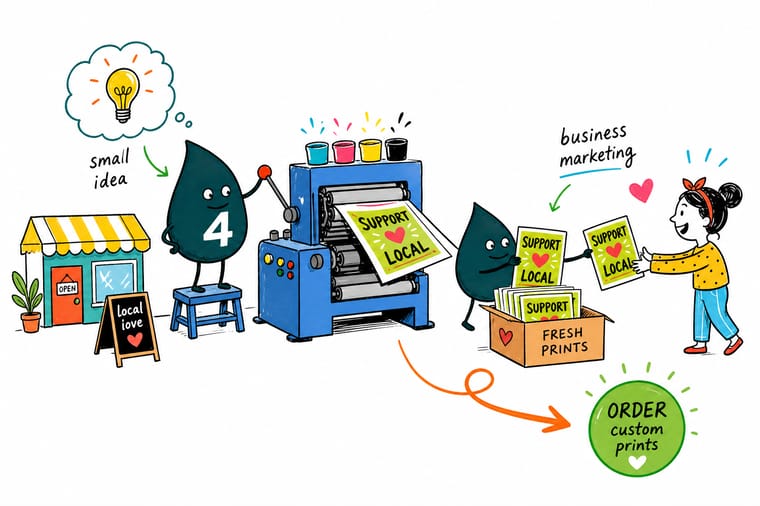
Print 100 before you print 1000, put a unique short link or QR target on every version, route and location, and give each run a fortnight before you judge it. Postcards start at $16.48 and flyers at $39.54, so a controlled test costs less than a week of ads and 4OVER4.COM ships it from New York fast.
Order flyers →What a first budget should buy
Rules that hold for every format on this page
- One offer, one deadline. A print piece with three offers is read as none of them. Pick the single thing you want someone to do and give it a date, because an offer with no expiry gets postponed forever.
- Readable beats clever. The headline has to work from across a counter or a pavement. If you have to lean in to read it, the design has already failed regardless of how it looks on screen.
- A unique code per run. Different short URL or QR target for every version, route and location. Sharing one destination across runs is how a marketing budget becomes unmeasurable.
- Print 100 before you print 1000. The cheapest edit is the one you make after seeing the piece in the real setting. Order the small run, walk the route, then reorder with the fix.
- Put the response method twice. Phone number and code, or address and URL. People respond in the channel they already use, and forcing the other one costs you the reply.
Explore more
More ways to print and promote
Door hangers run 250 for $290.41 in 7 business days and vinyl stickers print in 3.
Product Standard Flyers The cheapest way to test one offer on a real street. Product Standard Postcards Mail that lands at an address you choose, from $16.48. Product Vinyl Stickers Laminated vinyl that survives bottles, bumpers and toolboxes. Product Yard Signs A fixed message at a fixed spot for weeks, from $25.00. 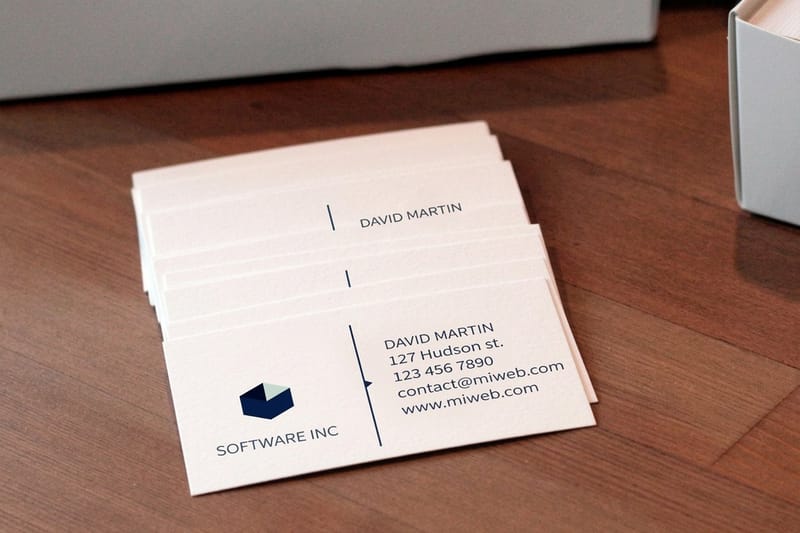 Product Standard Business Cards Referral and loyalty cards, printed from $17.57.
  Guide Door Hangers vs Flyers Which format suits a walking route and which does not.
  Hub Marketing Materials Every promotional print format in one place.
 Ready to run your first print test?
Pick a format, drop in your design or a free template, and 4OVER4.COM prints it sharp on premium stock and ships from New York as fast as your deadline needs.
Common questions about small business marketing
What is the cheapest marketing that actually works for a new business?
Postcards to your own customer list, then flyers on a route you can walk yourself. Standard postcards start at $16.48 and standard flyers at $39.54, so both fit inside a first month of trading. The reason they work is not the price, it is that both put a specific offer in front of a specific group of people and produce an answer within about a fortnight. Anything that takes three months to read is a poor first purchase when you do not yet know which customer you are chasing.
How do I know whether a flyer or postcard campaign worked?
Give the run its own destination and count what arrives there. That means a short URL or QR code used by nothing else, or a phone number you only print on that run, or at minimum a code word the customer has to mention. Then divide the total print and distribution cost by the number of responses you counted, and you have a cost per conversation you can compare against every other channel. If several runs share one landing page you cannot separate them, and that mistake is more common than any design problem.
Are door hangers worth it for a small business?
Only if you have a defined route you will cover more than once. Door hangers start at $290.41 because the minimum run is large, which makes them the highest first commitment on this page. That suits home services such as cleaning, lawn care and pest control, where the same streets are worth revisiting and where reaching a physical door matters more than reaching a mailbox. If you cannot name the streets you would walk, postcards give you the same reach for a much smaller opening spend.
How big does a QR code need to be on printed material?
Keep it around 0.8 inches square or larger for anything read at arm’s length, and larger again on a sign read from several feet away. Leave the quiet zone clear on all four sides, because artwork crowding the edge is the most common reason a code fails to scan. Test the printed proof with two or three real phones in poor light rather than trusting the screen preview. Also point the code at a page that matches the printed offer, since a code landing on a generic homepage teaches people not to bother with the next one.
Should a startup spend on print at all when digital ads are cheaper to test?
Use both, but for different jobs. Digital is better for finding out who responds, because you can change the creative in minutes and the feedback is immediate. Print is better once you know the geography, because a mailbox or a door handle has almost no competition and a physical piece stays in a kitchen for days. The common pattern for a local business is digital to learn the audience, print to saturate the area that audience lives in, and one shared code so both sides of the campaign report into the same number.
