
Political Door Hanger Examples That Win Grassroots Races


Nadia is our customer education voice, built from the knowledge of our production team, with over 20 years in printing.
Every campaign door hanger example on this page carries five things and nothing more: the candidate name, the office, one reason to vote, the election date, and the disclaimer your state requires. It works because a mailbox is federal property and a door knob is not, so a volunteer can leave one at every house on a walk list without postage and without breaking the law.
Political door hanger examples
Four examples cover most local races, each matched to a size in the table below. All of them print on 14pt or 16pt gloss cover with a High Gloss UV coating, from $290.41 for 250, in 7 business days.
- The introduction hanger. 3.5 x 11 inches, the candidate's face on the left and three five-word bullets on the right, a QR code on the back.
- The persuasion hanger. 4.25 x 11 inches, the name on top and a stack of endorsing groups and officials below it in one type size.
- The get out the vote hanger. 3.5 x 8.5 inches, the election date set huge, with the polling place on a tear-off strip 2 inches from the bottom.
- The slate hanger. 4.25 x 14 inches, a sample ballot line for every race or measure the campaign wants marked.
Political door hanger design rules
- Design from the hole down. The knob hole and slot take the top of the panel, so the headline starts below the cut.
- Make the name the largest element. Office, one reason and the date follow, in that order.
- Set the file to print. Final size, 0.125 inch of bleed on every edge, type 0.125 inch inside the trim, CMYK at 300 DPI.
- Leave the bottom 2 inches clear if you order the tear-off perforation.
Political door hanger sizes at a glance
| Size | What fits | Why you would pick it | Which pass it suits | Product at 4OVER4 |
|---|---|---|---|---|
| 3.5 x 8.5 in | Name, office, one issue, date | Read in under two seconds from the porch | Get-out-the-vote drop, final weekend | Political door hangers |
| 3.5 x 11 in | Photo, three bullets, a QR code | Room for a face without a fold | First introduction pass | Political door hangers |
| 4.25 x 11 in | Endorsement list, record, contact | The default. Widest use per dollar | Persuasion pass, mid campaign | Political door hangers |
| 4.25 x 14 in | Full platform, map, sample ballot | Reads like a mini flyer on the door | Ballot measures, multi-race slates | Political door hangers |
All four print full color on one or both sides on 14pt or 16pt gloss cover, sealed with a High Gloss UV coating that shrugs off dew and light rain. It is not waterproof over days, so plan drops around the forecast. You can order political door hangers in any of the four sizes straight from the configurator.
Why door hangers win grassroots campaigns
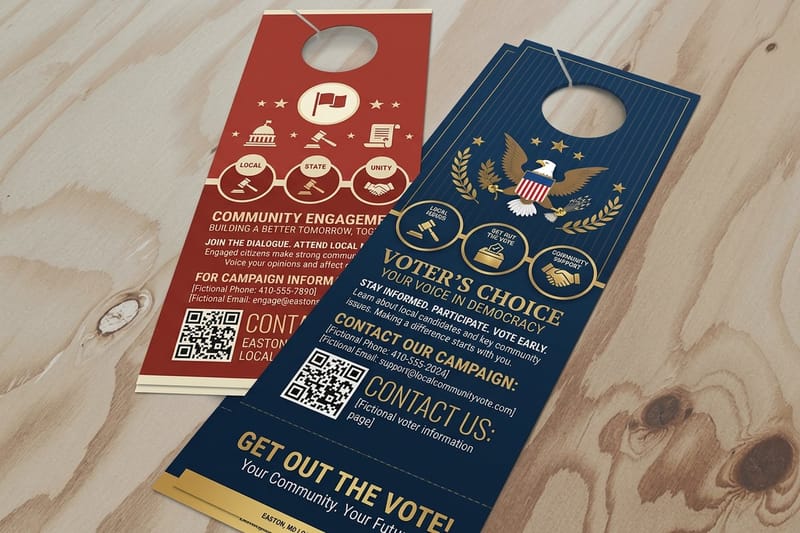
A door hanger reaches a voter at their front door without a stamp, without a mailing list, and without waking anyone up. It waits at handle height until somebody comes home, which is the one advantage no other campaign piece has: the voter finds it themselves, in their own time, and they have to physically take it off the knob to open the door.
That last part matters more than it sounds. A mailer arrives in a stack with the bills and the supermarket circular, and most of that stack goes in the recycling in one motion. A door hanger arrives alone. It gets handled. Our walkthrough of running a door hanger campaign covers the mechanics for any business, and a campaign runs on the same bones with tighter deadlines.
The legal side is the other reason field teams reach for them. A mailbox is federal property under 18 U.S.C. 1725 and only carriers may put things in it, so leaving an unstamped flyer in one exposes the campaign to a fine. A door knob is not a mailbox. Read the door hanger legal guide before your first walk, because posted no-soliciting signs, gated communities and some HOA rules still apply on top of that.
Where door hangers lose
They are labor, not media. Political flyers start at $39.54 and a machine can address political postcards from $16.48 and hand them to the post office. A door hanger only works if a person walks it to the door, so the real limit on your run is not budget, it is how many volunteer hours you can actually staff.
Order to the doors your team can physically cover in the window you have, then stop. A campaign sitting on 8,000 undelivered hangers on election night has burned money that should have gone into political yard signs at $25 or another round of calls.
They also do not target well. Every door on a street gets the same piece unless volunteers carry sorted packets, and sorting takes discipline your team may not have on a first cycle. If your win depends on speaking differently to soft supporters than to base voters, a mail program does that more reliably. The political direct mail guide sets out where each channel earns its place.
What to put on a political door hanger
Five things and nothing else: who you are, what office you are running for, one reason to care, when to vote, and the disclaimer your jurisdiction requires. Everything a voter needs has to survive being read at arm’s length while they are holding groceries.
Design from the hole down. The die-cut knob hole and its slot occupy the top of the panel, so a logo placed there gets a circle punched out of it. Start the headline below the cut, keep the candidate name the largest thing on the piece, and leave the bottom 2 inches clear if you are ordering the tear-off perforation.
The back is not spare space. Most campaigns hang the piece with the front facing out and the back against the door, so the back gets read only after the voter takes it off. Put the detail there: the record, the endorsements, the QR code, the volunteer sign-up. Put the ask on the front.
The disclaimer line, which is not optional
Federal candidate communications carry a "paid for by" disclaimer under FEC rules, and most states impose their own version on state and local races, including some that apply to ballot measure committees and independent expenditures. The wording, the minimum type size and the contrast requirement vary by state.
Check your own secretary of state or election board before the file goes to press, and get the committee treasurer to sign off on the exact string. A run of 5,000 hangers with a non-compliant disclaimer is a reprint, and at 7 business days of production a reprint in October is a lost week.
Copy blocks you can lift and rewrite
Introduction, first pass. "I am [Name], and I am running for [Office]. I grew up here, I still live on [Street], and I am running because [one specific local problem]. Election day is [date]. I would like your vote."
Persuasion, mid campaign. "[Name] for [Office]. Endorsed by [three names voters recognize]. On [issue], [Name] voted to [specific action]. Full record on the back."
Turn out the vote, final weekend. "Your polling place is [location]. It is open [hours] on [date]. Bring [ID requirement if any]. Vote [Name] for [Office]." That is the entire piece. Nothing else belongs on a GOTV hanger.
Sorry we missed you. "We knocked and you were out. I wanted to hear what matters to you before [date]. Call or text [number], or tear off the card below and mail it back." A tear-off makes this one worth the extra setup.
Sharpen the wording against real examples in the best election campaign messages, and if the phrasing is still not landing, building persuasive campaign messaging walks through the tests to run on it.
Door hanger design examples that convert
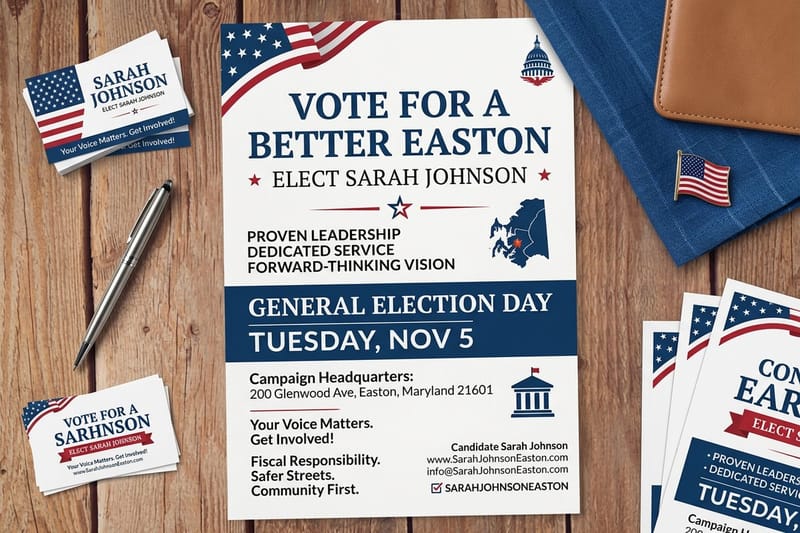
These are the layouts that hold up on a real door, in real light, at the distance a voter actually reads them. Each one is a full-bleed job on 14pt or 16pt gloss cover, so the artwork needs 0.125 inch of bleed on every edge and nothing critical inside 0.125 inch of the trim.
None of them are complicated. The design work that decides a door hanger is hierarchy and contrast, not illustration, and the pieces that fail almost always fail because three things were fighting to be the largest element.
Six layouts worth copying
1. Name over a flat color field. Candidate name at the top of the printed area, office beneath it, one line of promise, a date. No photograph. It is the cheapest to design and the easiest to read from the sidewalk, which is why so many local races use it.
2. Face on the left, three bullets on the right. Works on the 3.5 x 11 and up. Crop the photograph tight enough that the face reads at 3 inches wide, and keep the bullets to five words each.
3. The endorsement stack. Name at the top, then a vertical list of endorsing organizations and officials in the same type size. It says nothing about policy and it moves late deciders, which is exactly what the second pass is for.
4. Big date, small everything. The election date set enormous, the polling place under it, the candidate name at the bottom. Save it for the last 72 hours, when reminding beats persuading.
5. The tear-off pledge card. Add the 2 inch perforation and print a pledge-to-vote card the voter keeps by the door, or a reply card with your volunteer number. It gives the piece a second life on a fridge.
6. The slate card. On the 4.25 x 14, a full sample ballot line showing every race your campaign wants marked. Coordinated slates and ballot measure committees get more from this size than a single candidate does.
Sizing, bleed and the knob cut are all set out in the door hanger size guide, and the door hanger design guide covers type sizes and color contrast in more depth.
Similar graphic templates for the rest of the campaign
A door hanger rarely goes out alone, so start the other pieces from templates that share its layout. Keep the same name block, colors and 0.125 inch bleed, and the voter who took the hanger off the knob recognizes the postcard and the lawn sign a week later.
Postcards. Postcard templates reuse the endorsement stack or the big date layout, and political postcards start at $16.48 for 50.
Flyers. Flyer templates carry the face and bullets layout onto a 4.25 x 5.5 inch handout, from $39.54 for 50.
Yard signs. Yard sign templates keep only the name and the office, from $25 a sign.
Door hangers. Door hanger templates already place the knob cut and the perforation line 2 inches from the bottom.
What to cut before you print
Cut the paragraph. Nobody reads a paragraph on a knob. Cut the second photograph. Cut the social icons, which take space and tell a voter nothing they will act on before the polls close. Cut any QR code that lands on a homepage, because a code has to promise something specific to be worth scanning.
Keep one phone number, one web address and one date. If you are tempted to add anything else, print it on the back or leave it for a political postcard, where you have room to argue.
Organizing a bottom-up canvassing plan
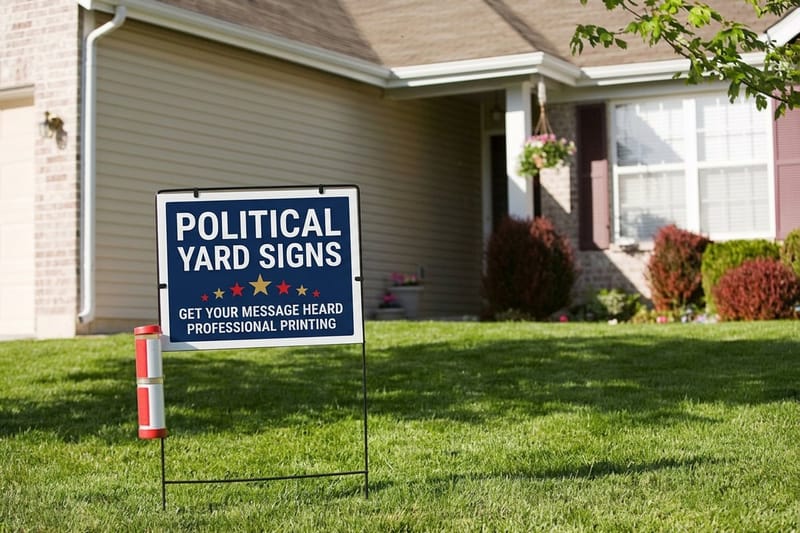
Build the plan from the doors up, not from the budget down. Pull the precincts you have to win, count the households in each one, and only then work out how many hangers to print and how many volunteer shifts that implies. Campaigns that pick a print quantity first end up with either a shortfall in the precinct that decides the race or a pallet in a garage.
Three passes over the same turf beats one pass over three times the turf. Pass one introduces the candidate, pass two proves the case with endorsements and record, pass three carries the polling place and the date. The same household seeing the campaign three times in six weeks is the effect you are buying.
Turf, teams and the tally
Cut turf into packets a single volunteer can finish in one shift, and cut them along streets rather than by count, because a packet that ends mid-block never gets finished. Give every volunteer a printed list, a pen and a rule for what to do at a no-soliciting sign, which is: skip it and mark it.
Collect the packets back at the end of every shift. The marked list is the only record you have of which doors got covered, and without it the second pass is guesswork. A campaign that tracks nothing cannot tell a thin precinct from a walked one.
Pair volunteers on first shifts and give each pair a captain who has walked before. Turnover on a field team is highest after the first shift, so the experience of that shift decides how much of your list gets covered in October.
Three passes, three quantities
Print each pass to the households it actually targets, not to the whole list. Pass one goes to every door on the turf. Pass two goes to soft supporters and undecideds your first pass identified, which is usually a fraction of the first quantity. Pass three goes to identified supporters only, because reminding an opponent to vote is a mistake you make once.
If all three messages are settled early, order them in one run rather than three. The per-piece price falls as the quantity climbs from 250 toward 25,000, so a single larger order across three artworks costs less than three separate small ones. What that saving costs you is flexibility, and in a fast-moving race late flexibility is sometimes worth more.
For the doors your team cannot reach in time, a campaign mailer plan picks up the remainder, and there is an honest look at the trade-offs in whether door to door still works.
Walk lists, timing and volunteer logistics
Work backwards from election day. Production is 7 business days from the moment your file clears preflight, then shipping, then a day to sort a pallet into turf packets. That puts about two weeks between locking artwork and the Saturday your volunteers walk, and it is why the last-minute reprint that would fix a typo is usually not an option in October.
Walk in daylight, and prefer late afternoon on a weekday or mid-morning at the weekend, when people are home to see a piece appear and neighbors are around to see volunteers in campaign shirts. Give every packet a start corner and an end corner so nobody has to decide where a route stops. Collect the marked lists back the same evening, every time, because that record is the only thing that makes the second pass smarter than the first.
Quantity and price
Political door hanger pricing and specs
Live configurator numbers from 250 pieces up to 25,000, where the per-unit cost drops as the run climbs.
| Quantity | Price Per Unit | Total |
|---|---|---|
| 250 | $1.16 | $290.41 |
| 500 | 62.2¢ | $311.24 |
| 1,000 | 33.2¢ | $332.08 |
| 2,500 | 22.2¢ | $554.39 |
| 5,000 | 17.8¢ | $887.86 |
| 10,000 | 12.5¢ | $1,249.11 |

You can also earn coins on every order and redeem them against later print runs, which matters when a campaign is buying signs, hangers and mail from the same budget line.
Designing and printing your door hangers
Set the file up at final size with 0.125 inch of bleed on every edge, keep type and logos 0.125 inch inside the trim, and build in CMYK at 300 DPI. The die-cut hole and slot at the top are cut after printing, so treat that area as lost: background art can run through it, but nothing you need to read.
Print it
Political door hangers, ready to walk
Four preset sizes on gloss cover with an optional tear-off perf, in production in 7 business days.
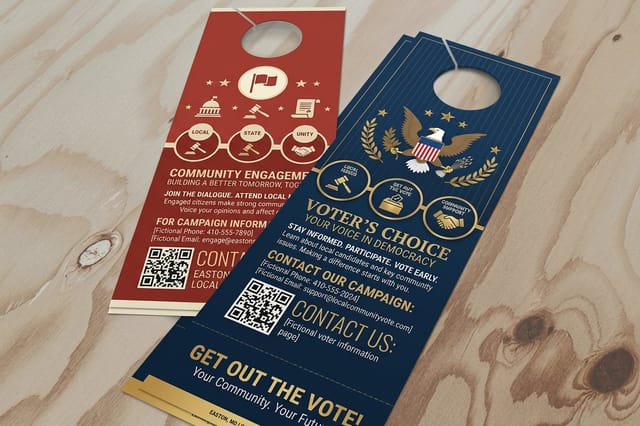
Choose 14pt for a lighter piece in volume and 16pt when the hanger has to survive a weekend on an exposed screen door: the heavier stock resists curling in humidity, which is what makes a piece look abandoned rather than delivered. The High Gloss UV coating handles dew and a passing shower. Neither stock is meant to sit outside through a storm, so if rain is forecast for the drop weekend, move it rather than replace the run. If you also need a piece for the doors nobody answered, look at political flyers and the political printing collection.
Matching the piece to the race
What you print depends on what kind of race you are running, so the piece changes by campaign type.
- Local and municipal candidates. A single 3.5 x 8.5 design walked three times over six weeks beats one 4.25 x 14 walked once. Name recognition is the whole job in a down-ballot race.
- State legislative races. Use the 4.25 x 11 for the persuasion pass, with endorsements on the back. District sizes here usually need a mail program running alongside the walk.
- Ballot measure committees. The 4.25 x 14 carries the measure number, the plain-language summary and the ask. Voters need the number, because that is what appears on the ballot.
- Coordinated slates and party committees. Print a slate card with every endorsed race on one panel and split the run across the campaigns. One artwork, one price break, shared cost.
- Union and advocacy field programs. Members walking their own neighbourhoods get better reception than paid canvassers. Add a tear-off with the volunteer sign-up and collect them back.
Blanks with the knob cut already in place
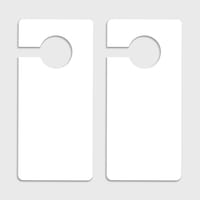
If your campaign has no designer, start from a template rather than a blank canvas. 4OVER4.COM sizes its blanks to exact product specs, in all four sizes from 3.5 x 8.5 to 4.25 x 14 inches, with the knob cut, the 0.125 inch bleed, the trim and the optional perforation line 2 inches from the bottom already marked, so artwork lands where it should. Grab one from the blank template library, or work from a layout in the free door hanger template guide.
Start fast
Blanks with the knob cut already in place
Door hanger design templates and exact-size blanks with the knob cut and bleed already in place.
Wally plans the drop before he prints it
Count the doors, then buy the paper
Pull your target precincts, count the households, and multiply by the number of passes you are walking. Lock artwork two weeks before each drop, because production takes 7 business days. Print 3.5 x 8.5 for the get-out-the-vote pass and 4.25 x 11 for persuasion, start the headline below the knob cut, and keep the paid for by line legible.
Order political door hangers →What a door hanger has to carry
Design rules that hold at every size
- Start the headline below the knob cut. The die-cut hole and slot own the top of the panel. Anything designed there gets punched through, and it is the single most common file error we send back.
- One element is the biggest. Name, date or photograph. Pick one and let the other two be smaller. Three elements the same size means a voter reads none of them.
- Set the disclaimer legibly. Several states impose a minimum type size and a contrast requirement on the "paid for by" line. Small gray type on a color field fails both.
- Keep the bottom 2 inches clear for a perf. If you are ordering the tear-off, nothing critical crosses that line. Perforation position has tolerance and a headline sitting on it will look wrong.
- Proof it on the door, not the screen. Print one at size, cut the hole, hang it on a real door and walk to the sidewalk. Type that looked confident at 100 percent zoom often disappears at 15 feet.
Explore more
The rest of the campaign kit
Political postcards run 50 for $16.48 and campaign stickers 25 for $23.88, both out in 3 business days.
Product Political Door Hangers Four sizes on 14pt or 16pt gloss cover, with an optional tear-off perf. Product Door Hangers The same die-cut panel for any non-political field campaign. Product Political Yard Signs Stake the supporters your canvassers identify at the door. 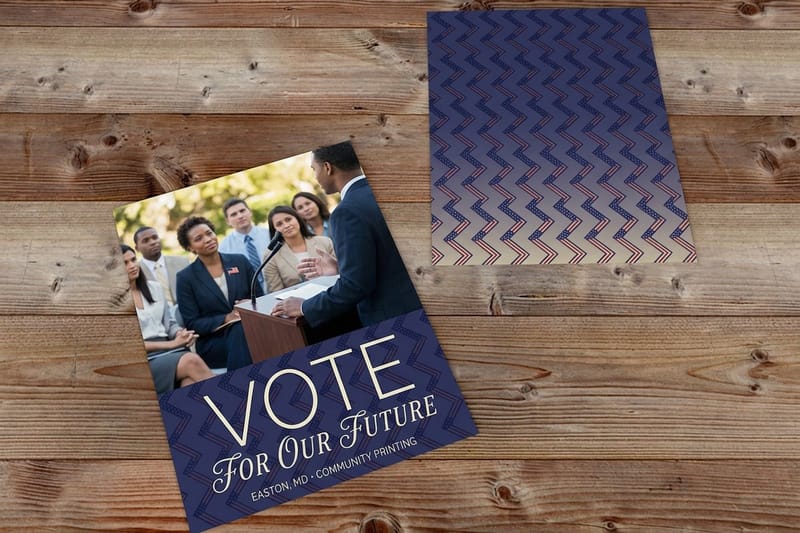 Product Political Postcards Reach the doors your volunteers cannot walk in time.
 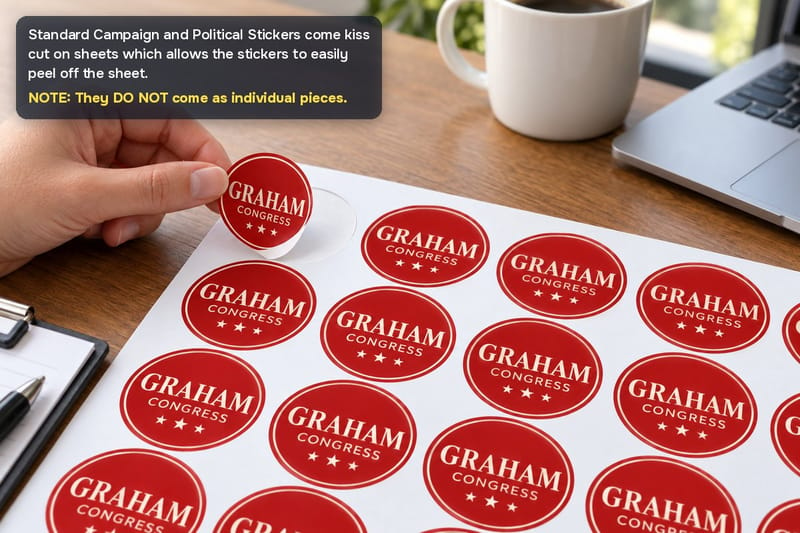 Product Campaign Stickers Hand them out at the door and on the polling place line.
  Category Political Printing Collection Every campaign piece we print, in one place.
 Ready to get your campaign on the doors?
Pick your size, upload your artwork or start from a free blank, and 4OVER4.COM prints it full color on gloss cover in time for the walk.
Common questions about political door hangers
Is it legal to put a political door hanger on someone’s door?
Hanging a piece on a door knob is generally lawful, and it is the reason campaigns use door hangers instead of unstamped flyers. Putting anything in a mailbox is not: under 18 U.S.C. 1725 a mailbox is reserved for mail that carries postage, and campaigns have been fined for using them. The same mailbox rule shapes gym marketing, as fitness banners vs flyers vs door hangers for gym marketing explains. Beyond the federal rule, respect posted no-soliciting signs, private roads, gated communities and any local canvassing ordinance or curfew, and check whether your jurisdiction requires canvassers to register. Our door hanger legal guide covers the general rules, but a campaign should confirm local ordinances with its own counsel.
How many political door hangers should I order?
Count the households in the precincts you have to win, decide how many passes you are walking, and multiply. Then add a margin for damaged pieces and doors your volunteers walk twice by accident. The harder limit is people, not paper: a piece only lands if somebody carries it there, so size the run to the volunteer shifts you can genuinely staff in the weeks you have left. Political door hangers at 4OVER4.COM start at $290.41 per 250 and the per-piece price steps down as the quantity climbs toward 25,000, so it is worth checking where the next break falls before you set the number.
What size door hanger works best for a campaign?
The 4.25 x 11 inch is the default and covers most persuasion work, with room for a photograph, three bullets and an endorsement list on the back. Drop to 3.5 x 8.5 for a get-out-the-vote pass, where the whole piece is a polling place and a date and smaller is easier to walk in volume. Go up to 4.25 x 14 only when you are carrying a slate, a sample ballot or a ballot measure summary, because the extra area costs more per piece and most single-candidate messages do not need it.
How far ahead do I need to order?
Standard production is 7 business days, and that clock starts after your file passes preflight, not when you place the order. Add shipping to your field office and a day or two to sort the delivery into turf packets, and the practical answer is roughly two weeks between locking artwork and the weekend your volunteers walk. For a three-pass program that means the first artwork is finished about eight weeks out. Rush options exist, but building a campaign schedule around them is how a GOTV drop ends up arriving on election day.
Do political door hangers need a paid for by disclaimer?
Federal candidate and committee communications require one under FEC rules, and most states impose their own disclaimer requirements on state and local races, ballot measure committees and independent expenditures. Requirements differ on wording, minimum type size and contrast against the background, and some states also regulate what a slate card or a sample ballot may look like. Get the exact string from your election board or your committee counsel and have the treasurer approve it before the file goes to press, because a non-compliant run is a full reprint.
