
The Best Election Campaign Messages and the Print Pieces That Carry Them


Tobias is our voice for cutting, binding and large format, built from the knowledge of our production team, with over 20 years in printing.
The best election campaign ideas and political campaign message samples share one shape: name one problem, make one promise, and put one person behind it, in words a voter can repeat to a neighbor. Then each printed piece carries the part of that message its format can hold: the sign carries the name, the mailer carries the argument, and the door hanger carries the ask.
Election campaign ideas, piece by piece
Four printed pieces carry most local campaigns, each with a job, a size and a lead time.
- Yard signs at the approaches. 12" x 18", 12" x 24" or 18" x 24" on 4mm coroplast, from a single sign at $25, in 5 business days.
- Persuasion postcards. A 6" x 9" card on 16pt stock, from 50 cards at $16.48, in 3 business days, one frame per mailing.
- Flyers for the town hall table. 8.5" x 11" on 100# text, from 50 in 3 business days.
- Door hangers for the last ten days. 4.25" x 11" on 14pt or 16pt gloss, 250 for $290.41, in 7 business days, so order them first.
Political campaign message samples you can adapt
Each sample fits the word count its piece can carry. Swap in your name, office and issue.
- Yard sign, 3 to 5 words. "[Name] for School Board." The name and the office, nothing else.
- Poster, 5 to 12 words. "[Name] for Council. Fix the roads on Main Street first."
- Door hanger, 15 to 25 words. "Election Day is Tuesday, [date]. Your polling place is [school]. [Name] asks for your vote for Mayor."
- Mail postcard, 40 to 60 words. "Your water bill went up $340. Here is who voted for it." Then one paragraph on the fix, the vote record as proof, and the date to vote.
Message length by campaign print piece
| Piece | Words it can carry | What the message has to do | Where it goes | Product at 4OVER4 |
|---|---|---|---|---|
| Yard sign | 3 to 5 words | Name recognition and the look of momentum | Supporter lawns, intersections, polling-place approaches | Political yard signs, from $25 |
| Poster | 5 to 12 words | Name plus one line of positioning | Storefront windows, union halls, campus boards | Political posters, from $25 |
| Door hanger | 15 to 25 words | One ask, with the date and the place to vote | Get-out-the-vote canvassing in target precincts | Political door hangers, from $290.41 |
| Mail postcard | 40 to 60 words | One frame, argued and backed by a single proof | Persuasion mail to modeled undecided voters | Political postcards, from $16.48 |
| Flyer | 120 to 200 words | Three issue positions a volunteer can hand over and explain | Events, literature drops, coffee meetings | Political flyers, from $39.54 |
| Brochure | 400 words and up | The full platform, for a voter already leaning your way | Endorsement meetings, donor asks, candidate forums | Political brochures, from $57.11 |
Word counts follow reading conditions, not taste: a sign is read in a second from a car, a mailer over a recycling bin. Write to the count, then cut it again. You can order political yard signs in the standard 18 by 24 inch format straight from the configurator.
What makes an election message work
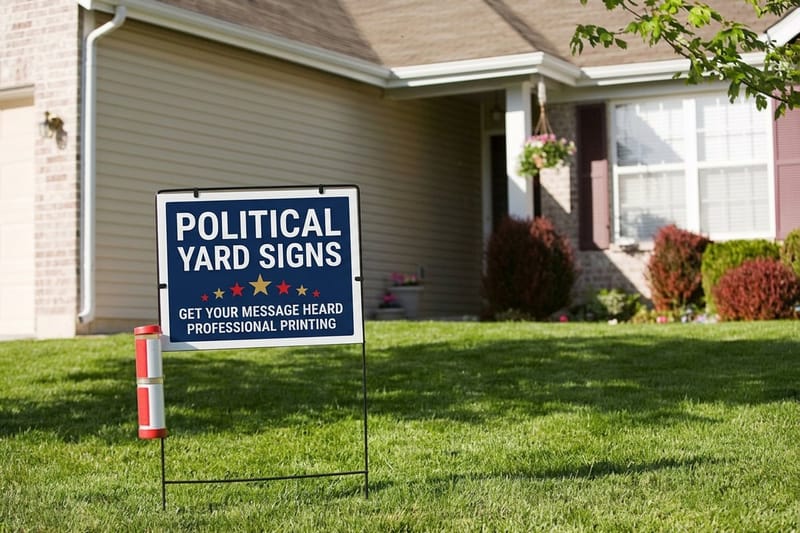
The best election campaign messages name one problem, make one promise, and put one person behind it, and they do it in words a voter can repeat to a neighbor without looking anything up. Everything else on the page is decoration.
That is the test. Say your message out loud to somebody who does not follow the race. If they can hand it on accurately an hour later, it is a message. If they can only tell you it sounded positive, it is a slogan, and slogans do not survive contact with a ballot.
Campaigns lose the plot here because a platform has fifteen good ideas in it and every one of them has a champion on the team. Fifteen ideas printed across fifteen pieces is fifteen impressions of nothing. The discipline that wins is picking one frame and letting the sign, the mailer and the door hanger each carry the part of it their format can actually hold. Our guide to persuasive campaign messaging for voters works through that narrowing exercise line by line.
The three parts every message needs
A working message has a subject the voter already cares about, a verb that commits, and a proof that makes the commitment believable. "Lower property taxes" has a subject and no verb and no proof, so it reads as noise. "I cut the county levy twice. I will do it again." has all three and fits on a postcard with room left for the disclaimer.
The proof is the part campaigns skip, and it is the part that does the work. A vote you took, a bridge you fixed, a job you held for twenty years in the district: any of those beats an adjective. If you have no record, the proof can be a person, which is why endorsement mail exists.
Why the same words fail on different pieces
A sign is read in about a second from a car moving at thirty miles an hour. A door hanger is read standing on a step with a bag of groceries in one hand. A mailer is read over a bin, and it has about the time it takes to decide whether it is going in. Those are three different reading conditions, and a sentence tuned for one of them fails in the other two.
So the message stays constant and the form changes. The sign carries the name. The door hanger carries the ask and the date. The mailer carries the argument. A campaign that prints the same paragraph on all three has wasted two of them.
Nine message frameworks that earn votes
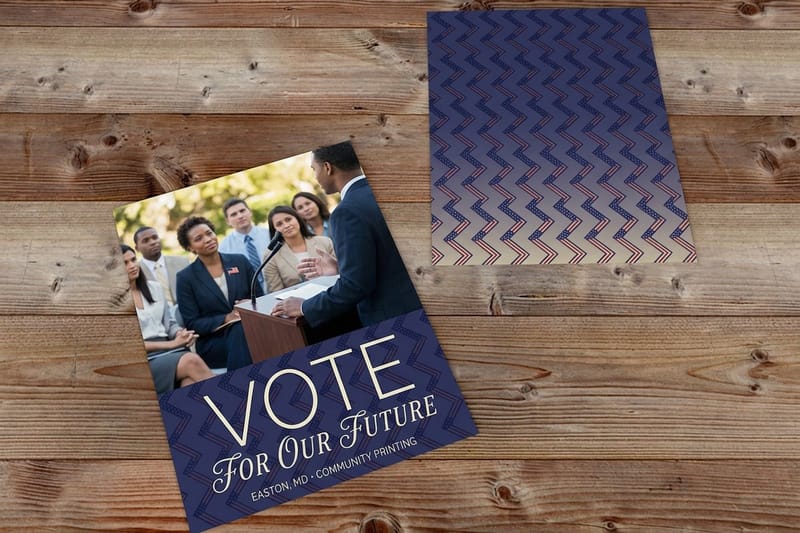
These are nine frames that keep showing up in races that win, each with the wording that fits it and the piece it belongs on. They are not interchangeable: the first four build recognition, the middle three persuade, and the last two are damage control and turnout.
Test them cheaply before you commit a budget. Political postcards start at $16.48 and political yard signs at $25, which is small enough to print two versions of a frame and see which one your volunteers actually enjoy delivering.
Frames one to four: getting the name known
1. The office-first frame. "Ana Reyes for School Board." Dull, and it is the correct message for a first-time candidate in a low-information race, because the name and the office are the entire job. Put it on signs and leave it there. Anything cleverer costs you the office line, which is what voters need to match you to the ballot.
2. The identity frame. "A teacher for the school board." One noun the voter already trusts, applied to the seat. It works because it answers the only question a busy voter is asking, which is whether you belong in the room.
3. The local proof frame. "I got the Third Street bridge fixed." Name a thing the voter drives over. Geography is the most persuasive detail in local politics and it is free.
4. The endorsement frame. "The firefighters back Reyes." Borrow the credibility you have not built yet. This one needs the endorser’s logo and permission, so start the approval process weeks before the file goes to print.
Frames five to seven: changing a mind
5. The contrast frame. "He voted to close the clinic. I will reopen it." Two sentences, both checkable, no adjectives. Contrast moves voters who are paying attention and it raises your own negatives at the same time, so it belongs on mail addressed to modeled undecideds, not on a sign in a supporter’s yard where it just annoys people who already agree with you.
6. The cost frame. "Your water bill went up $340. Here is who voted for it." Money in a household budget beats abstraction every time. Cite the number from a public document and keep the citation on the piece, in small type, because the first thing an opponent does is call it a lie.
7. The one-promise frame. "One term. One job. Fix the buses." Voters have been promised everything and believe none of it, so a candidate who narrows to a single deliverable is making a different kind of offer. The risk is real: you will be held to it, and you should be.
Frames eight and nine: defense and turnout
8. The response frame. When an attack lands, answer it in your own words on your own piece, state the fact plainly, and move straight back to your frame in the same breath. Never repeat the attack in the headline. A flyer gives you the room to answer properly, which a sign never will.
9. The ask frame. "Polls close at 8pm Tuesday. Your polling place is Lincoln Elementary." In the final week the message stops being persuasion and becomes logistics: the date, the hours, the address, and how to hand in a mail ballot. This is what door hangers are for, and it is worth checking every address block against your own turf list before you print, because a wrong polling place on a hanger is worse than no hanger.
A ninth frame does not mean nine pieces. Pick one frame for the campaign, one supporting frame for mail, and let the ask frame take over for the last seven days. Our walkthrough of planning campaign mailers sets out the sequence and the lead times.
Matching the message to the paper it lands on
Once the frame is chosen, the format decides how much of it survives. Word counts are not a style preference here: they follow from how long the piece is held and how far away it is read from.
Signs and posters are recognition tools. They do not persuade anybody and they were never meant to, which is why arguing over the tagline on a sign is the most common way a campaign wastes a fortnight. Mail persuades. Doors turn out. Brochures close the people who are already with you.
The other constraint is the disclaimer. Federal candidate communications carry a paid-for statement, and most states apply their own rule to local and judicial races. Build the disclaimer box into the layout at the start, at a size that is legible on the finished piece, and have your compliance advisor read the proof rather than the artboard. Reprinting a mail run because the disclaimer sat inside the trim is an expensive lesson.
Where each piece actually earns its cost
Yard signs buy permission. A street with eleven of your signs tells a neighbor that supporting you is normal, and that social proof is the entire return. Judge them by placement density on a few visible streets, not by total count.
Mail buys attention from people who will never open the door. Door hangers buy turnout from people you have already identified. At a $290.41 starting point, door hangers are the most expensive piece per contact on this list, so they belong in the precincts your data already says will decide the race, in the final week, and nowhere else.
Brochures are for the room, not the street: an endorsement interview, a donor meeting, a candidate forum where somebody asks what you would actually do. Political brochures start at $57.11 and a hundred of them will outlast the campaign.
Print the same face everywhere
Use one photograph, one type family and one color pair across every piece. A voter who has seen your sign should recognize your mailer before reading a word of it, and that recognition is worth more than any individual line of copy.
Check the color on paper rather than on screen before the run. Deep reds and navy blues shift noticeably between a coated sign face and an uncoated mail stock, and a candidate photo that looked right on a monitor can print heavy. Order a proof, look at it under daylight, and then release the job.
Campaign print pricing and specs at 4OVER4.COM
A campaign print budget comes down to four lines: yard signs from $25 each on 4mm coroplast, postcards from $16.48 for 50, flyers from $39.54, and door hangers at $290.41 for 250, the one real minimum in the kit. Lead times differ too, 5 business days for signs, 3 for postcards and flyers, 7 for door hangers, so the hangers go in first. The sign prices below come straight from the live configurator, so you can build the print line of the budget before the first order goes in.
Quantity and price
Political yard sign pricing and specs
Real configurator numbers on coroplast, where ordering the full street at once costs far less per sign than topping up twice.
| Quantity | Price Per Unit | Total |
|---|---|---|
| 1 | $25.00 | $25.00 |
You can also earn coins on every order and redeem them against the next print run, which matters when a campaign reorders the same piece three times in eight weeks.
Stock and finish choices that change the message
Material is part of the message. A flimsy sign that folds in the first storm says something about the campaign, and voters read it. Coroplast in 4mm holds up on a lawn through a season; a thin card sign does not survive a wet fortnight. On mail, a heavier uncoated stock reads as serious and a high-gloss coated stock reads as advertising, and which one you want depends on whether the piece is a letter from a neighbor or a contrast hit.
Print it
Persuasion mail, ready to address
Standard mail sizes on campaign stock, the fastest route from an approved frame to a drop date.
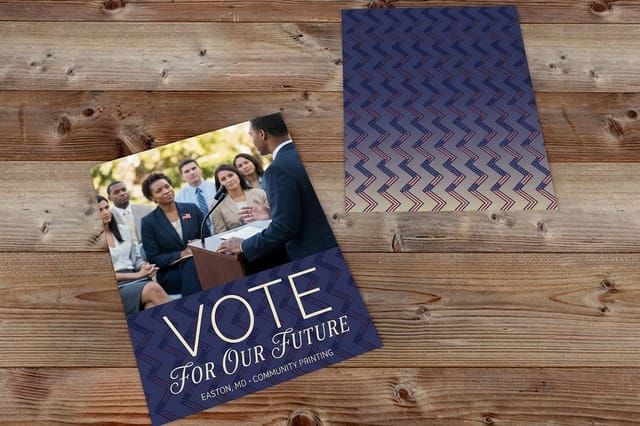
Finish changes legibility as much as look. Gloss lifts a candidate photograph and shrugs off rain, matte cuts glare so type stays readable in direct sun, and uncoated takes a handwritten note from a volunteer, which is the single cheapest way to make a piece feel personal. For the mail-specific rules on address blocks, clear zones and postage tiers, read our guide to direct mail for political campaigns.
Choosing the frame for your race
Different races reward different frames, so here is the quick breakdown by ballot line.
- School board and city council. The identity frame plus the office line. Recognition is nearly the whole race, so spend on yard signs and one persuasion postcard rather than a wide mail program.
- State legislative races. Contrast on mail, one promise on the sign. Enough voters are paying attention for an argument to land, and enough are not for the name to still need repeating.
- Ballot measures. There is no candidate, so the cost frame carries the campaign. Say what it costs a household and what it buys, and repeat the same two numbers on every piece.
- Judicial and non-partisan races. Credentials and endorsements, never policy promises. Check the conduct rules for your state before writing a word, because they restrict what a judicial candidate may say.
- Union and association elections. Local proof beats platform. Name the shift, the site or the shop you fixed something for, and print flyers your stewards can hand over and explain.
Blanks with room left for the disclaimer
If you are working without a designer, start from a blank sized to the piece: an 18" x 24" yard sign, a 6" x 9" postcard, a 4.25" x 11" door hanger. Each blank marks the bleed and the safe area 0.125 inch inside the trim, and the paid-for-by disclaimer belongs inside that safe area on every piece, so the cutter never clips it. Grab a print ready blank from the blank template library with bleed and trim already marked, or start from a layout in the design template library.
Start fast
Blanks with room left for the disclaimer
Campaign mail templates and exact size blanks so your artwork and your disclaimer both land inside the cut line.

Wally cuts the campaign message down to what fits
One frame, three formats, no wasted impressions
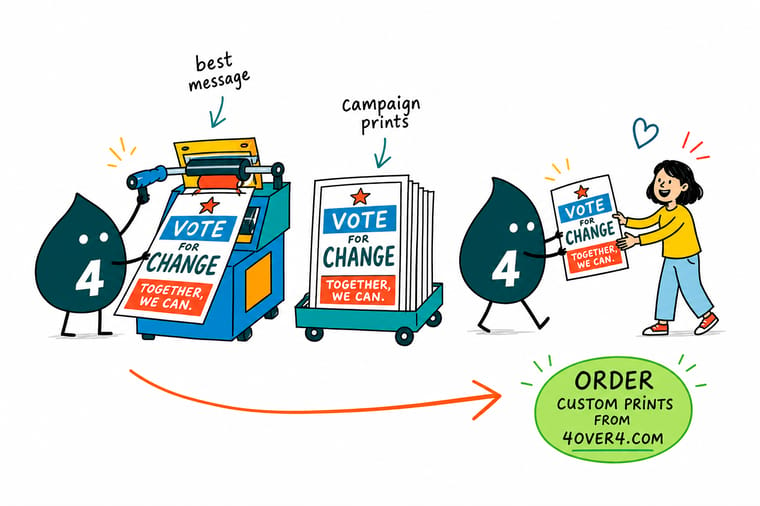
Write the message once, then split it: name and office on the yard sign, the argument and one proof on the postcard, the date and polling place on the door hanger. Keep one photo, one type family and one color pair across all three, size the paid-for disclaimer so it is legible and clear of the trim, and check a printed proof in daylight before the run goes.
Order political yard signs →What a message has to do to move a ballot
Message rules that hold on every piece
- Cut to nine words on the sign. Name, office, and nothing that needs a second reading. Everything you delete makes the rest bigger, and bigger is what gets read at thirty miles an hour.
- Put the proof next to the promise. A commitment with a checkable fact beside it survives an opponent’s mailer. A commitment on its own does not.
- Never repeat an attack in a headline. Answering in your own words puts the fact in front of the voter. Restating the charge in large type does the opponent’s printing for them.
- Design the disclaimer in on day one. The paid-for box is not an afterthought at the bottom. Size it legibly, keep it clear of the trim, and have compliance read the proof.
- Proof the candidate photo on paper. Skin tones and deep blues both shift between coated sign face and uncoated mail stock. Look at a printed proof in daylight before the run goes.
Explore more
More ways to print and win the race
Political door hangers run 250 for $290.41 and take 7 business days, the longest lead in the kit.
Product Political Yard Signs Name recognition on the streets that decide the race. Product Political Postcards Persuasion mail for the voters your model says are movable. Product Political Flyers Room for three issue positions a volunteer can explain. 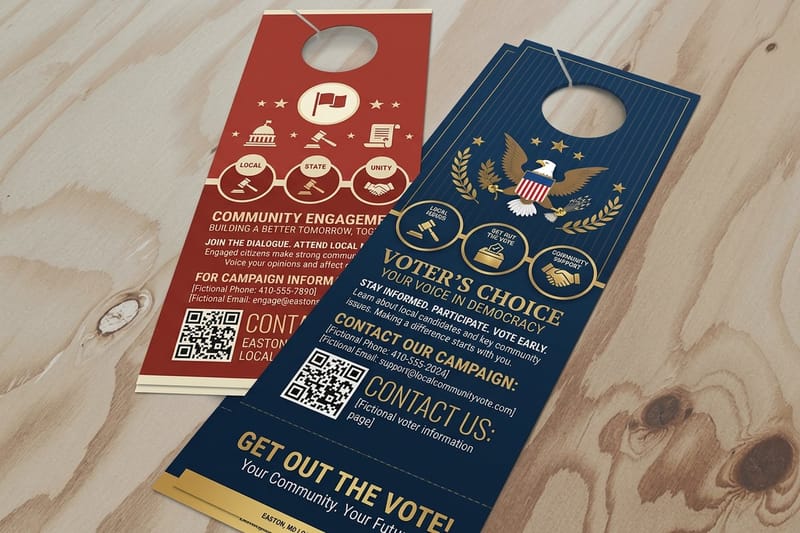 Product Political Door Hangers The final-week ask, with the date and the polling place.
 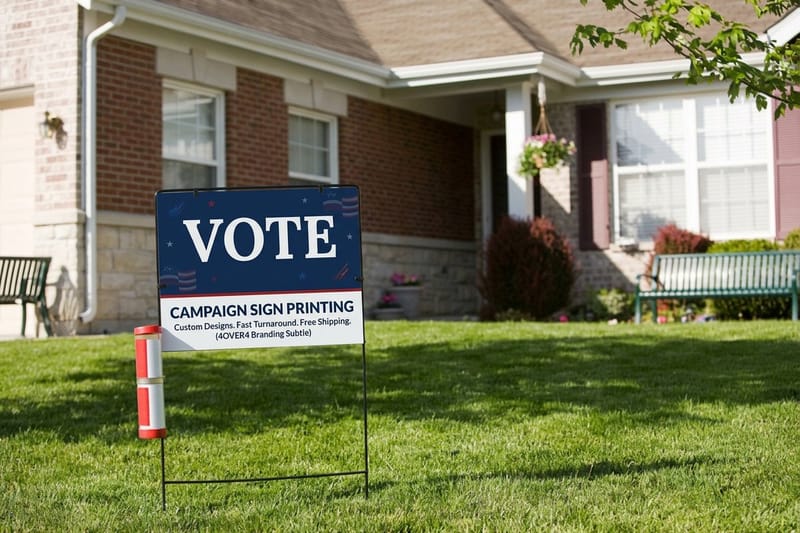 Category Political Printing Signs, mail, doors and stickers for the whole campaign.
  Guide How to Design Political Mailers Layout, disclaimer placement and USPS rules for campaign mail.
 Ready to print the campaign?
Pick your pieces, drop in your artwork or a free template, and 4OVER4.COM prints it sharp on campaign stock, as fast as your drop date needs.
Common questions about campaign messages
What is the best message for a first-time candidate?
Name and office, printed large, repeated everywhere. In a low-information race most voters meet you for the first time on the ballot itself, so the job of your signs is to make the name familiar enough to recognize in that booth. Add one identity word if it fits without crowding the office line, as in "A teacher for the school board". Save the argument for mail, where a voter is holding the piece and can read a full sentence. Political yard signs at 4OVER4.COM start at $25.
How many words should a yard sign have?
Three to five, plus the name and the office. A sign is read from a moving car in roughly a second, and every word you add shrinks the ones that matter. The most common mistake is a tagline that pushes the candidate name down to a size that cannot be read from the road, which turns the whole run into decoration. Print one sign, stake it, and look at it from a car before you order the rest. Our guide to yard sign best practices covers stake placement, spacing and the sizes that stay legible.
Should a campaign go negative in print?
Contrast works on addressed mail and rarely anywhere else. Two checkable sentences, no adjectives, both sourced to a public record, delivered to voters your data says are undecided. It moves attentive voters and it raises your own negatives at the same time, which is the trade you are making, so keep it off signs and off pieces that go to people who already support you. Never lead with the opponent name in the headline: state the fact, then return to your own frame in the next line.
What has to appear on a printed campaign piece?
Federal candidate communications carry a paid-for disclaimer identifying the committee, and most states add their own requirement for state, local and judicial races. Judicial candidates face extra limits on what they may promise. Build the disclaimer into the layout from the first draft, keep it clear of the trim and at a size that is legible on the finished piece, and have your compliance advisor read a printed proof rather than the design file. Reprinting a mail run over a disclaimer is a cost no campaign budgets for.
When should door hangers replace mail?
In the last seven to ten days, in precincts you have already identified, when the message has shifted from persuasion to turnout. A hanger reaches a voter who never opens mail and it carries the date, the hours and the polling place in a form that stays on the door. It is also the most expensive piece per contact here, with political door hangers starting at $290.41, so it is a targeting decision rather than a volume one. Check every address and polling place against your turf list before the file goes to print.
