
Direct Mail for Political Campaigns That Actually Reaches Voters


Nadia is our customer education voice, built from the knowledge of our production team, with over 20 years in printing.
A campaign-manager playbook for the 2026 cycle: pick the universe, clear the compliance box, count the waves backwards from the ballot, and print and mail the whole program in one order.
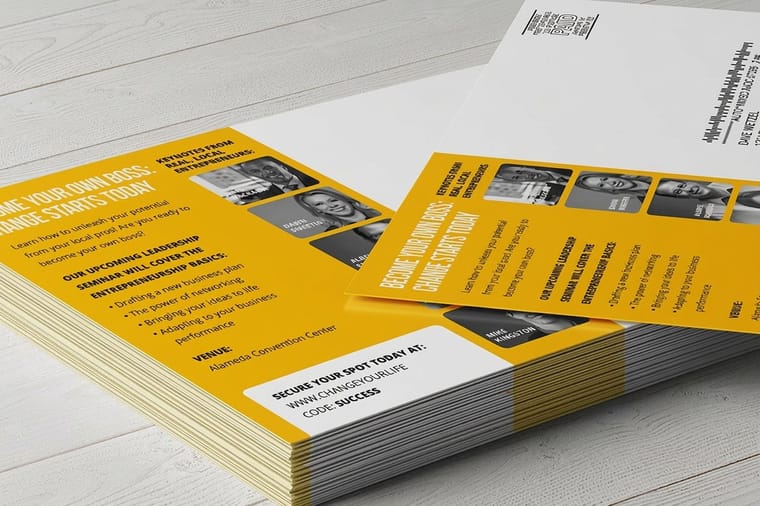
Political direct mail works by matching a printed piece to a voter file selection, then landing it inside a window that closes when your voter votes, not on Election Day. Decide first whether you are mailing an addressed list or saturating carrier routes with EDDM, because that choice sets the size, the postage and the artwork. Draw the paid-for disclaimer box into the file at the start, count backwards from the in-home date through USPS transit and print turnaround to find your real order deadline, and buy depth on a tight universe before breadth on a loose one.
Quick answer
Universe first, compliance second, calendar third
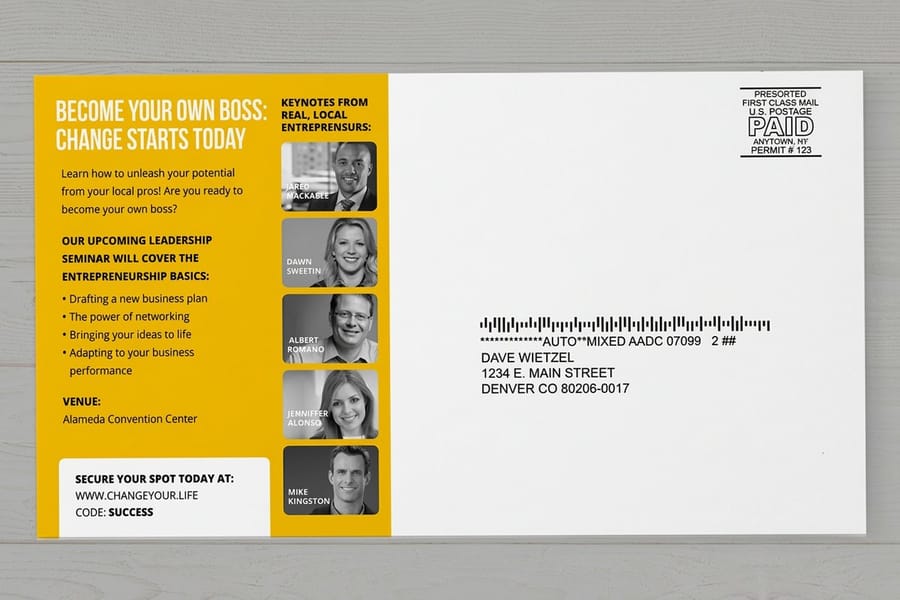
Every decision in a mail program hangs off one question: are you mailing a list or a carrier route. An addressed voter file drop reaches only the households you selected and accepts any postcard size. An EDDM drop reaches every address on the route, costs less per piece, and only accepts flat-size mail, which rules out standard postcards. Once the route is settled, the disclaimer box gets drawn into the layout rather than added at the end, and the drop dates get counted backwards from the in-home window through USPS transit and print turnaround to a hard order date.
How Direct Mail Works in a Political Campaign
The whole program fits in four moves, and each one is covered in detail further down.
- Pick the voter universe. An addressed voter file selection or an EDDM carrier route, because that choice sets the size and the postage.
- Clear the paid-for disclaimer. Draw the box into the file before any other artwork and get the wording signed off.
- Plan the waves back from the ballot. Introduction, contrast, chase and vote plan, each with an order date counted back from its in-home window.
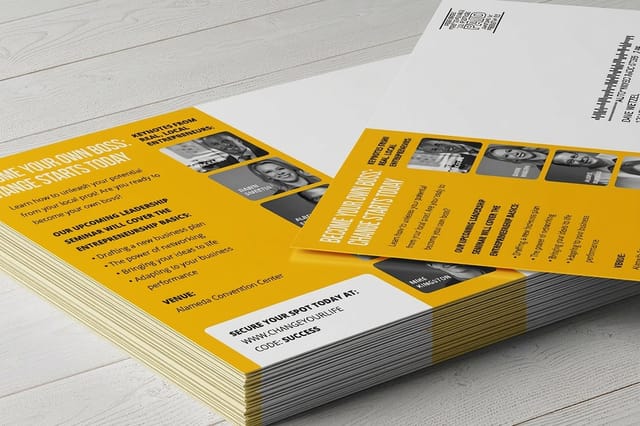
- Print and mail in one order. Direct mail postcards run 5,000 for $241.51, about 4.83 cents each, and print in 4 business days, or 2 on rush, with addressing and the drop handled in the same order.
What Campaign Mail Does That a Digital Buy Cannot
Mail is the only channel that buys straight off the public voter file. You can pull registered voters in a precinct by party, by age and by how many of the last four elections they turned out for, then put a printed piece into exactly those households and nowhere else. Digital targeting approximates that with modeled audiences and lookalikes. Mail matches it address by address.
The second thing mail does is sit still. A card lands on the counter next to the keys, gets read by whoever brought the mail in, and often gets read again by someone else in the house. That second read costs nothing, and it is a large part of why a household program in a low-turnout municipal race can outrun the same money spent on impressions.
Now the limits, because they set the budget. Mail cannot be changed once it is on press, so a piece dropping Tuesday cannot answer an attack that lands Wednesday. There is no click and no clean attribution. You pay full freight for every household in the universe whether the piece is read or binned. In a high-turnout federal race where four campaigns are mailing the same voters, your marginal piece is worth far less than it is in a school board contest where nobody else is mailing at all.
The practical read: mail earns its place when the universe is small and defined, when the argument needs more room than a headline, and when you need voters who never see your ads. Build the everyday drops on direct mail postcards and keep the heavier formats for the one piece that has to carry a record. If the message itself is still moving, work through persuasive campaign messaging for voters before anything goes to paper, and browse the rest of the campaign range in political printing.
Voter File List or EDDM, Decided Before You Design Anything
This is the fork that decides the size, the stock, the postage and the artwork, so it comes first. An addressed drop mails to the names on your file. An Every Door Direct Mail drop mails to every address on a carrier route, with no names at all.
| Delivery route | Who receives it | What you supply | Where it fails |
|---|---|---|---|
| Addressed list mail | Only the households on your voter file selection. | A standardized address list, cleaned against moves. | Bad data. A stale file mails the moved, the deceased and the duplicated, and you pay postage on all of it. |
| EDDM Retail | Every address on the carrier routes you pick, up to 5,000 pieces per ZIP Code per day. | Route selections and a flat-size piece. No list, no names, no permit at the retail counter. | You buy the opposition and the non-voters along with your targets, and most postcard sizes are not eligible. |
| Door hangers | Any door your walkers can reach, in the turf you choose. | Volunteers, a walk list and time. | No walkers means no delivery, and nothing records who actually got one. |
The size rule catches more campaigns than anything else on this page. EDDM only accepts flat-size mail, which means the piece has to beat at least one letter limit: over 6-1/8 inches high, over 11-1/2 inches long, or over 1/4 inch thick. A 4 by 6 card does not. Neither does a 6 by 11 jumbo, because 6 inches is inside the height limit and 11 inches is inside the length limit. An 8.5 by 11 sheet clears it easily on height, and an 11 by 17 sheet half folded down to 8.5 by 11 clears it too. Trifold that same sheet to 8.5 by 3.67 and it is a letter again, back out of EDDM.
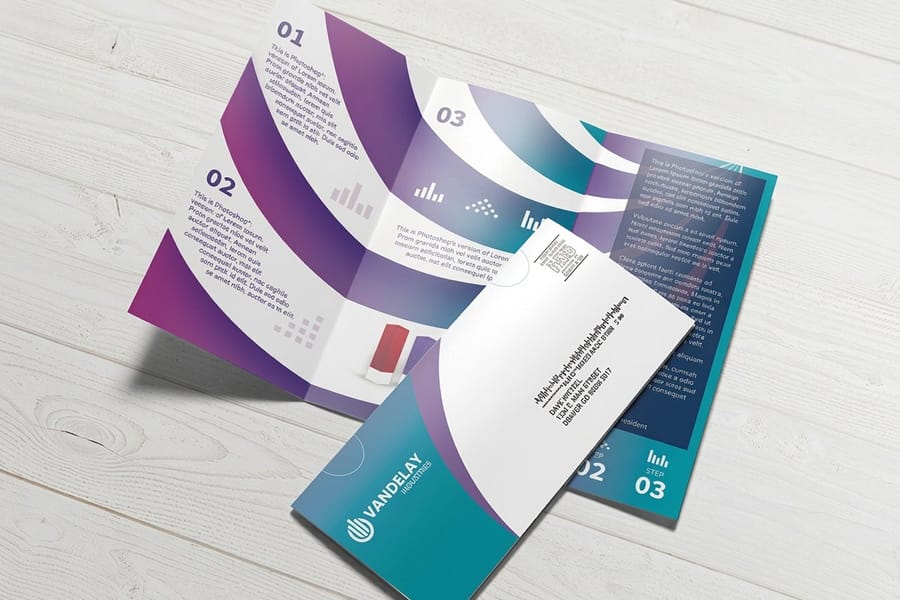
So the honest sequencing is: choose addressed or saturation, then choose the format that route allows, then design. For a saturation drop, direct mail brochures at 8.5 by 11 or 11 by 17 give you a flat-size piece with room for a record and an endorsement list. For an addressed drop, the postcard formats are cheaper per touch and easier to repeat. The mechanics of each route are laid out in what Every Door Direct Mail is and how to build or rent a mailing list. If your ground game is doing the delivery instead of USPS, door hangers put the same message on the knob with no postage at all.
The Paid-For Box and the Rules That Stop a Mailing
Treat the disclaimer as a layout element with a fixed footprint, drawn into the file on day one. Campaigns that leave it until the artwork is finished end up shrinking it into a corner where it collides with the address block, and that is how a mailing gets reprinted.
For federal communications the FEC asks for three things at once: the disclaimer sits in a printed box set apart from the rest of the piece, it is printed with a reasonable degree of color contrast against its background, and the type is large enough to be clearly readable. The agency treats 12-point type as sufficient on a communication no larger than 24 by 36 inches, which covers every mail format on this page. Mail paid for by a committee the candidate did not authorize carries the additional line that it is not authorized by any candidate or candidate committee, along with the payer address, telephone or website. State and municipal contests run on state law, and the wording and size requirements genuinely differ, so have your compliance counsel sign off on the exact string before the file uploads.
Two placement habits save reprints. Put the box on the address side, in the upper area away from the bottom of the panel, because the bottom strip and the right-hand corner belong to the USPS barcode and the address block. And keep it out of the ink area a carrier route or postage indicia will occupy. Our blank template library ships every size at the real trim with the bleed and safe margin drawn in, which makes those clear zones easy to respect.
The postal rules are shorter but they cost money. USPS flags campaign mail as Political Mail so it moves visibly through the plant, and ballots themselves travel as Election Mail under a separate tag. Candidate and political committees are not eligible for nonprofit prices, so campaign mail pays commercial rates, full stop. Automation pricing is available, but only when the artwork follows USPS layout rules and the list is standardized: art that misses those guidelines mails at the standard rate and gets invoiced at the difference. The address and clear zone specifics are worked through in how to mail a postcard correctly, and if you would rather hand the presorting and postage to us, that is what our mailing services cover.
How Many Waves, and the Order Date Behind Each One
Four waves is the shape most down-ballot programs settle into, and each one is aimed at a different voter rather than a different week. An introduction piece around six to four weeks out puts the name and the biography in front of people who have never heard it. A contrast piece follows while voters are still deciding. A ballot-chase piece goes to the voters who requested or were sent a mail ballot, timed to arrive while that ballot is still sitting unopened. A short vote-plan piece closes it out, telling people where and when.
The date that governs all of it is not Election Day. In a mail-ballot state, a large share of your universe votes weeks early, so the persuasion argument has to be finished and in homes before ballots drop, and the chase piece is worthless if it arrives after the envelope has gone back. Get the ballot mailing date from your state or county election office and build the calendar around that, not around the first Tuesday.
Write the chain for each wave on one line, starting from the ballot: the county's ballot mailing date, the in-home window you want for that wave, USPS transit before it, which for Marketing Mail runs days rather than hours, and print turnaround before that, 4 business days standard and 2 on rush at 4OVER4.COM. The first date on the line is the order date, and it goes on the campaign calendar next to the ballot date so the artwork, the disclaimer text and the list are finished by then. The timeline above lays the four waves and that backwards calculation on the same axis.
One more scheduling note worth the money: order the whole program at once and stage the drops, rather than reordering each wave. It removes four separate chances to miss a turnaround, and the per-piece price on a single larger run is lower than on four small ones. For the tactics inside each wave, how to get more from a direct mail drop is the companion piece, and oversized postcards are the usual choice when one wave has to be louder than the rest.
Political Mail Pieces and When Each One Lands
Each wave has a piece that suits its job. Every one carries the paid-for box set out in the compliance section above.
| Piece | Size and stock | Where it lands in the calendar |
|---|---|---|
| Early ID postcard | 4 x 6 in direct mail postcard on 14pt gloss | Six to four weeks out, to introduce the name |
| Persuasion postcard | 6 x 9 or 6 x 11 in oversized postcard on 16pt | The contrast wave, while voters are still deciding |
| Slate card | 5.5 x 8.5 in oversized postcard on 14pt | Beside the persuasion wave, when endorsements are set |
| Letter | 8.5 x 11 in direct mail letter on 100# text, folded | The ballot chase, to voters holding an unreturned ballot |
| GOTV reminder | 4 x 6 in postcard on 14pt, First-Class | The last days, with where and when to vote |
| Door hanger | 4.25 x 11 in on 14pt or 16pt gloss | Walk weekends in the chase and GOTV turf |
Postcards print in 2 business days on rush, which is the cushion for a GOTV card when the calendar slips. Door hangers take 7 business days, so order them with the first wave.
Specs That Survive the Mail Stream and What They Cost
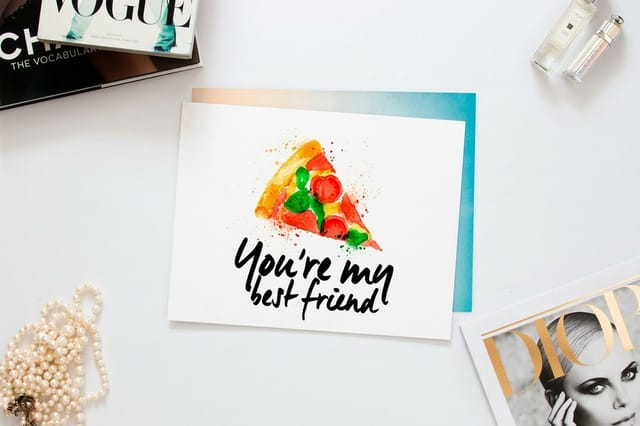
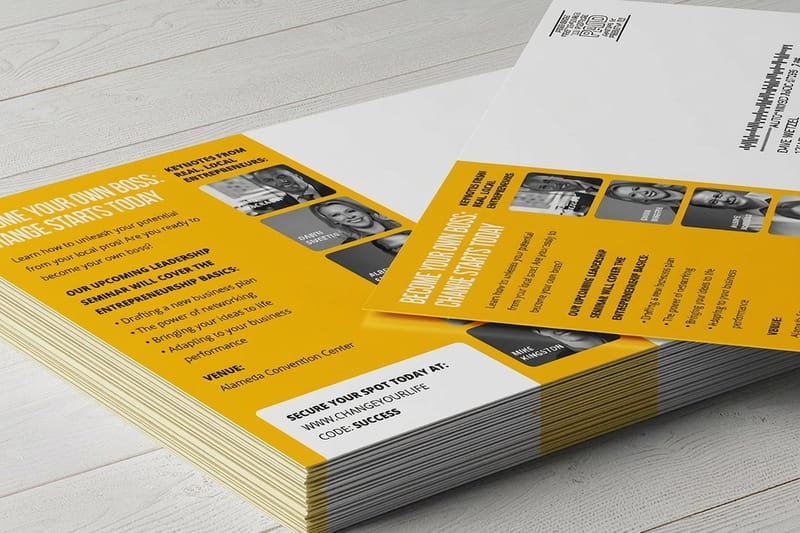
Direct mail postcards print in 9 sizes, from a 4 by 6 card up to a 6 by 11 jumbo, on any of 7 stocks. The default 14pt gloss cover is the cheapest thing that still reads as a real piece of mail. Step up to 16pt when the piece has to be carried in a pocket or held on a fridge, because the extra caliper resists the bend it picks up in the tray. The one worth knowing about is the 14pt uncoated cover: it takes pen ink, so a volunteer can sign the back or add a line by hand, which is the closest a printed piece gets to a personal note.
Ink coverage is a real cost lever. A 4/0 card prints full color on the front with a blank back, 4/1 adds a black message and address panel, and 4/4 runs full color both sides. For campaign mail 4/1 is usually the right call: the front carries the image and the headline, the back carries the message, the disclaimer box and the address block in black, and you keep the cost of a second color pass.
| Format | Sizes | Entry price | At volume |
|---|---|---|---|
| Direct mail postcards | 9 sizes, 4" x 6" up to 6" x 11" | 500 for $89.68, about 17.9 cents each | 5,000 for $241.51, about 4.83 cents each |
| Oversized postcards | 4 sizes, 5.5" x 8.5" up to 6" x 11" | 100 for $62.40, about 62.4 cents each | 5,000 for $350.60, about 7.01 cents each |
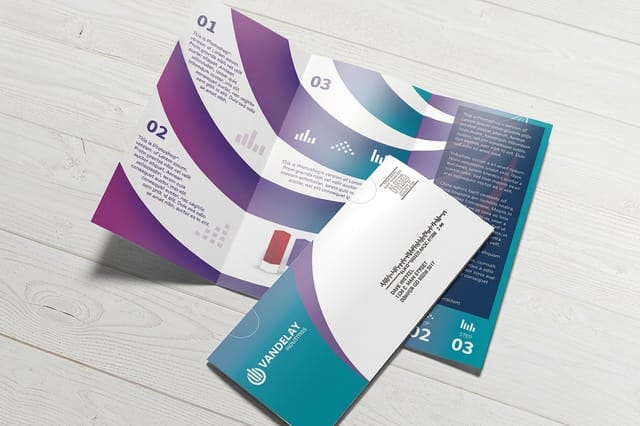
| Direct mail brochures | 4 flat sizes, 8.5" x 11" up to 11" x 17", 9 folds | 500 for $238.73, about 47.7 cents each | 25,000 for $1,716.60, under 7 cents each |
Read that table as a frequency question rather than a format question. Printing is cheap at volume and postage is not, so the real decision is how many times you can afford to touch the same household. A 5,000-piece postcard run at 4.83 cents a card lets a tight universe hear from you three times for less print money than one brochure drop to a list twice the size. Save the brochure for the piece that genuinely needs six panels, such as an endorsement list or a record on several issues.
File setup is the same discipline as any print job. Build at the real trim size with 1/8 inch bleed, keep live copy inside the safe margin, convert type to outlines, and leave the address side clear where USPS needs it. Start from a press-ready blank in the blank template library, or lay the piece out from a ready-made design in our design templates if there is no designer on the campaign. When you are comparing the whole postcard range side by side, postcard printing lists every stock and finish we run.
Wally plans the mail calendar
Count backwards from the ballot, not from Election Day
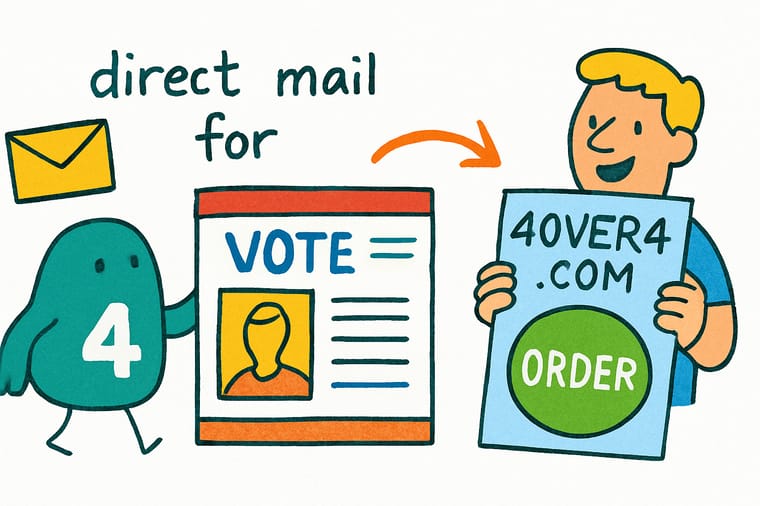
Wally starts at the day the voter actually votes, which in a mail-ballot state is weeks early. He walks back through USPS transit, then back through print turnaround of 4 business days standard or 2 on rush, and lands on the day the artwork and the list have to be finished. That day is the real deadline. He also checks the size before he designs, because EDDM only takes flat-size mail and a 4 by 6 card is a letter.
Order direct mail postcards →
Specs and pricing
Campaign mail formats, sizes, and starting prices
The three formats that carry most political programs: direct mail postcards in nine sizes from 4 by 6 to 6 by 11 inches, oversized postcards in four sizes from 5.5 by 8.5 inches, and direct mail brochures in four flat sizes with nine folds. Live configuration choices and starting prices come straight from the 4OVER4.COM configurator.



Print it
Order the whole mail program in one run
Order all four waves at once and stage the drops. Postcards print in 4 business days, brochures in 6, and the addressing and drop come with the same order.
%22%2F%3E%3Ccircle%20cx%3D%2236%22%20cy%3D%2220%22%20r%3D%2231%22%20fill%3D%22%23a78bfa%22%20opacity%3D%220.15%22%2F%3E%3Ccircle%20cx%3D%2233%22%20cy%3D%2229%22%20r%3D%2210%22%20fill%3D%22%23a78bfa%22%20opacity%3D%220.1%22%2F%3E%3Crect%20x%3D%2276%22%20y%3D%2210%22%20width%3D%2221%22%20height%3D%2220%22%20rx%3D%224%22%20fill%3D%22%23a78bfa%22%20opacity%3D%220.08%22%20transform%3D%22rotate(16%2080%2030)%22%2F%3E%3C%2Fsvg%3E)
Explore more
Where to go next
The EDDM size rule and ZIP cap, clean voter and rental lists, messaging before print, address block rules, and the full political range.
By the numbers
Campaign print you can schedule against at 4OVER4
Common Questions
Your political mail questions, answered
Does every political mailer need a paid-for disclaimer?
Federal candidate and committee mail does, and most state and local races have their own version of the same rule. For federal communications the FEC asks for the disclaimer in a printed box set apart from the rest of the piece, with a reasonable degree of color contrast and type large enough to be clearly readable, and it treats 12-point type as sufficient on a piece no larger than 24 by 36 inches. Mail paid for by a committee that is not authorized by the candidate also carries the line stating it is not authorized by any candidate or candidate committee, plus the payer address, phone or web address. State and municipal races follow state law, which often differs on wording and size, so confirm the exact language with your compliance counsel before the file goes to press.
Can a campaign use EDDM instead of buying a voter list?
Yes, with two catches. EDDM Retail delivers to every address on the carrier routes you select, up to 5,000 pieces per ZIP Code per day, and it needs no mailing list and no permit at the retail counter. The first catch is that you are paying to reach the opposition, unregistered adults and people who never vote, which is fine for a name-recognition drop in a small municipal race and wasteful for a persuasion program. The second is size: EDDM only accepts flat-size mail, so a standard postcard does not qualify and you need a piece such as an 8.5 by 11 sheet.
How many pieces should a campaign mail, and how many times?
Work from the universe, not from a piece count. Pull your target voters, divide the mail budget by that number, and see how many touches it buys. At 4OVER4.COM printing math, 5,000 direct mail postcards cost $241.51 to print, about 4.83 cents each, so a 5,000-household universe can usually absorb three or four printed touches on the same budget that would buy one oversized mailer to a much larger list. Postage is separate and is quoted on the order. Depth on a tight universe beats breadth on a loose one in almost every down-ballot race.
When should the last mail piece land?
Before your voters vote, which in a mail-ballot state is weeks before Election Day. If ballots go out on a known date, the persuasion wave has to be finished and in homes before that date, and the chase piece has to land while the ballot is still on the kitchen table. Then count backwards: in-home window, minus USPS transit time, minus print turnaround of 4 business days standard or 2 on rush, gives you the day the order and the artwork actually have to be finished.
Do political committees get nonprofit postage rates?
No. Nonprofit prices are reserved for authorized qualifying organizations, and candidate committees and political committees are not among them, so campaign mail pays commercial prices. What you can do is earn automation prices by building the piece to USPS layout rules, which means a clear address block, correct clear zones for the barcode, and an address list that has been standardized. Artwork that breaks those rules gets mailed at the higher standard rate and invoiced accordingly, which is the most common unpleasant surprise on a first campaign mailing.
What size and stock hold up best for campaign mail?
For a workhorse drop, a 4 by 6 or 4 by 9 card on 14pt gloss cover is the cheapest thing that still feels like a real piece of mail. Step to 16pt when the card has to survive being carried around, since the extra caliper resists bending in the tray. The 14pt uncoated cover is the one to know about: it takes pen ink, so volunteers can add a handwritten line or sign the back, which is the closest a printed piece gets to a personal note. Save the 6 by 11 jumbo and the folded brochure for the single mailer that has to carry an endorsement list or a full record.
Get Started
50 oversized postcards cost $51.62, or $1.03 each
Pick the size, set the quantity, upload the art with the disclaimer box already drawn in, and we print and mail the drop while your wave is still open.
Legal Disclaimer
Gold Standard guarantees apply to all standard orders placed through 4over4.com. Price match requires verifiable proof of a competitor's published price for an equivalent product with matching specifications and turnaround time. Satisfaction guarantee covers manufacturing defects and print quality issues. Contact support with order number and documentation.
