
Creative Ways to Hand Out Business Cards Without Being Pushy


Emma is our prepress and print production voice, built from the knowledge of our production team, with over 20 years in printing.
Hand the card at the end of a useful answer, never at the start of a pitch. Give two rather than one, write on the back of the one you hand over, and the whole exchange stops feeling like selling and starts feeling like admin between two people who just agreed on something. The card itself is a printed piece worth choosing on purpose: standard business cards with an uncoated back take the note, and spot UV business cards get turned over in the hand.
Where to hand a card over, and what to say
| Setting | The moment to offer | Something worth saying | Card that fits |
|---|---|---|---|
| A conversation at an event | After you answer their question | Here, the details are on this, message me and I will send you the file | Raised foil or spot UV |
| A client you already serve | At handover, with the finished job | Two cards, one for you and one for whoever asks who did it | Standard, in quantity |
| A supplier or a trade counter | While they are writing your order down | Save yourself the typing, everything is on here | Plastic, it survives a workshop |
| A conference or a trade booth | After you have taken theirs | I will follow up Thursday about the sizing question | Holographic, it gets shown around |
| A social or a shared table | Only when someone asks what you do | Easier if I just give you this, no obligation at all | Standard with a written note |
The wording is not the point, the order is. Every row puts the card after the useful thing rather than before it. You can order standard business cards from the configurator and test the handoff before you spend anything on a finish.
Creative ways to give out business cards
Five ideas go past the plain swap, and each one needs a slightly different printed piece. The sizes, stocks and prices come from the configurator, so you can order the exact version you read about.
- The fridge card. A 2 x 3.5 business card magnet on 17pt or 35pt indoor magnet, from $19.68 for 25, for trades and services whose customers call again months later.
- The sticker that seals the bag. A 2 x 3.5 business card sticker on uncoated or semi-gloss label stock, from $10.76 for 25, pressed onto a delivery bag, a box or a quote folder.
- The numbered card. Choose Yes, Variable Data and each card carries its own code, so the call that comes in tells you which event or conversation produced it.
- The square card. A 2 x 2 card stands out in a pile of rectangles, and the 1.5 x 3.5 slim size slides behind a conference badge without bending.
- The pair from one order. Order two sets in one run, one design with your details to keep and one worded to be passed on to whoever asks who did the work.
Why the handoff matters more than the card
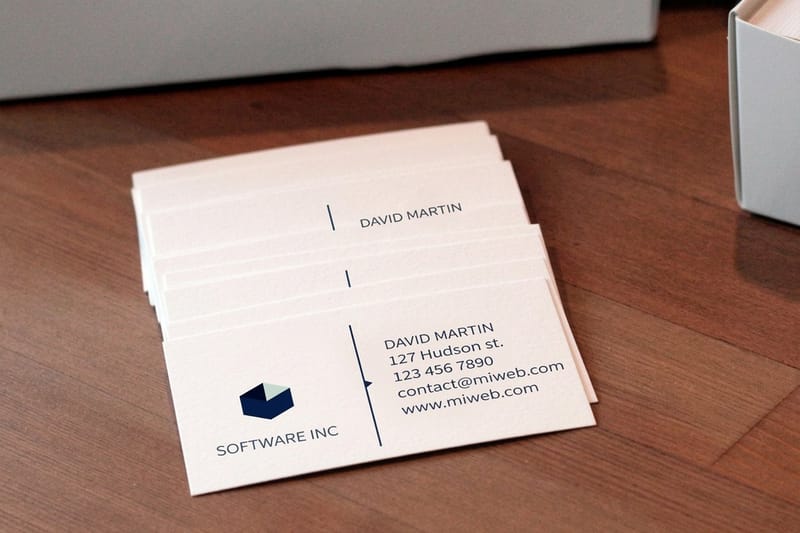
Hand the card at the end of a useful answer, not at the start of a pitch. That single change is what separates a card someone keeps from a card that goes into a jacket pocket with four others and gets thrown out on Sunday.
Nobody minds being given a card. They mind being sold to, and the two feel identical when the card arrives before the conversation has earned it. The card is not the offer. It is what you leave behind after you have already been useful.
Think about what the card is actually for. It is a memory aid, and the memory it aids is the two minutes you just spent talking. Handed cold, it has nothing to attach itself to, so the person is holding a rectangle from a stranger. Handed after you told them the one thing they wanted to know, it becomes the object that means that conversation.
The passive side of this, dropping cards in places where people find them later, is a separate skill with its own rules. Our guide to where to leave business cards covers that, and whether you can leave cards in mailboxes answers the question that gets people in trouble. This page is about the moment you are standing in front of someone.
Stop opening with the card and start closing with it. Same box, same design, different result.
Two sentences that make it easy
The first sentence names something you will do. The second hands over the card as the way to make it happen. "I will dig out the spec sheet for that size, message me and I will send it across" then "everything is on here". Now the card is a task you have taken on, not a favour you are asking for.
What kills the moment is asking permission. "Would it be alright if I gave you my card" makes the other person do the work of saying yes to a stranger. Offer it flat, in one movement, and keep talking about the thing you were already talking about. If they do not want it, they will put it down and nobody has to have a conversation about it.
When to keep the box shut
Do not hand a card to somebody who is mid sentence, holding food in both hands, or clearly trying to reach the person behind you. Do not hand one out at a funeral, a hospital, or anywhere the room has a purpose that is not yours. Every one of those has been done, and every one of them is what gives cards a bad name.
The other case is quantity. Working a room by putting one card in every hand is direct mail with legs, and it converts about as well as an unaddressed leaflet. Ten conversations that end in ten cards beat sixty cards and no conversations, and the ten cost you less to print.
Natural ways to share your card
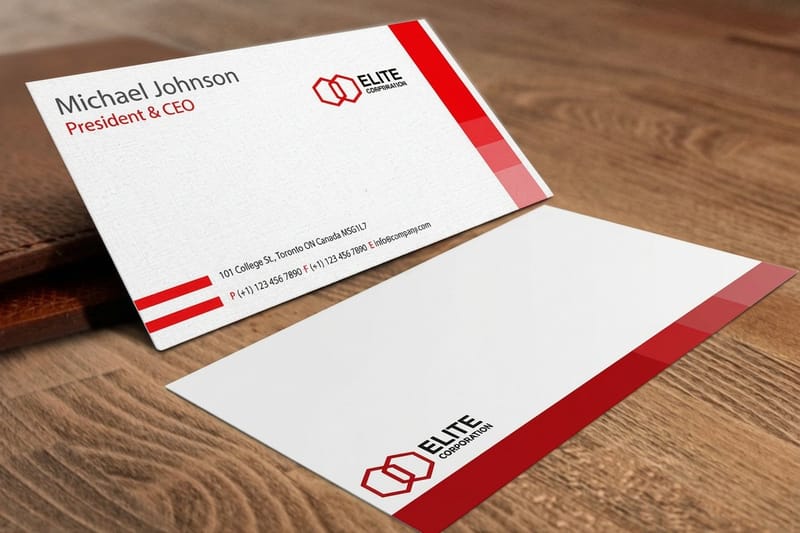
None of these need a script memorised. They work because they attach the card to something the other person already wanted.
They also work on a plain card. Start with standard business cards from $17.57 while you are testing what you say, then move up a finish once you know the handoff lands.
Six handoffs that never feel like a pitch
1. The answer handoff. Somebody asks what a job like theirs usually costs, or how long it takes. Answer honestly, then give the card as the place the answer lives. The card is now documentation, not advertising.
2. The written note. Turn the card over and write the thing you promised: a size, a name, a date. A card with your handwriting on it gets kept, because throwing it away means throwing away information they do not have anywhere else.
3. The pair. Give two. "One for you, one for whoever asks who did this." It is the only genuinely low pressure way to ask for a referral, and people pass the second one on far more often than they will pass on the only one they have.
4. The tuck. Into the invoice, the delivery box, the folder of finished work. The customer already trusts you at that point, which is the cheapest moment to ask for the next job. Pair it with a postcard if you want the follow up to arrive in the post instead.
5. The swap you start. Ask for theirs first. Most people reach for their own pocket immediately, and now yours arrives as a reply rather than an approach.
6. The code on the back. A QR that lands somewhere worth landing, a portfolio or a booking page, not a homepage. Our guide to QR codes on business cards covers the sizing and the quiet zone that stop it failing to scan under bad lighting.
The follow up is part of the handoff
A card handed with a promise attached is only worth anything if the promise arrives. Send the thing within two days, while they can still picture your face. Reference the conversation in the first line, not your services.
This is also why the write on the back trick matters so much. It reminds you what you agreed to as much as it reminds them, and it gives the follow up message a subject that is not "great to meet you".
Networking and event tactics
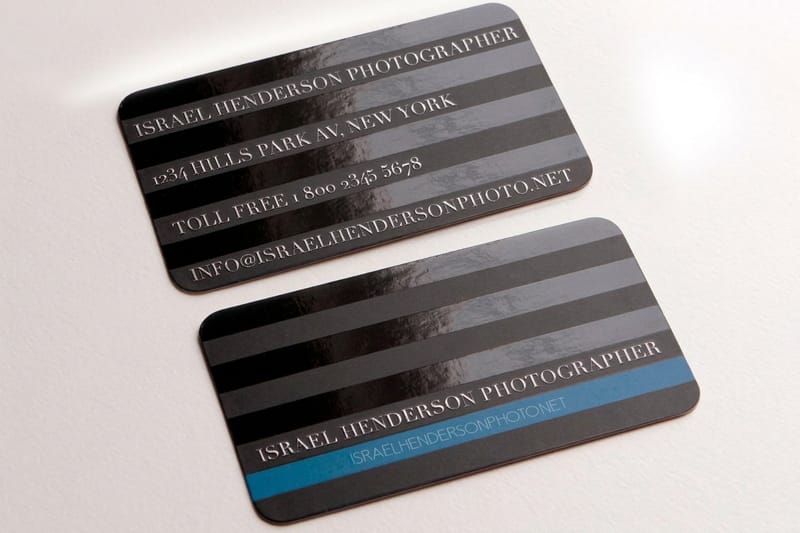
Events are where the pushy version of this happens, because everyone arrives holding a target. The people who do well at them treat the card as the last step of a good conversation and treat the conversation as the point.
Practical setup first. Keep your cards in one pocket and the cards you collect in another, so you never fumble and never hand someone else’s card out by mistake. Carry a pen that writes on coated stock, a fine tip permanent marker rather than a ballpoint, because a ballpoint skates across a gloss finish and smears.
What works in a room full of people
Take before you give. Asking for someone’s card is a compliment. Giving yours unasked is a request. Do the first and the second usually happens by itself.
Name the follow up out loud. "I will send you the file on Thursday" turns a card into an appointment. Write Thursday on the back of the one you hand over.
Leave the booth. The queue for coffee and the seat next to you in a session are better ground than a stand, because neither person is performing a role.
Use the badge sleeve. Slide one card behind your own conference badge. When someone asks, it is already in your hand, and you never do the pocket search that breaks the moment.
Speak, and let the card follow. If you run a session or ask a question from the floor, people come to you afterwards. That is the only situation where a stack of cards on a table earns its keep.
The bit everyone skips
Sort the cards you collected the same night, while you still remember who was who. Write one line on each about what you talked about. The pile you cannot identify by Wednesday is dead weight, and it was dead the moment you put it in a pocket without a note.
For a show that matters, the card is one piece of a set. A conference networking bundle pairs cards with the flyers and signage that make the stand look like it belongs to a real company, and our design service will lay all of it out to match if you do not have an in house designer.
Card features that earn a keep
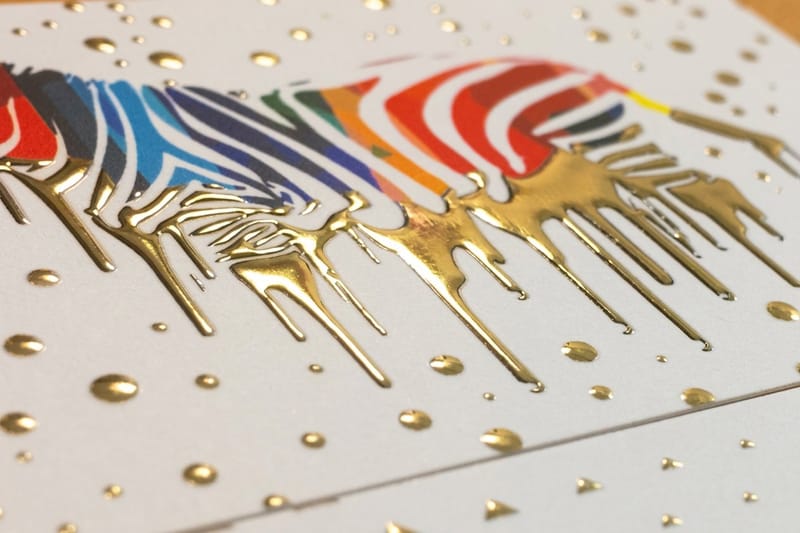
A finish does one job: it buys you the extra three seconds while the person turns the card over instead of pocketing it. That is the window where they read the second line and remember the conversation. It is worth paying for, and it is worth knowing what each one costs you as well as what it gives you.
Every one of these has a real drawback. Anybody who tells you otherwise is selling the finish rather than explaining it.
What each finish gives, and what it takes
Spot UV, from $76.88. Gloss on selected areas of a matte card. Nearly invisible in a photograph, obvious the second it is in a hand, which makes it the best value tactile upgrade on the list. The catch is that it needs a real design decision: spot gloss over everything is the same as no spot gloss.
Raised foil, from $86.78. Metallic and physically raised, so it registers by touch before anyone looks at it. It reads best on a smooth stock and it flattens out on a heavily textured one, so choose the stock and the foil together. What a foil accent actually is explains where to place it.
Holographic, from $251.36. The rainbow shift makes people show the card to the person next to them, which is distribution you did not pay for. It fights small type badly, so keep your phone number and email on an unfoiled panel. How to make holographic business cards covers the artwork setup.
Plastic, from $180.02. It survives a wallet for years where a paper card is soft in a month, and it is the right choice for trades and anyone whose card lives in a toolbox. The trade off is real though: you cannot write on it with a normal pen, which removes the single most effective handoff on this page.
Weight, before finish
If you only change one thing, change the thickness rather than the finish. A 16pt card feels considered and a thin card feels like a leaflet, and people register that in the hand before they have read a word. Our thickness chart lines the weights up side by side.
Size matters for the same reason but in the opposite direction. A card that does not fit a wallet gets left behind, however good it looks, so check the standard business card sizes before you get clever with the trim.
Make your card worth handing out
The handoff carries most of the weight, but the object still has to hold up once it is in a pocket. Two things decide that: the thickness, which people feel before they read anything, and whether the back has room for you to write on. Standard cards print on 14pt or 16pt gloss cover, or on 16pt and 18pt uncoated cover that takes a pen, and choosing 4/1 over 4/4 printing keeps the back a clean black ink panel with room for a note. Pricing below comes straight from the live configurator, so you can see where the steps fall before you commit a quantity.
Quantity and price
Business card pricing and specs
Real configurator numbers, where the per unit cost drops as the run grows. Print enough that you never hesitate to give one away.
| Quantity | Price Per Unit | Total |
|---|---|---|
| 100 | 17.6¢ | $17.57 |
| 200 | 11.5¢ | $23.07 |
| 300 | 9.15¢ | $27.46 |
| 400 | 7.96¢ | $31.86 |
| 500 | 7.25¢ | $36.26 |
| 600 | 6.77¢ | $40.64 |
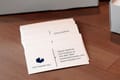
Keep one side calmer than you want to. A back panel that is fully printed edge to edge looks good in a mockup and gives you nowhere to write the note that makes the card survive. Leave a clear band, matte rather than gloss, and the pen will take. You can also earn coins on every order and put them against the next run.
Getting the file right before you print
Two things go wrong on business card files more than anything else, and both are cheap to avoid. Type placed too close to the trim gets cut into, because the guillotine works to a tolerance and a stack of cards shifts slightly as it is cut. Keep anything you care about at least an eighth of an inch inside the edge, and add the same amount of bleed outside it.
Print it
Standard business cards
The card to test your handoff with, before you pay for a finish.
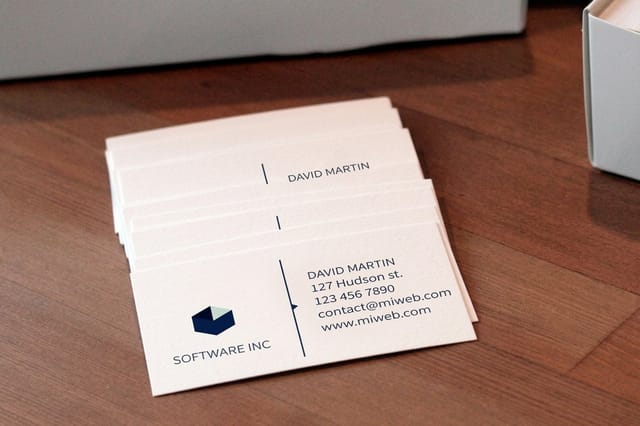
The second is the finish sitting in the wrong layer. Spot UV and foil both need their own artwork layer marked as a shape, not a color effect, and a file that flattens them into the main image comes back for a redo. File check and proofing catches that before the press runs, and the foil accent guide shows what the layer should contain. If the design itself is the hold up, our design service will build the file to spec.
What to hand out, by what you do
The right card depends less on your taste than on where the card is going to live once it leaves your hand.
- Trades and site work. Plastic or 16pt, because the card lives in a van and a wallet, and hand two at the end of the job so the neighbor gets one.
- Consultants and services. Standard stock with a spot UV mark, handed after you have answered something for free. The written note on the back does more than the finish.
- Creative and studio work. Holographic or raised foil, because your card is a sample of your taste and people show it to other people.
- Retail and hospitality. Volume matters more than finish. Standard cards at the till, in the bag, and tucked into the receipt.
- Real estate and property. Two cards every time, one to keep and one to pass on, and always write the property or the date on the back.
Blanks with the trim and bleed put in for you
If you are starting from nothing, a template saves the two mistakes above by putting the eighth of an inch bleed and the eighth of an inch safe margin in for you on a 2 x 3.5 card. The configurator also offers the 2 x 2 square, the 1.5 x 3.5 slim and the 2.125 x 3.375 size, so pull the blank that matches the size you order. 4OVER4.COM sizes its blanks to the exact product specs, so your artwork lands inside the cut line. Pull a blank from the blank template library or start from a layout in the design template library.
Start fast
Blanks with the trim and bleed put in for you
Business card layouts and exact size blanks with bleed and trim already marked.
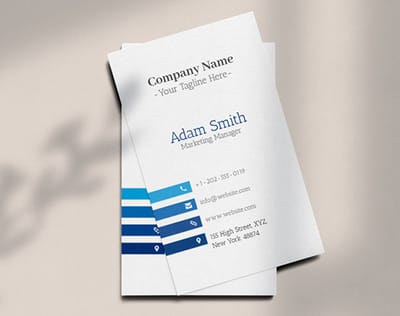
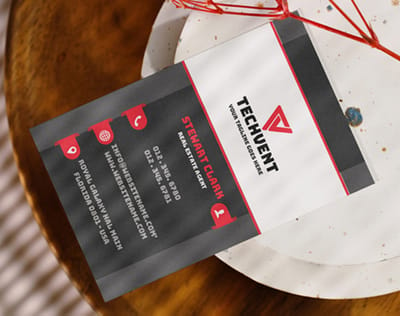
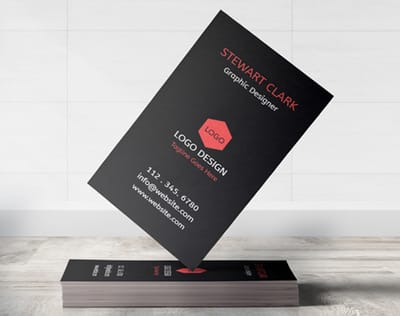
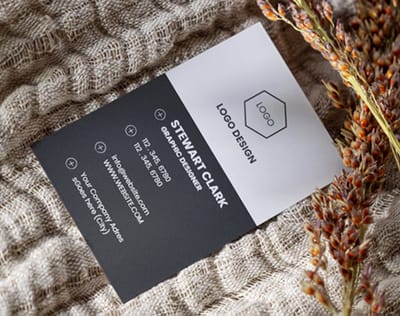





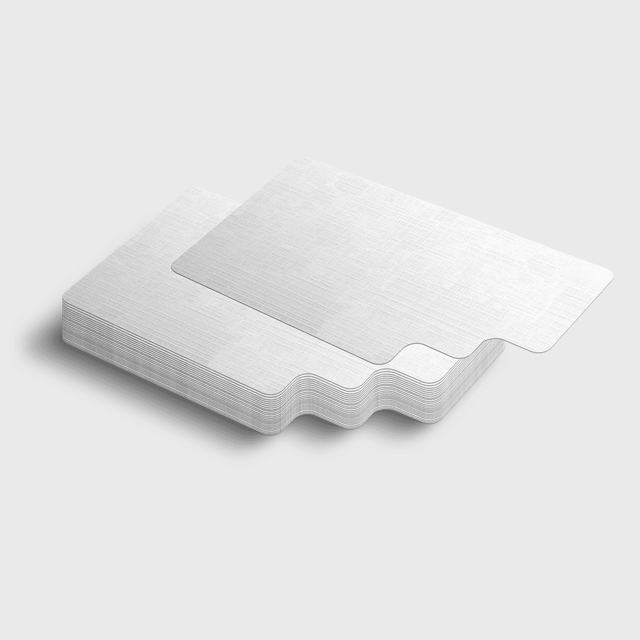
Wally hands the card over at the right moment
Answer first, then let the card be where the answer lives
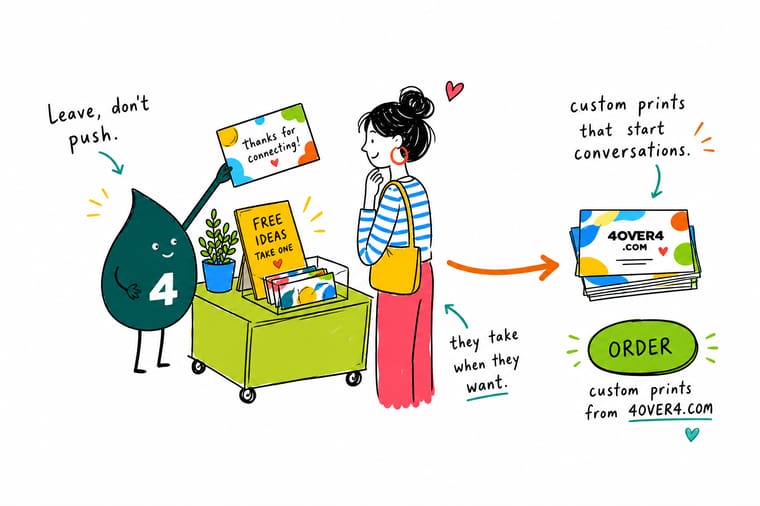
Wait until someone asks you something you can answer, give the answer properly, then hand the card as the place it is written down. Give two, one to keep and one to pass on, and write the promise on the back with a fine tip marker. Leave a matte band on the back so the pen takes, keep type an eighth of an inch inside the trim, and 4OVER4.COM prints the run on 14pt or 16pt stock.
Order business cards →What to remember about handing out cards
Habits that make the handoff easy
- Answer first, hand second. The card should arrive as the place your answer lives. Reverse that order and it reads as a pitch no matter how you say it.
- Write something on it. A size, a date, a name. Your handwriting is what stops the card being interchangeable with every other card in the pocket.
- Carry a marker, not a biro. A ballpoint skids and smears on a coated card. A fine tip permanent marker writes on gloss, foil and plastic laminate.
- Give two, not one. The second card is the referral ask, made without ever asking. People pass on a spare far more readily than their only copy.
- Sort the pile the same night. One line per card about what you talked about. A stack you cannot identify by midweek was never a stack of leads.
Explore more
Cards, finishes and where to leave them
Holographic cards run 250 for $251.36 in 15 business days and plastic 250 for $180.02 in 7.
Product Standard Business Cards From $17.57, cheap enough to hand out without counting. Product Spot UV Business Cards Gloss on a matte card, obvious the moment it is held. Product Raised Foil Business Cards Metallic and raised, so it registers by touch first. 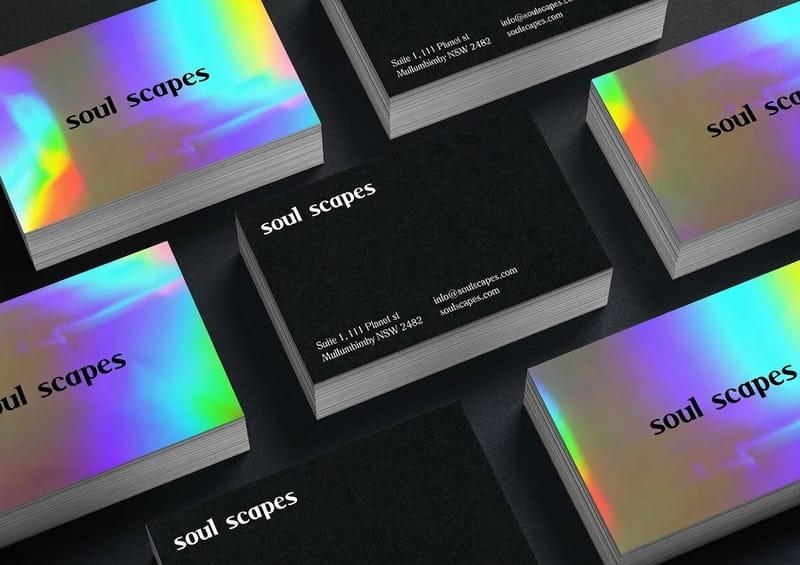 Product Holographic Business Cards The card people show to the person next to them.
  Guide Where to Leave Business Cards The passive side, and the places that actually work.
  Category Business Card Printing Every stock, size and finish in one place.
 Ready to print a box worth handing out?
Pick your stock and finish, drop in your design or a free template, and 4OVER4.COM prints it sharp and ships it as fast as your calendar needs.
Common questions about handing out business cards
When is the right moment to hand someone your business card?
Straight after you have answered a question they asked, and not before. At that point the card is the place your answer lives, so it reads as documentation rather than a pitch. Handing one over at hello gives the person a rectangle from a stranger with nothing to attach it to, which is why those cards end up in a pocket and then a bin. If the conversation never reaches a question you can answer, do not force it. A card given to somebody with no reason to keep it is a card you paid to print and then threw away yourself.
How do I give out my card without sounding like I am selling?
Say what you are going to do for them, then hand the card as the way to make that happen. "I will dig out the sizing sheet, message me and I will send it" followed by "everything is on here" does the whole job in two short sentences. Avoid asking permission, because "would it be alright if I gave you my card" makes the other person say yes to a stranger, which is the exact pressure you are trying to remove. Offer it flat, in one movement, and carry on talking about whatever you were already discussing.
Should I write on the back of my business card?
Yes, and it is the single highest return habit on this page. A size, a date, a name, whatever you just promised. The card then carries information the person cannot get anywhere else, so throwing it away costs them something. It also reminds you what you agreed to, which makes the follow up message specific instead of generic. Carry a fine tip permanent marker rather than a ballpoint, because a biro skates and smears across a gloss coated card. That is also the reason to think twice about plastic business cards if this is your main tactic, since nothing ordinary writes on them.
How many business cards should I take to a networking event?
Enough for the conversations you expect to have, plus a margin, which for most people is far fewer than they carry. Ten real conversations that each end with a card do more than sixty cards pressed into hands on the way past. Take a box rather than a handful so you are never rationing, but judge the evening on how many people you could describe afterwards, not on how many cards left the box. Standard business cards start at $17.57 at 4OVER4.COM, so the cost of carrying spares is not the constraint.
Does a fancy finish actually make a difference?
It buys you roughly three extra seconds while the person turns the card over instead of pocketing it, and that window is when they read the second line and reattach the card to your face. Spot UV at $76.88 is the best value version because it is nearly invisible in a photo and unmistakable in the hand. Raised foil at $86.78 registers by touch before anyone looks at it. Holographic at $251.36 gets shown to the person standing next to them, which is free distribution. None of it rescues a bad handoff though. Timing does more for your callback rate than any finish on the list.
