
Best Trade Show Collateral for Booth Traffic and Follow-Up


The best trade show collateral is light enough to carry for the rest of the day and specific enough to be worth keeping: a card or a one-page spec sheet for anyone who stops, and a sample or a short bound piece only for a qualified lead. The pieces that win after the show are different again, because a postcard mailed a week later arrives in an empty channel while every other exhibitor is still competing inside the same 48-hour inbox.
Trade show collateral compared
| Piece | What it costs to carry | When it earns a conversation | When it fails | Who it suits |
|---|---|---|---|---|
| Business card | Nothing, it fits a badge holder | Someone wants your name and nothing else yet | You expected it to explain the product | Every exhibitor, every show |
| One-page spec sheet | A few grams, folds into a bag | A buyer is comparing you against two other booths | It is really a brochure squeezed onto one side | Technical and industrial products |
| Product sample or swatch | Bulk, and you pay the freight | The product has to be touched to be believed | Handed to anyone who slows down | Print, textiles, materials, packaging |
| Multi-page brochure | Heavy, and the first thing binned | A named lead asked for the full range | Stacked on the counter for self-service | Long-cycle capital purchases |
| Mailed follow-up piece | Nothing, it never goes to the show | It arrives a week after the badge scan | It repeats what you already emailed | Any show with a real lead list |
Nothing on this list replaces the display that makes someone stop walking in the first place. Start with the booth, then decide what goes on the counter. You can see the full exhibitor range in trade show printing.
What to hand out on the floor
The floor piece has one job: survive the rest of the day. An attendee who takes something from you at ten in the morning is going to carry it past forty more booths, through lunch, into a hotel room, and then decide at the suitcase whether it flies home. Anything that is heavy, glossy and thick loses that decision, which is why hotel recycling bins fill with brochures on the last night of every show.
So the handout on the counter should be light and specific. A card, a single sheet, or a folded piece that carries one product family and one way to get in touch. Save the range, the case studies and the price list for the follow-up, when the person actually asked for them and has a desk to read them at.
The second thing that decides the floor piece is who is allowed to take it. If it sits in a stack at the front of the booth, everyone takes one, including the students, the competitors and the people collecting bag stuffers. That is not distribution, it is shrinkage. Hand pieces out yourself and the print run drops by half without losing a single conversation. Our first-time exhibitor checklist puts numbers around what to bring for a first show.
Two tiers, not one
The mistake that costs the most is printing one piece for everybody. A single expensive brochure means you either give it to everyone and burn the budget, or hoard it and hand out nothing. Print two tiers instead. The cheap tier goes to anyone who stops: a card or a one-page sheet, printed in volume, no agonising over who gets one. The expensive tier is a sample, a swatch book or a bound overview, and it only leaves your hands after a real conversation.
The split also fixes your quantities. You can estimate the cheap tier from booth traffic, which is a guess, and the expensive tier from qualified conversations, which is a much smaller and much more accurate number. Most exhibitors need a few hundred of the first and a few dozen of the second.
Print the URL as well as the QR code
QR codes belong on trade show print, because they keep the paper honest: anything that changes, like pricing, lead times or a spec sheet revision, lives on a page you control instead of on a run you already paid for. But print the readable address underneath it.
A show floor with several thousand people on the same cell towers and the same guest wifi is the one place a scan reliably fails, and a code with no fallback becomes a dead end. A short URL under the code costs nothing and rescues the scan that did not connect.
What Exhibitor Collateral Actually Means
Exhibitor collateral is everything printed that you bring to a show and then give away or leave behind. It is a narrower category than it sounds, and the line matters as soon as you are budgeting.
The display is not collateral. A booth kit, a backdrop, a banner and a table cover are capital that comes home with you and goes out again to the next show. Collateral is consumable. It leaves the hall in somebody else's bag and does not come back.
That split is why the two are priced and planned so differently. You buy a display once and spread it across a year of shows. You print collateral per show, against the number of conversations you expect rather than the number of people who walk past.
Event collateral is the wider term you will also meet. It covers everything printed for an event, including the signage, badges, programmes and wayfinding the organiser produces, so a lot of it is not yours at all.
The leave-behind that survives the flight home
A leave-behind is different from a handout. It is the piece you give to someone you have already qualified, and its job is to still be on a desk two weeks later when the decision gets made. That means it has to be either useful or physical enough that throwing it away feels wasteful.
Samples do this better than paper. If you sell something that has a texture, a weight or a finish, the sample is the argument, and no amount of photography replaces it. If you sell something you cannot hand over, the next best thing is a piece that carries information a buyer needs anyway: a sizing chart, a compatibility table, a materials comparison. People keep reference. They do not keep adjectives.
Watch the freight. Show freight is billed by weight against a minimum charge, and the advance warehouse adds handling on top, so a pallet of heavy brochures costs you at print, at shipping, and again on the way home if you overprinted. Two cartons of light pieces plus a small box of samples is the shape most booths should be aiming for, and it fits alongside the case that carries your fabric booth kit.
What makes a leave-behind get kept
Put something on it the buyer cannot get from your website in one search. A conversion table, a tolerance chart, a checklist for the thing they were asking about at the booth. That single practical block is why the piece stays on the desk instead of going in the drawer, and it is the difference between a leave-behind and a printed advertisement.
Then write the name of the person who handed it over on it. Ten booths later nobody remembers which company said the useful thing. A pen and thirty seconds fixes a problem no print budget can.
The booth itself is collateral
Everything above assumes people stop, and that is a function of the display, not the paperwork. A booth that reads from across the aisle does more for traffic than any handout, because the handout only works after the conversation has started.
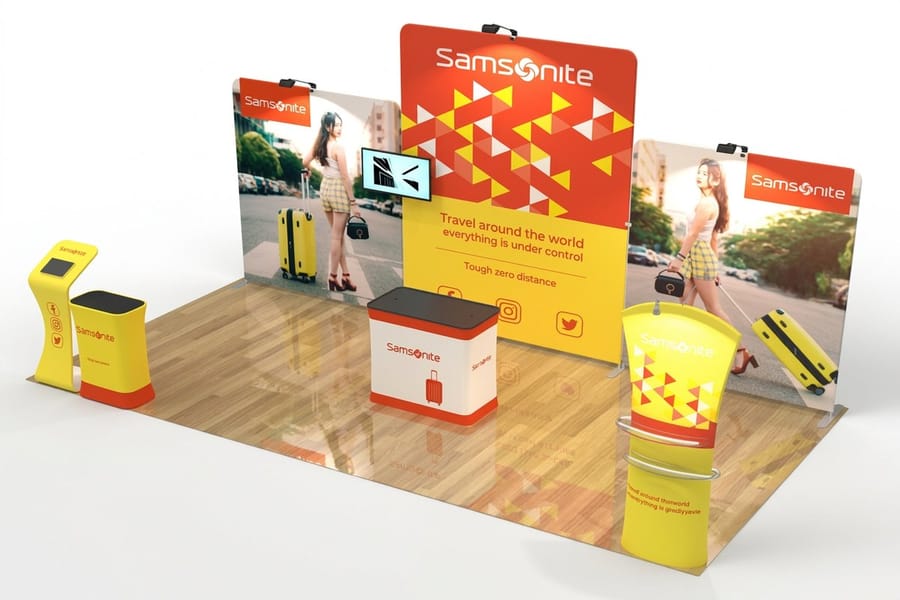
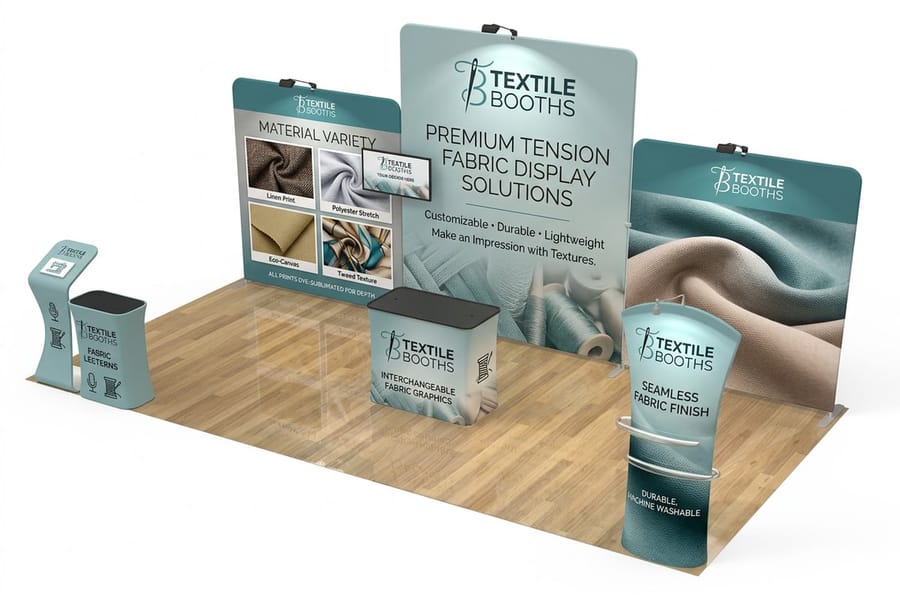
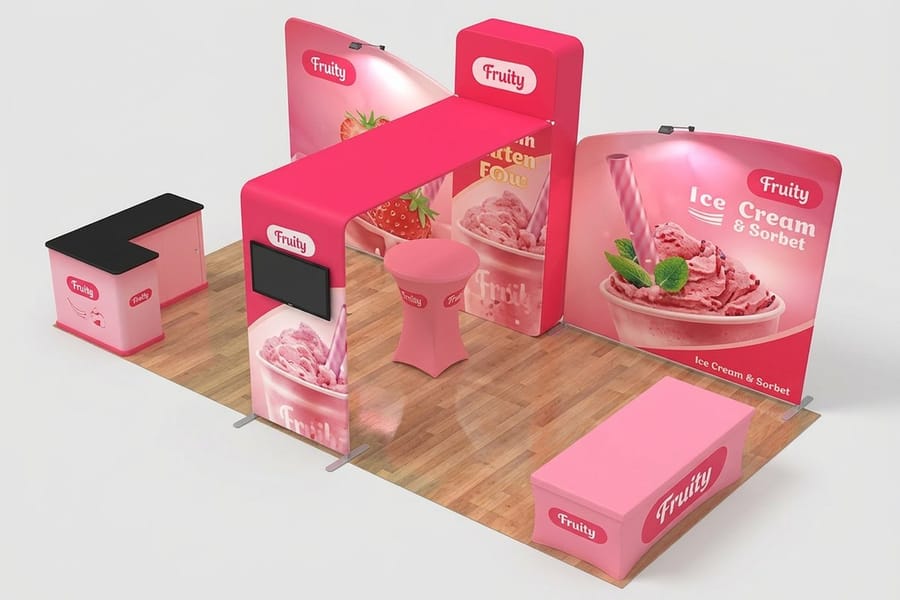
Kits solve this the pragmatic way: printed graphics, frame and case together, sized to a standard booth footprint. Trade show booth kits and fabric booth kits both start at $2,599.00 at 4OVER4.COM, and the practical difference is the graphic. Rigid panels hold colour hard and edge-to-edge; fabric packs smaller, travels as luggage, and washes out creases after a flight, at the cost of a slightly softer image. The booth design guide goes deeper on layout, and choosing trade show banners covers the pieces that fill the gaps around the kit.
Follow-up print, the piece that arrives after the show
Here is the part most exhibitors skip. Everyone you scanned gets an email within 48 hours, and so does everyone they scanned at the other two hundred booths. That inbox is the most crowded it will be all year, and a follow-up sent into it competes with every competitor you were standing next to.
Printed mail lands in the other channel, the empty one. A postcard or a short letter that arrives seven to ten days after the show reaches a desk with nothing else on it, at exactly the point where the badge scan has gone cold and the buyer has forgotten which of the four suppliers said the sensible thing. Reference the conversation in one line and the piece stops being direct mail and becomes a reminder.
The practical requirement is speed, not volume. You will have a few hundred names at most, you will have them the day after the show, and the piece needs to be in the post that same week. That is a short-run digital job, not an offset one, and it is worth setting up the artwork before you travel so the only thing left afterwards is the list.
Send it before the memory fades, not while the inbox is full
Send the email fast, because that is the channel people expect and because a lead who is ready to move will reply to it. Then let the print land a week later as the second touch. Two channels, staggered, is a completely different result from two emails.
Keep the piece to one offer and one action. A follow-up that lists everything you make is a catalogue nobody asked for. A follow-up that references the exact thing the buyer stopped to look at is a conversation restarting.
Booth kit pricing and specs at 4OVER4.COM
Collateral gets handed out inside a booth, so the booth is where the budget starts. The numbers below come straight from the live configurator, so you can size the display spend before you decide how much is left for paper.
Quantity and price
Trade show booth kit pricing and specs
Real configurator numbers for a complete kit, graphics, frame and case included.
| Quantity | Price Per Unit | Total |
|---|---|---|
| 1 | $2,599.00 | $2,599.00 |
| 2 | $2,599.00 | $5,198.00 |
| 3 | $2,499.00 | $7,497.00 |
| 4 | $2,499.00 | $9,996.00 |
| 5 | $2,499.00 | $12,495.00 |
If you exhibit more than once a year, the fabric version usually pays for itself on baggage and setup time rather than on print cost. Compare both in booth kits printing before you commit to a frame system, because the frame is the part you keep for years and the graphic is the part you reprint.
Rigid panels or fabric, and what it changes
Rigid graphic panels hold colour hard, sit dead flat, and look their best under the harsh overhead lighting most halls use. They also travel as panels, which means cases, freight and a real chance of a corner ding on the return trip. Tension fabric folds into a bag, comes out of a flight with creases that relax within an hour, and can be washed between shows. The trade is a slightly softer image and a little sheen under a spotlight.
Print it
Fabric booth kits, packed and ready
Tension fabric graphics on a push-fit frame, folded into a case that checks as luggage.
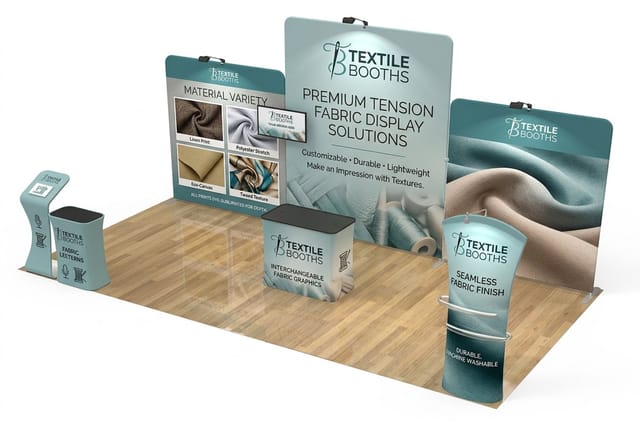
Pick by how you travel. A team driving to two regional shows a year can handle rigid panels comfortably and will get the better image out of them. Anyone flying to four or more shows should take the fabric and put the freight saving into samples, because a sample handed to a qualified buyer does more than a marginally crisper backdrop. For the pieces that fill in around the main wall, curved tension fabric displays covers the shapes that read well from an angle, and trade show poster sizes settles how big the surrounding graphics need to be.
What to print, by what you sell
The right mix changes with the product, so here is the split by business type.
- Manufacturers and industrial suppliers. A one-page spec sheet per product family, plus a materials sample for qualified leads. Buyers compare on numbers, so print the numbers and skip the adjectives.
- Software and services. You have nothing to hand over, so make the leave-behind useful in itself: a comparison table, an implementation checklist, a sizing worksheet with your name on it.
- Food, beverage and consumer brands. The sample is the pitch. Budget most of the collateral spend on getting product into hands and keep the paper down to a card with the wholesale contact.
- Agencies and studios. One printed piece of real work beats a capabilities deck. Take a small number of high-quality samples and give them out by hand, never off the counter.
- First-time exhibitors. Underprint the paper and overprint nothing. Bring one cheap tier, a small expensive tier, and put the saved budget into the display so people stop in the first place.
Planning the run before you travel
Everything gets harder the week of the show, so the decisions worth making early are the boring ones: how many of each tier, what the follow-up piece says, and who is allowed to hand out the expensive samples. Trade show facts and statistics is a useful sanity check on what the floor actually looks like before you plan around it.
Wally packs the collateral that comes home in a pocket, not a bin
Two tiers, handed over, never stacked
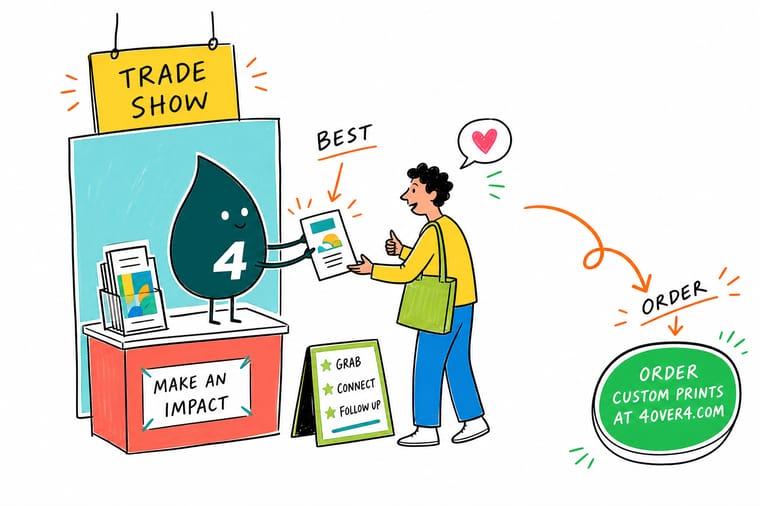
Print a light cheap piece for anyone who stops and a small run of samples or bound pieces for qualified leads only. Put the changeable facts behind a QR code with the readable URL under it, keep the weight down because show freight bills by weight, and have the mailed follow-up artwork ready before you travel so it posts the week after the show.
Order a trade show booth kit →What to remember about trade show collateral
Rules that hold at any show size
- Weight is a design constraint. Every gram is something an attendee has to carry and something you pay freight on twice. Decide the format by what it weighs before you decide what goes on it.
- Hand it over, never stack it. A pile at the front of the booth is taken by everyone and read by nobody. Handing pieces out yourself halves the run and doubles the relevance.
- Put the changeable facts behind a code. Prices, lead times and revisions go on a page you can edit. Print the readable URL under the QR so a failed scan still finds you.
- Give the piece a reason to be kept. A chart, a checklist or a table the buyer would otherwise have to look up. Reference stays on desks; advertising goes in the bin.
- Set the follow-up artwork before you travel. The only thing you should be doing the week after the show is loading a list. Everything else should already be print-ready.
Explore more
More ways to print and exhibit
Related products, categories and reading on 4OVER4.COM, one card each, so you can keep planning the show.
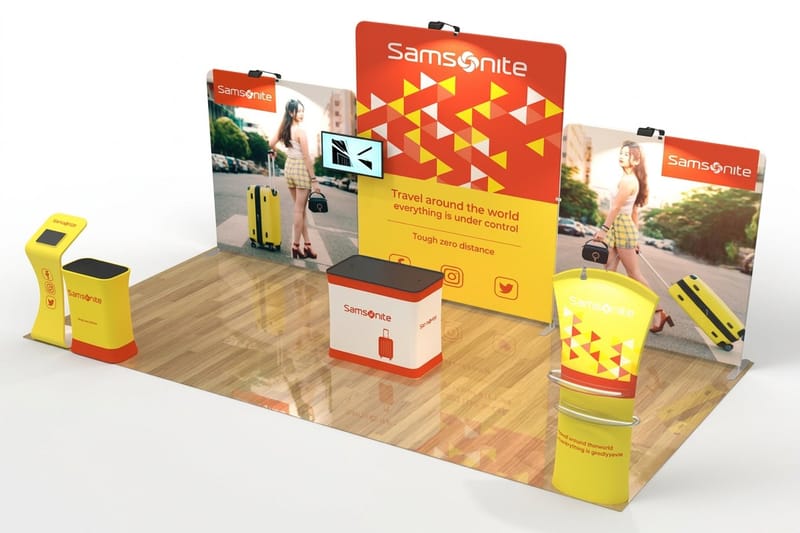 Product Trade Show Booth Kits Printed graphics, frame and case, sized to a standard booth.
 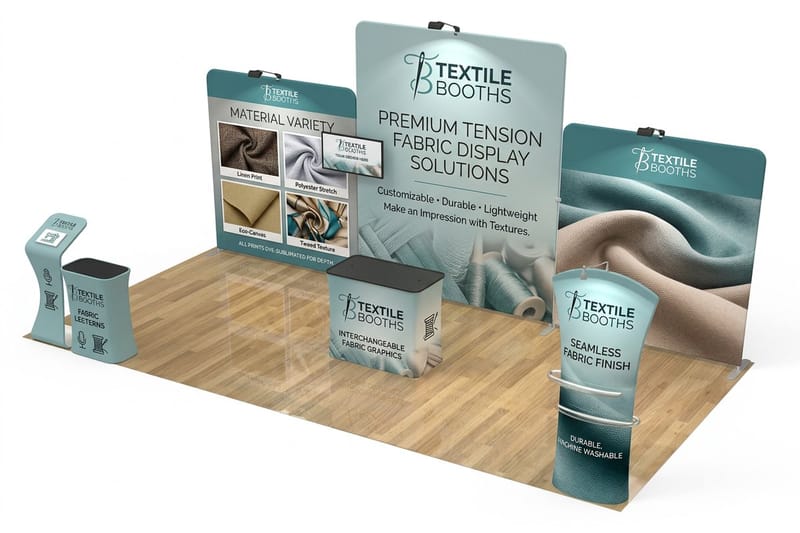 Product Fabric Booth Kits Tension fabric graphics that pack down and travel as luggage.
  Category Trade Show Printing Every piece an exhibitor prints, in one place. Category Booth Kits Printing Complete display kits by size and graphic type.
  Guide Trade Show Booth Design Layout and sightlines that make people stop walking.
  Guide Trade Show Banner Sizes Which banner type fits which spot in the booth.
  Article Booth Ideas and Materials Checklist What to build the booth from, and what to pack.
  Article 7 Steps to Trade Show Marketing The plan around the booth, before and after the show.
 Ready to print for your next show?
Pick the kit that matches how you travel, load your graphics, and 4OVER4.COM prints and ships it in time for move-in day.
Common questions about trade show collateral
What does exhibitor collateral mean?
It is the printed material an exhibitor brings to a trade show to hand out or leave with a prospect. Cards, one page spec sheets, samples, short bound pieces and the follow up mailer all count. The booth itself, the banners and the table cover do not, because they travel home again and get used at the next show rather than being consumed at this one.
What does collateral mean in marketing?
Marketing collateral is any produced material that supports a sale rather than making one directly. Brochures, case studies, spec sheets, presentation decks and sell sheets are the common examples, and the defining feature is that a person uses them inside a conversation instead of them working alone the way an advertisement does. The word comes from collateral in the sense of accompanying, not from the financial meaning.
What does event collateral mean?
Event collateral is everything printed for an event, which is a far wider net than what any one exhibitor brings. It takes in the organiser's signage, wayfinding, badges, lanyards, programmes and floor plans alongside the handouts exhibitors print for their own booths. If you are quoting a job, agree which half of that you are being asked for before you price it.
How much collateral should we bring to a trade show?
Estimate the cheap tier from expected booth traffic and the expensive tier from expected qualified conversations, and accept that the second number is much smaller. Most single-booth exhibitors need a few hundred cards or one-page sheets and a few dozen samples or bound pieces. Underprinting is cheaper than overprinting, because leftovers either ship home at freight rates billed by weight or get thrown away at the hall. If you run out of the cheap tier on day one, that is useful information for the next show, and it costs you far less than the pallet that came back untouched.
Do printed handouts still work when everyone scans badges?
They work for a different job. The badge scan captures the lead for you; the printed piece is what the attendee keeps to remember which of the two hundred booths you were. Those are not the same task, and the scan does nothing for recall. The handouts that fail are the ones trying to be a website: long, general, and full of information the person could have looked up. The ones that work carry a single specific thing the buyer would otherwise have to search for, plus a clear way to reach a named human.
Should we print prices on trade show handouts?
Print prices only when they are stable for at least a year and you are happy for a competitor two aisles over to read them. Otherwise put the pricing behind a QR code that points to a page you control, and print the readable URL underneath it in case the scan fails in a crowded hall. The advantage of the code is that you can update the page the week after the show without reprinting anything. The disadvantage is that a buyer comparing three booths on the spot cannot see your number, so for straightforward commodity products the printed price often wins the comparison.
What should we mail after the show, and when?
A postcard or a short letter, arriving seven to ten days after the show closes. Send the email within 48 hours because that is what people expect, then let the printed piece land as the second touch once the post-show inbox has cleared. Reference the specific thing the person stopped to look at in the first line, name the person who spoke to them, and give exactly one action. Because the list is small and you only get it the day after the show, this is a short-run digital job, so set the artwork up before you travel and leave only the addresses to load.
Is it cheaper to ship collateral to the show or carry it?
For small quantities, carry it. Show freight is billed by weight against a minimum charge and the advance warehouse adds handling on both directions, so two light cartons that fit as checked baggage often cost less than the minimum on a shipment. Once you are past what a couple of people can reasonably move through an airport, ship it, and ship only what you expect to hand out. A fabric booth kit helps here for the same reason, because the graphics fold into a case instead of travelling as rigid panels.
