
Why an Address Correction Fee Appears After a Shipment Leaves


A correction charge is billed for research the carrier did after your label printed. A handful of things set it off, the residential flag is not yours to set, and a list can be cleaned before it reaches the press.
A UPS address correction fee shows up after the fact because it is billed when a hub or a driver has to research an address the label got wrong, and that research happens days after the label printed. The usual triggers are a missing apartment or suite number, a street name or number that does not match the ZIP, a missing directional, or a PO Box on a ground service. A basic ZIP check catches almost none of them. Delivery point validation, run on the list before it goes to press, catches the expensive ones.

Quick answer
The charge is research, and research happens after the label
An address correction fee is billed when the carrier has to work out where a package really goes. That work happens in a hub, days after your label printed, so it reaches you as an invoice line rather than a checkout total. Missing unit numbers are the single largest cause, followed by a street that does not exist in the ZIP you supplied and a PO Box on a service that cannot serve one. Validation removes most of it, but only if you buy the level that confirms the exact delivery point rather than the level that only checks the ZIP.
What the Correction Charge Is Actually Paying For

The fee is not a penalty for a typo. It buys human work. A package reaches a hub or a driver with an address that cannot be delivered as written, someone researches the real address, edits it in the system, and pushes the package back out. That research happens two or three days after your label printed, which is why the charge appears on a later invoice instead of at checkout.
Two details catch people out. The charge is assessed against each package that needed the correction, so a five carton shipment going to one bad address can carry it five times. And the package almost always still arrives, which means a clean tracking history proves nothing about the quality of your address data.
The correction charge also sits separately from the residential surcharge and the delivery area surcharge. Seeing all three on one package is common, and each has a different cause. Fixing the address removes one of them and does nothing about the other two.
The Address Faults That Trigger a Correction

Six faults account for nearly all of it, and they do not fail at the same stage. Sorting them by which check catches them is the fastest way to decide what your list actually needs.
| Fault | What happens to the package | Which check catches it |
|---|---|---|
| Missing apartment, suite or unit | Driver has no specific destination in a multi-tenant building, so the hub researches it. | Delivery point validation only. |
| Street number outside the real range | Corrected against carrier records, then delivered. | Street level matching. |
| City or state that does not fit the ZIP | Rerouted, occasionally to a different hub, adding a day. | The basic city and ZIP check. |
| Missing directional, the N, S, E or W | Sent to the wrong end of a split street. | Street level matching. |
| PO Box on a ground service | Undeliverable by that carrier, returned or rerouted. | None. The address is valid, just not for that service. |
| Unit number stranded on its own line | Slower sortation and a manual look, sometimes a full research. | None. It passes every check and still causes trouble. |
That last row is the one worth memorising. Postal addressing standards put the secondary unit designator on the same line as the street address, right after it, and move it to the line above only when the line runs out of room. A file that stacks STE 400 above the street passes every validation service on the market, prints beautifully, and still slows a driver down.
When those faults live in a spreadsheet, printing multiplies them. A run of standard address labels from $23.88 is cheap to reprint. A run that already shipped on a thousand cartons is not. Fix the list before it goes to press.
Residential or Commercial Is the Carrier Call, Not Yours

You do not classify the address. The carrier does, from its own delivery observations, and it rebills you when it disagrees with the box you ticked in your shipping software. Marking a home office as commercial to duck the residential surcharge is the most reliable way to earn an adjustment on a later invoice, plus a correction charge on top if the address needed research anyway.
Classification follows the building, not the recipient. A consultant working from a townhouse is residential no matter how the company name reads on the label. A retail unit on the ground floor of an apartment block is usually commercial, because a driver serves it during business hours. When a location genuinely changes use, the carrier updates it from driver data over months, not from what a shipper types this week.
The practical move for a mailing is to split the list before you quote the job. Residential rows carry their own surcharge, and in remote ZIPs they pick up the extended delivery area surcharge as well, so a list that is 60 percent residential prices very differently from one that is 10 percent. Building that split in takes a filter and five minutes. Our guide to addressing a package for e-commerce shipments covers the label side of the same problem.
Validate the List Before It Reaches the Press

Three checks do almost all of the work, and they are not interchangeable. Buying the cheap one and calling the list validated is where most of the money leaks.
- City, state and ZIP matching. Confirms the three agree with each other. It catches a transposed ZIP and nothing else, and it is the check most cheap tools stop at.
- CASS, street level matching. Certified matching against the postal address file. It fixes misspelled streets, bad number ranges, missing directionals, and it appends the ZIP plus four that identifies the delivery segment.
- DPV, delivery point validation. The one that answers the question the others dodge: does this exact unit exist. It is what fails an address missing its suite number, and it is what removes the single biggest source of correction charges.
None of the three tells you whether the recipient is still there. That is a separate lookup against change of address records, which cover moves people actually filed with the postal service. Run it on any list older than a season and you will find rows you would otherwise print, ship, and pay a return on.
Here is the trade-off nobody mentions when they sell validation. The service hands the address back in postal standard form: uppercase, abbreviated, punctuation stripped. That form routes best and it looks wrong on anything a customer is meant to admire. Keep two columns in the list, the validated form for the carrier and the human form for the print, and decide per product which one goes on the label. Shipping cartons take the postal form. A printed return address label on an invitation should read the way a person writes it, and premium address labels from $29.16 are usually going on something where that matters.
One honest limit. Postal validation checks against the postal database, and the carrier routes against its own, so the two can disagree on new construction, recently renumbered streets, and campuses where a building code beats a street number. A validated address is far less likely to trigger a correction. It is not a contract. For volume work, roll address labels from $322.98 come as a continuous roll rather than sheets, which suits a validated list you print in one pass, and the full range sits on the address labels printing page.
Wally explains the correction fee
The label left clean looking, and the bill came later
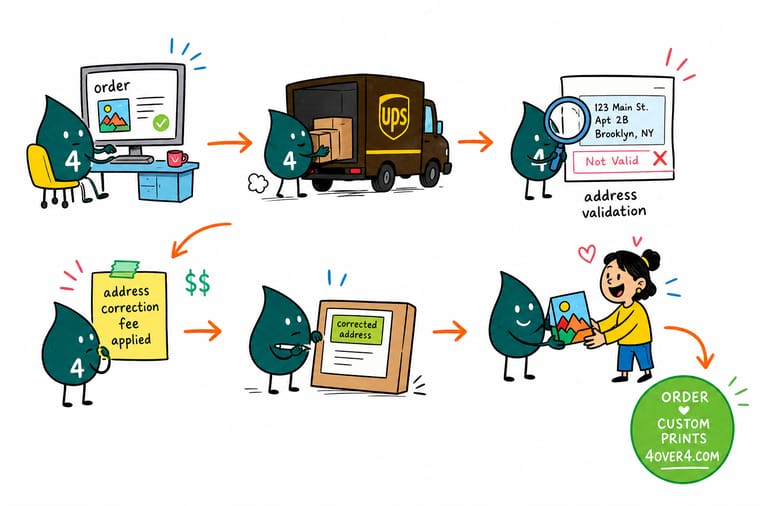
Wally prints a label that says 1350 Broadway and stops there. The street is real, the ZIP is right, and every cheap validator waves it through. Then the driver reaches a building with forty tenants and no suite number, the hub looks the company up, and the research shows up on next week's invoice. Wally now runs the list through delivery point validation first, keeps the postal form for the carton and the human form for anything a customer reads, and prints once.
Order standard address labels →Specs and pricing
Address label stocks, sizes, and starting prices
Compare the label options side by side, with live configuration choices and starting prices straight from the 4OVER4.COM configurator.



Print it
Print the list once, on labels that stick



Explore more
Where to go next





By the numbers
Shipping labels come off the same floor as the print
Common Questions
Your address correction questions, answered
Why did the address correction fee appear days after my package shipped?
Because the charge is created by an event in the network, not at the point of sale. A package leaves with the address you supplied, and only when a hub scan or a driver hits a problem does UPS research the correct address, edit it, and attach the correction charge to that tracking number. The charge then flows onto the next weekly invoice. Nothing in tracking flags it, which is why most shippers discover corrections by reading invoice detail rather than by watching deliveries.
Does the package still get delivered when a correction fee is charged?
Usually yes, and that is exactly what makes the fee easy to miss. UPS researches the address, completes the delivery, and bills the research. A delivered package is not evidence that your address data was clean. If you want to find the faults in your list, sort a month of invoice lines by charge type rather than looking at the tracking history.
Can I dispute a UPS address correction charge?
You can request a review, and the argument that works is evidence that the address as supplied was complete and deliverable. A screenshot of the validated address, with the delivery point confirmed, is the useful attachment. Disputes based on the package arriving on time do not go anywhere, because delivery is not what the fee is charging for. Build the habit of storing the validation response alongside the order record and the dispute takes two minutes instead of an afternoon.
Will address validation stop every correction fee?
No, and any service that promises it is overselling. Postal validation checks an address against the postal database. Carriers route against their own address data, so the two can disagree on new construction, recently renumbered streets, and large campuses where a building code matters more than a street number. What validation does reliably is remove the ordinary faults, which is the overwhelming majority of them: missing units, bad ZIP and city pairs, misspelled streets, missing directionals.
Why does a PO Box trigger a problem when the address is perfectly valid?
Because validity and deliverability are different questions. A PO Box is a real, confirmable delivery point in the postal database, so it passes every validation check. Ground services from a private carrier cannot deliver to one, since the box sits inside a post office. The fix is a filter, not a validator: flag PO Box rows in the list and route them to a postal service or to a hybrid service that hands the parcel to the postal service for the final leg.
Where exactly should the suite number sit on a printed address label?
On the same line as the street address, immediately after it, as in 1350 BROADWAY STE 400. It moves to the line directly above the street address only when the line genuinely runs out of room. A label that stacks the unit designator on its own line above the street passes validation, prints attractively, and still costs a driver time. If you are laying out a label template, set the street line wide enough that the designator fits beside the street in the common cases.
Get Started
25 address labels cost $23.88, roll labels 100 for $322.98
Pick a sheet, a premium stock or a continuous roll, upload the validated file, and we print address labels that go on straight and come off the roll without a fight.
Legal Disclaimer
Gold Standard guarantees apply to all standard orders placed through 4over4.com. Price match requires verifiable proof of a competitor's published price for an equivalent product with matching specifications and turnaround time. Satisfaction guarantee covers manufacturing defects and print quality issues. Contact support with order number and documentation. On-time delivery rate based on tracked orders 1999 to 2026. Individual results may vary based on shipping carrier performance.
