
Suede vs Cotton vs Ultra Thick Linen Business Cards Compared on Feel, Finish and Turnaround


Three premium stocks, three different jobs. Each has a real caliper, a way it takes ink, a list of pressed finishes it accepts, a price for 250 cards, and a wait measured in days.
Suede is a 16pt card sealed in a soft touch laminate, cotton is a 45pt uncoated sheet, and ultra thick linen is a 24pt uncoated sheet with a weave pressed into it. Suede is the fast, affordable one at $87.15 per 250 on a 4 business day turnaround, and the only one that takes spot UV or a rush. Cotton and linen are the pressed effect cards, the only two that take foil, debossing and edge painting, and both run 15 business days at four times the entry price.
Quick answer
One sealed card and two bare sheets
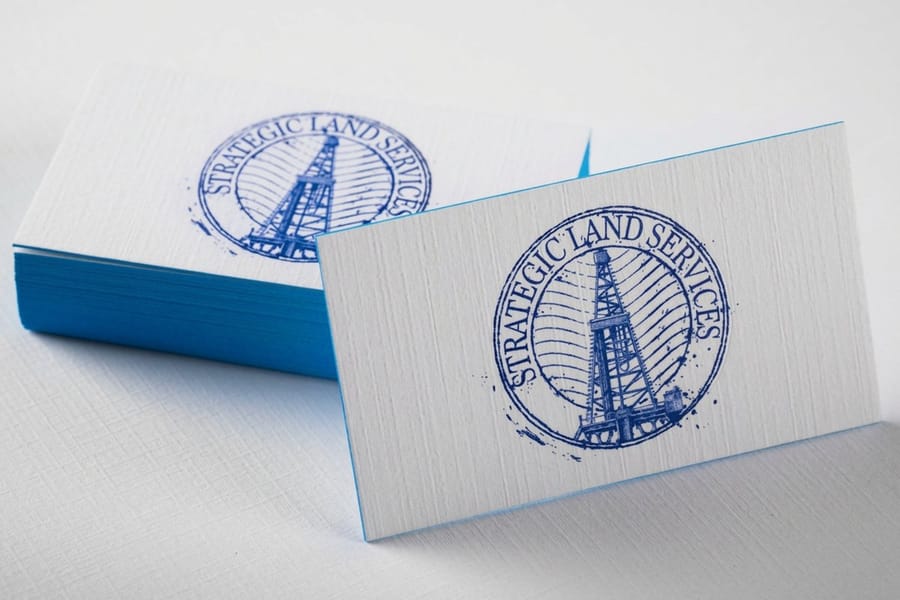
The line that matters runs between the laminate and the paper. Suede is a 16pt card under a soft touch film, so it keeps ink crisp, takes spot UV, ships in 4 business days and starts at $87.15 per 250. Cotton at 45pt and ultra thick linen at 24pt are uncoated, so ink sinks in, foil and debossing register, edge painting has something to grip, and both need 15 business days and roughly four times the entry price. Choose the film for speed and volume, the bare fiber for the card that gets kept.
What Suede, Cotton and Linen Actually Are
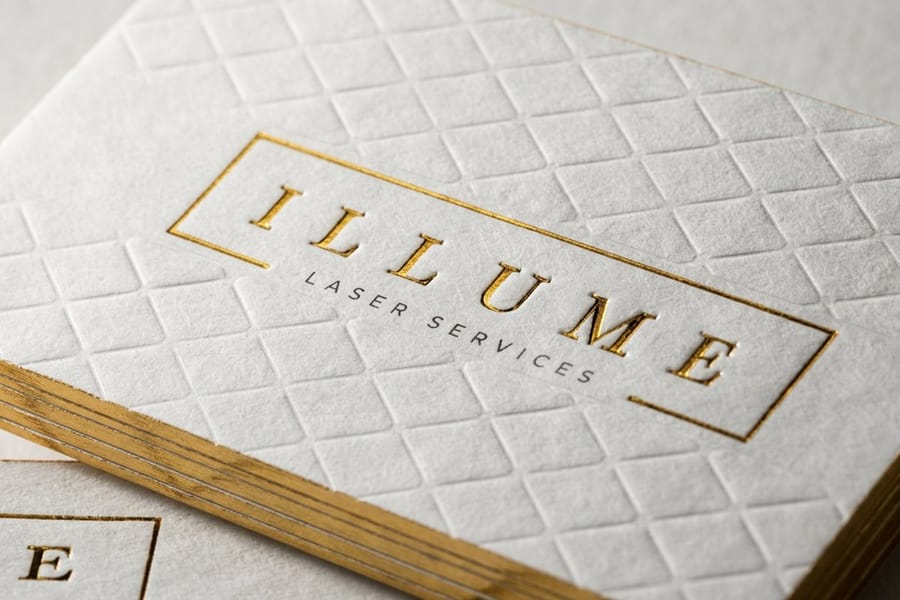
Two of these are paper and one is a film. Cotton and ultra thick linen are uncoated sheets that you touch directly. Suede is an ordinary 16pt printed card sealed inside a soft touch laminate, so what your fingers read is the plastic, not the paper under it.
That split explains almost everything that follows. A sealed surface holds ink on top of itself and rejects anything pressed into it. A bare surface drinks the ink and takes an impression. Once you know which side of the line a stock sits on, the finish menu and the price stop looking arbitrary.
| Stock | Caliper | Surface | Embellishments | 250 cards | Standard production |
|---|---|---|---|---|---|
| Suede | 16pt | Soft touch suede laminate, matte and velvety | Spot UV, rounded corners | $87.15 | 4 business days |
| Ultra Thick Linen | 24pt | Uncoated white linen with a pressed weave | Foil, deboss, painted edge | $377.68 | 15 business days |
| Cotton | 45pt | Uncoated cotton fiber, soft matte tooth | Foil, deboss, painted edge | $328.42 | 15 business days |
Caliper is measured in points, and a point is one thousandth of an inch, so the cotton card is 0.045 in against 0.016 in for suede. If the ladder of thicknesses is what you are really comparing, 14pt vs 16pt vs 32pt business cards walks the whole range, and business card stock explained covers the surfaces we print on across business cards printing.
How Each One Feels, and What the Feel Costs You
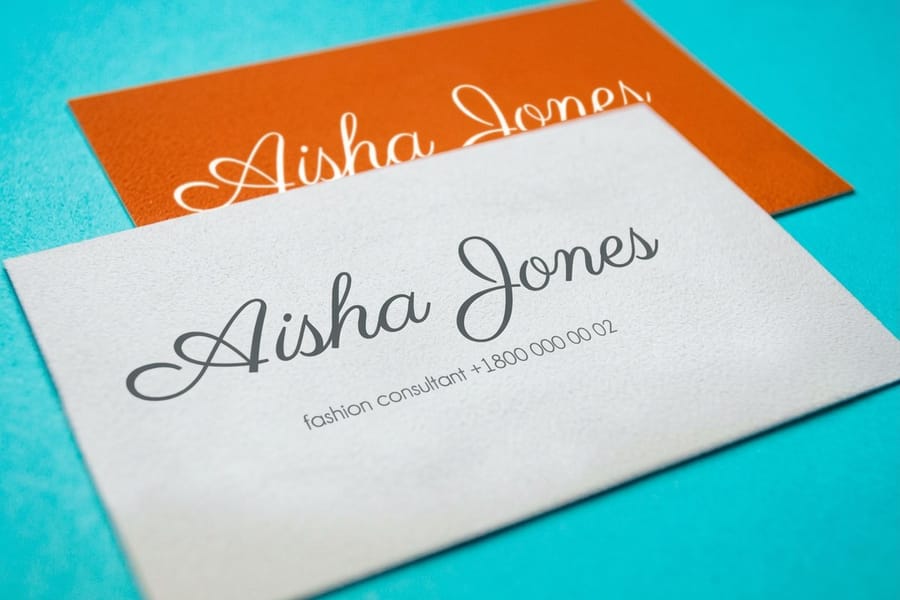
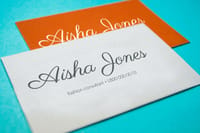
Suede is the one people react to fastest. The laminate has real drag under a fingertip, closer to velvet than to paper, and it happens on a card that still measures like a normal card. Nobody picks up a suede card and comments on its weight. They comment on the surface.
Cotton is the opposite reaction. Nothing about the surface is dramatic, but 45pt is heavy enough that people adjust their grip. The sheet is soft and slightly warm, with the open tooth of a fine art paper, and the edge is thick enough to read from across a table. It behaves like a small object rather than a piece of card.
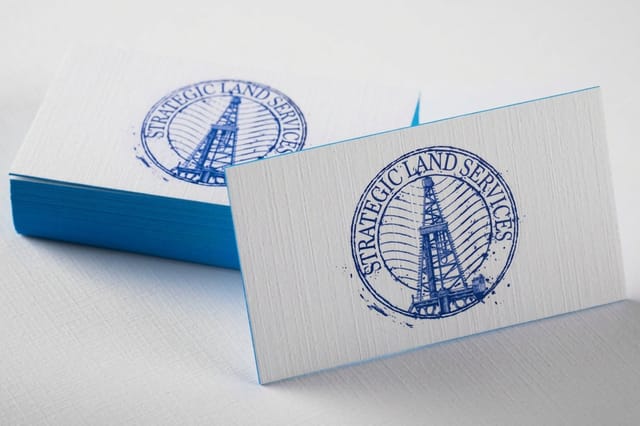
Linen sits between the two and is the only one that talks to your fingertips in a pattern. The weave is pressed into the sheet, so you feel a fine crosshatch, the finish people associate with wedding stationery. At 24pt it has a rigid snap without the desk presence of the cotton sheet.
The trade is straightforward. A laminate protects the card and gives it a memorable surface, but it seals the paper away, and it will not take a pen. Bare fiber gives you a warmer surface and accepts anything you press or write on it, and it scuffs where a film would not. If soft touch is the specific feel you are chasing, our comparison of matte, gloss and soft touch finishes is the better starting point.
How Ink and Embellishments Behave on Each Stock
On suede the ink is printed first and then covered, so color stays exactly where the press put it. The matte film knocks a little brightness out of a saturated photo, and in exchange nothing bleeds, nothing spreads and fingerprints do not show. That is why a spot UV accent works so hard on this card: glossy raised varnish against a flat matte field is the strongest contrast you can get with one color.
On cotton the ink sinks into the fiber. Solids come out deep and slightly soft edged, and thin rules and small reversed type thicken a touch as the ink spreads. Design for it rather than around it. Thicken your hairlines, set small type a shade heavier than you would on a coated sheet, and let a deboss or a painted edge do the work a varnish would do elsewhere. Cotton takes no gloss or UV coating at all, because sealing the surface removes the reason to buy it.
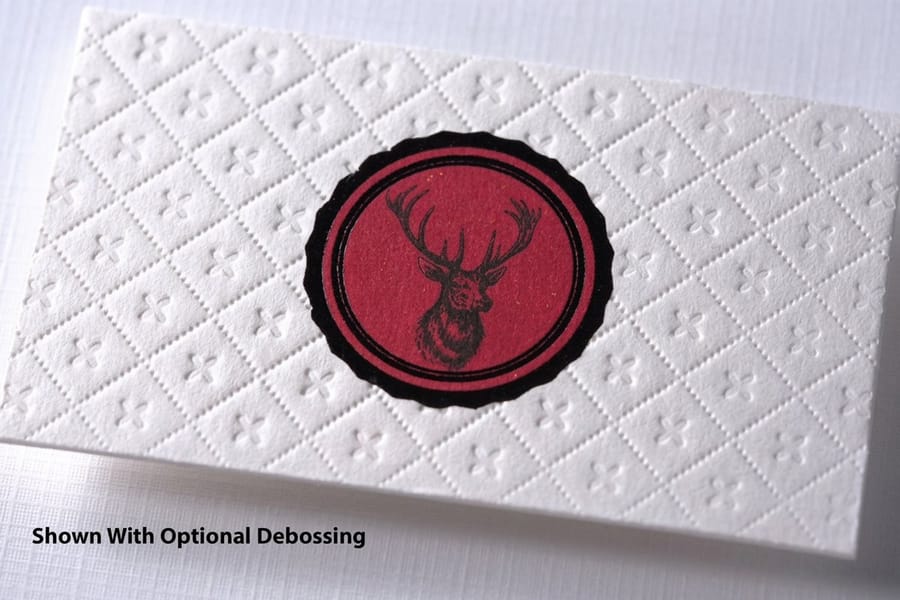
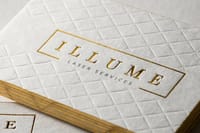
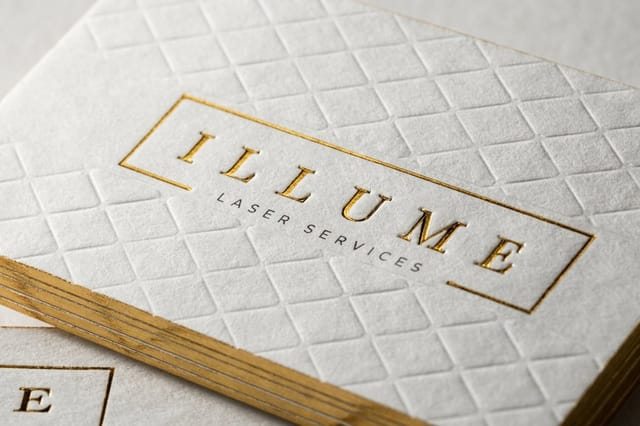
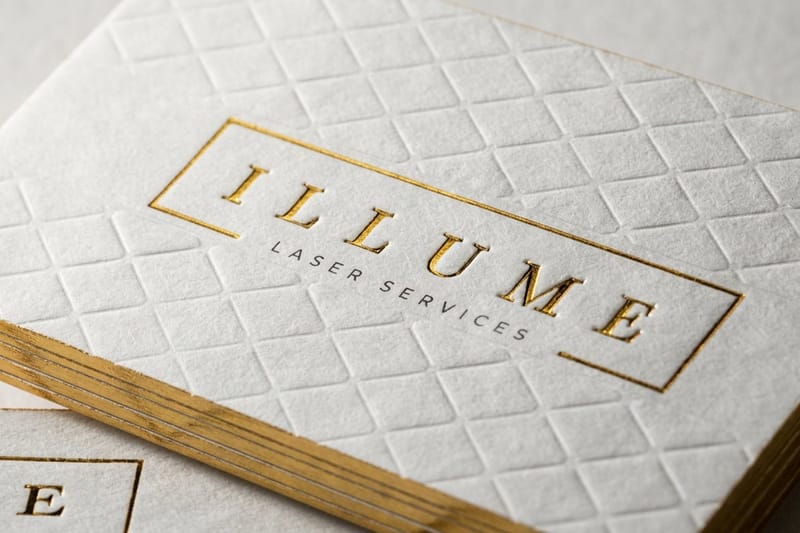
Linen adds a texture under the ink. The pressed weave means a photograph picks up the crosshatch and fine detail softens, while flat color and confident type look considered. Foil is the finish that pays off most here: hot metal against a woven ground is a contrast you cannot fake in ink.
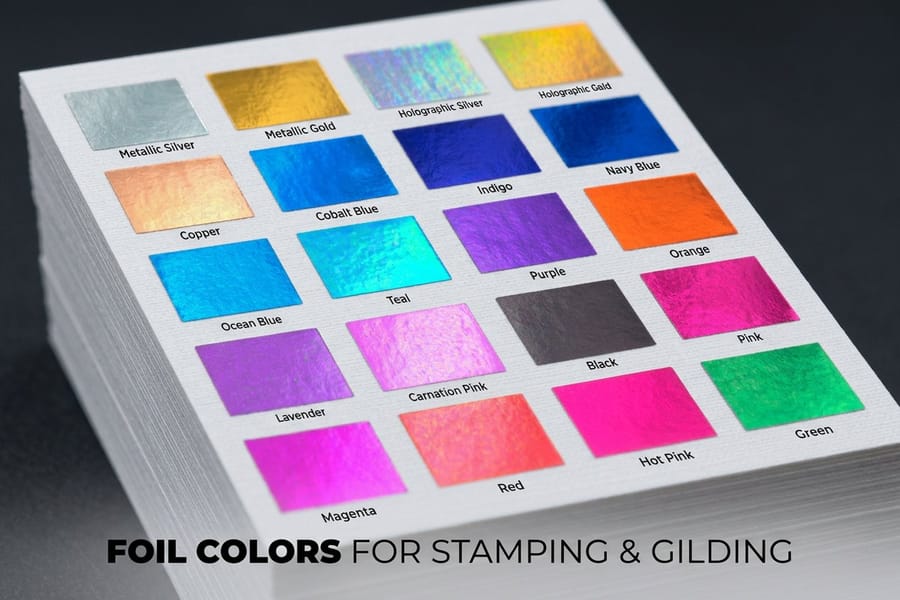
Cotton and linen both accept foil stamping, debossing and edge painting on one or both sides. Suede accepts none of them. If those pressed effects are the point of the card, read embossed vs debossed before you build the file, check what the metal actually does in foil stamping vs foil printing vs metallic ink, and see how the color band is applied in painted edge business cards. For the glossy route on suede, what spot UV printing is covers the setup.
What Each One Costs in Money and in Days
Start with the calendar, because it removes options faster than the budget does. Suede business cards run a 4 business day standard turnaround with rush tiers at 3 days, 2 days, next day and same day. Cotton and ultra thick linen both run 15 business days standard. If your event is inside three weeks, suede is the only one of the three that can make it.
Now the money, per set of 250 and then at volume.
| Stock | 250 cards | 1,000 cards | Top tier | Per card at the top |
|---|---|---|---|---|
| Suede | $87.15 | $137.68 | 5,000 for $327.15 | About $0.07 |
| Ultra Thick Linen | $377.68 | $630.31 | 2,000 for $1,009.25 | About $0.50 |
| Cotton | $328.42 | $548.09 | 2,000 for $877.60 | About $0.44 |
Read the first column and the last column together. At 250 cards suede is roughly a quarter of the price of the other two. At volume the ratio changes shape entirely, because suede keeps scaling to 25,000 while cotton and linen stop at 2,000. The uncoated stocks are priced as short run premium pieces, and they behave like it.
Both uncoated cards include a free online proof, which is worth taking on a 15 day job. A thin reversed rule that will thicken on cotton is far cheaper to catch on screen than at 250 cards. For the wider picture on where the money goes as a run climbs, see what business cards cost and why.
Which Card to Order for Which Job
Pick by the job the card has to do, not by which one sounds most premium.
- You hand out cards constantly and the date is close. Suede. It is the cheapest per card, it ships in 4 business days, and the surface still gets a reaction at an event.
- The card is the pitch and it gets handed over once. Cotton. 45pt with a painted edge is a physical object, and the person you gave it to will not throw it away.
- You want texture and pressed effects on a card people still file. Ultra thick linen. Foil on a woven ground at 24pt, without the bulk of a 45pt sheet.
- People write on the back of your card. Cotton or linen. Bare uncoated fiber takes a pen. Any laminate, suede included, does not.
- You need a photograph to hold detail. None of these three. Move to a laminated card such as silk laminated business cards, or read what silk laminated business cards are first.
Whichever you choose, settle the size and the bleed before you upload. All three trim after printing, and on a thick uncoated stock the cut edge is far more visible, so a border that looks even in the file can look uneven on the card. Start from a press ready file in the blank template library, check the measurements against the business card size guide, or build the layout in our design templates and let the stock carry the texture. If cotton and linen have you curious about the fibers themselves, 75 cotton 25 linen paper explains the blend that stationery mills use.
Wally sorts the three stocks
One card is sealed, two are bare, and that decides everything
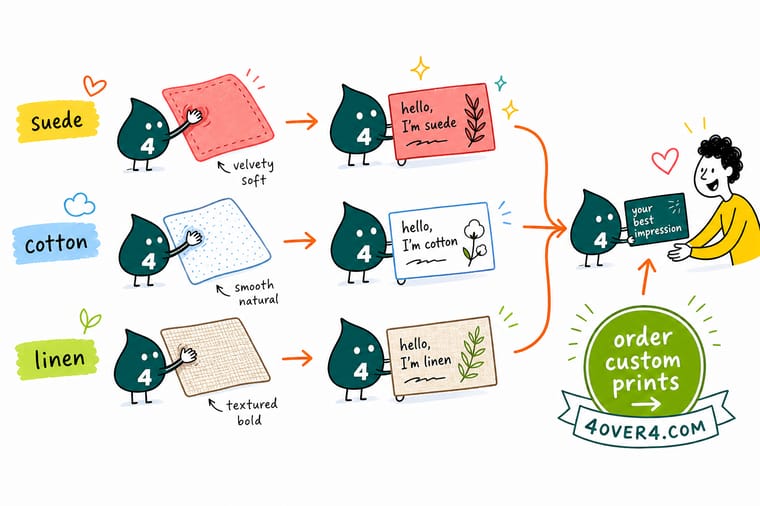
Wally runs a thumb across all three. The suede card is a film, so the ink stays crisp underneath and a spot UV logo goes glossy on the matte, but nothing presses into it and a ballpoint just skates. The cotton card is 45pt of bare fiber, so the ink sinks in and the foil, the deboss and the painted edge all bite. The linen card is the same bare fiber with a weave pressed through it, textured under foil and matte under color. Speed and volume, take the film. A card somebody keeps, take the fiber.
Compare every business card stock →Pros and cons
The upside and the trade-offs, stock by stock
Suede business cards, 16pt laminated
The upside
- Soft touch laminate that reads velvety and matte the moment it lands in a hand
- 4 business day standard turnaround, with 3 day, 2 day, next day and same day rush
- Cheapest of the three by a wide margin at $87.15 per 250, near 7 cents a card at 5,000
- Four sizes, including a 2 in square and a slim 1.5 in by 3.5 in, plus rounded corners at 1/8 in or 1/4 in
- Spot UV on the front, the back or both turns a logo glossy against the flat surface
The trade-offs
- A 16pt card, so the edge has nothing to show and edge painting is not an option
- The laminate seals the sheet, which rules out foil stamping and debossing
- Ballpoint ink skates on a soft touch film, so an appointment line on the back needs a fine tip marker
- Feels premium but still measures like a normal card in a stack
Cotton business cards, 45pt uncoated
The upside
- 45pt uncoated cotton, thick enough that the edge is visible across a desk
- Foil stamping, debossing and painted edges all work with the thickness rather than against it
- Ink settles into the fiber, so solids read deep and matte with no glare under a lamp
- Takes a pen cleanly, which suede and any other laminated card will not
The trade-offs
- 15 business day standard production, so it is useless for a show three weeks out
- $328.42 for the first 250, about $1.31 a card at the entry tier
- Hairlines and small reversed type thicken slightly as the ink spreads into the fiber
- No gloss or UV coating, which would seal the surface and remove the reason to buy cotton
Ultra thick linen business cards, 24pt woven
The upside
- 24pt white linen with a woven crosshatch you feel before you read anything on it
- Foil, debossing and edge painting are all available, on one side or both
- The uncoated weave keeps deep color soft and matte, which suits type led layouts
- Thick enough for a rigid snap without the desk presence of a 45pt sheet
The trade-offs
- Most expensive entry of the three at $377.68 per 250, about $1.51 a card
- 15 business day standard production, same wait as cotton
- The weave breaks up photographs and very fine detail, so it rewards clean layouts
- Only three set sizes, though custom sizing up to 3 in by 4 in is available
Specs and pricing
The three stocks side by side, with live prices
Sizes, ink coverage, embellishments and turnaround, straight from the live configurator. Change the quantity and the per card cost moves with it.
Print it
Order the stock that suits the job
Explore more
Where to go next


By the numbers
Suede, cotton and linen card stocks
Common Questions
Your suede, cotton and linen questions, answered
Which of the three is the thickest business card?
Cotton, by a long way. It prints on 45pt uncoated stock, ultra thick linen is 24pt, and suede is a 16pt card under laminate. In practical terms, the cotton card is the one people turn sideways to look at, because 45pt leaves a visible edge across a desk and gives edge painting a real surface to sit on. Linen at 24pt has a rigid snap and clear presence without taking up the room a 45pt card does in a box.
Can you write on a suede business card?
Not with a ballpoint. The soft touch laminate is a sealed film, so ballpoint ink beads and smears instead of drying. A fine tip permanent marker works. If people are going to write appointment dates, mobile numbers or notes on the back of your card, print that side on cotton or linen, because bare uncoated fiber takes any pen you hand it.
Why does cotton cost nearly four times what suede costs?
You are buying a much heavier sheet and a slower press schedule. Cotton is 45pt of uncoated cotton stock against a 16pt laminated card, so the raw material per card is far greater, and cotton runs a 15 business day standard production against 4 business days for suede. The gap narrows as the run climbs: cotton falls to about $0.44 a card at 2,000, while suede lands near 7 cents at 5,000. It never closes, but it stops being four to one.
Which stocks take foil stamping, debossing and edge painting?
Cotton and ultra thick linen take all three. Foil presses a metallic finish into the surface, debossing pushes a recessed impression into it, and edge painting adds a band of color along the cut edge. Both are uncoated, so the pressed effects register cleanly and the thickness gives the edge something to paint. Suede takes none of them. The laminate seals the sheet and 16pt leaves no edge worth painting, which is why the suede card offers spot UV instead.
How fast can I get each one?
Suede is the only rush option here. It runs a 4 business day standard turnaround with 3 day, 2 day, next day and same day upgrades. Cotton and ultra thick linen both run 15 business days standard, and both offer a free online proof before the press runs. If your date is inside three weeks, the choice is already made for you.
Do photographs print well on cotton or linen?
Neither is built for photography. On cotton the ink settles into the fiber, so a photo reads deep but slightly soft edged and hairlines thicken. On linen the pressed weave sits under the ink, so fine detail picks up the texture of the crosshatch. Both look excellent with flat color, confident type and a pressed effect. If the card is carrying an image, a laminated stock like suede or a silk laminated card holds the detail better.
Is suede the same thing as soft touch or silk lamination?
They are cousins, not twins. All three are laminate films applied over a printed card. Suede is the velvety matte version with the most drag under a fingertip. Silk lamination is smoother and slightly slicker, and it is the finish on our Silk Laminated Business Cards from $74.53. If you want the same suede feel on a heavier sheet, Ultra Thick Suede Business Cards run the finish on thicker stock from $282.94 per 250.
Get Started
Suede runs 250 for $87.15, cotton 250 for $328.42
Set the size, the ink coverage and the finish on any of the three, and watch the price move as the quantity climbs. If the date is tight, start with suede. If the card has to be kept, start with cotton or linen.
Legal Disclaimer
Gold Standard guarantees apply to all standard orders placed through 4over4.com. Price match requires verifiable proof of a competitor's published price for an equivalent product with matching specifications and turnaround time. Satisfaction guarantee covers manufacturing defects and print quality issues. Contact support with order number and documentation. On-time delivery rate based on tracked orders 1999 to 2026. Individual results may vary based on shipping carrier performance.
