
Standard Hang Tag Sizes and When to Use Each One


Every hang tag size we cut, in inches, with the use each one actually suits. Plus where the hole goes, what a barcode needs, and how to build the file.
The standard hang tag sizes are 2 by 2, 2.5 by 2.5, 3.5 by 2, 2 by 3.5 and 2 by 4 inches, and 2 by 3.5 is the one most brands order. Kraft and foil tags add a narrow 1.5 by 3.5, and bottle neck tags run 2.125 by 5. Pick square for gifts and small goods, portrait for anything hanging on a rail, and 2 inches wide or more if a barcode has to scan.
Quick answer
Six sizes, one scale, and the two numbers that decide between them
Hang tag size comes down to what has to fit and how the tag hangs. A 2 by 3.5 inch portrait holds a logo, a price, a size and a barcode, and it hangs flat against a garment instead of turning edge on. Square tags at 2 by 2 or 2.5 by 2.5 suit gifts and small goods where a price ticket would look wrong. The two hard numbers are the quarter inch the drilled hole takes off the top and the 1.469 inches a full size UPC-A barcode needs across.
Why the Size Decides the Tag
Size is the first decision because it locks the other three. It decides how much copy fits, how the tag hangs on the string, and how the artwork has to be built.
Copy first. A 2 by 2 square gives you a logo and a price. That is the honest limit. Add a size code, a care line and a barcode and you have run out of paper before you have run out of information. A 2 by 3.5 portrait holds all four with room to breathe, which is why it became the apparel default rather than by anyone deciding it should be.
Then the hang. A tag that is wider than it is tall pivots on its string and turns edge on to the shopper walking past the rack. A tall narrow tag sits flat against the garment and stays facing out. If you have ever wondered why almost every clothing tag in a store is portrait, that is the reason, and no amount of heavier stock fixes a landscape tag that wants to spin.
Then the file. Bleed and safety margins take a quarter inch off every dimension, and the drilled hole takes another quarter inch off the top. A 2 by 2 tag with those allowances leaves you a live area closer to 1.5 by 1.25 inches. Work from the trim size and you will design something that gets cut in half. Read bleed and trim explained before you start the layout.
Standard Hang Tag Sizes and Dimensions

These are the sizes we actually cut, not a generic list. Each one comes from a live product configurator, so what you see here is what you can order today.
| Size | Shape | What it holds | Where it belongs |
|---|---|---|---|
| 2" x 2" | Square, 4 sq in | Logo and price, or a single icon set. | Jewelry, candles, small giftware, anything where the tag should stay quiet. |
| 2.5" x 2.5" | Square, 6.25 sq in | Logo, price, one short line of copy. | Homeware, ceramics, gift baskets, hampers. |
| 3.5" x 2" | Landscape | A wide wordmark with a price beneath it. | Folded goods and shelf stock that lies flat rather than hanging. |
| 2" x 3.5" | Portrait, business card footprint | Logo, price, size, barcode, one care line. | Apparel. The default, and the size to pick when unsure. |
| 2" x 4" | Tall portrait | Everything above, plus a short brand story on the reverse. | Premium apparel, bags, anything with a provenance claim to make. |
| 1.5" x 3.5" | Narrow portrait | A stamped or foiled logo and a price. Nothing more. | Kraft Hangtags and Metallic Foil Hangtags only. |
| 2.125" x 5" | Bottle neck | A vintage, a tasting note, a promotion. | Bottle Neck Hang Tags for wine, spirits and sauces. |
Read the last column before the first. Two sizes on that list are tied to specific stocks rather than available across the range: the 1.5 by 3.5 belongs to kraft and foil, and the 2.125 by 5 exists because it has to clear a bottle neck. Everything else runs on Standard Hang Tags, which start at $25.27 and carry all five common sizes in one configurator.
If the business card comparison is doing the work for you, the numbers in our business card size guide map across exactly. A 2 by 3.5 hang tag and a standard business card are the same rectangle, just drilled.
Best Size for Clothing, Gifts and Products

Pick by what the shopper does with the item, not by what looks good on your screen.
Clothing. Go 2 by 3.5. Hang Tags for Clothing start at $25.27 and carry three sizes, 2 by 2, 2 by 3.5 and 2 by 4, which is a deliberately short list because those are the three that work on a rail. Choose 2 by 4 only when the back of the tag has a real job, such as fabric origin or a wash symbol set that will not fit elsewhere. A taller tag is more paper to bend and more weight on a single drilled hole.
Gifts and homeware. Go square. A 2 by 2 or 2.5 by 2.5 tag reads as a finishing touch rather than a price ticket, which matters on a candle or a ceramic piece where the packaging is part of the gift. Kraft Hangtags at $57.96 print on a single uncoated kraft stock with four ink colour choices, and they take a rubber stamp or a handwritten name without smearing.
Bottles. Nothing else fits. A 2.125 by 5 inch bottle neck tag at $108.75 is cut to slide over a standard neck and hang without swinging into the label. A rectangular tag tied with string does the same job badly.
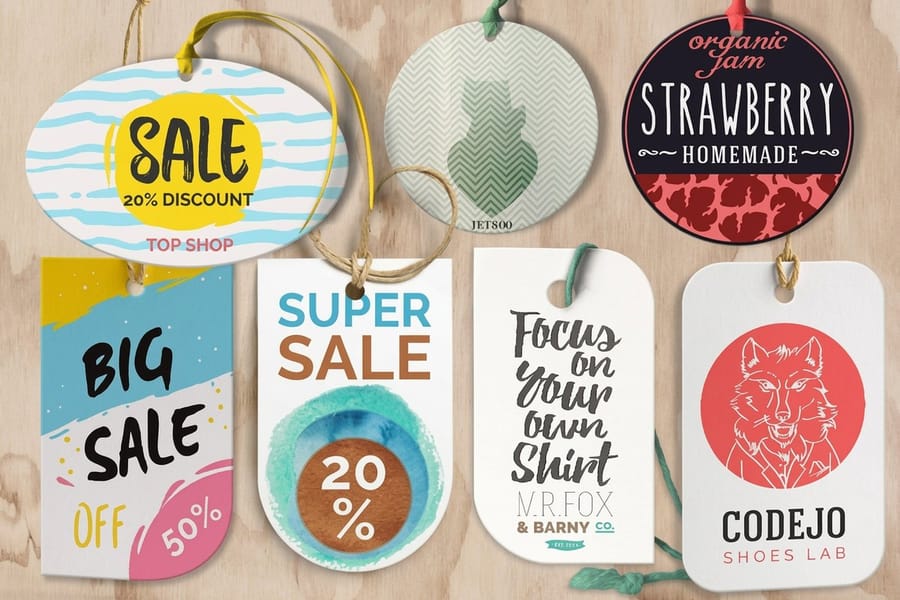
When a rectangle is wrong. Shaped Hangtags start at $107.64 and offer 80 diecut trim shapes with 27 paper types behind them. That is the route for a tag shaped like your product or your logo mark. The cheaper middle ground is Die-Cut Hangtags at $36.26, which give you a 2 by 3.5 with rounded corners so the tag stops fraying at the tips. Browse the full range on hang tags printing if you want to compare finishes rather than sizes.
The Hole, the String and the Finish
The hole is where most reprints come from, and it costs nothing to get right.
Hole drilling is a separate line in the configurator, not something that happens automatically. Standard Hang Tags offer five hole positions, so an off-centre hole for an asymmetric mark is a menu choice rather than a phone call. The drill sits about a quarter inch in from the edge, which means the top quarter inch of your artwork is dead space. Push a wordmark up into it and you will get a tag with a hole through the middle of a letter.
Corners come next. Square corners are the first thing to fray on a tag that lives in a shopper's hand, so Die-Cut Hangtags put rounded corners on the 2 by 3.5 as a stock option. On a tag that will be handled repeatedly, that small radius buys real life.
Finish is where a trade-off hides. Standard Hang Tags offer a standard finish or a high gloss UV coating. The gloss photographs beautifully and makes colour pop on a rack. It also makes the surface slick, so nobody can write a price, a size or a sale mark on it with a pen afterward. If your staff hand-mark tags at the till or during a sale, order the standard finish and keep the writing surface.
For something darker, Black Hangtags at $30.76 print on four papers from the White Series and add 23 edge painting options, so the cut edge becomes a colour of its own. That edge is only visible because the stock is thick, which brings us to paper.
Choosing the Stock Behind the Size
Height, not width, is what makes a tag floppy. A 2 by 2 square stays rigid on almost anything. A 2 by 4 on light stock curls the moment it is handled, and a curled tag on a rack looks like a mistake.
Standard Hang Tags carry 20 paper types grouped as uncoated, coated, linens, metallic pearlescent and a small other category. That range exists because the tag has two jobs at once: it has to survive handling and it has to carry the brand. Uncoated takes ink, stamps and pen. Coated holds colour and detail. Linen adds texture you can feel through a glove.
Two products narrow the choice deliberately. Kraft Hangtags run one uncoated kraft stock and four ink colours, because the point of kraft is that it looks like kraft. Metallic Foil Hangtags start at $257.38 on a single stock with seven foil colours and three foil side options, and the price reflects a foil pass rather than a fancier sheet. If you want to understand what changes between those groups, our guide to printing paper stocks covers the differences by hand feel, and paper weight for printing projects covers the numbers.
One practical rule from the shop floor: order the stock a step heavier than you think you need on any tag over 3 inches tall, and a step lighter than you think you need on a square. The extra rigidity is invisible until the tag is on a rail, and by then it is too late to change it.
How to Set Up and Print Custom Hang Tags
Four things get files rejected on hang tags, and they are the same four every time.
- Build at trim size with 0.125 inch bleed on every edge. Any background colour or image that reaches the edge has to run past it, or you get a white hairline where the knife lands slightly off.
- Keep live copy 0.125 inch inside the trim, and 0.25 inch clear of the top. The second number is the hole. Treat that strip as unusable.
- Decide one side or two before you design. The Ink Color menu is what sets that, and a tag with a price on the front and care instructions on the back has to be ordered as a two sided job from the start.
- Outline your fonts and supply artwork at full size in CMYK. A logo scaled up from a web file goes soft at 2 inches wide, which is small enough that nobody forgives it.
Start from a layout that already has those margins drawn. The hang tag blank templates carry the trim, bleed and safety lines for every size on this page, and there are matched templates for kraft and die-cut versions if you have chosen one of those.
If your tag is a custom outline rather than a stock size, the shape has to be supplied as a vector path on its own layer. Our guide to die cutting walks through how that path is built and how far it has to sit from the artwork. For the wider picture on what a tag is doing for the brand once it is on the product, read what hang tags are and why hang tags still matter.
Wally sizes up a hang tag
Measure the copy first, then the string
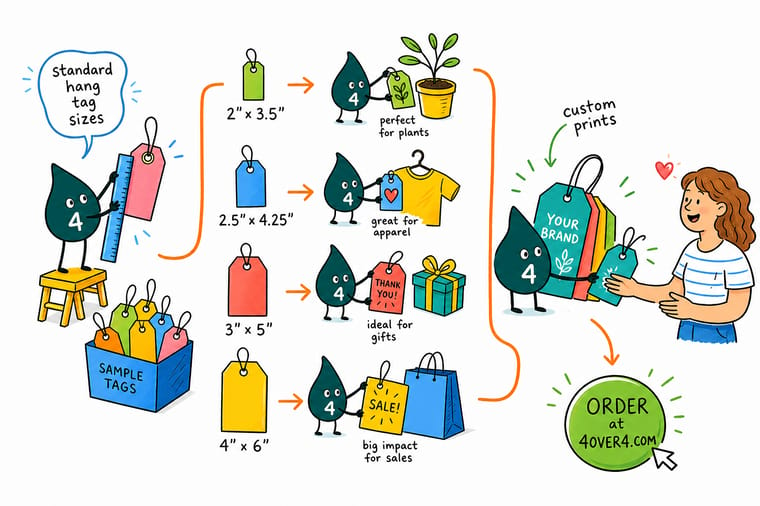
Wally lays the four common tags side by side and asks one question: what has to fit? A logo and a price go on the 2 by 2 square. Add a barcode and a size code and he reaches for the 2 by 3.5, because the barcode alone needs almost an inch and a half across. Add a brand story on the back and he moves up to the 2 by 4. Then he draws a line a quarter inch below the top edge and keeps everything under it, because that is where the drill goes. Every reprint he has seen started above that line.
Order standard hang tags →Specs and pricing
Hang tag sizes, options and starting prices
Every size, paper and hole position below comes straight from the live 4OVER4.COM configurator, so the numbers match what you will see at checkout.



Print it
Order hang tags in the size your product needs


Explore more
Where to go next



By the numbers
Hang tag printing you can count on at 4OVER4
Common Questions
Your hang tag size questions, answered
What is the most common hang tag size?
2 inches by 3.5 inches, the same footprint as a standard business card. It holds a logo, a price, a size code and a barcode without crowding, it hangs vertically so the front faces the shopper, and every design tool already has a template at that size. Standard Hang Tags at 4OVER4.COM carry it alongside 2 by 2, 2 by 4, 2.5 by 2.5 and 3.5 by 2 inches, so you can order a matched set across a product line without changing supplier.
What size hang tag fits a barcode?
Anything 2 inches wide or wider. A UPC-A symbol printed at 100 percent magnification is 1.469 inches wide and 1.02 inches tall, including the quiet zones the scanner needs on each side. On a 2 inch wide tag that leaves roughly a quarter inch of clear paper either side, which is comfortable. On the 1.5 inch wide Kraft Hangtag the symbol fills the width edge to edge, so you would have to shrink it below full magnification and risk a slow read at the register.
How thick should a hang tag be?
Thick enough to stay flat on a rack after a hundred shoppers have flicked past it. Standard Hang Tags run on 20 paper types spanning uncoated, coated, linen and metallic pearlescent groups, and the heavier options in that list hold their shape far better on a 2 by 4 tag than on a 2 by 2. Height is what makes a tag floppy, so the taller the tag, the more the stock weight matters. A small square tag survives on lighter paper.
Where does the hole go on a hang tag?
Centred on the short top edge, roughly a quarter inch down from the trim. Hole drilling is its own option in the configurator, and Standard Hang Tags offer five hole positions, so an off-centre hole for an asymmetric logo is available rather than a special request. The rule that matters for your artwork: leave the top quarter inch of the design clear. A drill bit through the middle of a wordmark is the single most common hang tag reprint.
Can I get a hang tag that is not a rectangle?
Yes. Shaped Hangtags start at $107.64 and carry 80 diecut trim shapes, from arches and circles to tags with a notched top. Die-Cut Hangtags start at $36.26 and give you rounded corners on the 2 by 3.5 size, which is the cheaper way to soften a rectangle without paying for a full custom shape. Pick the die-cut route when you want the tag to survive handling, since square corners are what catch and fray first.
What is the smallest hang tag you print?
The 2 by 2 inch square on Standard Hang Tags, and the narrow 1.5 by 3.5 inch portrait on Kraft Hangtags and Metallic Foil Hangtags. The square suits jewelry, candles and anything where the tag should not compete with the product. The narrow portrait suits a stamped or foiled logo with a price under it. Neither one holds a full care label, so plan on printing the back as well if you need more than two lines.
Get Started
Ready to tag your product?
Pick a size, choose your stock and hole position, and we print hang tags trimmed, drilled and ready to string.
Legal Disclaimer
Gold Standard guarantees apply to all standard orders placed through 4over4.com. Price match requires verifiable proof of a competitor's published price for an equivalent product with matching specifications and turnaround time. Satisfaction guarantee covers manufacturing defects and print quality issues. Contact support with order number and documentation. On-time delivery rate based on tracked orders 1999 to 2026. Individual results may vary based on shipping carrier performance.
