
Standard Calendar Sizes for Wall, Desk, Poster and Pocket


Tobias is our voice for cutting, binding and large format, built from the knowledge of our production team, with over 20 years in printing.
Wall, poster, desk pad, and pocket calendars each have their own standard dimensions. Each format has its own measurement, aspect ratio, paper, and binding, and the wall or desk it lands on sets all four.
Calendars come in four standard families, each with its own size. Wall calendars print at 11 by 8.5 inches folded (opening to 11 by 17) or as a 12 by 12 inch square. Poster calendars run 18 by 24 or 24 by 36 inches on one sheet. Desk pads sit near 22 by 17 inches, and pocket calendars fold down to roughly a 3.5 by 2 inch business-card size. Choose the format first, then the exact dimension within it. For a poster calendar, the blank poster template comes set to size with bleed.

Start here
The four calendar formats and what they measure
There is no single calendar size, only four common families, each with its own standard dimensions. Wall calendars print at 11 by 17 inches open or 12 by 12 square, poster calendars run 18 by 24 or 24 by 36 inches on a single sheet, desk pads spread to around 22 by 17 inches, and pocket calendars fold down near a business-card footprint. Pick the format for where it will live, match your artwork aspect ratio, then let 4OVER4.COM handle the paper and binding. The diagram further down compares all four side by side.
Why choosing the right calendar size matters

A calendar stays in view for an entire year: 12 months across the 26 pages of a Wire-O wall calendar, or all 12 on one poster sheet. It hangs on a kitchen wall, sits on a desk, or lives in a bag, and every day someone looks at it. That long shelf life is exactly why the size decision matters more than it does for a flyer that gets read once and recycled.
Get the size right and the calendar earns its place: the grid is easy to write in, the image has room to breathe, and it fits the wall or desk it was made for. Get it wrong and it is either too cramped to use or too big for where it needs to go. Before you touch the artwork, decide which of the four families you are printing, because a custom calendar behaves very differently at 11 by 17 inches than it does at 24 by 36.
This guide covers the standard dimensions for every common calendar type, then the aspect ratios, paper, and binding that follow from the size you pick. If you want the wider planning picture first, our guide on the six components of a custom calendar is a good companion read.
Common calendar types and their standard sizes
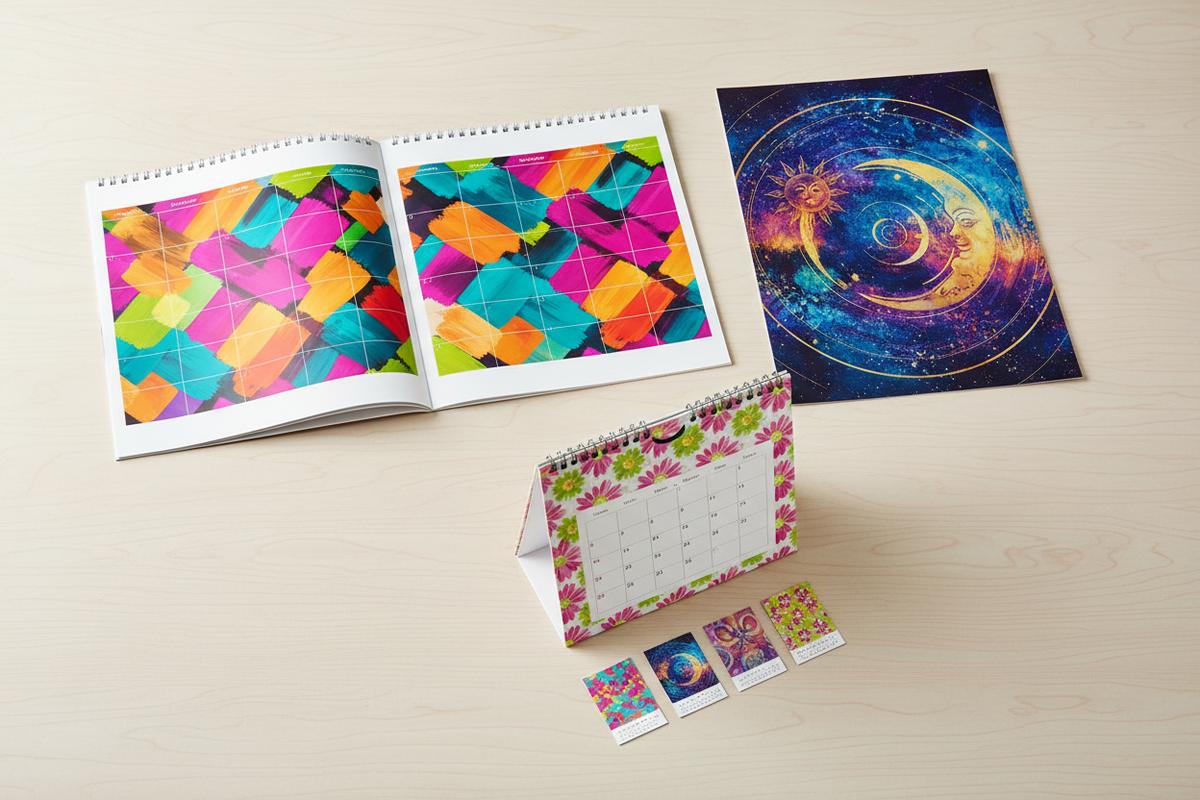
Almost every calendar on the market falls into one of four families, and each has a small set of go-to dimensions. Knowing them up front saves you from designing for a size that does not print or bind cleanly.
- Wall calendars: 11 by 8.5 inches folded (opens to 11 by 17), 12 by 12 inch square (opens to 12 by 24), and 18 by 12 inches for larger walls.
- Poster calendars: a single sheet at 18 by 24 or 24 by 36 inches, with 11 by 17 as a compact option.
- Desk pad calendars: roughly 22 by 17 inches for a blotter pad, or a standing tent at about 6 by 8.5 inches.
- Pocket calendars: a 3.5 by 2 inch card, or a folded panel around 3.5 by 6.5 inches.
What those families look like on the 4OVER4.COM order form:
| Calendar | Sizes | Pages and binding | Stocks | Smallest run |
|---|---|---|---|---|
| Standard wall calendar | 8.5 x 11 in | 24 or 28 pages, saddle stitched | 100# gloss or silk/matte text or 70# uncoated inside; 100# gloss text, 80# gloss or 14pt gloss cover | 25 |
| Wire-O wall calendar | 8.5 x 11, 9 x 12, 11 x 17, 12 x 12 in | 26 pages for 12 months or 38 for 18, black or white wire | 100# gloss text, 70# uncoated, 80# gloss cover or 14pt cover inside | 25 |
| Poster calendar | 11 x 17 to 22 x 28 in | One sheet, printed one or both sides | Nine stocks, from 100# gloss text to 15pt synthetic plastic | 50 |
Both wall calendars take a single 1/8 or 3/16 inch hanging hole, and the Wire-O version adds a thumb cut and hanger as an option.
The sections below break down each family in detail. For the numbers behind other printed pieces, keep our standard print sizes reference chart and the full plan-and-print a custom calendar walkthrough within reach.
Wall calendars: the everyday standard

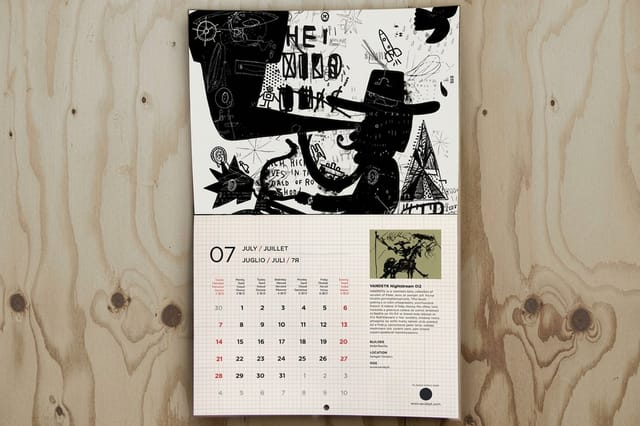
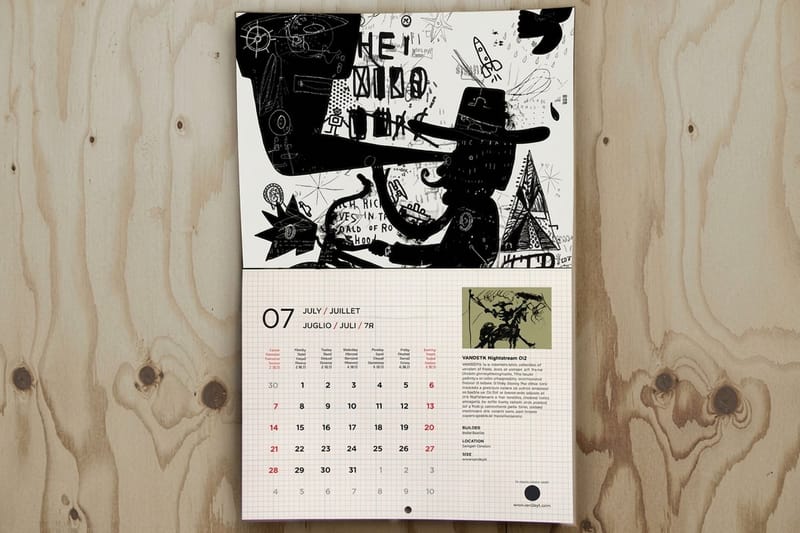
The wall calendar is the format most people picture when they hear the word. It binds at the top, hangs from a single hole or hook, and flips one page per month. The default size is 11 by 8.5 inches folded, opening to 11 by 17 inches, which gives you a full image panel on top and a readable date grid below.
When you want the image to be the star, the 12 by 12 inch square (opening to 12 by 24) is the premium favorite, common for photography and art calendars. For offices, shared spaces, and retail counters that need to be read from across the room, an 18 by 12 inch format gives the grid extra breathing room.
Because the top half is essentially a poster that changes twelve times a year, the same rules that govern wall art apply here. If you are treating each month as a display piece, the posters and wall art collection and our calendar printing options are the natural next stop.
Poster calendars: the whole year on one sheet

A poster calendar drops the flip-through format entirely and prints all twelve months on one large sheet. There is no binding, no monthly image swap, just the full year laid out as a single graphic. It works as a planning tool and a piece of wall decor at the same time.
The two standard sizes are 18 by 24 inches and 24 by 36 inches, with 11 by 17 inches serving as a compact desk-side version. The bigger the sheet, the more room each month gets, so a 24 by 36 poster calendar can hold real notes while an 18 by 24 stays cleaner and more decorative.
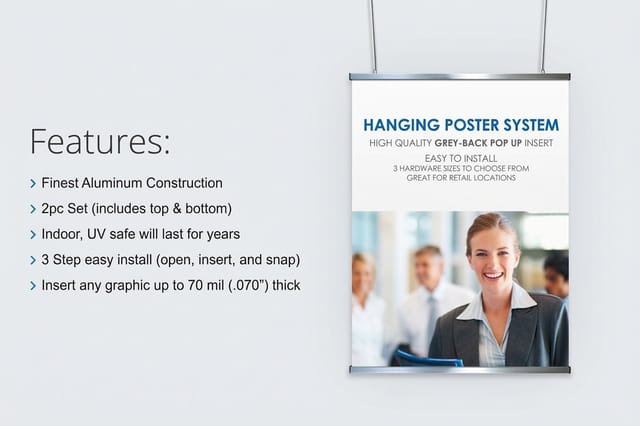
Since a poster calendar lives or dies by how it reads at a distance, it is worth sizing it like any other large-format print. Our poster sizes in inches guide and the large-format poster sizes breakdown cover the dimensions and viewing distances in depth, and a hanging poster display keeps the finished sheet flat on the wall.
Desk pad and tent calendars: sized for the workspace
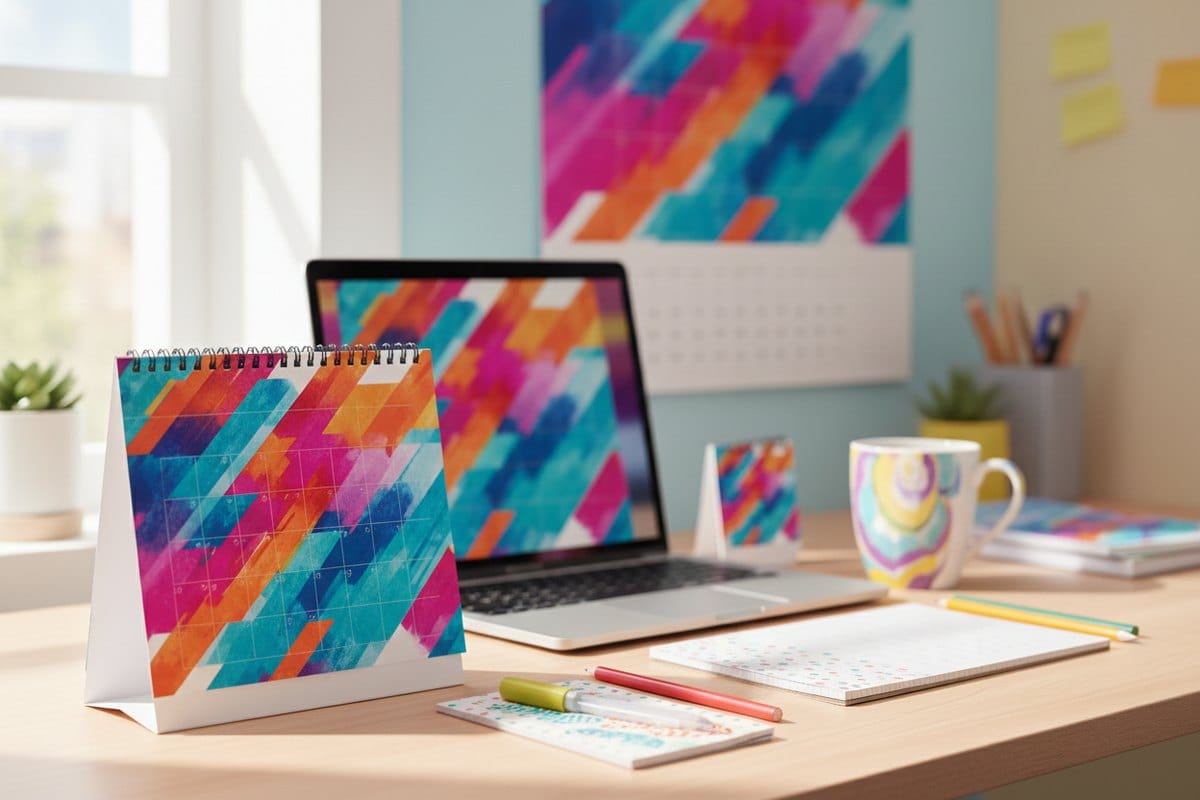
Desk calendars come in two very different shapes, and the size you need depends on how you use it. The desk pad, or blotter, is a large flat sheet around 22 by 17 inches that lies under your keyboard and doubles as a writing surface. A smaller 17 by 11 inch pad suits tighter desks.
The standing tent calendar folds into a small self-supporting easel, typically about 6 by 8.5 inches or 5 by 7 inches. It takes up almost no space and shows a month or a week at a glance without you having to write on it. Choose the pad when the calendar is a daily working surface and the tent when it is a quick reference.
Both formats are essentially bound or scored paper products, so the same construction thinking applies as with other multi-panel print. If your desk calendar leans toward a bound booklet of months, our notes on booklet printing and standard sizes and folds will help you plan the build.
Pocket calendars: built to travel
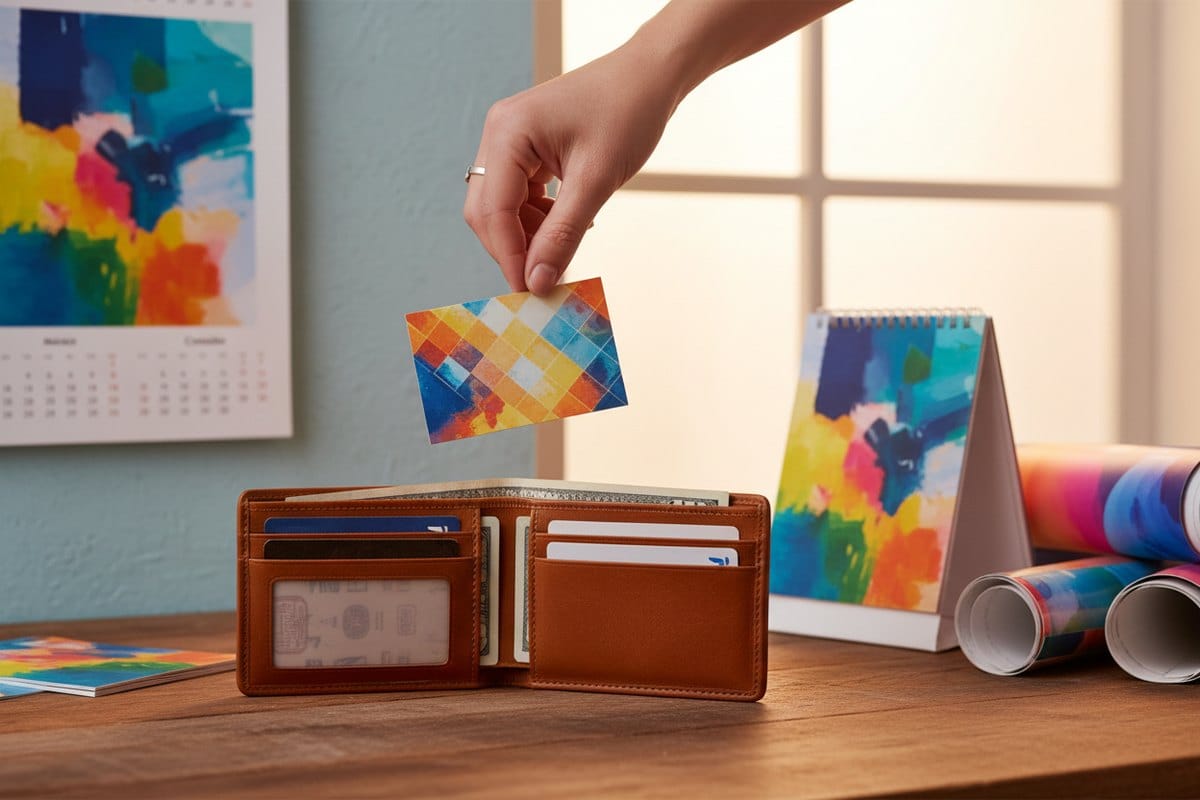
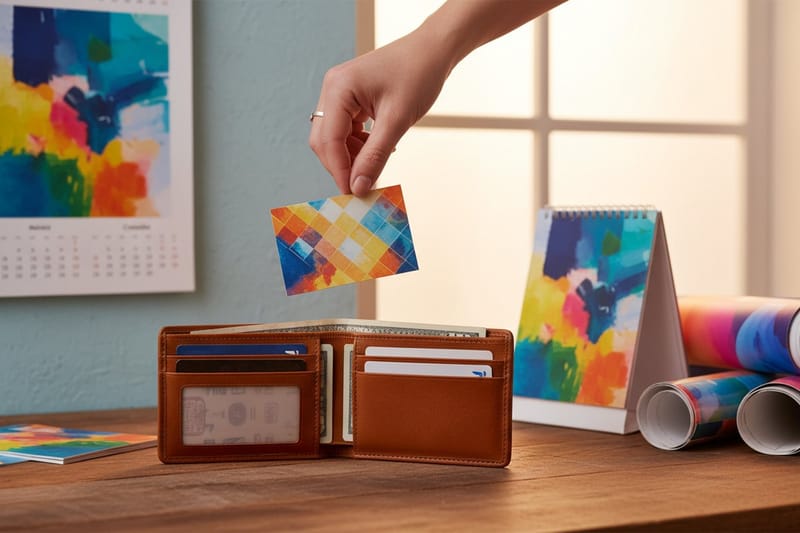
A pocket calendar disappears into a wallet, bag, or planner. The flat card version prints at 3.5 by 2 inches, the exact footprint of a business card, with a month or full year on the back. Folded versions start from a compact 3.5 by 6.5 inch or 2.75 by 4.25 inch panel and open into a multi-month spread.
Because the surface is tiny, the design has to be ruthless about hierarchy: dates first, everything else second. Pocket calendars make excellent giveaways and loyalty pieces precisely because they are cheap to produce in volume and people actually keep them for a year.
If you are printing at this scale, the same care that goes into small formats like cards pays off. Our quick guide to standard card sizes and the broader print sizes reference are useful for nailing the trim on anything this compact.
Aspect ratio recommendations for calendar images

Once you know the finished size, the next decision is how your images fit inside it. Every calendar format has an image area with its own aspect ratio, and matching your artwork to that ratio is what keeps photos from getting awkwardly cropped or letterboxed.
- Standard 11 by 17 wall calendar: the image panel is close to a 4:3 or 3:2 ratio, which fits most camera photos with little cropping.
- 12 by 12 square wall calendar: a 1:1 square image panel, ideal for tightly composed art and product shots.
- Poster calendar: the full sheet is the canvas, so design at the exact 18 by 24 or 24 by 36 ratio rather than dropping in a photo made for another shape.
Shoot or crop to the panel ratio from the start and you avoid the classic problem of a great photo whose subject gets sliced off at the trim. The same discipline that governs poster dimensions applies to every image window in a calendar.
Paper thickness and binding by calendar size

The bigger the calendar, the more the paper and binding matter. Larger sheets need enough weight to hang or stand without curling, and the binding has to hold up to a full year of flipping.
For the flippable pages of a wall calendar, a 100 lb gloss or matte text stock keeps images crisp while staying light enough to turn, often paired with a heavier 100 lb cover backer. Poster calendars print on a single heavier sheet so they stay flat on the wall. Desk pads use a sturdy backing board under a tear-off pad.
Binding follows the format: wall calendars usually use wire-o (twin loop) binding with a punched hanging hole, tent desk calendars use a small wire-o or scored fold, and bound booklet-style calendars can use saddle stitch. If you want the mechanics of bound and folded paper explained, our standard sizes and folds guide and booklet printing page cover the same construction choices.
Tips for customizing calendar dimensions
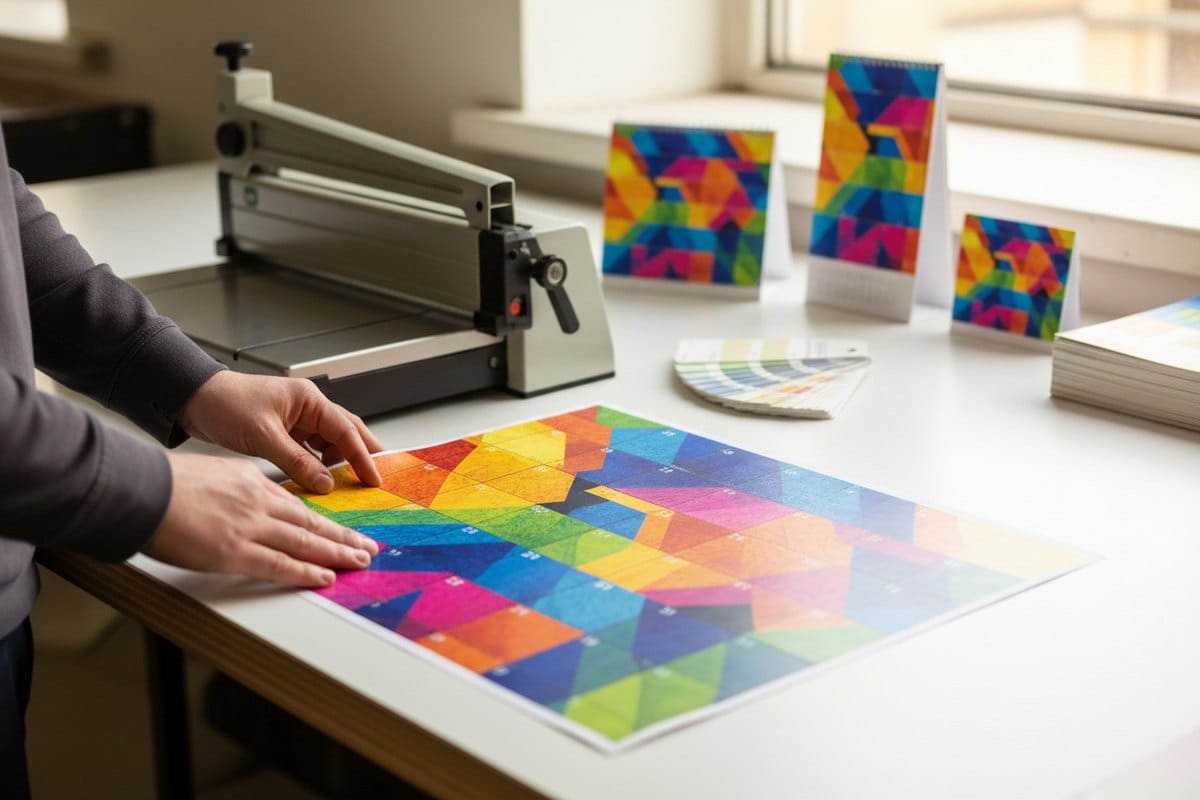
Standard sizes exist because they print, bind, and ship efficiently, but you are not locked into them. If you want a custom footprint, a few habits keep the file press-ready.
- Add bleed and honor the trim. Extend background art past the cut line and keep dates and text inside a safe margin so nothing important sits near the edge.
- Leave room for the binding. Wire-o and saddle-stitch bindings eat a strip along one edge, so keep the grid and key art clear of the bound side.
- Check the real size in hand. A dimension that looks right on screen can feel very different on paper, so order a sample before the full run.
When your dimensions are set, build the file to match and let the configurator handle the rest. Our plan-and-print a custom calendar guide walks through file prep, and free paper samples let you feel the stock before you commit to a size and quantity.
Wally explains calendar sizes
Pick the spot first, then the size follows
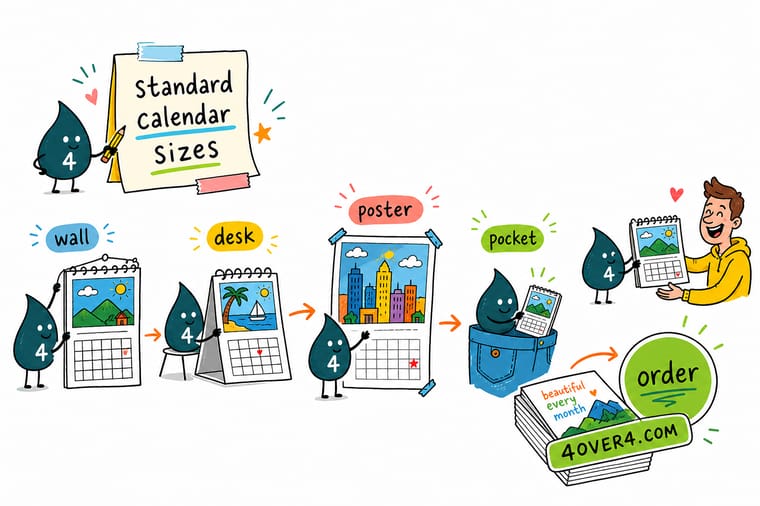
Wally sizes a calendar by asking one question: where does it live? A shared wall wants an 11 by 17 or a 12 by 12 square, a desk wants a pad you can write on, and a giveaway wants a pocket size that travels. Decide the spot, match your artwork to the panel, and 4OVER4 prints and binds it clean at the exact dimensions you choose.
Design and print a calendar →
Size diagram
Calendar sizes at a glance
One frame, four formats: the 11 x 17 inch open wall calendar, the 18 x 24 and 24 x 36 inch poster, the 22 x 17 inch desk pad and the 3.5 x 2 inch pocket card. Save it as a quick reference the next time you plan a wall, poster, desk, or pocket calendar.
Size drives everything downstream. Once you choose wall, poster, desk, or pocket, the aspect ratio, paper weight, and binding all fall into place.
Specs and pricing
Calendar specs and live pricing
Once the size is set, the rest of the decisions come down to stock, binding, and quantity. The standard calendar is 8.5 x 11 inches, saddle stitched at 24 or 28 pages, printed in full color or black on both sides, with an optional 1/8 or 3/16 inch hanging hole. Standard calendars start at 25 copies for $812.59, which is $32.50 each.
| Quantity | Price Per Unit | Total |
|---|---|---|
| 25 | $32.50 | $812.59 |
| 50 | $21.12 | $1,055.76 |
| 100 | $12.19 | $1,218.87 |
| 200 | $8.79 | $1,758.61 |
| 300 | $6.52 | $1,957.30 |
| 400 | $5.01 | $2,004.75 |
| 500 | $4.10 | $2,052.20 |
| 600 | $3.48 | $2,086.81 |
Print it
Put a size into print at 4OVER4

Explore more
Where to go next

By the numbers
The press behind a 12-month calendar
Common Questions
Common questions about calendar sizes
What is the standard calendar size?
There is no single standard, because calendars come in four common families and each has its own dimensions. The most common wall calendar is 11 by 8.5 inches folded, opening to 11 by 17 inches. Poster calendars typically run 18 by 24 or 24 by 36 inches, desk pad calendars sit around 22 by 17 inches, and pocket calendars fold down to roughly a business-card footprint. Choose the format first, then the exact size within it.
What are the most common wall calendar sizes?
The three you will see most often are 11 by 8.5 inches folded (which opens to 11 by 17), a 12 by 12 inch square (which opens to 12 by 24), and a larger 18 by 12 inch format for offices and retail walls. The 11 by 17 open size is the default because it balances a readable grid with an image big enough to enjoy, and it mails and ships efficiently.
What size is a desk calendar?
Desk calendars split into two shapes. A desk pad, or blotter, is a large single sheet around 22 by 17 inches that lies flat under your work. A standing tent calendar folds into a small easel that sits at roughly 6 by 8.5 or 5 by 7 inches. Pick the pad if you write on it daily and the tent if it is mostly a quick month-at-a-glance reference.
What size is a pocket calendar?
A pocket calendar is built to travel. The classic flat card version prints at about 3.5 by 2 inches, the same footprint as a business card, so it slides into a wallet. Folded pocket calendars open from a compact 3.5 by 6.5 inch or 2.75 by 4.25 inch panel into a multi-month spread. The whole point is that it disappears into a pocket or bag.
What is the difference between a poster calendar and a wall calendar?
A wall calendar has a page per month bound at the top, so you flip through the year. A poster calendar shows all twelve months on one large sheet, usually 18 by 24 or 24 by 36 inches, with no flipping and no binding. Wall calendars give each month a big image, poster calendars give you the full year at a glance and read as a graphic design piece.
How do I choose the right calendar size?
Start with where it lives and how it is read. A shared office wall wants an 11 by 17 or 12 by 12 that reads from a few feet away. A working desk wants a pad you can write on or a compact tent. A giveaway that needs to travel wants a pocket size. Then match your artwork aspect ratio to the format, confirm the binding, and order a free sample so you can judge the real size in hand. A 25-copy run starts at $812.59 and takes 7 business days.
What does it cost to print custom calendars, and how are prices set?
Calendar pricing scales with a few levers: quantity (more pieces lower the unit price), the finished size, the paper stock, the binding style, and the page count. At 4OVER4.COM you set each option in the configurator and the price updates live as you adjust it, so you can see exactly how a bigger size or a heavier stock changes the total before you order.
How big is an A4 calendar?
An A4 calendar page is 8.27 by 11.69 inches, the metric cousin of the US 8.5 by 11 inch sheet. The nearest wall calendar we print is 8.5 by 11 inches, which opens to 11 by 17 with the binding across the middle, on 100# gloss text inside and in runs from 25 copies. If your artwork was built at A4, allow a small reflow to fit the US page.
What is the standard pocket calendar size?
The standard pocket calendar is 3.5 by 2 inches (89 by 51 mm) flat, the same footprint as a business card, so it slips into a wallet or a badge holder without being trimmed down. Folded versions open to 3.5 by 4 inches, which is the size to pick when all twelve months have to fit and still be readable. The other common pocket format is a folded panel of about 3.5 by 6.5 inches, which buys you room for a full year plus notes. At 3.5 by 2 inches the artwork is 1050 by 600 px at 300 DPI, before bleed.
Get Started
Print 25 calendars from $32.50 each
Bring your dates and artwork to 4OVER4.COM and print on the size, stock, and binding that fits where it will hang or sit. Calendars run 7 business days in production once the file is approved.
Legal Disclaimer
Gold Standard guarantees apply to all standard orders placed through 4over4.com. Price match requires verifiable proof of a competitor's published price for an equivalent product with matching specifications and turnaround time. Satisfaction guarantee covers manufacturing defects and print quality issues. Contact support with order number and documentation.
