
A Spa Print Plan That Fills Midweek Appointments


A working print set for a spa: what to put on the menu, what makes a referral card get handed over, where a flyer is worth the paper, and how often each one should be reordered.
Three printed pieces fill a spa's quiet midweek slots: a half-letter service menu the client reads while she is on the table, a wallet-size referral card with a blank line for a friend's name, and a local flyer that names the slow days out loud. Coat the menu so treatment oil cannot stain it, leave the back of the referral card uncoated so a pen works on it, and keep the flyer to one offer inside walking distance of your door. Order undated pieces deep and dated pieces one season at a time.
Quick answer
One order, three pieces, three different moments
Print a service menu, a referral card and a local flyer together, and give each one a single job. The menu reaches the client who is already on your table and has time to read. The referral card reaches her friend, so it needs a writable back and a blank line for a name. The flyer reaches strangers inside walking distance, so it should name your slow days rather than list every treatment. Reorder the undated pieces in deep runs and the dated ones one season at a time.
The Three Pieces and the Job Each One Does
Most spa print budgets go wrong the same way: one beautiful brochure, ordered once, doing four jobs badly. Split the money instead. Each piece reaches a different person at a different moment, and the moment is what decides the size, the stock and the quantity.
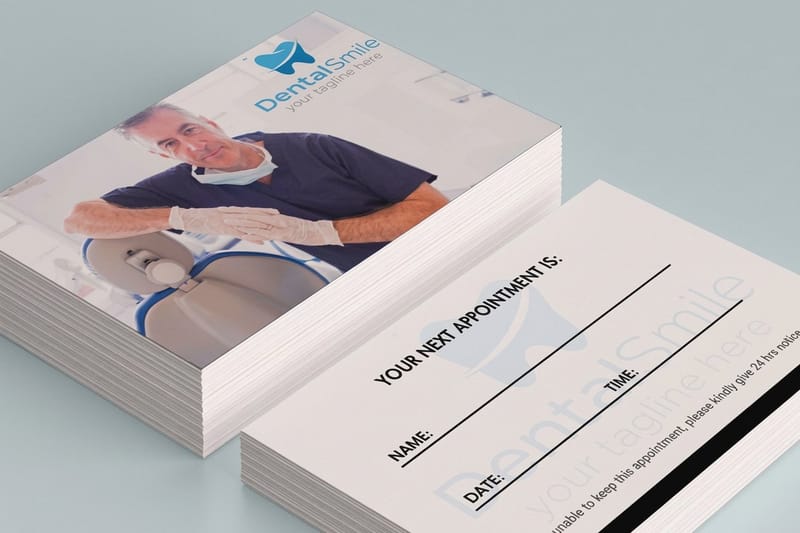
The service menu works on the client who is already lying on your table. She has forty minutes and nothing to look at, which is the only time all month she will read a treatment list properly. The referral card works on the person she has coffee with next week. The flyer works on someone who has never heard of you and walks past your block twice a day. The appointment card works on the calendar itself, because a client who leaves with a written date comes back at a rate a text reminder never matches.
| Piece | Who it reaches | Where it lives | Reprint when |
|---|---|---|---|
| Service menu | The client already in the room | Treatment room, reception table, gift bag | The treatment list changes, roughly once a season |
| Referral card | Her friend, colleague or sister | Handed over at checkout, then a wallet | The box runs low, since an undated card never expires |
| Local flyer | Strangers inside walking distance | Counters, boards and lobbies near your door | Every offer or season, in a quantity that season can use |
| Appointment card | The client on her way out | Her bag, then her fridge or her desk | Continuously, because it is consumed one per visit |
Order them in one job rather than four. You pay one shipping charge, the stock and the color match across the set, and the front desk gets everything at once instead of finding referral cards in a drawer three months after the campaign ended. If you have not written the plan the pieces serve, our small business marketing plan guide is the place to start before you spend anything on printing.
Service Menus That Survive a Treatment Room
A treatment room is a hostile place for paper. Massage oil, lotion, damp hands, humidity from a steam room down the hall. Uncoated stock absorbs all of it and the mark is permanent, so a menu that looked expensive in week one looks neglected by week six.
Coating is the fix, and the choice is a genuine trade-off rather than a preference. Gloss UV shrugs off oil completely, but it also shows every fingerprint, and a spa lit with warm low lamps is exactly the lighting that makes smudges visible. Matte or satin lamination gives up a little oil resistance and gains a surface that stays clean-looking and feels closer to the room. Most spas land on matte for anything that gets handled and gloss for the piece that sits behind glass or on a shelf.
Size follows the same logic. A half-letter menu at 5.5 by 8.5 inches fits a handbag and reads well flat on a table, which is what you want for the piece a client takes home. The full 8.5 by 11 sheet is a display piece for the window and the counter. Print spa flyers from $39.54 for both roles and cut the run between the two sizes rather than compromising on one.
The mistake worth naming: printing prices into the menu itself. Treatment lists are stable for a season, prices are not, and a menu with a number crossed out in pen undoes everything the paper was doing for you. Keep the numbers on a small standing piece from the counter cards range at the desk, and a price change costs you one cheap reprint instead of the whole box.
Referral Cards People Actually Hand Over
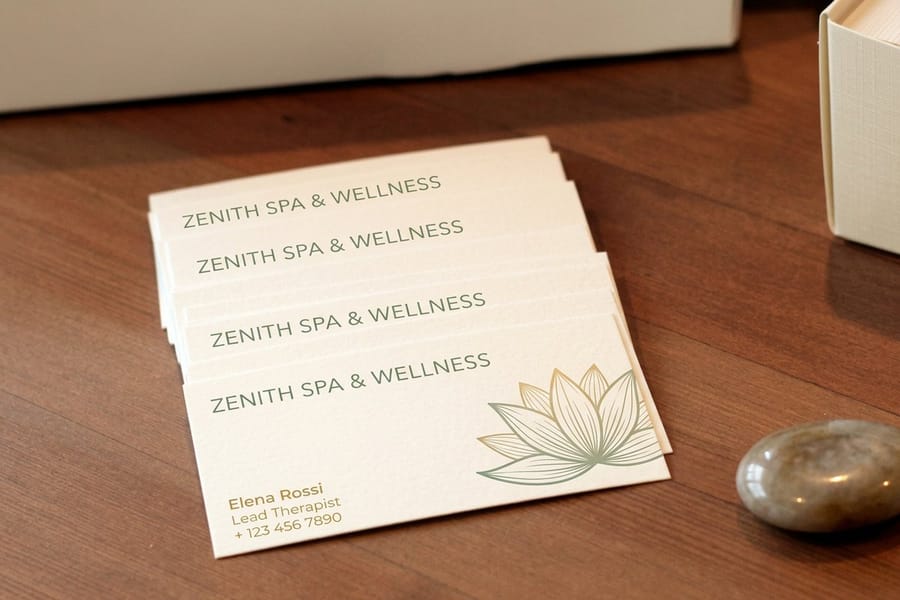
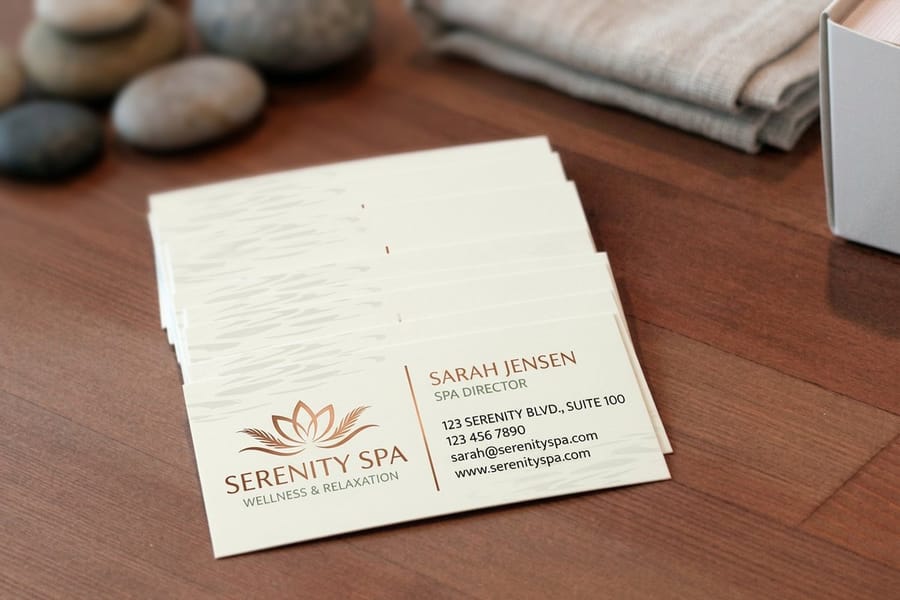
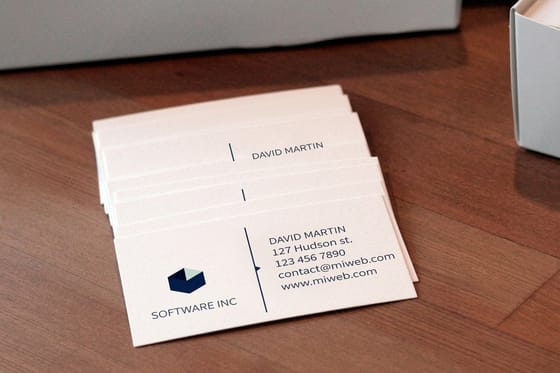
A referral card is a business card with a job. The format is settled by where it has to go: a wallet, which means 3.5 by 2 inches and nothing clever. Spa business cards start at $17.57 and are the base for the whole piece.
The back is where these cards succeed or fail. Leave two ruled lines on it, one for the client's name and one for the friend she is giving it to. That single detail is what turns an advertisement into a gift, because a card with a handwritten name on it gets kept and a card without one gets treated like a flyer. It also gives you a working attribution system with no software involved: the name on the line is who gets thanked.
Which means the back has to take a pen. A gloss UV coating on the reverse rejects ballpoint ink, the writing beads and smears, and the front desk quietly stops using the cards. Ask for uncoated or matte on the back and coat the front only. Do the same with the expiry: print a "valid through" line rather than a printed date, and let the desk fill it in when the card is handed over. Boxes with printed dates expire on the shelf.
Before you commit a design to a deep run, print a short test. 4OVER4.COM lists free business cards at $0.00, which is a cheap way to hold the wording in your hand and find out that the offer line reads badly before you print two thousand of them. If you want the design decisions covered properly, read how to print business cards step by step, then browse the full business card printing range for stock and finish options.
Flyers That Aim at the Slow Days, Not at Everyone

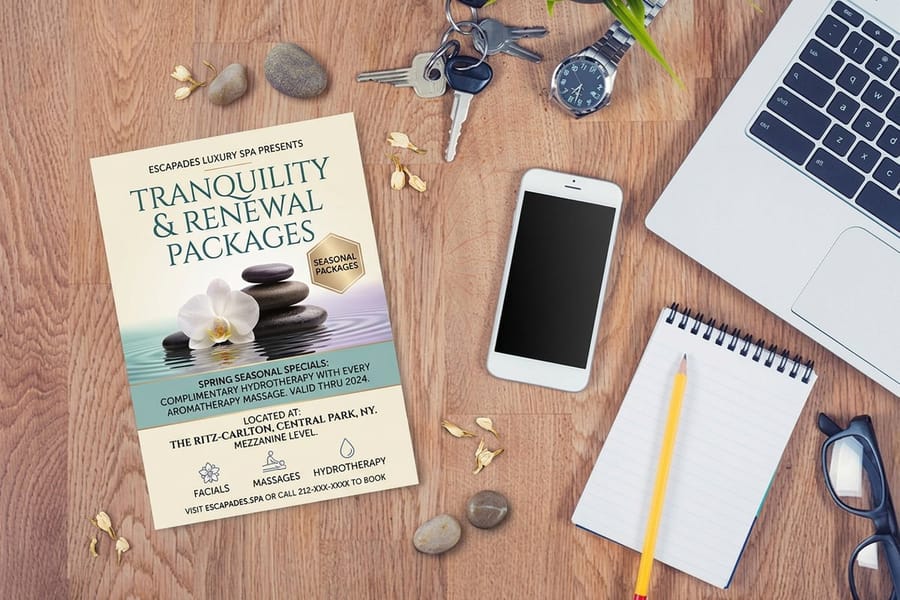
A spa has a radius, and it is short. People will drive across town for a restaurant and not for a facial, so a flyer earns its cost only where it lands within a walk or a quick errand of your door. The gym, the hair salon two blocks over, the coffee shop counter, the apartment lobby, the dentist's waiting room, the yoga studio. Businesses whose customers already live in your neighborhood are worth ten of any wider distribution.
Then say the quiet part on the sheet. If the problem is a hollow Tuesday to Thursday, print "Tuesday to Thursday" on the flyer in a size someone reads from three feet away. A generic flyer fills whatever was already filling, which is your Saturday. A flyer that names the slow days moves bookings from the day you cannot serve them into the day you can, and that is the entire point of the exercise.
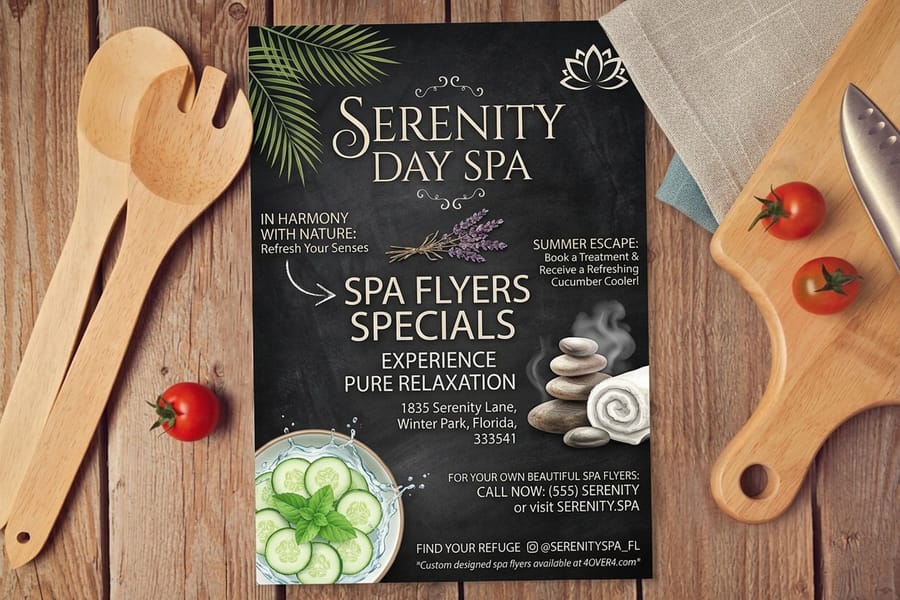
Keep the sheet to one offer, one day range, one address and one way to book. A flyer listing fourteen treatments asks the reader to make a decision they have no reason to make yet, and they make the easy one instead. Save the full list for the menu, where the client is already yours.
For where to physically put them, 20 places to leave print flyers is a practical list, and local print campaigns covers running the drop as a campaign with a start and an end rather than a one-off.
The Reorder Rhythm That Keeps the Set Current
Print goes stale in a specific way: a price changes, a therapist leaves, a season ends, and suddenly the whole set is subtly wrong and nobody wants to hand it out. The way to avoid that is to decide the reprint trigger at the same time you decide the quantity, before the first order.
Anything with a date, a price or a named person on it gets ordered for one season only. Anything evergreen gets ordered deep, because the per-unit price drops hard on the bigger runs and an undated referral card is as good in eighteen months as it is today. That single split is worth more than any discount you will chase.
For the pieces you reorder constantly, cut the design step out of the loop. Ready made cards start at $5.00 and use existing designs, so a reorder is a quantity decision instead of a design project, which matters when the front desk tells you on a Friday that the appointment cards are gone. Keep a standing stock of those from the appointment cards range, since they are consumed one per visit and are the first thing to run out.
Set a review on the calendar for the week before each season changes. Check the menu against the current treatment list, check the price card against the current prices, count the referral cards, and place one order for whatever needs it. Four small orders a year keeps everything current. Waiting until something runs out means the piece is missing from the desk for a week, which costs more than the printing. For more on tightening the rest of it, print marketing tips to grow your business covers the habits that surround the ordering.
Wally explains the spa print set
Three pieces, three people, one order
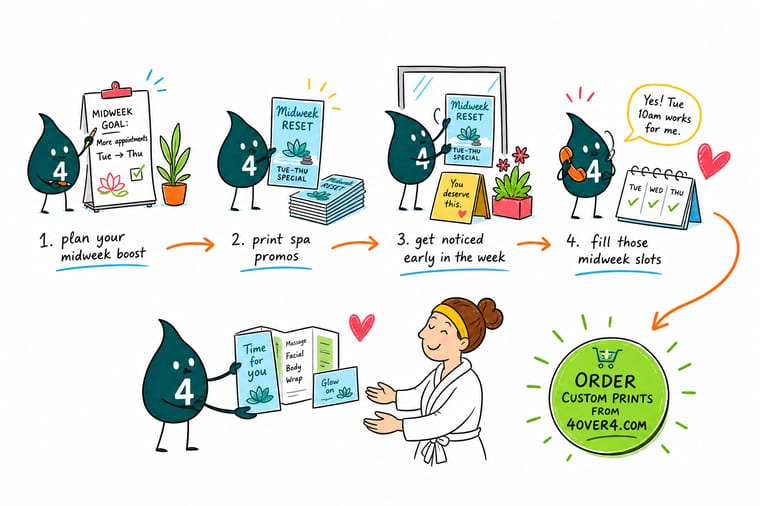
Wally hands the menu to the client on the table, because that is the only forty minutes she will ever spend reading a treatment list. He gives her a referral card at checkout with a blank line on the back, so she writes her friend's name on it and it stops being an advert. He walks the flyer two blocks to the gym and the coffee shop, with Tuesday to Thursday printed big, because those are the days he needs filled. Then he writes the reorder date on the calendar so none of it goes stale.
Order spa business cards →Specs and pricing
Sizes, stocks and starting prices for the set
Configure each piece side by side, with live size, stock and finish choices and starting prices straight from the 4OVER4.COM configurator.


Print it
Order the whole spa set in one job

Explore more
Where to go next

By the numbers
Twenty five years of printing behind a spa campaign
Common Questions
Your spa printing questions, answered
How many referral cards should a spa order to start?
Count the clients who come through in a month, double it, and order for a year. A card only leaves the desk when someone hands it over, so the real limit is how often your front desk remembers to do it, not how many you own. Spa business cards start at $17.57 at 4OVER4.COM, and the price per card falls steeply on the larger runs, so the deep order is usually cheaper than three small ones. The only reason to hold back is a printed date or a printed discount amount, because either one turns leftovers into waste.
What size should a spa service menu be?
Two sizes cover it. A half-letter sheet at 5.5 by 8.5 inches fits a handbag and reads comfortably in a treatment room, which is where the client actually has time to look at it. A full 8.5 by 11 flyer is for the window, the counter and the community board, not for handing over. If you only print one, print the half-letter and put a single counter card at checkout with the current prices on it.
What paper survives a treatment room?
A coated or laminated sheet, because uncoated stock drinks massage oil and lotion and the stain never comes out. Gloss UV resists the oil but shows every fingerprint under warm low light, which looks worse in a spa than a small stain would. Matte or satin lamination is the middle ground and the one most spas end up on. Order paper samples before you commit if the room is candlelit, because finish behaves very differently under warm light than under a showroom lamp.
Should I print prices on the service menu?
Only if your prices hold for the full life of the print run. Prices move more often than treatment lists do, and a menu with a crossed-out number is worse than no menu. The practical split is a menu that describes the treatments and a separate counter card or insert that carries the numbers, so a price change costs you a small reprint instead of the whole box.
Do flyers still work for a local spa?
They work inside a short radius and nowhere else. People do not drive across a city for a facial the way they drive for a restaurant, so a flyer is worth printing when it lands within a walk or a short errand of your door: the gym, the salon two blocks over, the coffee shop, the apartment lobby, the counter of any business whose customers already live nearby. Spa flyers start at $39.54. Beyond that radius the sheet is decoration.
How far ahead should I print a seasonal offer?
Print it so it lands two to three weeks before the offer opens, and print only what the season can absorb. A holiday gift certificate flyer that arrives the week the offer starts has no time to sit on a counter and get picked up, and one printed in a quantity meant for the whole year leaves you with a box of expired paper in February. Undated pieces are the ones to order deep.
Get Started
50 spa flyers cost $39.54, or 79 cents each
Print the menu, the referral cards and the flyers in one job, on stock that survives a treatment room, and have the whole set on your desk together.
Legal Disclaimer
Gold Standard guarantees apply to all standard orders placed through 4over4.com. Price match requires verifiable proof of a competitor's published price for an equivalent product with matching specifications and turnaround time. Satisfaction guarantee covers manufacturing defects and print quality issues. Contact support with order number and documentation. On-time delivery rate based on tracked orders 1999 to 2026. Individual results may vary based on shipping carrier performance.
