
How Shrink Sleeve Labels Wrap a Bottle and Distort Your Artwork


The tube, the four films, the distortion map, the tamper band, and the straightforward test that tells you whether your container needs a sleeve at all.
A shrink sleeve label is printed film seamed into a tube, dropped over a container, then heated until it contracts and grips the shape. It gives full 360 degree coverage and a tear-off tamper band, but the sleeve is sized to the container's widest point, so the artwork must be pre-stretched to survive the shrink at every narrower band. On a straight-walled bottle or jar, a flat pressure-sensitive label prints sharper, needs no distortion file and costs a fraction as much.
Quick answer
A tube of film, shrunk to the shape underneath it
The sleeve is built to clear the widest diameter on the container, and every narrower band is closed by heat. Shrink at any height equals one minus that diameter divided by the widest one, which is why a bottle with an 84 mm body and a 28 mm neck demands 67 percent shrink at the top and rules out PVC film on the spot. The artwork is stretched by the inverse of that ratio before it prints, so a mark drawn three times too wide in the flat file lands round on the finished bottle.
How a Shrink Sleeve Gets Onto a Bottle
The sequence explains every rule that follows, so it is worth walking through once.
One, the film is reverse printed. Art is printed on the inside face of a clear film web, usually rotogravure or wide-web flexo, then a white ink layer is laid behind it. The plastic ends up on the outside of the ink, which is why a sleeve survives ice buckets and condensation without scuffing.
Two, the web is seamed into a tube. The film is folded and solvent welded along one vertical line, producing a flat lay-flat tube wound onto a reel. That seam is a real design constraint: a solvent line runs down it, so no barcode, no critical type and no fine registration should cross it.
Three, the sleeve is cut and applied. An applicator opens the tube, cuts one sleeve to length, and drops it over the container. Nothing is stuck to anything yet, and the sleeve is loose enough at this point to fall off if the line stops.
Four, heat locks it on. The container passes through a steam tunnel or a hot air tunnel. Steam transfers heat evenly and is what most contoured containers use. Hot air is cheaper and drier but tends to leave wrinkles on complex shapes because the heat is less uniform.
Nothing in that chain involves adhesive, which is the practical difference from the pressure-sensitive bottle labels most brands actually use. A sleeve grips by tension alone.
The Four Films, and Why Recycling Now Decides It
Film choice used to be a question of shape and price. It is now mostly a question of what happens to the container after it is emptied, because a sleeve that does not separate cleanly contaminates the recyclate underneath it.
| Film | Typical max shrink | Behaviour on the line | End of life |
|---|---|---|---|
| PETG | Mid to high 70s percent | The workhorse for compound curves. Wide processing window, prints well, thickest and heaviest of the four. | Sinks in a wash tank like PET does, so it has to be perforated or floated off with a seam solvent. |
| PVC | Mid 60s percent | Lowest tunnel temperature and lowest film cost, but yellows with age and gives off chloride if incinerated. | Unwanted or excluded in a growing number of streams, and increasingly refused by retailers. |
| OPS | Around 70 percent | Lighter and stiffer, needs a tighter tunnel profile, less forgiving on aggressive shapes. | Floats away from PET flake in a wash tank, which is why bottle-to-bottle programs prefer it. |
| PLA | Around 70 percent | Compostable, heat sensitive, the narrowest processing window of the four. | Industrial composting only. It behaves as a contaminant in a plastics stream. |
Read the second column against your own container before anything else. If the tightest point on the bottle needs more than about 65 percent shrink, PVC is off the table no matter what it costs, and the decision is made for you. That single measurement decides more sleeve projects than any design argument.
Distortion, the Part That Catches Designers Out
Shrink is not uniform, so the artwork cannot be either. The sleeve is manufactured to slide over the widest part of the container, and every narrower band has to be pulled in by the difference. Work the arithmetic on a real bottle and the size of the problem becomes obvious.
Take a bottle that measures 84 mm across the body and 28 mm at the neck. The sleeve is sized for 84 mm. At the neck the film must shrink to a third of that, so anything printed in the neck band is compressed horizontally to a third of its printed width. Draw a logo round in the flat file and it lands as a squashed oval. Draw it three times wider than it should look and it lands correct.
That is what a distortion file does. The converter measures the container diameter at fixed intervals up its height, builds a map of the shrink required at each one, and the designer applies that map to the artwork before output. The consequences are worth stating plainly:
- The map belongs to one container. A 500 ml and a 750 ml version of the same bottle need separate art.
- Small type belongs in the low-shrink band, near the widest diameter, where distortion is close to nothing.
- Barcodes go vertical, in a low-shrink zone, and never across the seam. A barcode compressed sideways stops scanning.
- Fine rules and gradients running through a high-shrink zone will band, because the film is being asked to move a long way.
None of this applies to a flat label. A die-cut label prints exactly as it was drawn, which is why brands with a lot of SKU changes tend to stay with pressure-sensitive. If you want the file mechanics for a wrap that goes on flat, our packaging file preparation guide and the blank template library cover the setup.
Tamper Bands, Tunnels and Minimum Runs
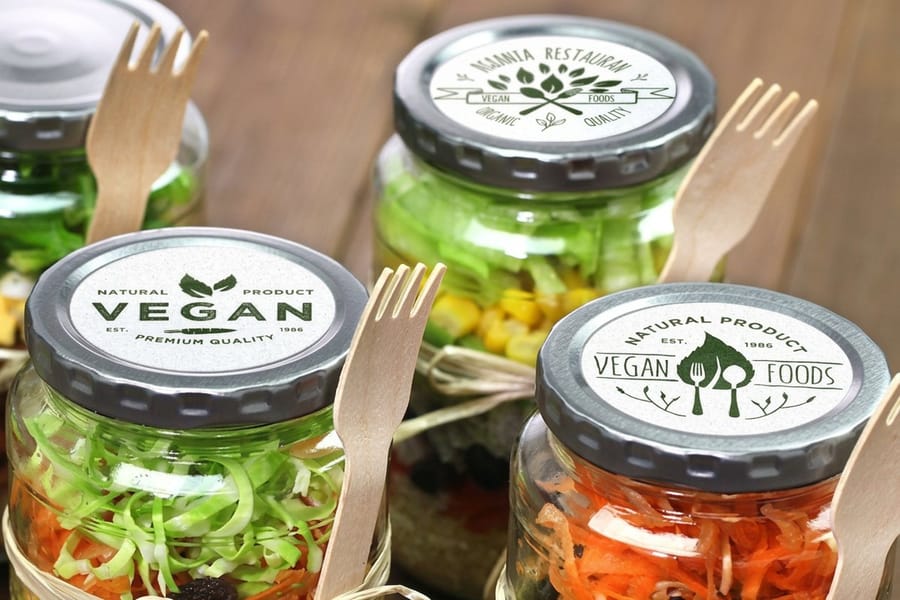
The tamper band is the honest reason a lot of brands sleeve a container that has no curves at all. A horizontal line of perforations is punched into the film across the cap and neck. Opening the container tears it, and there is no way to put it back. Supplements, kombucha, cold-pressed juice and anything sold chilled use it because a retailer or a regulator asks for evidence of first opening.
Two things about that are easy to miss. A full-body sleeve without perforation is not tamper evident by itself, so the feature has to be specified. And if tamper evidence is the only thing you need, a plain neck band costs a fraction of sleeving the whole container and leaves the body free for a proper printed label.
The other reality is volume. A sleeve project carries film origination, a distortion map per container, an applicator setup and a tunnel profile that has to be dialled in on real bottles, so converters price it in the tens of thousands of units. Below that the setup dominates the unit cost. Pressure-sensitive labels have none of that overhead: premium beverage labels start at $29.16 for a short run with no tooling, which is why a launch or a seasonal flavour usually starts there and only moves to sleeving once volume justifies it.
When a Sleeve Is the Wrong Answer
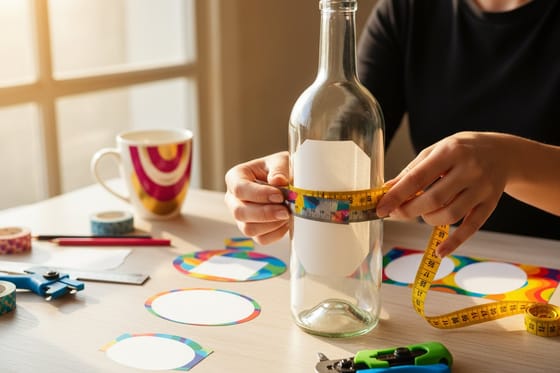
Run a straight edge up the side of your container. If it touches all the way along the label area, the container is straight walled and a shrink sleeve is solving a problem you do not have. That covers most beer and wine bottles, most jars, most tins, most cans and nearly every cosmetic tube.
| Question | Shrink sleeve | Pressure-sensitive label |
|---|---|---|
| Container shape | Handles compound curves and cap-to-base coverage. | Straight walls or a gentle taper. |
| Artwork | Distortion map required, one per container. | Prints as drawn, no distortion, no remapping. |
| Finishes | Reverse print under film. Foil and heavy varnish are awkward. | Foil, spot gloss, matte, metallic and clear stocks all available. |
| Setup and minimum | Film origination, applicator and tunnel setup. Tens of thousands of units. | No tooling. Short runs from $25.00. |
| Changing one SKU | New distortion art and a new film run. | Reprint that label alone and leave the rest untouched. |
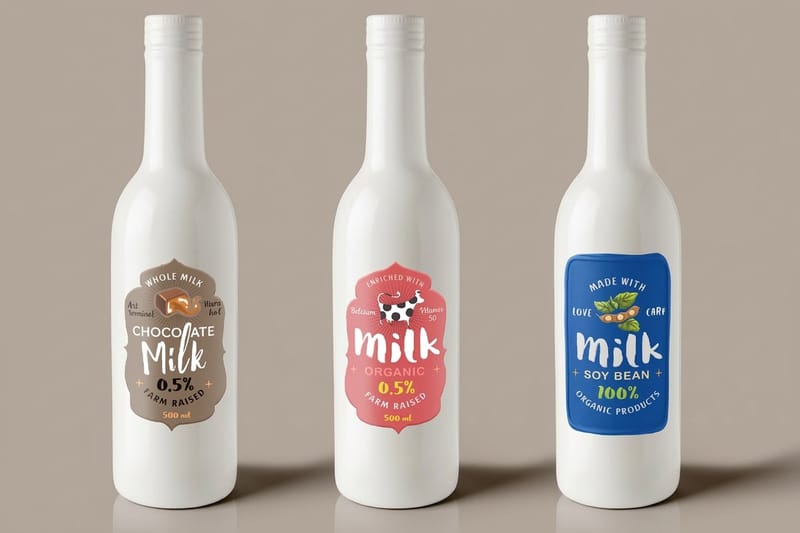
4OVER4.COM prints the right column. Premium bottle labels and premium beverage labels start at $29.16, clear labels for the no-label look start at $25.00, and a custom outline in die-cut labels starts at $93.37. Browse by container at bottle label printing and beverage label printing, or start from the full label printing range. If you want a second opinion on the design itself before you order, the product label design interview is the place to start.
Wally explains shrink sleeves
One tube, one blast of steam, and a lot of arithmetic
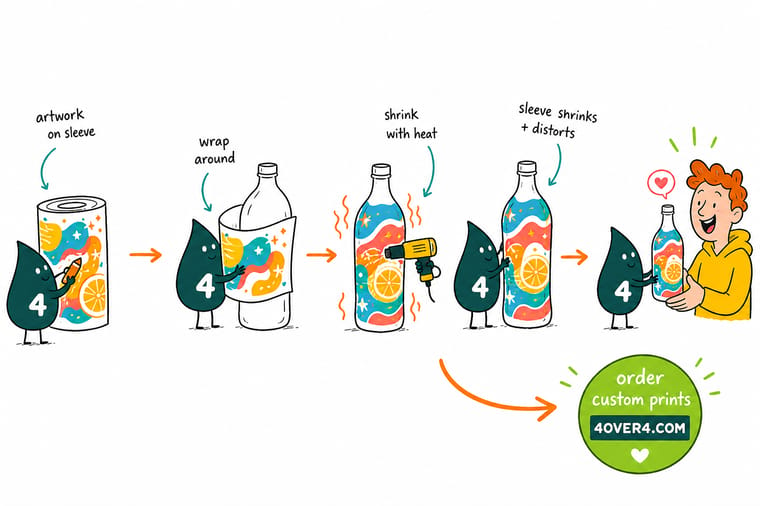
Wally cuts a tube of printed film wider than the bottle, drops it over the top, and sends it through steam. The film pulls in until it hugs every curve. The catch is that it pulls in further at the neck than at the body, so he has to draw the logo wide and squat before it prints or it lands as a squashed oval. On a straight-sided bottle he skips all of it and sticks on a flat label, which prints sharper and costs a lot less.
Order premium bottle labels →Specs and pricing
Label sizes, stocks and starting prices
Configure a flat label for your container, with live size and material options and starting prices straight from the 4OVER4.COM configurator.

Print it
Labels that fit your container without a shrink tunnel
Explore more
Where to go next

By the numbers
Label printing you can count on at 4OVER4
Common Questions
Your shrink sleeve questions, answered
What is a shrink sleeve label?
A shrink sleeve is a printed plastic film that has been seamed into a tube slightly wider than the container, slipped over it, and then heated so the film contracts and locks onto the shape. It is not adhesive, so nothing sticks to the bottle. Because the tube covers the container all the way around and can run from the cap to the base, it gives full 360 degree decoration and can carry a tear-off tamper band at the closure. The print is almost always reverse printed on the inside face of the film, so the plastic itself protects the ink from scuffing.
Why does shrink sleeve artwork have to be distorted?
Because the film shrinks by a different amount at every height. The sleeve is built to fit over the widest part of the container, so wherever the container is narrower the film has to pull in by that difference, and anything printed there gets squeezed horizontally by the same ratio. The fix is to pre-stretch the art. The converter measures the container diameter at intervals, builds a distortion map, and the designer applies it so a logo that must look round on the neck is drawn as a wide ellipse in the flat file. Change the bottle and the map is worthless, which is why sleeve art cannot be reused across a range of container shapes.
Which shrink film should I choose?
PETG handles the most aggressive shapes, with maximum transverse shrink in the mid to high seventies, and it takes print well, which is why contoured bottles default to it. PVC shrinks in the mid sixties, runs at lower tunnel temperatures and costs less, but it is restricted or unwanted in a growing number of recycling streams. OPS sits around the low seventies, is lighter and generally the friendlier option for PET bottle recycling because it floats away from the PET flake in a wash tank. PLA is the compostable option and shrinks in the seventies, but it is heat sensitive and the least forgiving on a fast line. Ask the recycler before the printer, since the film choice is now mostly a waste-stream decision.
Do shrink sleeves make a package tamper evident?
They can, and that is the main reason many beverage and supplement brands use them. A perforated horizontal band is punched into the film across the cap and neck, so opening the container tears the perforation permanently. A full-body sleeve without perforation is not tamper evident on its own, and a separate neck band is often applied instead. If tamper evidence is the only requirement, a neck band alone is far cheaper than sleeving the whole container.
When is a pressure-sensitive label the better choice?
Whenever the labelling area is straight walled or only gently tapered, which covers most bottles, jars, tins and cans. A pressure-sensitive label prints at higher resolution on paper or film stock, carries foil and spot varnish that shrink film handles poorly, needs no distortion file, no tooling and no five-figure minimum, and it can be reprinted for a single flavour without touching the rest of the range. A shrink sleeve earns its cost on genuinely contoured containers, on full cap-to-base coverage, and where the tamper band is required.
Does 4OVER4.COM print shrink sleeves?
No. We print pressure-sensitive labels, which is the right answer for the great majority of containers people ask us about. Premium bottle labels and premium beverage labels start at $29.16, wine labels, beer labels and clear labels start at $25.00, and die-cut labels in a custom outline start at $93.37. All of them print in short runs with no tooling charge, so you can test a design on a few hundred units before committing to anything. If your container genuinely needs a full wrap over a compound curve, a sleeve converter is the right supplier and we will say so.
Get Started
Measure the bottle, then print the label that fits it
Send us the container size and we print waterproof bottle, beverage and die-cut labels in short runs, with no tooling charge and no distortion file to build.
Legal Disclaimer
Gold Standard guarantees apply to all standard orders placed through 4over4.com. Price match requires verifiable proof of a competitor's published price for an equivalent product with matching specifications and turnaround time. Satisfaction guarantee covers manufacturing defects and print quality issues. Contact support with order number and documentation. On-time delivery rate based on tracked orders 1999 to 2026. Individual results may vary based on shipping carrier performance.
