
Choosing PVC Sign Thickness by Span, Mounting and Location


Same board, same print, three very different sheets once they are on a wall. Each thickness buys something different, a thin panel starts to bow past a certain width, and the hardware quietly decides the whole thing.
Use 3mm where something else carries the panel, 6mm for a normal point-fixed wall sign up to around 36 inches wide, and 10mm when the span is longer or the edge itself has to be seen, drilled or routed. A sheet resists bending by roughly the cube of its thickness, so 6mm is about eight times stiffer than 3mm while weighing only twice as much. Unsupported span, not sign size, is the number that decides.
Quick answer
Span first, hardware second, size almost never
Pick the thickness from how far the panel has to hold itself up, then check that your fixings suit it. Fully backed or framed, 3mm is enough. Four corner screws or standoffs on a wall, 6mm. Hanging, free standing, wider than about 4 feet, or edge-drilled for a hidden stud, 10mm. Weight rises in step with thickness while stiffness rises with its cube, which is why the jump from 3mm to 6mm fixes almost every bowing complaint for very little extra.
What 3mm, 6mm and 10mm Actually Change
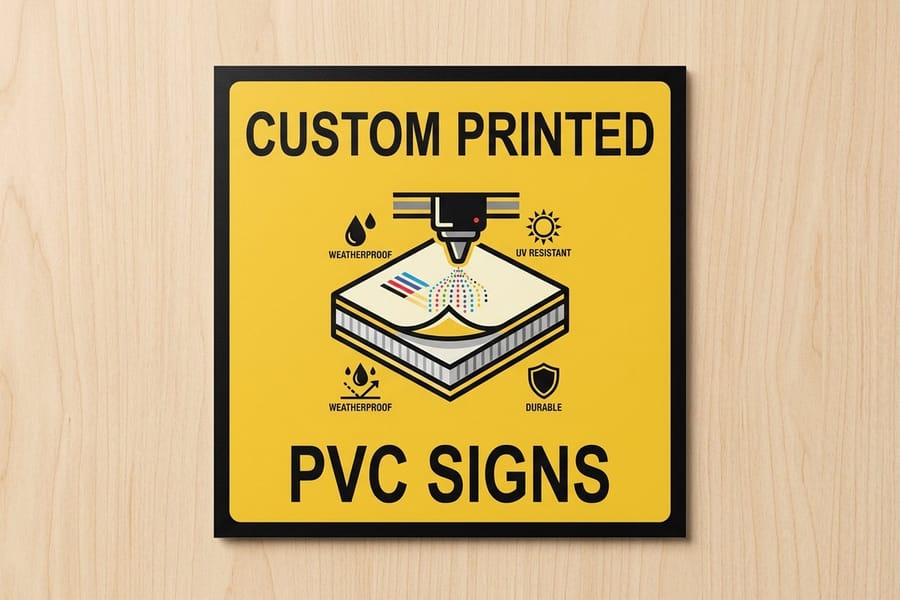
All three are the same material. Expanded PVC is a closed cell foam board with a smooth matte skin, the stuff sign shops call Sintra or Komatex, and it takes UV ink directly on a flatbed press. The print is identical at every thickness. What changes is how the sheet behaves once it is on a wall.
In round numbers, 3mm is an eighth of an inch, 6mm is a quarter, 10mm is a bit under three eighths. Those sound like small steps. They are not, because a flat panel resists bending by roughly the cube of its thickness. Doubling 3mm to 6mm makes the sheet about eight times harder to bow. Going from 6mm to 10mm adds another factor of four or so.
Weight, meanwhile, only tracks thickness directly. A 6mm panel weighs twice what the same size does in 3mm, and 10mm is a little over three times. So the trade is lopsided in your favour: you buy a large jump in stiffness for a modest jump in weight and freight. That is why the honest advice for most wall signs is to stop worrying and order PVC signs in 6mm.
| Thickness | Relative stiffness | Relative weight | Comfortable unsupported width | Hardware it takes |
|---|---|---|---|---|
| 3mm | Baseline | Baseline | Up to about 18 inches, and only vertical | Tape, hook and loop, screws through a washer into a backer |
| 6mm | Roughly 8x | 2x | Around 36 inches on a flat wall | Face screws, through-bolted standoffs, frame channel |
| 10mm | Roughly 35x | A little over 3x | Around 48 inches, still with two fixings per edge | Everything above, plus edge-drilled studs and routed shapes |
Treat those widths as where a printer stops arguing with you, not as a failure point. A 3mm panel at 24 inches will not fall apart. It will simply look slightly wavy when light rakes across it, and that is the thing clients notice from the doorway.
Span Is the Number That Decides Thickness

Sign size is not what makes a panel bow. Unsupported span is. A 4 foot wide sign glued flat to a wall across its whole back has an unsupported span of zero and could be 3mm. The same 4 foot sign hanging from two eyelets has a span of 4 feet and wants 10mm, or a frame.
Before you pick a thickness, work out where the support actually is:
- Fully backed. Adhered flat to a door, a window, a panel or a plywood board. The substrate carries everything, so 3mm is genuinely fine and the thinner sheet even helps, because there is less thermal movement fighting the adhesive.
- Edge captured. Slid into a channel frame, a snap frame or a slatwall groove. The frame sets the line. 3mm works up to roughly poster size, 6mm above that so the middle does not belly out.
- Point fixed. Four corner screws or four standoffs, which is the most common wall sign. Now the diagonal between fixings is the real span, and that is where 6mm earns its place.
- Hung or free standing. Two top eyelets, an A-frame, a stake, a post. The panel is carrying itself. Use 10mm, or accept that it will take a permanent curve.
That last point is worth spelling out. PVC creeps: held under a steady load for months, especially warm months, it does not spring back when the load is removed. A sagging panel is not a bad batch of board, it is the material doing exactly what plastics do. Give it more thickness or more support and the problem disappears. If the sign genuinely has to hang from two corners outdoors and stay dead flat for years, the answer is not thicker PVC, it is aluminum sign panels starting at $29. Every style of aluminum sign sits on one category page, and for staked signs our comparison of vinyl vs coroplast vs metal yard signs and which one lasts outside covers the outdoor case.
For anything soft and rolled rather than rigid, the whole span conversation goes away. PVC banners from $25 hem and grommet to a frame or a fence, and the tension does the work instead of the sheet.
Mounting Hardware Picks the Thickness More Often Than Size Does
Half the thickness questions we get are really hardware questions with the hardware left out. Say how it is going on the wall and the answer usually picks itself.
Standoff barrels. The cap tightens down on a small ring of board around each hole. On 3mm that ring compresses and you get a visible dimple at all four corners, which is the exact opposite of the clean floating look standoffs are bought for. 6mm holds flat. 10mm is what you want if the sign sits at eye level in a lobby, because the edge becomes part of the design.
Face screws. Fine on all three, with one rule: do not countersink into 3mm. There is not enough material under the head and the cone punches through the skin. Use a pan head and a finish washer instead, and drill the hole a size over so the panel can move.
Edge drilling. Only 10mm. Drill into the thickness of the board, epoxy in a threaded stud, and the sign hangs off the wall with nothing visible on the face. This is the trick behind most flush-mounted reception signs, and it is the single best reason to pay for the thick board.
Adhesive. VHB tape and silicone both hold expanded PVC well, and here the thin sheet wins. A 3mm panel puts less weight on the bond and moves less as the temperature swings, so the tape has an easier life. This is also the case for a printed face applied over an existing panel, where PVC stickers from $25 can replace a full board entirely. The PVC stickers story taps through the ways to build one.
Whatever you choose, hardware and board are a single decision. The mounting and rigid printing collection lists the boards and the ways they hang in one place, and the PVC printing collection covers everything we print on this material.
Indoors, Outdoors, and Where PVC Gives Up
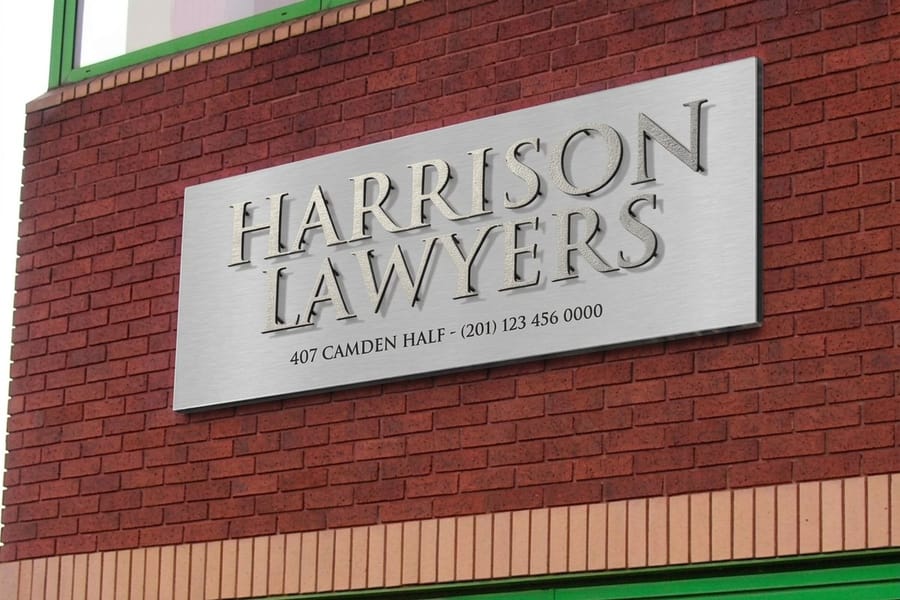
Indoors, expanded PVC is close to ideal. It is light, it cuts cleanly, it does not yellow under normal lighting, and the matte face flatters printed type in a way that gloss acrylic does not. Pick a thickness by span and hardware, hang it, forget about it.
Outdoors is where you need to know the limits. Water is not one of them. PVC is a foam plastic with a closed cell structure, so rain, humidity and washdowns do nothing to it, which is why it beats foam board and MDF outright for anything damp. Two other things do matter.
Temperature movement. Expanded PVC changes size with temperature more than the brick, timber or steel it is fixed to. A panel screwed down hard at every point on a cold morning has nowhere to expand by mid afternoon, so it pushes itself into a bow between the fixings. Oversized holes and screws left a hair loose solve it completely.
Solar load. A panel printed with heavy dark coverage absorbs far more heat in direct sun than a light one. Combine that with a long unsupported span and a thin sheet and you get the classic warped sign. If the design is mostly black and the wall faces the afternoon sun, either move up a thickness, add fixings in the middle of the run, or switch material.
The switch point is honest and worth naming. Roadside signs, anything above about 4 feet on a single span, anything expected to hold a flat face for a decade, and anything in relentless sun belongs on aluminum. Our comparison of aluminum, coroplast and PVC walks through the three substrates side by side, and the PVC board guide covers what the material is before you get to picking a thickness. For ideas on what to actually put outside, our outdoor sign ideas are a good place to start.
Wally explains PVC thickness
Double the thickness, eight times the stiffness
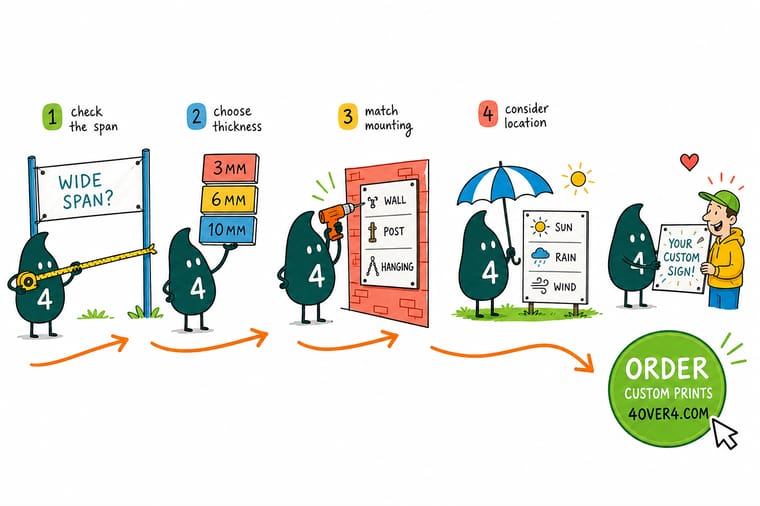
Wally holds a 3mm sheet by its two corners and it droops in the middle. He picks up the same sign in 6mm and it stays flat, even though it only weighs twice as much. That is the whole trick: stiffness follows the cube of thickness, weight follows thickness. So he asks one question before quoting a board. How far does the panel have to hold itself up with nothing behind it? Backed or framed, 3mm. Screwed to a wall at four corners, 6mm. Hanging free, or edge-drilled for a hidden stud, 10mm.
Configure your PVC sign →
Specs and pricing
Rigid sign boards, sizes, and starting prices
Compare the rigid substrates side by side, with live size and thickness choices and starting prices straight from the 4OVER4.COM configurator. PVC signs and rigid plastic come in 11 x 17 in to 36 x 36 in or any size, with 1 in rounded corners and grommets as options. Aluminum panels are 1/8 in thick, 11 x 17 in to 30 x 40 in, with a 2.5 mil gloss or matte laminate and drilled holes at the corners or center.


Print it
Order a panel that stays flat
PVC signs and PVC rigid plastic start at $25 and aluminum sign panels at $29, and each takes 4 business days at standard turnaround. Choose aluminum when a panel has to hang from two corners outdoors for years.



Explore more
Where to go next
Two guides cover what a PVC sign is and how aluminum, coroplast and PVC compare. Two category pages price PVC and mounted boards, and two articles show outdoor and storefront sign ideas.



By the numbers
The rigid sign line behind 3mm to 10mm
Common Questions
Your PVC thickness questions, answered
What thickness should a 24 by 36 inch PVC sign be?
6mm. At that size a 3mm sheet has a 36 inch run with nothing holding the middle, and it will show a slow wave when you look along the face from the side. 6mm sits flat on a wall with four corner screws or two runs of tape, and the extra weight is small enough that nothing about the mounting changes. Go to 10mm only if the panel is standing off the wall on barrels where the edge is part of what people see.
Can 3mm PVC go outside?
Yes, but only when something else is carrying it. Expanded PVC does not rot, swell or delaminate in rain, so weather is not what kills a thin panel. Span is. A 3mm sheet screwed flat onto a plywood backer or slid into a channel frame will last outdoors for years. The same sheet hung from two top corners on a fence will bow within a season, and once PVC takes a set it does not come back.
Will a PVC sign warp in the sun?
It can, and the way it happens is predictable. Expanded PVC expands and contracts with temperature noticeably more than the wall, post or frame it is fixed to, so a panel screwed down tight at every hole has nowhere to go and pushes itself into a curve. Drill the holes a size larger than the screw, use a washer, and leave the screws just short of tight. Heavy dark ink coverage makes it worse because a black panel in direct sun runs much hotter than a white one, which is a fair reason to choose aluminum sign panels for a south-facing exterior sign.
What thickness do standoffs need?
6mm is the practical minimum for through-bolted standoffs and 10mm is better. The barrel cap tightens onto a small ring of material around the hole, and on 3mm that ring dimples inward and leaves a visible crater around every fixing. On 6mm it stays flat. On 10mm you have the option of edge-drilling instead, tapping a stud into the thickness of the board so nothing shows on the face at all, which is how most flush lobby signs are done.
Is 10mm PVC as strong as aluminum?
No, and the two fail in different ways, which matters more than the raw comparison. A 10mm PVC panel is stiff and light and will not dent, but it softens with heat and slowly takes a permanent set under its own weight if it is unsupported for long enough. An aluminum panel is thinner, heavier for its size, holds its shape indefinitely and shrugs off sun, but it creases if something hits it and the crease is forever. Interior and short-term exterior work goes to PVC. Anything roadside, structural or expected to last a decade goes to aluminum.
Can I cut and drill PVC sign board myself?
Easily, which is one of the genuine advantages over aluminum or acrylic. Expanded PVC cuts with a utility knife on 3mm, a fine-tooth blade on 6mm and 10mm, and drills with ordinary wood bits without chipping or cracking. Feed slowly so friction does not melt the cut edge back together. If you want a shape rather than a rectangle, ask us to contour cut it instead: a routed edge on 10mm reads as a deliberate shape, while a hand-cut curve in 3mm tends to look feathered.
Get Started
PVC signs and aluminum panels both print in 4 business days
Tell us the size and how it is going up. We match the thickness to the span, print it direct to the board, and cut it to your shape.
Legal Disclaimer
Gold Standard guarantees apply to all standard orders placed through 4over4.com. Price match requires verifiable proof of a competitor's published price for an equivalent product with matching specifications and turnaround time. Satisfaction guarantee covers manufacturing defects and print quality issues. Contact support with order number and documentation.
